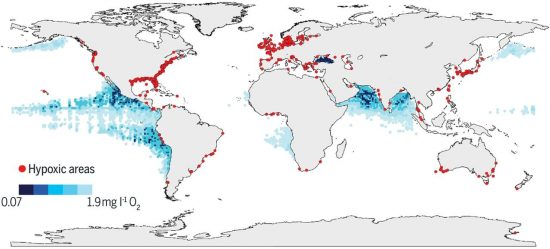
Oxygen is essential to ocean life and the chemical processes that occur there. But measurements at sites along coasts and in the mid-ocean are showing that several million square kilometers and hundreds of coastal sites show oxygen concentrations that are significantly lower than they should be to support abundant marine life.
Global warming is playing its part. Greenhouse gases, particularly carbon dioxide (CO2) are getting absorbed by ocean surface waters increasing acidity. Other gases like nitrous and sulfur dioxide are changing the biochemistry as well. And then there is fertilizer runoff injecting phosphorus and even more nitrogen into coastal ocean waters. And finally, there is the effluent from coastal cities and from communities along rivers that continue to pollute.
Today the ocean is a carbon sink, absorbing the CO2 we put into the atmosphere. In the near future, the ocean may turn into a net emitter of nitrous oxides contributing to atmospheric warming.
The map below illustrates coastal hypoxic areas seen in red as well as levels of deoxygenation along coastlines and in open ocean areas. It is a troubling picture.
The solution is staring humanity in the face. To fix the ocean we have to do the same things we need to do to fix the air: reduce greenhouse gas emissions and other air pollution. And in addition, we have to stop using the ocean as a giant sewer for our activities.
]]>What they don’t talk about is the impact increased CO2 has on the oceans of the world. Most studies of the ocean talk about increasing acidification. What they don’t talk about is the impact of climate change on other gasses in the ocean, in particular, oxygen. A newly published study appearing in Research Letters in the February 16, 2017, issue of the journal Nature, analyzes data from the last five decades, looking at salinity, temperature and gas mix in the world’s oceans at multiple depths.
Projecting their findings which show a decline over the past 5 decades, the researchers project an additional 7% decline in oxygen content with “detrimental consequences for fisheries and coastal economies.” The study accumulates observations available from ocean surveys dating back to 1903. Oxygen levels, the study notes, show regional variation. But one thing clearly stands out. Overall, the oceans are trending towards dangerous deoxygenation. The study further notes a growing number of “dead zones” in the ocean where oxygen levels are in such low concentration that most animal life is untenable.
The scientists further correlate the oxygen decline with ocean warming. Oxygen solubility appears to be directly impacted by surface warming, and as the ocean cycles water vertically, the impact is reduced levels in deeper waters. The research assessed the entire water column continuously since 1960. In some areas of the ocean oxygen levels declined 4% per decade. The largest decreases were found in the Arctic, North and Tropical Pacific, Southern Ocean surrounding Antarctica, and the South Atlantic. These areas accounted for almost 60% of the total oxygen decline. In the water column, large losses were observed at depths from 2,000 meters to the ocean floor.
Based on these findings climate modelers project accelerated oxygen losses going into the next century at rates 25% greater than what has been observed from collected data. The end result increased volumes of anoxic water, that is dead zones, with substantial changes to ocean ecosystems.
The other impact oxygen depletion will have is the production of nitrous oxide (N2O). This potent greenhouse gas can be found in the upper 500 meters of the ocean water column. Deoxygenation plus surface ocean warming from increases in the atmospheric temperatures, when combined, are seen as agents for N2O production. Adding another greenhouse gas to the mix which includes CO2 and methane (CH4) will further accelerate overall warming of the planet.
States Matthew Long, an oceanographer at the National Center for Atmospheric Research, “It is alarming to see this signal begin to emerge clearly in the observational data. Since ocean deoxygenation is intrinsically linked to climate warming, substantial action to mitigate climate change will be required to reverse the trend of oxygen loss.”

]]>