The number of viewers has almost doubled since this morning with over 900 now watching. Lots of people have been commenting during the live demo. Some have been people who have read my blog postings on cold fusion.
This part of the demonstration is not as painfully slow as the earlier demo using argon. But I agree with many who are posting in the chat session that there is nothing here that could be called an independent test of the technology being demonstrated.
At around 20 minutes after introducing the hydrogen and heating up the reactor to 179 Celsius the LENR readings display energy outputs exceeding inputs. In the screen below you can see that with 2 kilowatts of energy input, consisting of heat and high voltage, the reactor generates more than 4.8 kilowatts of output, a ratio of 2.4:1.

As the test progresses the ratios eventually exceed 3:1 energy output to input. The values constantly vary but as the reactor stabilizes it seems to get better output. There is no doubt in my mind that something is cooking inside the Defkalion LENR. But what?
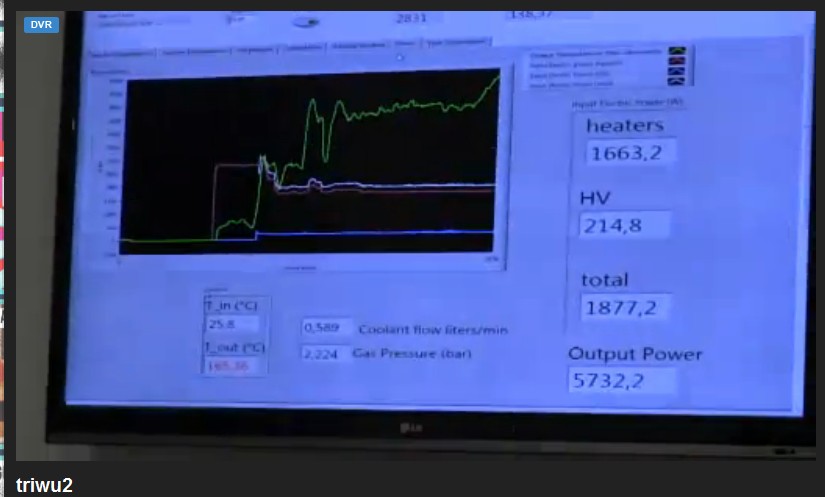
I don’t know how this demonstration proves a nuclear or other type of interaction to explain the excess heat. And I think it has to be said that a demonstration is far from being an independent test, for as much as the moderator can claim “transparency” and invite a journalist to nose around there is no independent way to verify that the data screens we are seeing aren’t doctored in some way. That’s why, as I have stated in the past, an independent test by a neutral and recognized third party is the best way to validate Defkalion’s claims without revealing their trade secrets.
For those of you who missed the live demonstration you can view it on the Livestream site.
]]>
In the first demonstration the reactor is primed with argon, an inert gas. In the second demonstration the reactor will be primed using hydrogen. I have been watching the argon testing so far and as I said before, there is nothing terribly exciting about watching this in real time.
The narrator has stated to the viewers who are watching the live demo that we will not see a net energy output gain from argon but will see one when hydrogen is injected into the reactor.
Defkalion could learn a thing or two about marketing when doing a demo. If you had wanted to create a buzz in the room I would have started with the hydrogen to show net energy gain from the reactor and then used the argon control to show the difference. But maybe by doing it this way they want to demonstrate scientific rigor.
It will be interesting to see the results from the hydrogen. I’ll keep watching.

]]>
I was told by another reader “if you think that the production of U238 fission products by transmutation in a LENR (low energy nuclear reactor) reaction is not nuclear, then you are in the wrong line of work…please educate yourself.” I’m all for educating myself so I looked up one of the terms introduced by this particular commenter – nanoplasmonics, (see image below) which I found out is the study of optical phenomena at a nanoscale. Nanoplasmonics concerns plasmons described as entities that “lurk on and below the surface of metals.” I must admit this was an entirely new subject for me and I wondered what it had to do with cold fusion and the presence of observed anomalous heat generation.
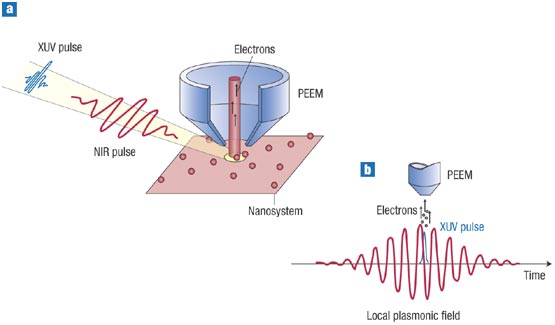
I was given a link by this same reader to a paper. Here is the link for all who are interested. In the article it states that “recent theoretical work shows the capability of laser radiation to directly excite nuclear levels of energy.” The technology described uses lasers to initiate nuclear reactions in nanoparticles suspended in liquid. This leads to nuclear decay. This phenomena is what my reader was referring to when he commented on my denial of transmutation as being anything more than alchemy. The paper goes on to state:
“If the results from works on “cold fusion” raised (and still raise) certain doubts due to their irreproducibility in different laboratories, experimental evidence on the possibility of the transmutation of various nuclei upon the laser excitation of nanoparticles and electro-explosions of metallic electrodes in aqueous solutions of salts of unstable isotopes are well reproducible. These results confirm the possibility of initiation of nuclear transformations in cold plasma.”
I won’t quarrel with the prose although it is quite a mouthful. The paper, however, goes on to describe experiments using lasers to irradiate different nanoparticles in cold suspensions and concludes that in fact transmutation is observed with the synthesis of tritium from deuterium oxide (heavy water).
Here, however, is where I have some problems. The paper is undated. In my attempts to find if it had been published anywhere I came up empty. That included doing Google searches, a search on the CERN pub site and on other journal article aggregation sites. So for the moment all I can conclude is that I have been given a document that may or may not have been peer reviewed, and may be on to something or not. But I am sure I will hear more from this reader who did ask me to educate myself and so I have lived up to the request.
Another reader also questioned my intelligence and knowledge and pointed me to the work being conducted by Defkalion, a company that has been associated with Andrea Rossi and has sought funding from the Greek government in the past. I find it funny that anyone would seek funding from a government that has itself sought a bailout from the European Union, but that’s another subject.
So what does Defkalion add to solving the mystery of cold fusion? Here is what one reader sent me although I found no reference to it on Defkalion’s web pages:
“There will be an official announcement of this technology during ICCF 18 (International Conference Cold Fusion 18) at the University of Missouri (USA). For those interested you can see this webcast of all phases of the experiment , ignition, performance and switching off. Two independent scientists and two science journalists at international level will participate in this broadcast, as well as a member of the Cicap. ”
This announcement was purported to come directly from the CEO of Defkalion, Franco Cappiello.
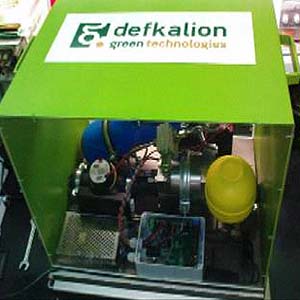
Another reader had things to say about Defkalion that were less than kind but I will let you find their comments in the postings. To me Defkalion remains a quandary. I have viewed presentations they have posted in which they describe observed transmutations from vulcanism and high-voltage accidents with the implication that, therefore, LENR is real. But I have yet to see or read about any of the supposed companies that are partnering with them to rollout OEM versions of the Hyperion (seen below), a commercial LENR product that has been promised on several occasions.
For those of you seeking answers to the mystery of cold fusion and the anomalous heat observations I would recommend you either attend the upcoming ICCF-18 Conference at the Columbia, Missouri campus of University of Missouri taking place next week (July 21-27) or research the presenters and get access to the papers they submit.
I will leave you with a quote from the document ascribed to the keynote speaker who is presenting at the conference.
Now here’s the fantasy.
Presidential candidate, Mitt Romney, back in December of 2011 during an interview on science talked about cold fusion and work being done at the University of Utah. He was referring to the Fleischmann/Pons experiments that led to the 1989 cold fusion announcement. Here is a transcript of his comments:
“I do believe in basic science. I believe in participating in space. I believe in analysis of new sources of energy. I believe in laboratories, looking at ways to conduct electricity with — with cold fusion, if we can come up with it. It was the University of Utah that solved that. We somehow can’t figure out how to duplicate it.”
I’m glad he added that last sentence since it appears the University of Utah had “solved” cold fusion in his previous sentence. Is it coincidence that Mr. Romney sees cold fusion as a solved technology because it comes from an educational institution in the state of Utah? Is this faith-based science?
Did Mr. Romney not know that the University of Utah discontinued experiments in cold fusion two years after the 1989 announcement?
Did he not know that the University of Utah allowed its cold-fusion patents to lapse in 1998?
Did he not know that the original researchers, Pons and Fleischmann went to France to continue research for a subsidiary of Toyota and that the research funding from Japan stopped in 1997?
Don’t get me wrong, I think cold fusion would be an incredible technology if it could be pulled off. But every reference to it invoking proof comes with caveats. It’s always in the lab, or somebody has written a paper, or posted experimental results.
Take for instance the proof claim using a National Instruments video, a talk given at a recent conference. This video clip isn’t about cold fusion. It’s about measuring results from experiments using technology created by National Instruments, in particular, LabView, a new software application.
The video provides no proof of cold fusion’s viability other than to describe it as controversial and talk about someone’s masters thesis that lists 184 examples of “positive” experimental results. At the end of the talk the presenter states “we don’t judge, we measure.”
At this conference National Instruments sponsored a panel of experts and a LENR was demonstrated on the show floor. But the “expert” panel hyped the technology rather than demonstrated commercial viability. Representatives from companies like Defkalion Green, that purport to be ready to bring their Hyperion cold fusion reactor to market, did more talking than showing.
That seems to be the nature of cold fusion proof these days. A few websites, blogs and chats extolling a product and technology that fails to deliver. I’d like to see it if it is real. And I am certain Mr. Romney wants it to be as real as his positions and policies on so many other subjects for which he purportedly has expertise or receives expert advice.

]]>
In the latest posting, July 24, 2012, Andrea Rossi, the developer of the energy catalyzer cold fusion technology he calls E-Cat, claims he will deliver the first commercial 1 Megawatt e-Cat plant this year. He also indicated that a performance report showing that E-Cat is stable in temperatures over 1,000 Celsius will be released in a couple of months. This isn’t the first time that Rossi has promised delivery. Nor is it the first time that he has promised to release a report on the technology.
If you are unfamiliar with LENR and the E-Cat in particular, the technology relies on a chemical reaction that transmutes two elements into another releasing energy in the form of heat. In the case of E-Cat the elements are powdered nickel infused with hydrogen transmuting into copper. The amount of energy released is claimed to be 100 times the energy input. Rossi reports he can get enough heat from E-Cat cold fusion to power up steam turbines for electricity generation. Ultimately he hopes to directly generate energy from his E-Cats without a turbine. Well we’ll see!
Not to be outdone, a Rossi competitor, in fact a breakaway company called Defkalion is building its own LENR and joining up with a Swiss start up to deliver a car with a LENR on board. The first generation of iCar, the name the company has chosen, will use a Tesla Model S. The LENR is the Hyperion Series B. The developers of the technology claim the Hyperion will generate 10 to 45 Kilowatts of thermal energy. To produce 45 Kilowatts the LENR will consume only 300 watts. The iCar will have a single charge range of 36,000 kilometers (22,000 miles). The power storage of a Hyperion LENR is estimated to be 400 times the amount stored in conventional lithium-ion battery packs currently used by Tesla.

After successfully demonstrating the first generation iCar, plans are in the works to launch a second generation vehicle with an on board LENR capable of powering a car for 140,000 kilometers (87,000 miles) between recharges.
Again I ask the question, is all this hype going to actually produce something real? If so, then we will witness an energy revolution. If not, we can always remember P.T. Barnum’s quote, “The bigger the humbug, the better people will like it.” And this is one humdinger of a story right now.
]]>