Since then the ones I remember include:
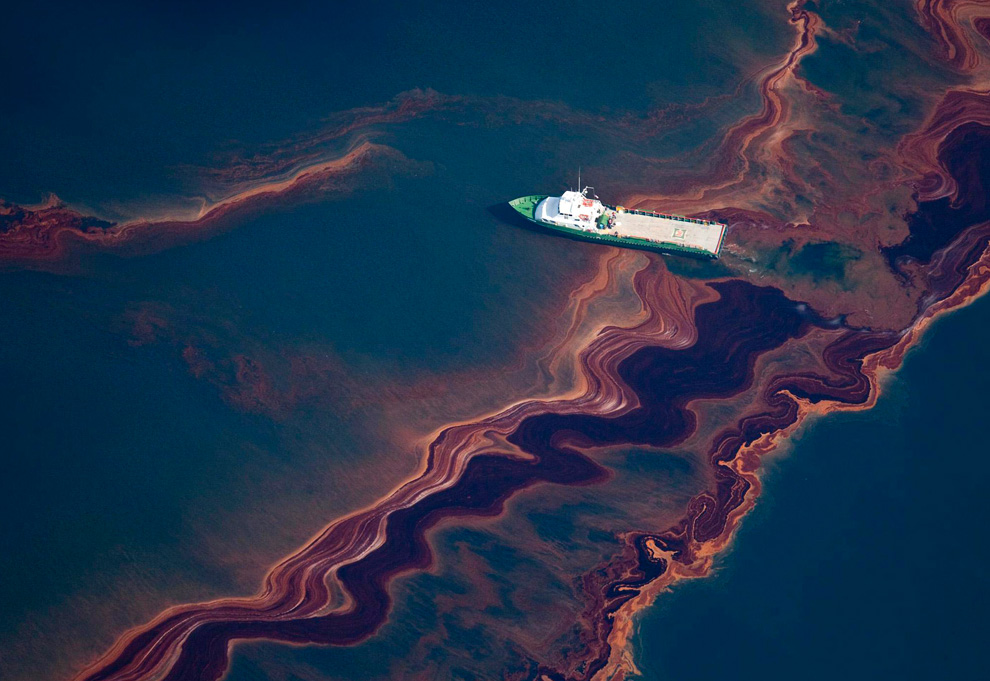
At the time of the Torrey Canyon the operator, British Petroleum, had just invented dispersant detergents which were liberally dumped onto the wreck, and even rolled off the Welsh cliffs onto the polluted beaches and rocky shore. Since then fossil fuel and marine shipping companies have come up with all kinds of technology to attempt to break up oil spills on the surface of our oceans. The industry’s oil spill response documents include the latest in dispersants, booms, and skimmers and what works best in cold or warm water, in rough seas, and in windy conditions or calm.
Conventional thinking today says that when an oil spill occurs, it spreads fast with some of the discharge evaporating, and microbes digesting the rest. There is no reference to the role sunlight plays. That is an oversight.
New research published in the last week from, the Woods Hole Oceanographic Institute, Cape Cod, Massachusetts, suggests that oil spills need to be treated differently in the presence of sunlight. The multi-authored article entitled, Partial Photochemical Oxidation was a Dominant Fate of Deepwater Horizon Surface Oil, describes a previously unknown phenomenon.
Sunlight exposure over several days chemically altered 50% of the oil contained within the Deepwater Horizon slick making chemical dispersants less effective. The sunlight played no part in evaporation and so the oil remained on the surface unresponsive to the dispersants that were being dumped into the Gulf. In the end, the oil had to be skimmed up but not before it damaged the biodiversity along the Louisiana coast and in the Gulf.
It appears no one in the fossil fuel and chemical industry had observed this phenomenon before, that sunlight photo-oxidizes compounds to the molecules contained in oil, and binding more oxygen to them altering their makeup. And the longer the oil sat on the surface the greater degree of oxidation.
Within the over three months from the Deepwater oil spill start to the well being capped, almost 500 million barrels entered the water of the Gulf with most of it floating to the surface. There the oxygen contained within oil molecules reacted to sunlight in less than five days.
So why is this important?
Today oil spill response teams prepare and practice using fresh, not weathered oil. They don’t look at how they need to alter their response based on sunlight conditions. But looking back at the Deepwater Horizon case, it is clear that dispersants used today are largely ineffective on photo-oxidized oil. That means we need to invent new dispersants or develop new oil cleanup techniques. And during training crews need to test photo-oxidized oil with boom, skimmer and absorption technology to see if these tools are impacted negatively. Still to be done is an accurate calculation of the photo-oxidizing process subject to different environments, whether cold or warm water or in rough seas.
For Canada, which hopes to build a pipeline from Alberta’s oil sands to a cold water port on the British Columbia coast, testing of the photo-oxidizing effect on heavy synthetic crude, the product being shipped to Asian markets, needs to be done to update spill response standards. This should be part of the environmental due diligence currently underway, and before we witness tanker traffic increases from 5 to 34 per month in the narrow channels linked to the Burnaby. British Columbia, oil terminal.

The infographic below gives you a picture of the 10 deepest water projects currently in production or under development. Oil companies are going deeper to find fossil fuel deposits while the nations of the world commit to reducing human-generated carbon in the atmosphere. The juxtaposition of these contradictions is troubling in so many ways.

On April 20, 2010, the world learned about an oil well blowout in the Gulf of Mexico that killed 11 workers and dumped millions of barrels of oil into the sea. An undetected leak in the well caused gas to rise through the cement-encased drill hole leading to an on deck explosion and fire. This was accompanied by the failure of a seafloor-installed device called a blowout preventer.
The drilling rig, owned by the contractor, Transocean, had encountered some problems while completing the project. The unknowns still remain. Could the drilling have passed through a layer of methane hydrate? Methane hydrates form on the ocean floor. They consist of compressed natural gas that forms into ice under the immense pressures of overlying seawater. Destabilized, methane hydrates can rapidly expand to 164 times their volume.
Deepwater Horizon had experienced sudden methane releases during drilling which strongly suggests the presence of methane hydrate on the sea floor or buried in sediments the drill passed through.
What was the depth of the seafloor for at the site of Deepwater Horizon? 700 meters less than the most shallow of the wells depicted in the above infographic.
It remains uncertain whether British Petroleum was aware of the presence of any methane hydrates on the seafloor or sediments beneath the drilling rig. Some describe the accident as preventable citing that the company was cutting corners in terms of margin of safety related to the cement that surrounded the wellhole bore. The well depth was almost 5,600 meters, of which 4,050 meters was below the sea floor. Described by the industry as not exceptionally deep, reviews of the procedures cite the failure of contractors to use the right amount of casing cement and enough setting time to cause an imperfect seal which ultimately compromised the blowout preventer. In other words, a bad well plan, poorly executed and a net result of 11 dead, 87 days and 5 million barrels of oil spilling into the Gulf, a disaster for the ecology of many parts of the U.S. Gulf coast and for sea life which continues to this day.
And yet the industry just continues to chug along while the rest of us wait for the next human-generated environmental disaster.
Add to this the intent of the new American president to open America’s coastlines, Atlantic, Pacific, and Arctic, to more offshore oil and gas drilling, overturning the previous administration’s rulings to protect coastal waters from another Deepwater Horizon. The areas outlined in blue on the map below represent those previously excluded and likely in the near future, if the administration succeeds, in becoming a playground for oil companies.

So I repeat the question posed at the beginning of this piece. Will we witness another Deepwater Horizon in our lifetimes?

]]>
Recent sampling of ocean-floor sediments done by University of California-Santa Barbara geochemists have been published in the Proceedings of the National Academy of Sciences. A 3,200 square kilometer (1,235 squre miles) area around the site shows the distribution of the plume of oil leaking from the blowout as it permeated the water and then began to settle on the seafloor. The implications for animal and plant life in the water column and seafloor sediments remains unknown.
So what has happened to the remaining unaccounted for 1.4 million barrels? Some may remain suspended in the water column. Some may have eventually reached the surface and evaporated. And some may have been gobbled up by bacteria. But the remaining glop of oil covers a vast area on the ocean floor and current technology makes it virtually impossible to clean it up or recover it.
What a testament to our fossil fuel addiction.

Of course there has always been a recognizable downside to fossil fuels – spills. But with so much of fuel around spills have always taken a back seat to drilling and exploiting the resource. But an unrecognized downside, carbon emissions, is altering our dependence on fossil fuels. And because fossil fuels are being found today in less accessible places, the technologies we bring to bear to find and extract them come with increasing risk. That risk was no more obvious with Deepwater Horizon and the BP oil spill which began on April 20, 2010, capped almost three months later, and responsible for spilling 4.9 million barrels of oil into the Gulf of Mexico. The response to this spill is our first story today.
Dispersants from Deepwater Horizon Remain in the Environment Four Years Later
Did you know that in attempting to clean up the oil from Deepwater Horizon, besides the skimmers and booms and other technologies deployed, more than 6.8 million liters (1.8 million gallons) of dispersants were released to break up the slicks that coated the Gulf? And residue from those dispersants, chemicals that contain ingredients found in laxatives, is still being found in the tar balls that wash up on Gulf Coast beaches.
BP and the U.S. Environmental Protection Agency had reported that chemical dispersants evaporate leaving little to no residue. But the scientists at Woods Hole Oceanographic Institute and Haverford College in Pennsylvania, have proof that is not the case. Their report appears in Environment Sicence & Technology Letters and states that samples from corals, sediments and beach sites continue to contain the dispersant, dioctyl sodium sulfosuccinate or DOSS, although in low quantities. The long term impact from the chemical on the biology of the Gulf remains an unknown. A BP spokesperson when asked about the report stated the residual dispersant poses no risk just like deep water drilling poses none as well.
Steam Injection Ruled the Cause of Northern Alberta Oil Sands Spills
A form of fracking using injected steam is named as the cause for the Northern Alberta bitumen leak reported in July of 2013 by this blog site. The spill described as an underground blowout began in April 2013. The oil sands operator, Canadian Natural Resources Ltd. (CNRL) repeatedly assured the Alberta Energy Regulator that the spill was contained. But it was not and is to this day not.
And now we find out from a review panel report that the method employed in steam injection caused five fractures (one as early as 2009) with the bitumen erupting in areas as much as 12 kilometers from the original fracking site. It appears the fractures penetrated what was considered to be an impermeable layer of shale leading to the bitumen dispersing into groundwater and erupting as much as a half kilometer (more than a quarter mile) from the targeted position.
This operation has spilled more than 12,000 barrels of bitumen to-date into an area that is difficult to clean up because of its remoteness and the multiple locations where the bitumen has seeped to the surface. Some of it is leaking into a lake.
Cost so far is $50 million.

Fermilab Physicist Invents Oil Spill Cleanup Technology
Arden Warner (seen in the photograph below taken by Hanae Armitage) says he gets crazy ideas all the time. A physicist at the Fermilab in Illinois Warner tried a garage experiment taking metal shavings from a old shovel, and mixing them with some motor oil and water. He then used a magnet to attract the oil in which the iron shavings were suspended.
Warner has since received a patent for what may prove to be a breakthrough in oil clean up technology. He has tested his method on more than 100 types of oil and it works with all of them.
In a more refined state than the garage experiment his process involves using magnetite dust dispersed over a spill/ A magnetic field is then applied. The colloid suspension of oil and filings, defined as a magnetorheological fluid, can be pooled to a single location and then removed.
Warner is experimenting with hydrophobic iron filings to improve the extraction efficiency. This type of iron sink into oil right away and doesn’t interact with the water, hence hydrophobic, which makes it convenient when a magnetic field is applied. A magnetic conveyor can be used to pick up the suspension and recover the oil. The oil is then cleaned of the suspended filings and can be fully recovered. And so can the filings which are dried and reused. Want to see a 30-second demonstration? Watch the video.

Curiosity Out to Discover Why There is Methane on Mars
We have known from the Mars Express, an orbiter circling Mars, that the planet cyclically exhales methane gas but what has not been ascertained is whether this is chemically or biologically induced. Well it seems that Curiosity with its Sample Analysis at Mars instrument, called SAM for short, is sniffing the Martian atmosphere at Gale Crater and may soon have an answer to this mystery.
Why is methane on Mars considered odd? Because methane has a chemical lifetime of between 300 and 600 years and if it was produced some time from a past geological event it would have long since oxidized to become CO2. But Mars Express has measured the rise and fall of methane in the Northern Hemisphere of the planet and these rise and falls correlate with the change of seasons.
There are two explanations. The first is biological. The second is chemical.
If biological the methane could be coming from living microorganisms or from microbes long dead whose exhalations froze in the Martian subsurface and periodically release when the temperatures at the surface rise during the Martian summer. In 2003 and 2006 Mars Express observed methane concentration in three areas of the planet. All areas appeared to have once had flowing water. If that water froze and formed a subsurface ice layer, there could be microorganisms living below the ice layer.
If chemical the methane could come from a Martian subsurface spring, or from vulcanism, or from trapped methane preserved in geological structures that when exposed to liquid water releases the gas. We have considerable visual evidence that salt-laden water briefly shows up on Mars causing flow patterns on valley walls. So if methane is trapped in sedimentary formations these flows could be the trigger.
As Curiosity wanders across the Gale Crater floor and samples the soil and drills in rocks, SAM will be smelling the air. As it gathers data we may finally have an answer to support the original findings of the Viking landers which were first discounted. We may be witnessing evidence of Martian life.

Variations in the Flow of the Gulf Stream May Release Trapped Methane from the Ocean Floor
If you watched the revival of Dallas on television this year then you know that Christopher, Bobby Ewing’s adopted son, was working to unlock the energy stored in methane hydrate. I have written about hydrates before. These are frozen deposits that can be found on the sea floor or just below it in sedimentary formations. Hydrates form at low temperatures under high pressure as methane gas leaks from under the sea floor into the cold water above. Hydrates represent a potential rich source of energy if we can discover a way to harvest them without them blowing up.
But one of this week’s stories is about changes in the temperature of the Gulf Stream as it carries water from the Gulf of Mexico into the North Atlantic. What scientists recently observed is the heating of sediments by the Stream along a strip of seafloor that contains an estimated 2.5 billion metric tons of methane hydrate. The study, which was reported in this month’s Nature, indirectly measured the seafloor temperature and concluded that the hydrates may be disintegrating.
In the past it has been proposed that sudden releases of methane from hydrates caused a global warming event 55 million years ago. If the present hydrates are melting, the methane released will have about a ten year life in the atmosphere before oxidizing. But hydrate releases don’t just affect the atmosphere. They can cause subsurface slides along the edge of the continental shelf. And slides could accelerate the release of the frozen gas.

Was the BP Deepwater Horizon Disaster Caused by Methane Ice and Human Error?
When survivors of the BP drilling rig explosion described what happened on April 20, 2010 they talked about the process they engaged in prior to the explosion. This involved decreasing the pressure in the drill column and applying heat to the concrete cap to set it at the wellhead. What followed was an explosion on the rig platform caused by a sudden release of methane. It packed enough of a wallop to blow away much of the rig’s superstructure and resulted in the subsequent fire and crippling damage at the base of the drill column.
The Deepwater Horizon was parked over the Mississippi Canyon in the Gulf of Mexico. This geological formation had suspected hydrate-bearing sediments. And even if there were no hydrates present, the intense cold and pressure experienced at the drill base could produce methane hydrate crystallization that would rapidly clog the drilling column. This should have been known to the drilling crew because methane hydrates are a recognized industry hazard in deepwater drilling. The American Association of Drilling Engineers has published information about cementing processes in the presence of hydrates cautioning operators to allow extra time for cementing the wellhead to prevent hydrate destabilization. But apparently the cementing operation was carried out as if no methane hydrate hazard existed. And because the blowout preventer on the ocean floor had previously been damaged weeks before and not been repaired, when the methane expanded all hell broke loose and millions of barrels of oil spilled into the Gulf.


