
How To Mine A £60 Trillion Asteroid by Fuel Fighter.
Deep Space Industries‘ (DSI) launch of Prospector-X (see infographic below) will test out all systems to ensure that the sequel, Prospector-1, succeeds as the first space mining mission to an asteroid.

States Grant Bonin, chief engineer, “DSI is developing Prospector-1 both for its own asteroid mining ambitions, as well as to bring an extremely low-cost, yet high-performance exploration capability to the market. We hope to enable both existing and new public and private organizations to explore the inner solar system using this affordable platform.”
DSI is a California company with roots in NASA’s Ames Research Laboratory. Recently it entered into partnership with the nation of Luxembourg who through the Spaceresources.lu initiative have established a European equivalent to the American commercial space act. The goal is to give Europe the ability to create a space-based economy using in situ space resources.
DSI isn’t the only company with which Luxembourg is working. A similar understanding has been entered into with Planetary Resources, a rival to DSI in the race to mine asteroids.
What is novel about DSI’s technology?
Prospector-1 weighs less than 50 kilograms (110 pounds) when fueled so it doesn’t require a powerful booster rocket to get it to orbit and beyond. It also uses a water propulsion system called Comet (TM) that generates thrust by expelling heated water vapour. Comet is an electrothermal micro-propulsion thruster that can be incorporated into a wide range of spacecraft. The advantage of this propulsion technology is that it can harvest water from the asteroids it visits and refuel.

As its name suggests the Prospector-1 is an exploration spacecraft designed to assess a target for its resource value. It has on board an optical navigation system, visible and mid-wave infrared camera, a scanning antenna and star tracker for deep space navigation and communication, and a triple array of solar panels. It is capable of studying an asteroid in detail, able to assess its resource content including locating water ice to a depth of one meter (3.3 feet) below the surface regolith. Once Prospector-1 successfully maps the asteroid it will touchdown on the surface with its instrumented landing legs testing the geological characteristics of the surface.
The follow up mission is a mining robotic spacecraft which will upon rendezvous and contact with the asteroid begin the process of harvesting water ice for fuel and other materials of value for return to Earth orbit. Once back the mining spacecraft will rendezvous with a harvester in orbit which will perform material separation. Materials from these missions will be used to build a space manufacturing capacity capable of fabricating structures impossible to launch and assemble from Earth. These mega-structures will become the home of humans in Deep Space. Other structures will be sent to the Moon or Mars where they will serve to make us an interplanetary species.

]]>
Russia’s Revived Space Program
The Russian announcements indicate that Roscosmos intends to make a significant new investment, 2.1 trillion rubles (almost $70 billion U.S.) between now and 2020. Some of that money will be allocated to building a new delivery system for human space flight to replace the Soyuz capsule and launch vehicle. Russia’s Soyuz and R-7 rocket have been the backbone of their human space program for 50 years. And today Soyuz remains the primary way flight crews get to and leave the International Space Station (ISS). Russia’s launch capability started to show cracks with the loss of one Soyuz resupply vessel in August 2011, leading to the delay of subsequent flight crew missions. Although sketchy on details, Russia plans to have a new propulsion system and transportation module ready for testing by 2018 with full deployment for human space missions by 2020.
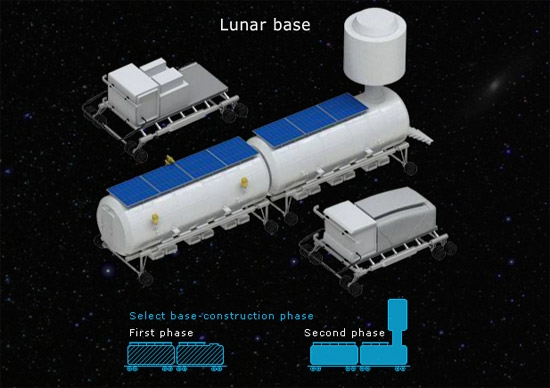
Russia is also getting back into the business of sending robotic spacecraft to the Moon and Mars. The first new Moon mission in 42 years is planned for 2015 and will be followed by others over the next five years. Russia is opening a new space city called Cosmodrome Vostochny and the first Luna-Glob will be sent to the Moon from there. The launcher will continue to be the same as those currently used for Soyuz missions. The Luna-Glob will test a new surface landing system. Russian scientists have chosen six lunar landing sites for future missions. And one planned for 2017 will be a joint Russian-Indian module called Luna-Resurs. For Mars where Russia and its predecessor, the Soviet Union, have had little success, the next effort to get to the planet will be a joint one with ESA planned to arrive in 2016. This will be followed by a joint effort to land a rover like Curiosity in 2018. And ultimately Russia intends to send humans to the Moon to establish a lunar base (see image below).
NASA Finds Partnership Works for Them
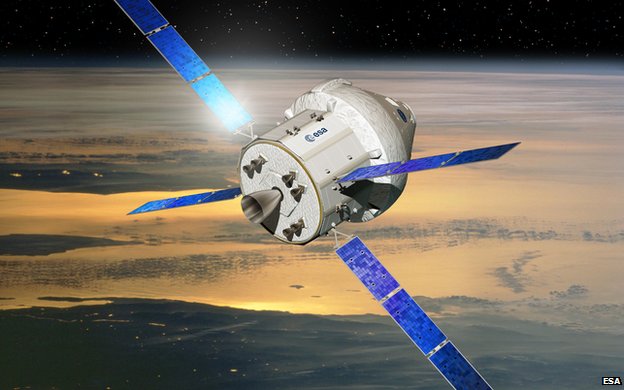
NASA and ESA signed an agreement this month calling for ESA to build the service module for Orion, the space capsule touted for future Deep Space missions with humans aboard. The service module hardware seen in the artist rendering below will include propulsion, power, thermal control, water, air and other essential supplies for supporting the crew and capsule. The first Orion test flight is scheduled for 2014 with plans to send an unmanned capsule 5,800 kilometers (3,600 miles) into space. The service module will get its first test in 2017 when NASA plans to send the first Space Launch System (SLS) rocket in an unmanned flight to circle the Moon and return to Earth. Human flights to the Moon and back on Orion are currently scheduled for 2021 with flights to Near Earth Asteroids (NEA) planned for the mid-2020s. Add this announcement to last weeks when NASA awarded Bigelow Aerospace a substantial contract to supply the ISS with an inflatable module and NASA recent awarding of contracts to three other private space ventures and you can see a picture emerging of how the agency intends to achieve its Near Earth and Deep Space goals.
NASA also announced this month a call for its Innovative Advanced Concepts Program (NIAC) seeking proposals from academia and industry to achieve new breakthroughs in aerospace technology. They plan to fund 15 proposals covering technologies for shielding spacecraft from radiation, developing ocean exploration technologies on Earth that could be exported for use on Moons like Europa, improved air purification systems for space capsules, and new methods of propulsion and power systems for operating space capsules. NIAC currently limits these opportunities to U.S. citizens and organizations based in the U.S. In 2012 NIAC funded 28 proposals each receiving between $100,000 and $500,000.
Mining Asteroids Competition Heating Up
Asteroids, often seen as the space junk left over when the Solar System organized itself into the Sun, planets and dwarf planets, are the target of two commercial ventures, each planning to mine and harvest these rocks in space. Some months ago I wrote about Planetary Resources with its ambitious plan to launch 5 space telescopes to search out asteroids suitable for exploitation. The first of these will be launched in 2014. By 2016 probes will land and do assay work sending samples and data from asteroids back to Earth. Mining would begin in 2022. Backed by some major billionaire entrepreneurs including Larry Page and Eric Schmidt from Google, and James Cameron, the film producer, to name three, the venture intends to harvest valuable materials like iron, nickel, water, and platinum from these space rocks, generating billions in revenue.
But Planetary Resources are no longer the only team at play among the more than 10,000 asteroids already mapped of which 1,700 are deemed potentially rich in assets worth exploiting. The competition, Deep Space Industries (DSi). This week the company announced its plan to launch a number of spacecraft given the name FireFly, to do asteroid prospecting. DSi is taking a different approach. Each Firefly is a CubeSat, a small (25 kilogram or 55 pound), low-cost satellite that will piggyback with launches of telecommunication satellites. Each FireFly mission is designed to last from 2-6 months. The FireFly missions will be followed in 2016 by DragonFly launches. These 32 kilogram (70 pound) spacecraft seen in the artist depiction below will bring back between 27 and 68 kilograms (60 to 150 pounds) of samples harvested from selected asteroids. See the image of what DSi’s first targets will be Earth-crossing asteroids seen as easier to reach than the Moon and as potential threats to Earth should one strike the planet. A 50-meter (165 feet) in diameter asteroid could weigh more than 200,000 tons composed of 20% iron-nickel. In some cases DSi plans to move asteroids to make them easier to harvest but it will only do this with rocks less than 30 meters in diameter (less than 100 feet) that are Earth crossing. Asteroids of this size should they accidentally enter the Earth’s atmosphere would break up and burn out in the atmosphere.
Both companies see much of what they produce being used to help build a space economy focused on space construction from habitats at LaGrange points or on the surface of the Moon and Mars, to materials for building Earth and Solar System satellites. Only a small percentage will actually be sent to Earth.
]]>

