dark side of the Moon – Techso Mogro
https://techsomogro.com/
Science, Technology and the FutureSat, 12 Jan 2019 20:50:12 +0000en-US
hourly
1 https://wordpress.org/?v=6.8.1China’s Trip to the Dark Side – of the Moon That Is
https://techsomogro.com/chinas-trip-dark-side-moon/?utm_source=rss&utm_medium=rss&utm_campaign=chinas-trip-dark-side-moon
https://techsomogro.com/chinas-trip-dark-side-moon/#respondSat, 12 Jan 2019 20:38:55 +0000https://techsomogro.com/?p=26893
January 12, 2019 – It keeps on getting more interesting in space these days as NASA breezes by a duo-planetoid 1.6 billion kilometers past Pluto, begins circling the asteroid Bennu with plans to grab a surface sample to return to Earth, Juno keeps doing flybys of the upper atmosphere of Jupiter sending us pictures that you want to hang on your walls as pieces of art, and China soft lands a mission on the hemisphere of the Moon we never see, colloquially known as the Dark Side.
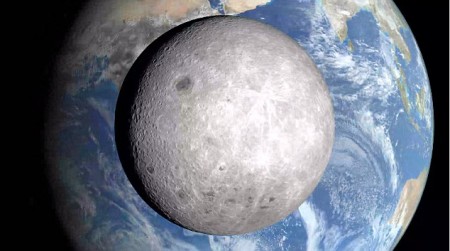
The only reason it has been referred to as the Dark Side is that the Moon is in tidal lock with Earth, always presenting the same face to us down here. But in fact, the side that faces away receives just as much sunlight as our side. We just never see it unless we send a spacecraft to view what’s back there and send us pictures. There have been lots of those, so many in fact, that we have created detailed maps and named most if not all of the geological features found there. And China chose one of those named areas for its first attempt at landing on the never seen side.
This was a first for any spacefaring nation. Landing on January 2, 2019, the spacecraft touched down in the Von Kármán crater (named after a Hungarian scientist), 186 kilometers in diameter, and located in proximity to the Moon’s South Pole. The Von Kármán crater is part of a much larger impact zone stretching more than 2,500 kilometers and is one of the oldest geological features on the Moon. This area of our celestial neighbour witnessed several basaltic flooding events in the Moon’s early history creating what is referred to as a basin-scale impact melt deposit. Chang’e 4 should have a field day studying the composition of the surface of the crater as it samples the regolith and gathers a ton of data.
Since its soft landing, the spacecraft has unleashed its rover named Yuta 2, or Jade Rabbit 2. The rover is the second one that China has put on the Moon. The first called Yuta, explored an area of the Moon we see in 2013 for 973 days before falling silent.
This rover is carrying a bevy of scientific instruments including:
VNIS, the Visible Near-Infrared Spectrometer,
PCam, a Panoramic Camera,
LPR, a Lunar Penetrating Radar,
and a unique biological experiment with eggs of silkworms, and seeds from a number of plant species, including potatoes. The Chinese scientists want to monitor how the lunar environment impacts biological growth.
Some interesting facts about the Moon’s other side. The lunar crust is thicker and contains less potassium and phosphorus. Scientists don’t know why. The far side is also considerably rougher with the exception being the Von Kármán crater seen in the image below.
The Moon’s Von Kármán crater is seen here in a picture taken by the Lunar Reconnaissance Orbiter Camera. (Photo credit: NASA/GSFC/Arizona State University)
To ensure continuous communication between Chang’e 4, Yuta 2, and Earth’s ground stations, China placed a bridge relay communication satellite, Queqiao, in orbit around the Moon in June of 2018. We should be able to get a continuous feed of data and images over the coming months and learn a little bit more about a side of our nearest celestial neighbour, a side that has kept us in the dark for years, but certainly not a Dark Side.
The lander and rover shortly after arrival hunkered down to protect their instrumentation from the heat of the 14-Earth-day long lunar day where temperatures at high noon exceed 100 Celsius (212 Fahrenheit). But two days ago both lander and rover awakened.
NASA’s Lunar Reconnaissance Orbiter will fly over the Change’e 4 landing site on January 31st and maybe give us a “birds-eye” satellite view of the site. It should make for an interesting picture. Meanwhile, you can check out Yutu 2 in the picture below.
This image of Yutu 2 was taken by the Chang’e 4 lander. (Photo Credit: CNSA)
]]>https://techsomogro.com/chinas-trip-dark-side-moon/feed/0ESA Executive Lobbies for Lunar Colony on the Moon’s Dark Side
https://techsomogro.com/esa-executive-lobbies-lunar-colony-moons-dark-side/?utm_source=rss&utm_medium=rss&utm_campaign=esa-executive-lobbies-lunar-colony-moons-dark-side
https://techsomogro.com/esa-executive-lobbies-lunar-colony-moons-dark-side/#respondMon, 08 Jun 2015 14:10:56 +0000http://www.21stcentech.com/?p=17534June 8, 2015 – Why would anyone want to put a human habitation on the “dark side” of the Moon? Well for one thing it really isn’t dark. It’s we who were in the dark about the far side of the Moon until the Soviet Union sent us the first pictures of what our closest neighbour’s other face looked like back in 1959.
The Moon is tidally locked to the Earth. So we never could see its other side until we sent robotic spacecraft to circumnavigate our satellite. Today we know that its topography is far more rugged than the face of the Moon we see. And it is the destination of choice for Johann-Dietrich Worner, the new head of the European Space Agency (ESA). He believes this would be the logical next step in our outward urge to become a spacefaring species.
In past postings I have advocated that before we consider going to Mars we need to establish outposts in Deep Space that would serve as way stations. NASA talks about cis-lunar human presence in space and not necessarily a lunar colony. Which is the right strategy?
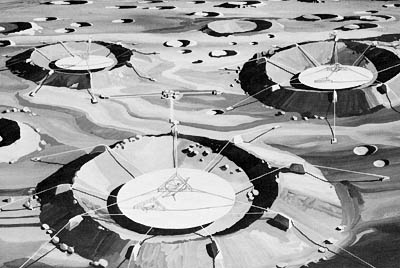
If we are going back to the Moon it should be with specific goals that make it a better choice than placing a self-sustaining human habitation at a Lagrange Point within lunar vicinity. For one thing if we go to the surface of the Moon to use it as a way station then we have to deal with overcoming the Moon’s gravity well each time we take off for elsewhere. At a Lagrange Point that would not be the case saving us the need to produce the fuel for launching from the lunar surface. But Worner argues that a human colony on the far side of the Moon would have incredible scientific impact particularly in the fields of astronomy and cosmology. A series of space telescopes on the Moon’s far side would give us an unprecedented view of the Cosmos. Radio telescopes would be free of Earth chatter.
For Worner who described the International Space Station’s (ISS) mission as one that will soon end, there has to be a logical next destination. He chooses the Moon, not Mars which he describes as a “nice destination.”
Charles Bolden, head of NASA, sees the Moon as an “interesting destination.” But his notion is to establish infrastructure in lunar orbit that points us to our next big destination, Mars. He believes that going down to the lunar surface can be handled by entrepreneurs and international joint private-public ventures and partnerships. He doesn’t see NASA taking a leadership role in a lunar colony although he wouldn’t mind having the agency participate.
And speaking of partnerships, why is China not a participant on ISS while Russia remains involved despite its clandestine war in Eastern Ukraine? The ISS has invited astronauts from the European Union, Canada, Brazil, Japan, Korea, South Africa and many other nations but not China. Instead China has its own plans to build a permanent space station, visit the Moon and eventually establish a permanent human colony there. What a duplication of effort.
For NASA how is China any more a potential threat as a space partner than Russia? Aren’t both Russia and China equal rivals and yet one, despite its recent geopolitical maneuvering remains joined at the hip with the United States on the ISS.
What could China bring to international cooperation in space? A program that has already shown that the Chinese have sufficient knowledge and expertise to contribute to space exploration and human space missions in a big way. After all when you look at the bigger picture, isn’t China the largest trading partner of the United States? It’s not Russia so wouldn’t you think a rethink is in order?