What is open source? In the world of software many developers have made available the original software source code for computer languages, operating systems and applications. These open source tools are the opposite of “proprietary “ or “closed source” systems. Open source arose from the 1980s free software movement, a guerilla response to companies like Microsoft and IBM who sold closed source software licenses with expensive upgrades and maintenance contracts.
Developers of the various UNIX operating systems were among the initiators of what eventually became the Open Source Initiative. The Firefox and Chrome browsers that I use on my desktop and chrome-book laptop are products of open source. The Android operating system found on the majority of smartphones today is open source. Users are encouraged to enhance the code, develop applications, and share their results.
D-Wave, with the release of the source code of Qbsolv, is joining the open source movement in the hope it will be a quantum computing game changer. And they are not alone in this pursuit. Last year a Los Alamos researcher, Scott Pakin, released Qmasm, a quantum macro assembler, to help Qbsolv developers create programs that current D-Wave systems can’t even handle. These will be programs for future releases of ever more powerful D-Wave systems.
Other quantum computing developers see the merit of making the technology more accessible. For example, IBM offers a cloud-based quantum computing platform for “students, researchers and general science enthusiasts” to get a hands-on experience creating and running algorithms and experiments using qubits. Even Microsoft has created a quantum computing simulator to give developers an opportunity to write code and experiment with qubit-based applications.
Early users of Qbsolv have found it beneficial. It has enhanced the problem solving capability of D-Wave systems by a 20-times factor. States Fred Glover, Professor at University of Colorado and CTO of Opt Tek Systems, “Qbsolv opens a world of possibility for developers….Quantum applications are a new frontier and we’re just beginning to scratch the surface.” The current problems addressed, however, seem less real-world and more esoteric.
For example Qbsolv is being used to find “a faster solution to the multiple-sequence alignment problem….to study the evolution and function of DNA, RNA and protein.” Another application developed by Los Alamos scientists has helped to “find better ways of splitting the molecules on which they performed electronic structure calculations, among the most computationally intensive of all scientific calculations.”
Where can Qbsolv take quantum computing? Scientists see its potential for helping solve some of the world’s biggest challenges including improving crop yields to feed a growing human population, or addressing the planet’s changing climate through more accurate modeling of the environment, or finding new ways to treat and cure disease. A recent quantum application successfully predicts epileptic seizures in patients 20 to 40 minutes before they occur.
Google isn’t alone in announcing quantum advancements. States Serguei Beloussov, CEO of Acronis, a cloud data protection, backup and disaster recovery service provider, “it is a technology that is developing very rapidly…..companies like Amazon, Alibaba, Google, want to be in front of that change.” But as optimistic as the quantum engineers act, it seems we are always talking about it being a decade away. Beloussov was a former doubting Thomas. He in past quotes stated that we wouldn’t see a working quantum computer materialize for another 20 to 40 years. But now he is far more optimistic stating “in the past two years, especially in the past year, there have been many advances in the field which were very hard to predict so it’s possible that these changes [can arrive closer to] the next five to ten years….personally, I think it will be less than ten years.”
One of the driving forces pushing quantum computing advancement is security. It appears that we are reaching the limits of encryption on binary-based computer systems. The advancements in artificial intelligence alone may make systems that we once thought 100% secure, an open book to hackers. That means data from communications to financial reports and national intelligence will no longer be secure.
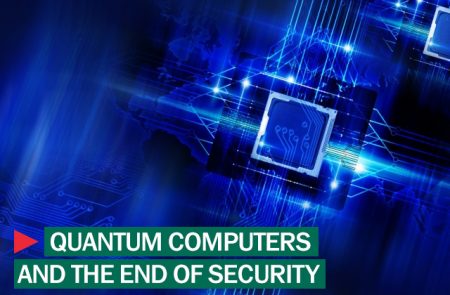
As the illustration above states, with quantum computers we may see the end of security. Quantum computers aren’t susceptible to the hacking technology we are vulnerable to today. That’s because extracting a quantum bit (qubit) is very hard. A hacker trying to read quantum data has to deal with the physics of quantum mechanics in which the state of a bit is not limited to a “0” or “1”, an “on” or “off” or a “yes” or “no.
As seen in the illustration below a quantum bit can assume positions anywhere between and around a “0” or “1.” This fuzziness of position makes any attempt to tamper with data written on a quantum device impossible to hack into without either destroying the state of the data bit or alerting the user to the attempt. And even if alerted, the user’s data isn’t compromised.
With a quantum e-mail server Hillary Clinton’s and the Democratic National Committee’s emails would remain private. No chance Russian hackers or Wikileaks could share their contents with the world as we have seen in the last month in the run up to the American November presidential election.

One of the issues holding quantum computers back, however, is the absence of software. Last year I wrote about Cambridge Quantum Computing Limited and their release of the first DOS or operating system for quantum computers. Another company located in Vancouver, 1QBit, has been contracted to build software for D-Wave Fortune 50 customers. And in May this year D-Wave announced the launch of Quantum for Quants, an online community focused on the financial community to encourage the development of software tools for that industry. At the time of the announcement, Marcos de Lopez de Prado, Senior Managing Director, Lawrence Berkeley National Laboratory, stated, “Quantum computers enable us to use the laws of physics to solve intractable mathematical problems…..it will change the job of the mathematician and computer scientist in the years to come.” The Quantum for Quants community will share in the development of quantum software applications for finance.
And not to be forgotten is IBM and its foray into quantum computing. In the last few months IBM has announced the first publicly accessible quantum computer, a five qubit system (D-Wave’s are 1,000 qubit systems) that is accessible over the Internet. IBM calls its Quantum Experience the “birth of quantum cloud computing,” giving anyone hands-on access to working with quantum bits. The IBM initiative is focused on building a universal quantum computer programmable to do any computing task at an exponentially faster rate than existing computing systems and to apply the technology in science and business.
States Dario Gil, Vice President of Science and Solutions at IBM Research, “it is a beautiful challenge to pursue the path to build the first universal quantum computer, but it requires us to change how we think about the world.” Why is that? Because we live in a world governed by classical physics and its rules and limitations. They don’t exist in the world of quantum mechanics which opens up a natural world of quantum effects we have trouble conceiving let alone understanding.
So do we have an answer to the question posed in the headline of this posting? If you believe the experts, we have never been closer to commercial quantum computing. The timeline…..maybe 5, maybe 10 years, or maybe 40. So stay tuned to this website for the next quantum breakthrough pronouncement. Until then we remain subject to silicon, Moore’s Law and the limitations of binary logic.
]]>
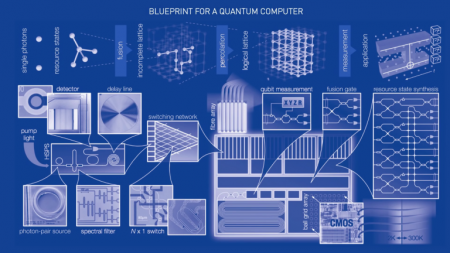
Quantum logic and quantum algorithms have been the stuff of physics labs to date. Quantum computers have progressed from one qubit to two and three with the biggest challenge being getting them to scale to a point where they are practical for commercial use. The University Maryland’s five-qubit programmable module uses ion trap quantum architecture (see illustration below) and its inventors state it can scale by connecting a number of individual modules together. Not yet demonstrated this would be the logical next step to creating a commercial device.

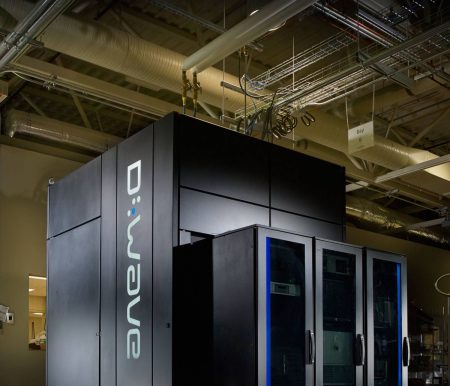
On the other hand, D-Wave’s latest quantum processor, seen in the image below, makes the University of Maryland efforts seem passe. The company’s latest model claims to break the 1,000 qubit mark although many physicists including those at Maryland are skeptical. But not the folks at Google and NASA who have upgraded from 512 qubits to this new processing capability. D-Wave intends to keep making upgrades to these systems in strategic partnership with its users at University of Southern California, NASA, Google and Lockheed Martin.

It would seem, therefore, that existing computing technology will face a challenge from quantum processors and their amazing potential. As quantum computing approaches a threshold where it will serve commercial applications and become widely distributed, the National Security Agency (NSA) of the United States is voicing its concern that existing security and encryption standards will prove inadequate as a defense against quantum computing purchasers with malevolence on their minds. In other words, once quantum computers are being used not by a few, but by many, the NSA believes any secrets protected by current best encryption standards will no longer be secret.
The truth is, today, no one knows how to make quantum-computer-proof encryption. And as quantum computers scale to millions or hundreds of millions of qubits, any current computer and current software will be vulnerable.
Google, IBM, Microsoft and NSA are cognizant of the importance of developing cryptographic keys that even a 100-million qubit quantum devices cannot break. In their pursuit of developing commercial quantum computing circuits it is, therefore, clear that a window of vulnerability exists now as the technology scales up.

The first two bullet points below I have previously written about. The latter two, however, represent the latest quantum computing advances.
Passing the Bell Test
Also referred to as Bell’s inequality experiments, the test is named after John Bell and demonstrates the unique phenomenon that occurs in quantum mechanics known as entanglement. Entanglement allows what is referred to as counter-intuitive phenomena. For example, the measuring of a particle locally can instantly affect another particle even if it is located far away from the first. This is quantum physics at its most mysterious level. And recently just to prove its real, Australia’s University of New South Wales reported that one of its engineering teams wrote and manipulated two quantum bits in a silicon microchip passing the Bell test.
The University’s experiment is explained in a video link provided here. It involved two quantum particles, one an electron and the other a nucleus from a single phosphorus atom placed inside a silicon chip. Although in close proximity to each other the experiment created two-particle entangled states. Stated Professor Andrea Morello in the School of Electrical Engineering & Telecommunications, “passing the Bell test with such a high score is the strongest possible proof that we have the operation of a quantum computer entirely under control. In particular we can access the purely-quantum type of code that requires the use of the delicate quantum entanglement between two particles.”

Writing Quantum Software Code
A new Vancouver, British Columbia company, 1QBit, founded three years ago, is out to build software for D-Wave quantum computers. Its customers are Fortune 50 companies and its product, quantum-ready software, takes about six months to build per project. The applications being built tackle high-value problems in finance, energy, the life sciences and others according to 1QBit’s web site. Getting companies quantum-ready is the mission. Non-disclosure agreements prevent the company from identifying its customers but the projects being tackled appear to be focused on finding meaningful patterns in complex data.
States Andrew Fursman, (seen in picture below) CEO of 1QBit, “similarly shaped molecules have similar effects.” He’s talking about comparing the molecules of new drugs for one of the company’s clients. “…if you build something you think is going to be a pretty good cure for heart disease but has a similar shape to something known to cause cancer, that’s a good cause for concern.”
Quantum-ready software capable of this type of discernment can be tweaked to look at other patterns. Fursman notes it is just as applicable to discern patterns in money laundering for example. “The breakthroughs made here are going to trickle down to so many different industries.”

But from Down Under comes some exciting news for those of you who have been forever waiting for the quantum computing revolution to spring forth. The promise of a commercial quantum computer has existed for several decades. In Canada, D-Wave, a Vancouver-based company, is the closest so far to delivering quantum technology. Google uses D-Wave technology. Facebook is investing in quantum technology. And Intel just announced a budget of $50 million to be spent on quantum research and development.
The Australian breakthrough as announced in the last week is an engineering feat, the building of a silicon-based quantum logic gate. Produced by an electrical engineering team at University of New South Wales, the logic gate performs calculations in quantum fashion. Instead of being in a either a bit state of “0” or “1” the gate bridges the divide allowing the qubits (quantum bits) to intertwine making fuzzy calculations possible. And by fuzzy we mean states that lie between “0” and “1,” something our current computer technology is incapable of doing.
Now comes the next step, building a prototype silicon quantum processor which the Aussie team believes will require somewhere between $35 and $70 million U.S. in investment. The University is seeking commercial partners for the venture and recently filed a patent for a full-scale quantum computer chip featuring millions of qubits.
So when will you and I have a quantum computer in our homes? Not likely for several decades states the engineers from New South Wales. The first commercial quantum computers will more than likely be purchased by big data companies and will be housed in large data centres where they will provide cloud-based services to users like you and me who will access applications through the Internet.
When you think about it that shouldn’t be a surprise. I already use a Chromebook computer when I am traveling and do all my work in the cloud. Quantum computing may further this trend.

Recently in the New York Times, Ray Johnson, Lockheed’s chief technical officer described how the company intends to use its quantum computer to test radar, space and aircraft systems. A typical test would look at a satellite network and instantly determine how it would be impacted by a solar coronal event, or a nuclear explosion. Such analysis in traditional silicon-based computing could take weeks and involve reading of millions of lines of code. But the D-Wave quantum computer would react instantly. Johnson describes it as “a revolution not unlike the early days of computing.”
Quantum computers are now for real. They are fast and great at solving complex problems. D-Wave is one of the first companies to take the technology from the lab to commercial application. Early adopters are using its products to:
The D-Wave system that Lockheed Martin is using adiabatic quantum computing or AQC. This is technology that does away with circuits and components found in classical computers. There are no switches or logic gates. You can read a definition of AQC on Wikipedia. I’m not sure it helps much so if any of my readers can provide further insights this should lead to a lively discussion.


