Although the Martian atmosphere is tenuous at best, the winds still blow on this planet creating much of the surface erosion observed by the robotic spacecraft, landers, and rovers we have dispatched to it. Orbiters have observed how much the landscape is shifted by winds. Jon Telling, Geochemist at the School of Natural and Environmental Sciences, Newcastle University, when describing the role of the Martian wind states that “the rate of erosion is estimated to be comparable to those of cold and arid sand dune fields on Earth.”
Ruling out wind erosion as the source for periodic methane release, therefore, made sense. The Newcastle researchers noted that detected methane on Mars is unevenly distributed and appears temporarily in isolated pockets on the surface. A biological origin based on seasonal or subsurface changes was a likely explanation. But a purely geochemical one was also plausible. No one had really considered Martian winds as the engine for methane release.
What the Newcastle researchers concluded, however, was that wind erosion could be playing a part but that the methane volumes detected suggested this was highly unlikely.
So if it is not wind erosion, what is it?
Marco Giuranna, of the National Astrophysics Institute, in Rome, participated in an international team studying Martian methane gas releases. They used data from the Curiosity rover and one of ESA’s orbiters, the Mars Express, to study a 250 square kilometer area of the Gale Crater surface. The team ran a million computer models of different emission scenarios and concluded that the most likely source for the gas was subsurface frozen methane that was occasionally leaking. But as to what created this methane layer, the team had no answer.
Near the end of June of this year, the Jet Propulsion Laboratory-Caltech team that is working with the Curiosity rover announced that they had detected the largest transient plume of methane coming from the Gale Crater so far. The amount was 21 parts per billion measured by SAM’s (sample analysis laboratory) tunable laser spectrometer.
On Earth, microbial life called methanogens, are a big source of atmospheric methane. You find methanogens in the gut bacteria of cows. You also find them in melting permafrost, in peat bogs, and almost anywhere there is decaying vegetation.
But some methane on Earth has geological origins. For example, volcanoes on Earth belch methane, although there is no evidence of active volcanism on Mars today. So we can rule out volcanism as a Martian methane source.
So what other Martian geological processes are likely the methane source?
Could the weathering of carbonate rocks exposed to liquid water in the right temperature conditions produce methane? This chemical origin of methane would follow a pattern of seasonal variation based on the rise and fall of daily temperatures. Seasonal methane variation has been observed on Mars.
But a biological origin would equally be plausible when looking at seasonal methane on Mars. Martian microbes would be more active in the right temperature conditions.
But Gale Crater methane observations have also been sudden with transient plumes of the gas being detected. It’s as if the planet is doing its own version of “cow farts.”
And even curiouser and curiouser is the lack of data showing methane’s presence from ESA’s ExoMars Trace Gas Orbiter, which has been circling the planet for the last year looking for the gas. Talk about causing methane confusion back here on Earth for exobiologists and geochemists who are still trying to figure out if Mars has native microbial life or just some exotic geological processes.

]]>
Magnitude in space refers to the brightness of an object seen from Earth. And you should be able to see Mars from Toronto at a point about 24 degrees above the southern horizon, midnight local time. For folks Down Under, Mars will be directly overhead when viewed from Brisbane. And about 70 degrees above the northern horizon if viewed in Wellington, New Zealand.
What you won’t see when you peer up into the sky is the planetwide dust storm that has enveloped Mars for much of this year. This dust storm may eventually cause the demise of NASA’s solar-powered rover, Opportunity. Curiosity, powered by plutonium, isn’t being affected.
Nor when you look at Mars will you see what was announced this week: the discovery of a salty body of water lying 1.5 kilometers below the south polar region of the planet, an announcement that got lots of press coverage because of the implications for finding life. But more on that further down in this posting.
In fact, observing Mars from Earth through a telescope, something I used to do when I was younger, doesn’t allow you to see all that much. I had a three-inch refractor when I was in my teens and at best I could make out a line or two on the Martian surface. That in hindsight was probably a faint impression of the Valle Marinaris, Mars’ supersized version of the Grand Canyon. If I really concentrated I sometimes could make out the polar ice caps. I never did see those Giovanni Schiaparelli canals that got people in the 19th century excited about a Martian civilization and led Percival Lowell’s to create elaborate drawings of cities connected by waterways, and of course to H. G. Wells 1897 serialized novel, “The War of the Worlds.”
The controversies of these 19th-century observations evolved into those of the late 20th and 21st. When two Viking landers reached Mars in 1976 they conducted soil analysis experiments that indicated life may have existed or exists on the planet today. NASA, in announcing the experiment results, erred on the side of caution at the time by stating they were inconclusive, or negative. It was said that Mars’ unique surface chemistry created false reads. But Curiosity in its exploration of Gale Crater over the last few years in its sampling has produced chemical results that suggest that what the Vikings discovered was likely biosignatures of past and possibly present life.
Then there is the publication of results from Martian orbiters which have tracked seasonal plumes of methane gas released into the atmosphere from the Martian surface. There can be two explanations for this observed phenomenon: biological or geological. On Earth, 95% of methane released from the surface comes from biological sources whether fossil organics or biomass. The fact that orbiters have continued to measure methane oscillations on Mars suggests an active source is continuing to replenish the gas. Curiosity has also detected methane emanations at Gale Crater described as burps that quickly dissipate. Again, the likely explanation beneath the Martian surface is past or present biology.
There’s more. Other research results from Mars from past landers and rovers including the Phoenix in 2008 have found perchlorates in the soil (chlorine and oxygen molecules). Here on Earth perchlorate is toxic to most life with the exception of extremophile bacteria. So perchlorate doesn’t eliminate Martian biology particularly when you consider its presence means water ice on Mars has a lower melting point than here on Earth. This suggests Martian water can be in a liquid state in bone-chilling temperatures.
This month on NASA’s website, an article appeared asking if the surface soil of Mars is perhaps too dry to sustain life. The article notes that Mars is 1,000 times drier than the driest place here on Earth, the Atacama Desert of South America. In the Atacama which infrequently gets rain, (I mean once every few years) there is evidence of past microbial activity dating back thousands of years. NASA scientists in the article speculate that the paradigm of the Atacama could be happening on Mars where life today may not be viable on the dry surface but may have been evident in the past leaving biological signatures like the ones Viking and Curiosity discovered.
And finally, we have the discovery of subsurface liquid water in the Planum Australe region of Mars at the South Polar Ice Cap, described as a lake. Mars Express, the European Space Agency orbiter, used subsurface radar to collect data from 2012 to 2015 that shows liquid water below ground in an area 20 kilometers wide and several meters in depth. This is not the first time subsurface water has been detected on Mars. Several sites have been found but none quite as large as this latest one. The Mars Express data and results are described in a journal article published this month in Science.
Other orbiter discoveries describe subsurface ice in “thick underground sheets” that get exposed on the rim edges of craters in the mid-latitudes of the planet. These observations are not isolated. The occurrence of ice just below the surface may explain the stria seen in images that appear as long thin dark lines cascading down from cliff edges and crater rims.
Mars is turning out to be much more than the barren world we once thought but yet far less than what 19th century astronomers perceived. So when you get the chance to go out and view the night sky over the next few days, factor all of the above as you search for and find that bright red dot of light.
The source of these organic molecules remains unknown.
Does that mean there has been life or is life on Mars? No one in the NASA community would suggest we leap to that conclusion.
So let’s review what we know about the site Curiosity is exploring which may give us clues as to the likelihood of ancient or present life.
The surface conditions at today’s Gale Crater are brutally inhospitable to life as we know it. Radiation from space and the chemistry of surface regolith makes it impossible to believe anything could be alive.
But water once ran across the surface of Gale Crater a very long time ago. And where water is found most scientists believe the chances for life to emerge are pretty good. At least based on our survey of one planet, Earth gives us the confidence to believe that.
But what about below the Martian surface?
Curiosity has been drilling down below the surface to sample subterranean Mars. And getting down 5 centimeters (about 2 inches) creates a very different picture than the one we see on the surface. Below the surface Curiosity has found organic molecules in a sedimentary rock known as mudstone which formed when silt accumulated at the bottom of a body of water in Gale Crater that existed approximately 3 billion years ago.
The concentration of organic molecules detected here is on the order of 10 parts per million, 100 times greater than any prior detection of organics on Mars. Among the molecules found are thiophenes (containing sulfur), benzene, toluene, propane, and butane. These latter two detected in the burning of samles onboard Curiosity’s lab, may be remnants of much larger organic molecules which we find on Earth in places like coal seams. And then there are previous detections of organic molecules including Curiosity finding chlorine at the deepest point of Gale Crater where water was present for a considerable period of time 3 billion years past.
So what’s organic in the atmosphere?
Curiosity over three Martian years and 4.5 Earth years has confirmed the existence of methane gas. Mars produces the gas seasonally with peak methane in the late summer of the northern hemisphere, and late winter in the southern hemisphere. “We were just blown away” states Christopher Webster of the Jet Propulsion Laboratory in Pasadena, California. Why? Because the amount of methane detected in the seasonal peaks grows by a factor of three. States Webster “It’s tripling…that’s a huge, huge difference.”
So from these two findings, announced today, what can we conclude?
Mars may or may not have life on it today. The presence of organic molecules in old rock formations may indicate that life was present earlier in the planet’s history. The methane outgassing may be an indicator that the ancient life has managed to survive to the present. But then again, the methane may come from a native chemical process with no ties to life at all. But our imagination cannot help but consider that there is something living on Mars below the surface, and when conditions are warm enough it comes out of hibernation.
In the press release issued by NASA today, Michael Meyer, lead scientist at NASA’s Mars Exploration Program, states “Are there signs of life on Mars? We don’t know, but these results tell us we are on the right track.”
In the next few years the experimental onboard laboratories contained on two future rovers, NASA’s Mars 2020, and ESA’s ExoMars, should have better experiments capable of helping us answer the questions that have arisen from Curiosity’s discoveries. Until then we will continue to learn more from the two NASA rovers still operating on the planet surface, the indomitable Opportunity, and the tantalizing Curiosity.

Considering the present state of the planet how could this be so? The Jet Propulsion Laboratory scientists have put together a hypothesis that Mars had a much thicker atmosphere in the past with temperatures well above freezing globally. They have yet, however, to understand the mechanism that could of caused this considering the orbital location of the planet as beyond the outer edge of what is described as the Goldilocks Zone.
What has changed the scientists mind about Mars’ wet period? The robot rover which first landed near an ancient river bed has been traversing the Gale Crater bottom and is now in the foothills on the edge of Mount Sharp. Here it has transitioned into an ancient wet environment with evidence of not streams but a lake and river delta/ That evidence appears as numerous layers of sedimentary rock (see image below) that could only have been laid down at the bottom of a lake over substantial time. The sediments in the picture lie 150 meters (500 feet) up the side of Mount Sharp. Evidence of interspersed dry periods can be seen in wind erosion patterns within the sediments. This indicates that in this region of Mars there were lakes that refilled and dried up over a very long period of time. Previously the wet period of Mars was believed to have been very short lived. Not any longer.

How deep were the lakes in Gale Crater? At least several hundred meters according to Project Scientist, John Grotzinger, who states, “The great thing about a lake that occurs repeatedly, over and over, is that each time it comes back it is another experiment to tell you how the environment works…..As Curiosity climbs higher on Mount Sharp, we will have a series of experiments to show patterns in how the atmosphere and the water and the sediments interact. We may see how the chemistry changed in the lakes over time.”
The picture below is a simulated illustration of what Gale Crater Lake may have looked like on Mars. Note the runoff from snow melting on the crater rim forming streams and deltas on the edge of the lake. If the lake filled the entire crater it would have been 154 kilometers (95 miles) in diameter. The illustrator is showing the lake level approximately where Curiosity has discovered the sedimentary layers deposited in the deltas as the water entered the lake. The only thing missing is Mount Sharp itself. The evolution of the mountain is still not fully understood. Was it formed by rebound from the initial impact or did it accumulate and grow over time? In any case the mountain would probably appear as an island at the centre of the lake.

]]>
Yet to be determined – a landing site. This is critical for sample collection. Sites where we have evidence of water will be preferred. There are a number of craters and valleys on Mars that are on the short list.
This rover won’t be limited to probing, grinding and analyzing the planet surface. It won’t be limited to looking for evidence of free flowing water in Mars past. Some 58 teams of scientists have submitted instrumentation and experiment proposals to put on board. NASA will begin shortening that list sometime in the summer before making final selections. One potential experiment package may repeat the tests of the original Viking landers in search of the chemistry of life that may still inhabit the planet in microbial form.
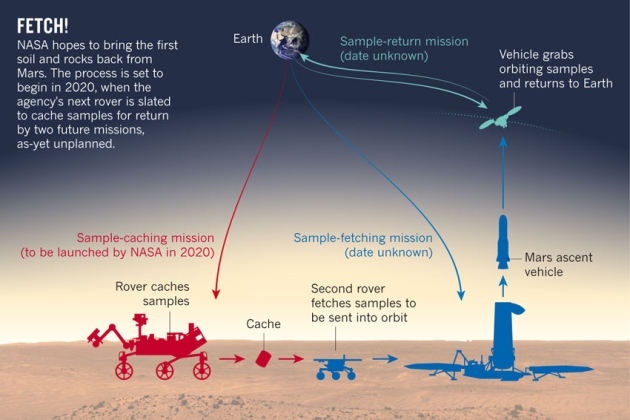
And this rover will be designed to collect samples and cache them for a return trip to Earth. The current plan involves sampling and storing 30 cylinders containing rock and soil. A second rocket with a rover would be dispatched from Earth to pick up the samples and then lift off from Mars on a return voyage to Earth. Upon returning it would enter into low-Earth orbit where it would rendezvous with another spacecraft which would then re-enter the atmosphere with samples on board.
The accompanying NASA illustration gives you a good idea of just what will be involved. As you can see this is a complicated robotic mission and hence six years doesn’t seem like an excessive timeline for planning.
The logarithmic histogram below compares cosmic radiation exposure from different sources. Note the exponential increase in exposure experienced by human crews on the International Space Station when compared to what we humans deal with here on the planet. One six month stay on the ISS equals 33 years here on Earth.
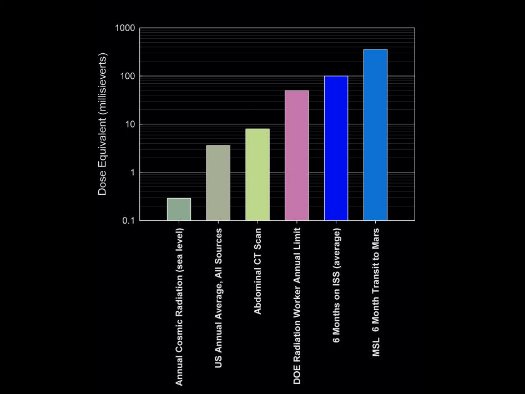
With the current technology being considered for missions to Mars like those announced by Mars One and Dennis Tito’s Inspiration Mars Foundation it is clear that a one-way trip will expose human crews to much more than ISS crews, in fact, over 330 millisieverts, equivalent to 110 years of exposure on Earth. For a return trip double the radiation exposure, and then add to that the doses received while on Mars or in orbit around the planet.
We know that exposure to radiation can lead to increased cell mutations and cancer. Exposure to 1 sievert over a lifetime equals a 5% increase in cancer risk. Current NASA astronauts are career limited after exposures equaling 3% risk.
What is the source of all of this space radiation? Most comes from charged particles emitted by the Sun. Solar flares and coronal mass ejections fry satellites, so imagine what these fairly regular solar incidents can do to the innards of an astronaut on a spacewalk, or even while inside the relative safety of a spacecraft. Today human crews aboard the ISS get constantly monitored for radiation exposure and they have the advantage of the relative safety provided by the Earth’s magnetic field which deflects many of the charged particles.
Now imagine the danger in Deep Space where Earth’s magnetic field can provide no protection. All we have is a shielded spacecraft today similar to the one that encased Curiosity. On its journey Curiosity didn’t just feel the Sun’s radiation. It was exposed to high energy cosmic rays emanating from supernovas occurring throughout the Milky Way Galaxy. These particles are a much greater threat, far more energetic than those emitted by the Sun. No shielding we currently design can stop them.
How then do we protect humans venturing into space? We might be able to devise better shielding using water. Hydrogen can be a great buffer to cosmic rays. But a better solution would be to cut the time it takes to get from Earth to Mars. This means ending our dependence on chemical propulsion systems once beyond Earth orbit. We have solutions like NERVA and VASIMIR, nuclear-propulsion systems that have been on NASA drawing boards for years. If we want Mars to be a place that healthy humans can explore and eventually settle then these are the systems that need development. Cutting the time it takes from 180 days to 30 is literally a matter of life and death.


What are we talking about here? The instrument involved is affectionately called SAM which stands for Sample Analysis at Mars. SAM has three different laboratory tools, all improvements over the instrumentation that the Viking landers used in their initial attempts in 1976 to find evidence of past life on Mars.
One tool is a mass spectrometer which separates elements and compounds by mass for identification and measurement.
The second is a gas chromatograph which vaporizes soil and rock samples to analyze the gases they emit.
The third is a tunable laser spectrometer which measures various isotopes of carbon, hydrogen and oxygen in sampled Martian atmospheric gases. The laser spectrometer is the principal tool searching for methane and water vapour.
Measurement by these tools is accurate to within 10 parts per thousand. SAM, therefore, is in the business of finding compounds essential for life both past and present and by sampling Martian rocks, soil and atmosphere, can come very close to telling us if there is life on Mars today.

That “one for the history books” statement, in light of what we know SAM is analyzing, leads to some interesting speculation. I don’t know about you, but Curiosity is a mere 107 days into its mission and may already have contributed to what may prove to be the definitive moment in our understanding of the existence of life in the Universe. I can’t wait to hear more. The official announcement is planned for the American Geophysical Union’s fall meeting in San Francisco starting the week of December 3rd.
Stay tuned!
]]>

