Then there was the Space Launch System (SLS) boondoggle with cost overruns in the billions for development of a single-use rocket for NASA’s Artemis Program. Years behind schedule, and still with no fully-assembled rocket, Boeing has demonstrated its inability to meet both physical and financial deadlines.
And now the latest, the launch of Boeing’s commercial crew module, Starliner, has run into its own problems. the uncrewed test of the Starliner launched yesterday failed to reach an orbit that will allow it to rendezvous with the International Space Station (ISS). Launched on the ULA Atlas-5 rocket (ULA is a consortium involving Boeing and Lockheed Martin) the future space taxi fired its engines at the wrong time because of an onboard clock malfunction. This meant too much fuel was used ending the opportunity to rendezvous and dock with the ISS.
For the folks at SpaceX, the other commercial space partner that NASA intends to use to ferry crews to the ISS and back, the failure of the Starliner to meet its objectives, tasted a bit sour. SpaceX is the junior partner in terms of funding in NASA’s Commercial Space Program. Boeing has received $4.82 billion to SpaceX’s $3.14 billion. Both companies have been commissioned to fly six trips to the ISS. A seat on Boeing’s Starliner will cost NASA $90 million while SpaceX will deliver each astronaut for $55 million. That compares to $86 million to buy a seat on the current Soyuz provider. Based on the numbers, it doesn’t make a lot of sense to use Boeing as a primary contractor for ISS crew delivery. But nonetheless, NASA continues to justify its commitment to Boeing as a prime commercial space partner.
The question I ask is why? It seems that Boeing cannot get many things right these days. The Starliner, like SLS, and the Max-8, has been beset with problems. First, it was reported engine problems in early testing contributing to a two-year delay in the project, then it was a parachute failing to open in an abort test, and now, in the first launch to orbit, an onboard failure that will mean Boeing on this mission will not be able to test rendezvous and docking, two essential requirements for fulfilling its crew delivery contract.
There is no doubt now that SpaceX will be the first non-government provider to give Americans a ride to the ISS and that it will happen, most likely, in the first half of 2020. SpaceX’s last test is scheduled for January 10, 2020, when they will deliberately abort a launch. As for Boeing, who knows when the company will unscramble the mess that seems to be part and parcel of its engineering efforts of late.
When asked about the latest Boeing snafu, NASA administrator, Jim Bridenstine (neither scientist, nor engineer), stated that if astronauts had been on board the Starliner would “be orbiting, or docking with the space station” now. But wasn’t this orbital test all about ensuring an extra margin of safety using automated systems in the event astronauts were somehow unavailable to take over? It seems in the age of Boeing and NASA’s current human space program, that less than perfect is becoming an accepted standard.
One only hopes that the Starliner manages a safe ground landing this Sunday, a first for American spacecraft intended for human crews. Until now all landings have been on water. The shortened mission, now only 48 hours, may provide enough useful information about the capsule’s performance in space to lessen any delay caused by the snafu.

]]>
The capsule is officially known as the Boeing Crew Space Transportation 100 Vehicle or CST-100. Boeing has partnered with Bigelow Aerospace, the company building inflatable modules for space hotels and future lunar colonies. One of these modules is scheduled for testing on the ISS in 2015.
The CST-100 is not a Bigelow-inspired inflatable but a seamless hard bodied capsule that has roughly the same conical shape as the Apollo spacecraft. But unlike Apollo it can fly up to 10 times and can be brought back to land on earth rather than water. It carries a crew complement of seven or a lesser number plus supplies. The shot below shows the mockup of an interior layout. This is the non-commercial version. Boeing and Bigelow plan a much more luxurious model for future commercial flights to the Bigelow Alpha Station, the first private space station.

CST-100 uses “innovative weld-less design” and has its own push rockets for escape in case of rocket launch failure. Apollo had a front mounted escape rocket mated to the capsule in case of emergency. The U.S. Space Shuttle didn’t provide that margin of safety which was a terrible mistake.
The on board rockets on CST-100 will also be used for navigation while in orbit. Boeing has also equipped the spacecraft with state-of-the-art commercial aircraft emergency systems. It has auto pilot but the crew can fly it manually as well. All lighting is LED and the computer and networking technology on board is up to date taking advantage of the latest commercial advances.
A CST-100 can stay docked in orbit up to six months. Upon return to Earth it will be refurbished for relaunch. Right now CST-100 is compatible for mating with an Atlas V rocket, the same rocket used to launch Curiosity Rover on its flight to Mars. Atlas V has never been used for human space flight. And there may be only a limited supply of them in the future based on Russia’s announcement that it no longer intends to supply the rocket engines used by the launcher. As a result Boeing may be looking elsewhere to get CST-100 aloft with SpaceX Falcon 9 and Falcon Heavy potential candidates. But neither of those two launchers have been tested for human spaceflight, and the Heavy has yet to fly.
The current Boeing-Bigelow schedule has an unmanned launch of CST-100 expected as early as 2016 with a crewed flight to follow. This would be subject to NASA approval and funding. I suspect the pressure is on NASA to find an alternative to Russia based on this week’s announcements. The CST-100 first crewed flight will have a complement of two astronauts plus supplies for the ISS. An artist rendering of that mission can be seen in the illustration below.
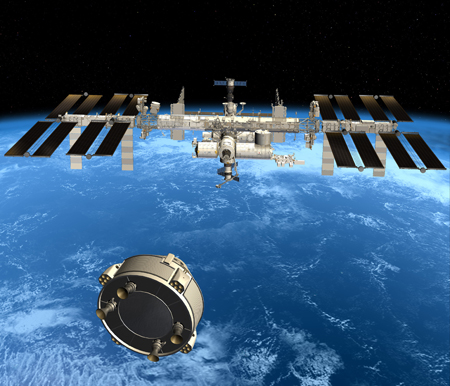
But Boeing isn’t just counting on the ISS as a destination for the CST-100. In working with Bigelow it has “bigger” plans. These include commercial flights to the yet to be launched Bigelow’s Alpha Station which may be in orbit by 2016 as well.

Bigelow recently released a price book for long-term stays on board Alpha Station which will offer a microgravity environment for those doing commercial research and development. Target customers include biotech and pharmaceutical companies with per seat rates for 10 to 60 day stays ranging from $26.25 to $36.75 million U.S. And Bigelow plans to lease up to 110 cubic meters of space on Alpha Station for $25 million U.S. And companies that want to run individual experiments on board will be charged $500,000 for two-months.
SpaceX has received $400 million from NASA. It leads the other companies in terms of its development achievements and plans to launch a first human crewed flight in 2015 atop its own Falcon-9 launch vehicle. Dragon will seat seven passengers. It incorporates abort capability all the way to orbit, something the Shuttle never had. It also features a powered descent system for landing on the ground (see picture below). Of those receiving contracts from NASA, only SpaceX has actually flown.
Boeing received $460 million. Its capsule is also designed for a crew of seven and will be launched using the Atlas V rocket from United Launch Alliance. The capsule looks similar to the Apollo and uses some of its legacy and proven technology. It also incorporates some of the Orion capsule features, NASA’s own crewed capsule designed for future Deep Space missions. The CST-100 will also feature an abort system in the event of a problem at launch. First test flights are planned for 2016.
SNC also known as Sierra Nevada received $212.5 million for its mini-shuttle space plane called Dream Chaser. Dream Chaser was first conceived as a NASA mini-shuttle but the project was cancelled only to be revived by private enterprise. Launched from the top of an Atlas V rocket, Dream Chaser plans to make its first orbital flight in 2016. An approach and landing test is scheduled for late 2012. Dream Chaser also has the capability of carrying a crew of seven into orbit. Of the three commercial launchers only Dream Chaser will be capable of landing on a runway in similar fashion to the Space Shuttle.
Until these American companies have their spacecraft ready to go the United States will still contract Russia and its proven Soyuz technology to send its astronauts into orbit and rendezvous with the International Space Station.

]]>


