I joined Facebook back in early 2006. I was writing a small business blog at the time and was looking at how social networks could leverage opportunities for new companies. Facebook was among about 30 different social networks that I test drove but soon it asserted its dominance. Today Facebook has nearly 2.9 billion monthly users. And it has added other social media platforms to its offering including WhatsApp, Instagram, and Messenger. These all have between one and two billion users. Only YouTube from Google is as pervasive on the Internet.
When I joined Facebook I saw all of its potentials as an online forum, a digital space where there were no national borders, and opportunities aplenty to engage the global community in collaborative ways. My naivete.
That Facebook is long gone if it ever even existed. Today it is a media giant and cash generator for its investors. Its online presence makes it a principal influencer of thought and purpose often appealing to the worst in humanity.
Frances Haugen, the Facebook whistleblower on 60 Minutes, worked there. She is a computer engineer with a Master’s Degree from Harvard. In her whistleblower complaint, she states that Facebook has promoted misinformation, hate speech, and incited violence through its pages because that makes money, increases traffic and sells more advertising to get more clicks. Facebook executives have denied that any of this is true. But the evidence as presented in the whistleblower complaint contradicts the company’s leaders.
Not only is Facebook misleading its users and investors, but when it describes its newest software algorithms to create meaningful interactions and content, it hides a reality that it is in the business of pushing negative communications because this gets more eyes and makes the company more money. And it’s true of audiences, whether they are Trump supporters in America or Modhi supporters in India, that racism, bigotry, antisemitism, anti-Muslim, and anti-vaxxer rhetoric are all good for Facebook’s bottom line.
Facebook tells you they monitor hate speech and misinformation, but the truth is they haven’t the staffing or means to look at much more than 10% of all of these messages and postings. Facebook’s final defence is that the divisiveness and hate found on its platform reflects current global society and cannot be blamed on them.
The growing reliance on our digital presence in the 21st century in examples like Facebook is not helping us to overcome the challenges we currently face. If anything applications like Facebook exacerbate them.
There are technological innovations that counter this negative Facebook narrative and here are some examples.
SEEDS is a digital platform and online community that encourages global collaboration and rewards participants for their pursuit of happiness and collective self-actualization. I recently joined the SEEDS community and have written about it. Seeds (lowercase) is the digital currency used to reward members of the community for their efforts. Seeds can be exchanged for non-digital currencies when needed.
Another good example of a digital presence that is a solutions maker is Kiva.org. I discovered Kiva back in 2007, a microloan operator aggregating capital from hundreds of thousands of lenders to provide money to Developing World entrepreneurs with little access to banks and other financial lenders. Recently I surpassed 100 loans that are helping to seed new projects in more than 40 countries. The unprecedented repayment rate of 99% with nary a default is unmatchable by any bank or other financial institution. Kiva launched Kiva U recently to educate young people in wealthier countries about similar-aged compatriots in the Developing World. Truly a bridge builder, Kiva is using the Internet the way I always ideally envisioned it rather than spreading disinformation and fueling hate for profit.
Crowdfunding represents another innovation of the digital age. A means of raising and exchanging money for projects deemed worthy by the general public, crowdfunding is a financial social movement offering real or digital currency to those whose ideas and products attract investors. The reward for crowdfunders is usually a premium of some kind, maybe an early release product, or bling. The most popular of these sites include Kickstarter, Indiegogo, Fundable, GoFundMe, and one less talked about, Mightycause that crowdfunds not-for-profits.
Exchanging money has gone digital over the Internet with the advent of mobile phones and access to the Internet. In the Developing World where there is a large number of people who don’t have bank accounts, it is a challenge to move money over any distance. Exchanging money electronically used to be a bank-to-bank or Western Union thing. But now there are many applications to use to replace these antiquated and expensive exchanges. One site, WorldRemit handles money at low exchange rates for more than 130 countries. In Kenya, WorldRemit partners with a smartphone app developer, M-PESA, a collaboration involving the local telecommunications company and a number of East African banks. Today M-PESA operates in 10 countries. But M-PESA doesn’t need a bank to move money. Its mobile phone app allows users to buy and sell goods and services and store the value of the exchange in a secure cloud on the Internet. And the service fee for each transaction is a fraction of what it used to cost. And if you want to turn the exchange value into cash you can pick it up at designated locales.
]]>At the low end of available capital markets, there is crowdfunding, a peer-to-peer network where a person can present a product or service to the world and ask for funding. Funding requests come in various forms from loans to equity investments, to rewards, or to advanced purchases of proposed products or services.
Crowdfunding has exploded onto the scene in recent years making it vastly easier for an entrepreneur anywhere in the world to digitally pitch an idea and raise funds to start a business. The total worldwide volume of crowdfunding, inclusive of peer-to-peer lending, reached $34 billion in 2017 involving 375 crowdfunding platforms in North America alone. Like many digital platforms, crowdfunding is experiencing double-digit growth with experts projecting money raised through it to reach $300 billion by 2025.
Kickstarter, one of the most popular reward-based crowdfunding platforms, has been responsible for launching almost 400,000 projects, with over $3 billion U.S. pledged by visitors to the site. The most successful Kickstarter campaign to date has been Pebble Time which raised over $20 million in 37 days.
Crowdfunding demonstrates the democratizing of capital, allowing a person with good ideas to get the cash needed from anyone, anywhere. No surprise that Goldman Sachs described crowdfunding as “potentially the most disruptive of all the new models of finance.”
In contrast to crowdfunding, we have venture capital, a more traditional source of startup funds that has been in existence for the past five decades. Venture capital helped in the birth of household names like Apple, Google, Amazon, and Uber. Known as VCs, these type of funding sources vary from individuals to corporations to institutional investors. Most invest money in exchange for equity in what are perceived to be high-growth opportunities. Funding can range from a hundred thousand dollars during a company’s seed stage to hundreds of millions invested to support later growth-stage companies.
Here again, the world is experiencing staggering global growth. In 2017, we saw new records set in venture capital investments:
Where is this money going? To companies in artificial intelligence (AI) where investments have doubled from $6 billion in 2016 to $12 in 2017. At the same time biotechnology has experienced massive year-over-year growth from $12.2 billion in 2016 to $16.6 invested in 2017.
New to the scene of capital formation is an instrument referred to as an Initial Coin Offering or ICO. Inspired by Bitcoin and other cryptocurrencies, ICOs are a new way to crowdfund a business venture by issuing tokens that can then be used to redeem value within the ecosystem of the startup. In some cases, the tokens have a clear utility in a company. For example, they can be used to vote in a prediction marketplace. In other cases, they can be used as a security representing a fractional share of a piece of real estate listed on the blockchain, the open source secure ledger system used by cryptocurrencies. Do a good job selling a vision and people will buy the ICO tokens you issue to raise capital for a new venture. A lot of ICO tokens can be traded on major cryptocurrency exchanges which means if a project goes well, the tokens rise in value, and investors sell them for a nice profit. Perhaps best of all, for an entrepreneur, the capital that comes from an ICO is non-diluting, meaning investors gain no equity in the company no matter how much the ICO might raise.
ICOs are also famous for raising money fast. Here are two good examples:
Filecoin is a good example. It is a blockchain-based decentralized data storage network which allows blockchain participants to let third parties store their data on your computer servers. Participants receive Filecoins as a reward. When Filecoin was launched it raised $257 million U.S., $52 million in presale, and $205.8 million in the second round. It took only 30 days with $135 million raised in the first hour alone.
EOS, a cryptocurrency provider, has also seen record-breaking purchases of its ICO, Block.one, raising $4 billion U.S. in a yearlong campaign that began in June of last year.
The Wall Street Journal recently reported that the total amount invested in ICOs rose from $6.6 billion U.S. last year to $7.15 billion in the first half of 2018 alone despite regulatory uncertainty and restrictions being imposed in countries like China and South Korea. And the number of ICOs per quarter continues to grow from roughly a dozen at the beginning of 2017, to over 100 by year-end. It is no wonder, therefore, that in this unregulated environment, scammers are entering the ICO business seeing it as an opportunity to line their pockets.
When it comes to the motherlode of deployable capital, look to Sovereign Wealth Funds (SWFs) which today hold an estimated $6.59 trillion in assets. As the promise and economic potential of tech startups continue to climb, it’s no surprise that SWFs are lining up to invest in them with the goal to yield outsized returns. In 2017 there were 42 SWF deals valued at some $16.2 billion states the Sovereign Wealth Lab research center at Madrid’s IE Business School. But this $16.2 billion pales in comparison to Masayoshi Son’s the “Vision Fund,” a megafund which initially has $100 billion in investment that Son hopes to see multiply tenfold in value in the coming decade.
Why raise such an enormous fund? Son believes that the Singularity of Ray Kurzweil fame will happen in the next 30 years and so he is building an investment fund which has drawn the interest of some big money players. Starting in September 2016 he got Mohammed bin Salman, Saudi Arabia’s crown prince interested in financing technology startups. The total bin Salman investment decision was made in 45 minutes amounting to $45 billion US. Since then the UAE-based Mubadala Investment Company and companies like Apple, Foxconn, and Qualcomm have all ponied up. SoftBank, a largely one-man show when it comes to deals, has been involved making nearly 100 investments using $36 billion in capital it has aggregated for new technology startups. SoftBank’s investments include Brain Corp, Mailbox, Boston Dynamics, Improbable, Nvidia, Slack, WeWork, OneWeb, Didi, and Uber.
Son has plans in the future to establish a second Vision Fund, followed by a third and fourth every few years. His ultimate goal is to have a technology investment fund of $880 billion U.S. by then to place well-qualified bets on the best new ideas and inventions rising from entrepreneurial minds.
No one in Silicon Valley comes close. Neither Sequoia Capital or Silver Lake, the two California-based heavyweights.
So no excuses, entrepreneurs. If you’ve got an idea there is no capital-related excuse to put off pursuing it to its ultimate success.
I am sure, other than point #1, most of you haven’t encountered these other sources of capital. That’s why I hope if you are budding entrepreneur, visiting this blog site, that you use the information below to help you get the funding to achieve your next moonshot.
Global crowdfunding has exploded onto the scene, and crowdfunding websites make it easy for anyone to market their ideas and get funded. The total worldwide volume hit $16.2 billion as of 2017, with 375 crowdfunding platforms in North America alone. The World Bank predicts that crowdfunding investments will be a $96 billion per year market in the Developing World by 2025.
Kickstarter, one of the most popular reward-based crowdsourcing platforms, has launched almost 400,000 projects, and over $3 billion has been pledged on the site. The most successful Kickstarter campaign to date, Pebble Time, raised over $20 million in 37 days, with $7.4 million in the first day alone. Even Oculus Rift, the product responsible for making VR a household name, was funded initially on Kickstarter.
Equity crowdfunding is also taking off tremendously, with worldwide volume exceeding $4 billion in 2016 and expected to grow $20 billion by 2020, surpassing worldwide angel capital.
What crowdsourcing does is democratize funding, allowing any good idea, regardless of its origin, to become realizable. As such, Goldman Sachs has described crowdfunding as “potentially the most disruptive of all the new models of finance.”
An Initial Coin Offering (ICO) or Token Generation Event (TGE) is a new fundraising tool from the cryptocurrency realm. In some ways, ICOs and TGEs are like crowdfunding campaigns, but instead of offering a product or shares of equity in a startup, companies offer “coins” (for ICOs) or “tokens” (for TGEs), which allow buyers to access blockchain-based software services. Rather than pitch to a venture capitalist to fund an idea, programmers may host a TGE and sell a fixed number of tokens to the open market (usually in exchange for Bitcoin or Ethereum). Consumers buy the tokens with the hope that, over time, the software or service will become widely used and increase the token’s value. This route is especially popular for companies that aim to create decentralized platforms because, by definition, no one owns these platforms or directly profits from them.
Nearly $2.3 billion has been raised to date in ICOs, with the large majority of that taking place in the first half of 2017 ($800 million in Q2 2017). In fact, in Q2 2017, ICOs outcompeted VC funding in virtually every regard as it relates to funding Blockchain projects (see chart).

Recently, an Ethereum startup and incubator called ConsenSys has been raising eyebrows in this exciting market. ConsenSys’s MTP is creating simplified and automated decentralized applications to facilitate peer-to-peer transactions and exchanges. They hope to spearhead this revolutionary idea into the mainstream. In September, the company launched a $50 million venture fund for startups working in blockchain technology.
I’ve noticed an uptick in funding to promising startups from Sovereign Wealth Funds (SWFs). A source of over $6.59 trillion in assets, SWFs are investing in early-stage ventures that hopefully will yield outsized returns if the funded firms experience exponential growth. Globally, there were 42 SWF deals valued at some $16.2 billion in 2016 based on data from the Sovereign Wealth Lab research center at Madrid’s IE Business School.
The largest technology investment fund ever, Softbank Vision fund, is backed by two sovereign nations: Saudi Arabia and the United Arab Emirates. The $100 billion Softbank Vision Fund plans to invest over $1 billion in Uber when it goes public. The fund recently bought Boston Dynamics (the robotics company) from Alphabet.
In addition to the Vision Fund, Saudi Arabia has also made recent headlines with its Vision 2030 initiative which describes a prosperous and sustainable future for Saudi Arabia as the Kingdom prepares for new technologies to replace the oil market that the current economy relies upon. Saudi Arabia has announced plans to invest $1 billion in Virgin’s space tourism companies as just one of many SWF investments.
Other SWF examples include Ireland’s “Strategic Investment Fund” and Australia’s “Future Fund.” In fact, many countries are so convinced that the future belongs to powerful entrepreneurs with massively transformative purpose, that they are pooling together billions of dollars to help them go for it. They see the potential of exponential technology coming from do-it-yourself innovators, and they want a slice of the pie. Perhaps your startup could be the next to catch the imagination of an entire country.

States Jon Morse, Mission Executive for Project Blue, “we’re at an incredible moment in history, where for the first time, we have the technology to actually find another Earth.” In going to crowdfunding on Kickstarter it demonstrates a growing trend for community-backed scientific research.
Nick Yulman, of Kickstarter says this is new territory for the crowdfunding site remarking that “groundbreaking campaigns like this give backers a chance to play a central role in the democratization of scientific discovery and an opportunity to learn directly from the creators driving innovation.”
Crowdfunding science is not new. When the Australian government back in 2013 dismantled its Climate Commission focused on climate change research a crowdfunding effort established the Climate Council, a not-for-profit that raised $730,000 U.S. in three days. Today as government-funded research dries up more and more fundamental research is going the crowdfunding route.
Project Blue is built on the foundational discovery work of the Kepler space telescope which in its survey of stars has identified thousands of exoplanets from gas giants to super Earths and smaller. The space telescope that the non-profit consortium hopes to develop with crowdfunding money will be integrated into a satellite no bigger than a washing machine. It will have a 45-50 centimeter aperture and be capable of seeing and imaging planets 20 billion times dimmer than their host stars. It will include a coronagraph to block the starlight from Alpha Centauri, a deformable mirror, on board wavefront sensors and software algorithms to control incoming light, and post-processing enhanced imaging capability. The wavefront technology is a NASA-proposed method of blocking starlight to allow for detection of orbiting planets.
The Kickstarter campaign has raised over $188,000 so far from 1,270 plus backers. If you are into becoming part of a mission that could be the first to find a second Earth, then give Project Blue an early Christmas present by pledging $10 or more. For your $10 you will receive regular mission updates, launch footage, behind-the-scenes video, acknowledgement on the website, and a mission laptop sticker. Make it $25 and you get all of the $10 stuff plus official membership and a Project Blue mission patch. $40 adds a Project Blue canvas tote bag. $65 in addition gives you a 1 centimeter square patch of the thermal shielding to be used on board the spacecraft. $100 adds in a mission t-shirt plus raw data imagery of the Alpha Centauri system. To find out more visit the Kickstarter site.

In keeping with that mission spirit the company has created a product it describes as a community chlorine maker. Designated the MSR SE200(TM), the company has launched an Indiegogo crowdfunding campaign to raise $50,000 U.S. to put 2,500 units in the hands of low-resource communities around the world in 2017, giving them the power to produce their own bacteria-free freshwater.
Drinking water is a challenge for many in the world. According to the World Health Organization (WHO), 4.2 billion today get freshwater through piped connections with 2.4 billion receiving water through public taps, protected wells and boreholes. That leaves 663 million relying on unimproved water sources including 159 million dependent on surface water. WHO estimates 1.8 billion get drinking water today from sources contaminated by human and animal waste. Contaminated water transmits diseases including cholera, dysentery, typhoid and polio. 842,000 people (361,000 of them children under the age of five) die from diarrhoea annually from unsafe drinking water. And although we have seen improvements in delivering uncontaminated freshwater the WHO estimates that by 2025 half of the world’s population will be residing in water-stressed areas which will make clean freshwater even more scarce.
Chlorine can stop waterborne infections but its availability in low and middle-income countries is limited by a lack of transportation infrastructure, poor storage facilities, and insufficient quantities for treating community drinking water.
The MSR SE200 is a potential drinking-water solution that is a simple, effective and an inexpensive way to create chlorine through a process of mixing salt and water and then having the battery-powered or pluggable device treat the brine through an electrolysis process to produce enough chlorine in five minutes to treat 200 liters of water. The average human needs to consume a liter of water a day, so that’s enough treated drinking water for 200.
World Vision, PATH, the Lemelson Foundation, Laird Norton Family Foundation, and Washington Global Health Alliance have partnered and funded MSR at various stages in developing the SE200. The company donated 100 kits to Haiti to decontaminate freshwater after the country was hit by Hurricane Matthew in October destroying many remote communities in the southwestern part of the country.

The Indiegogo campaign has a month to go and so far has raised more than $21,000 from 279 backers. If you want to participate a pledge of $160 will provide enough money to send one device to reach 200 people in need. The company will also give you a 30% discount coupon for purchases of any of its MSR gear. A minimum pledge of $10 will help provide treated water for 2 families, $30 for a classroom, $50 for over 60 people, $80 for over 100, and $320 a buy one and give one device offer.
For the more adventurous supporters a $16,000 campaign pledge will get you a trip to a World Vision community in Kenya. You can add on an optional safari while you are there. The pledge doesn’t include airfare, visas and vaccinations.
Corporate sponsors can pledge $40,000 to deliver 250 devices to 50,000 users to treat their own water. The sponsors company brand will be imprinted on each MSR SE200 shipped. The product is ready to ship now.

]]>
At Wageningen University, The Netherlands, researcher Wieger Wamelink harvested a crop of radishes, peas, tomatoes (see the first Martian tomato in the image below) and rye grown in both simulated Martian and lunar soils. The yields were comparable to what we can grow here on Earth. But the jury remains out on whether these harvested foods are edible.

Why?
The simulated soils gathered from Hawaiian volcanoes for Mars and the Arizona desert for the Moon contain heavy metals including lead, cadmium, mercury, iron and arsenic. How much of these potential poisons get taken up by the plants’ stems and leaves and how much by the edible fruits and seeds? Until now anything grown in these simulations has remained uneaten. But Wamelink hopes through a crowdfunding campaign to produce a new crop from his simulations and then test the yields for edibility.
The plan is to work with peas, tomatoes, radishes and two other crops replicating growth cycles five times. Plants would be grown in a Martian soil simulation, lunar simulation and Earth-based control medium. All will receive plant and human fecal organic matter and water in equal amounts. All planting is in a controlled underground environment with an Earth-simulated atmosphere and lighting approximating each environment. Fruit and other edible parts of each plant will be harvested and analyzed for heavy metal content.
The research will not only tell us if we can safely produce food locally for future Martian and lunar colonies, but also should help us here on Earth where farmers have to deal with marginal soils equally laced with heavy metals.
The crowdfunding campaign goal is 25,000 Euros with about one-third raised to date and two months left to go. The plan is to start the experiment in April 2016. If you want to help you can donate by clicking on this link.


First to go was the Climate Commission, a government funded body ($580,000 Australian annually) that provided information to the public on the impact and potential solutions to deal with climate change. The Abbott government was also the first in a long time to dispense with a Minister focused on science.
Another body, the Climate Change Authority also appears to be on the way out. This latter body is responsible for providing advice on carbon emission targets. But since Abbott plans to rescind Australia’s carbon tax as soon as legislation can be drafted it appears that the Authority will no longer have much authority or anyone to advise.
So what to do? Well the Climate Commission has been revived as a not-for-profit called the Climate Council and it has done this by raising $800,000 Australian ($730,000 U.S.) through crowdfunding in a campaign launched on its Facebook page. It took only 3 days for Aussies to chip in to fund the Council.
Not to be silenced by the new Conservative government which in its new climate action plan has stated it will not achieve the 5% reductions in greenhouse gas emissions the nation pledged at Copenhagen in 2009. Instead the new government has asked agriculture and industry to provide voluntary targets for reductions and has provided a capital pool of $3.2 billion Australian over four years to help them achieve their stated goals.
The revived Commission under the name Climate Council has released the first of what will be many reports. The story it tells is not encouraging. Australia in its 2012/2013 summer experienced the hottest January, the hottest summer, and the hottest day ever recorded.
For September 2013, the beginning of Australia’s spring, the country experienced its warmest in history with national temperatures 2.75 Celsius (4.95 Fahrenheit) degrees above the average between 1961 and 1990. Australia’s average temperature for the period from October 2012 to September 2013 was 1.25 Celsius (2.25 Fahrenheit) degrees above the long-term average and 0.17 Celsius (0.3 Fahrenheit) degrees warmer than any previous 12-month period prior to 2013.

When leadership chooses to be blind it puts on shutters. But crowdfunding for a cause is becoming a social media phenomenon and this crowdfunding initiative is probably the first to be used to bring back an axed government agency, apolitical and focused on providing accurate, science-based information on climate change.
Consider the bushfire outbreak on the western outskirts of Sydney following the 12 hottest months in Australia’s history, it seems that global action on climate change is coming from the grassroots and not from elected officials, at least not Down Under.

]]>
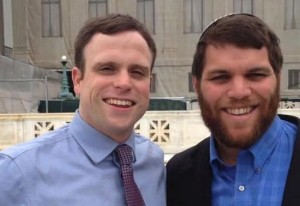
In this age of patient-centered medicine two researchers, Jeffrey Rosenfeld (seen in the image below on the right) and Christopher Mason (to his left) have launched a project, called Genome Liberty, to democratize the genome. What does that mean? They have created a DNA test that identifies how each of us metabolizes commonly prescribed medications. This is a test we can take with us when we go to see our doctor. And since most doctors will readily admit that they don’t understand everything about DNA and drug interactions, represents a breakthrough in medicine of enormous importance.
Doctors have known for years that not all of us respond to prescription medication the same way. I, for one, have problems with morphine. My body just cannot tolerate it. Why? Because I lack the protein vital to instructing my liver enzymes to metabolize the drug.
You see the human body is filled with proteins. Genes use proteins to instruct the body to react to the environment. When you take a prescription medication the gene acts like the bits and bytes in a computer program releasing a chemical set of instructions which in computer vernacular is formatted into proteins. The proteins then circulate through the network that is our body and when the right address is found deliver information to instruct the body to react.
Rosenfeld and Mason have created the Gene-Drug Interaction Test. The test identifies whether you have the appropriate proteins to allow your body to metabolize any of the following commonly prescribed medications:
Abilify
Celexa
Codeine
Coumadin
Dilantin
Estrogen
Haloperidol
Nexium
Plavix
Prilosec
Zocor
What’s involved? You go online, order and pay $99 for your own Gene-Drug Interaction Test. Genome Liberty sends you by mail a saliva collection kit. You follow the instructions to provide a saliva sample which you then send by mail to Genome Liberty’s certified medical laboratory. The lab test looks at your DNA for variations in 11 genes responsible for drug metabolism, the genes that trigger the instructions for enzyme secretions in the liver. They are critical to how your body handles as many as 80 different drugs.
Two weeks after submitting the saliva sample, Genome Liberty sends you the results indicating your body’s response to the commonly prescribed medications for which it tests. In the final report drug dosage recommendations and cautions are provided. This is information you share with your doctor. You also get it on a wallet card and in a smartphone app.
Rosenfeld and Mason have launched a crowdfunding effort to raise $100,000 to get Genome Liberty to market. The money they get will help them to refine the list of genetic markers they will test for, and will help them to get the resources to manage the administration involved in processing test requests and returning results.
The credentials of these two gentlemen are impeccable. Mason is a professor for the Tri-Institutional M.D./Ph.D. program between Cornell University, Memorial Sloan-Kettering Cancer Center and Rockefeller University. Mason also is an appointee for the Weill Cornell Cancer Center, and a fellow of the Yale Law School examining the legal implications of genomics technologies.
Rosenfeld has a Ph.D. from New York University and is an Assistant Professor at Rutgers New Jersey Medical School. He is also a research associate for the American Museum of Natural History and has been spearheading efforts to sequence the genome of under-studied organisms.
When asked why they have created Genome Liberty, Mason stated, “A better understanding of the genetic basis of health and disease can improve the detection, characterization, and treatment of disease that can improve and lengthen lives.” Rosenfeld adds, “My goal for Genome liberty is to allow individuals to have control over their genetic information and to use it to improve their health decisions.”
You can help democratize the genome by assisting these two to raise the money to fund the project. $10 gets you recognition on the donor page of Genome Liberty’s website as well as honorable mention in Facebook and Twitter. Provide a $25 contribution and you get a car magnet you can proudly display. For $36 you will have two questions about genetics answered personally by Mason or Rosenfeld. Pledge $50 and you get a Genome Liberty T-shirt. $75 gets you a Rosenfeld and Mason autographed poster. And $100 lets you pre-order the Genome-Drug Analysis Test and get your own personal report. To check out all the other categories visit the crowdfunding categories page.

So what is found in our global society today that can be described as an ecology of innovation? As a futurist who studies technological and scientific achievements, it is clear to me that one can define today a distinct, innovation ecology.
Here are some examples:

The Internet is the ubiquitous platform upon which this new ecology is built. It, along with global communication facilitated by cellular networks, connects all of human society today like never before. With a Wikipedia, a Google or a Bing it is hard to imagine not finding answers to almost any question you pose. Of course in the free flow of information also comes misinformation.
That’s where education plays a powerful role in an ecology of innovation. And today we are seeing more of those in our global society who have been denied access to learning finally making strides. I’m speaking of girls who in so many cultures have often been ignored as a resource capable of driving innovation. Today more and more of them are getting educational opportunities very much facilitated by access to inexpensive smartphones and the Internet as well as formal education.
Another is the notion of prizes, the offering of cash rewards to individuals or organizations that develop a specific technology or scientific accomplishment in pursuit of a defined goal set by those making the offer. This old 18th century idea continues to be renewed here in the 21st and is fostering innovation in space, aviation, transportation, biomedicine and environmental science. Even NASA and DARPA have announced prize competitions to encourage innovation within the private sector to meet the goals of the space program and the Pentagon.

Probably the recent phenomenon of crowdsourcing and crowdfunding through the Internet is the best example of an ecology of innovation. Sites like Indiegogo and Kickstarter are an inventor’s paradise, connecting those who create innovation with early adopters who are prepared to invest to see the technology get to market. The results have been astonishing to the point where crowdsourcing funding for pure science now exists at Petridish.

But it is the use of the word ecology that keeps making me think of the environment and the planet we live on. Of all areas of pursuit today we need our modern society focused on addressing the environmental challenges we face in the 21st century. We need as a society to create the innovation necessary to ensure our survival as a species. We live in interesting times, in a period when we know that we may be subject to significant environmental disruptions as the century unfolds and face challenges human society has never experienced before. Critical thinking, innovation, and invention will be ours and the planet’s salvation.

Orbital Sciences Prepares Antares Rocket and Cygnus Spacecraft for ISS Mission
SpaceX isn’t alone in providing a commercial launch service to support the International Space Station (ISS). At least not anymore if Orbital Sciences is successful with its test flight of the Antares rocket along with a capsule that will simulate its Cygnus module and provide telemetry to ground stations while in orbit. The launch is planned for sometime in the next week from Wallops Island, Virginia, not Cape Canaveral, Florida. Orbital was one of three companies originally contracted by NASA to deliver supplies to ISS. If this demonstration flight succeeds and the subsequent real supply mission goes off without a hitch the U.S. will now have two private companies in the launch to low-Earth orbit business.
Antares uses rocket engines developed originally in the Soviet Union for its defunct Moon program. Apparently 50 of these engines were left in storage after the USSR collapsed and Orbital has been buying from the Russians and refurbishing them. The Cygnus capsule, an artist rendition seen below, can carry up to 2,000 kilograms (4,100 pounds) of cargo in its pressurized hold but unlike the SpaceX Dragon, is not designed for re-entry and recovery and will burn up in the atmosphere after making its deliveries to the ISS.

Crowdfunding Becomes a Great Source for New Technology Investment
In 2012 crowdfunding platforms raised $2.7 billion for more than one million projects (see distribution map below). Today more than 300 crowdfunding sites exist and forecasts are predicting a banner 2013 with as much as $5.1 billion raised by this no longer novel method for finding investment capital.
Massolution has been tracking crowdfunding and provides an industry report on this financial revolution being fed by global connectivity through the Internet. Crowdfunding models vary. In some cases money is donated in return for t-shirts, baseball caps, or a first cut of the new company’s product. In other cases the money is strictly a loan, or an equity investment. And in some cases new companies pay royalties based on a percentage of every unit sold in proportion to the amount invested.

Global Capacity for Biofuels Growing Rapidly
Many countries around the world, in their desire to lessen dependence on fossil fuels, have turned to biofuels. Conventional biofuels like ethanol and biodiesel have dominated the market to date with the United States, Brazil and the European Union the largest producers.
But now advanced biofuels are starting to appear in commercial volume. These fuels include cellulosic ethanol (not made from food crops but from switch grass and other non-edible growth), biobutanol, green diesel, synthetic gasoline (made from recycled plastic), and green jet fuel. Global biofuels are expected to grow from 127 billion liters (33.6 billion gallons) in 2013 to reach volumes of 231 billion liters (61 billion gallons) by 2023. Compared to conventional fossil fuels it remains only a small percentage of the total amount we humans burn to support our advanced industrial society.

What is V2B, V2H and V2G and Why is it Important?
Currently there are only a few plug-in electric vehicles (PEVs) on the market – the Chevrolet Volt, Nissan Leaf and a new model of the Toyota Prius, the most notable. Industry forecasts for 2013 indicate global sales of more than 200,000 vehicles, and the debut of three dozen new PEV models. PEV batteries can both receive and give and that’s what V2B, V2H and V2G is all about.
V2B stands for vehicle-to-building. V2H stands for vehicle-to-home, and V2G stands for vehicle-to-grid. These are technologies that provide energy storage capacity of benefit to vehicles, buildings, homes and the power grid. Numerous pilot projects are testing technology involving the integration of hundreds of PEVs with the energy infrastructure of homes, buildings and smart grids to allow for a two-way exchange. In the event of power outages energy stored in PEVs can keep lights on while repairs are made. And when the grid is working PEVs can plug in to get juiced up for the next day’s drive. Although still at the early stage in its evolution V2B, V2H and V2G technology is expected to continue to grow through the decade reaching $76 million annually by 2020.

Chiplets Provide New Way to Electronic Circuitry
What are chiplets? They are tiny electronic circuits no larger than a grain of sand. You can see them on display at the Palo Alto Research Center in California where the Defense advanced Research Projects Agency (DARPA) is funding research into these tiny silicon microchips. A chiplet on its own can be a transistor, a microprocessor, memory or sensor. When combined together chiplets can create a robot, a computer, a TV display, you name it.
Chiplets are printed to a surface using inkjet-like printers either 2D or 3D. They can be used to manufacture a prototype, custom fabrication or mass customization. Thousands if not millions of chiplets in combination with computer-aided design (CAD) has the potential to revolutionize manufacturing although it will be several years before we see devices made this way.

A Postscript
Every week brings new and exciting technologies and scientific discoveries. I write about them because I find them fascinating. With so many crises happening and so many dire predictions about our future, finding new discoveries and new technology breakthroughs gives me considerable hope that we will rise above the worst in ourselves.
I am glad to have you along as readers in this voyage of discovery and welcome your questions and comments because they add extra value to the content. So please keep coming back and thank you today for dropping by.
– Len Rosen
]]>
