NASA has created the Planetary Defense Coordination Office to begin providing for a planetary-wide defence strategy that includes:
NASA’s Jet Propulsion Laboratory in Pasadena, California, is helping in this strategy by managing the agency’s near-Earth object study which tracks comets and space rocks in our orbital neighbourhood. The agency is also using the NEOWISE (Near-Earth Object Wide-field Infrared Survey Explorer) satellite to survey Earth’s close neighbours and has identified more than 26,000 objects so far. A future NASA satellite, the NEO Surveyor, will be deployed to find even more potential space rock threats.
NASA is joined by organizations like the International Astronomical Union (IAU), a body of academics and researchers from 90 countries that are employing several Earth-based observatories and space telescopes to track potential impactors.
Then there is B612, a non-profit organization created by two former NASA astronauts, Dr. Edward Lu, an astrophysicist, who flew on three space missions during the construction of the International Space Station, and his partner, Rusty Schweickart, who served on the crew of Apollo 9. The work they are doing is less about detection and more about developing defences. Why? Because B612 sees the planet’s vulnerability to space rock impactors.
Fortunately, most space rocks that enter our atmosphere are small and burn up harmlessly from friction and heat. About every five years, however, Earth intercepts one of at least 6 metres (20 feet) in diameter, that either detonates in the atmosphere or makes it to the planet’s surface. The vast majority of these fall into the ocean arriving unnoticed.
About once a century a larger space rock collides with Earth measuring up to hundreds of metres in diameter. If one of these were to strike an urban area the energy and shockwave produced would be more powerful than the largest hydrogen bomb ever tested.
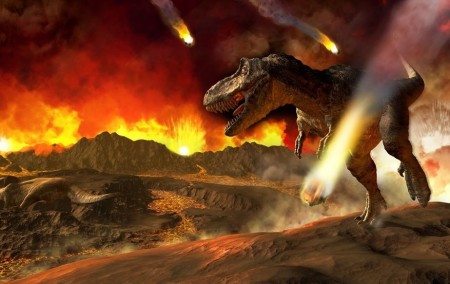
Finally, about every 15 million years we see a space rock equivalent to a dinosaur killer. These are rocks with the potential to wipe out much of life on Earth.
A recent study describes a period in Earth’s history in which city-sized asteroids struck our planet at frequency rates far greater than anything recent in the geological record. Between 2.5 and 3.5 billion years ago, these space rocks, the size of cities and larger continuously pummeled Earth. These were rocks equivalent or greater in size than the asteroid of the Cretaceous-Paleogene event that formed the Chicxulub Crater in the Yucatan. We still see evidence of these impactors on the lunar surface which was equally bombarded during that period and also received post-impact debris expelled into space from Earth. The remaining evidence here are spherules, molten glassy globs embedded in ancient rocks. The rest has worn away over time.
So how can we defend the planet from a future space rock strike as menacing as the one that took out the dinosaurs? NASA and JPL have a plan that will begin to unfold this fall with the launch of the Double Asteroid Redirection Test (DART).
DART will target a companion moonlet of the near-Earth asteroid, Didymos. The asteroid spans 780 metres (2,500 feet). Its moonlet is 160 metres (over 500 feet), more typical, states NASA, of the types of rocks that have struck Earth in the past. DART will crash into the moonlet. It is a kinetic energy weapon that will intercept its target in September 2022 with the asteroid about 11 million kilometres (6.8 million miles) from Earth. The impact speed will be 6.6 kilometres (4.1 miles) per second and the results should be captured by DART’s onboard camera with the signal beamed to Earth. In addition, Earth-based telescopes will monitor post-impact results which NASA hopes will show a small change to the moonlet’s orbit increasing it by several minutes.
As critical as DART will be in the evolving plan to defend Earth, it only works on potential impactors we can detect while still far away. We know of at least one recent space rock, however, that arrived here on Earth virtually undetected. That was the estimated 17-metre (56-foot) space rock that weighed 10,000 metric tons and travelled at a speed of 17.88 kilometres (11.11 miles) per second before exploding and breaking up over the Russian city of Chelyabinsk in February 2013. It came out of nowhere and had never been tracked because its orbit was atypical.
Another concern we will need to address is probably still decades away when commercial space mining operations begin to exploit the potential riches found within space rocks. Asteroid mining is seen as being worth tens of trillions of dollars.
An unintended consequence could be the altering of the orbit of one of these asteroids during a mining operation. What miners will need to ensure is they don’t cause a change that could send pieces or the entire asteroid on a collision course with Earth. Because the most likely mining candidates will be near-Earth asteroids and not those in the Asteroid Belt between Mars and Jupiter, the risks of such an accident are that much greater.
That risk is the subject of a conference paper presented at the 7th IAA Planetary Defense Conference, held in April of this year, in Vienna, Austria, where authors Aaron Boley and Michael Byers, from the University of British Columbia, describe a need to actively manage asteroid orbits as a precautionary principle.
]]>What I’m talking about is the results of a newly published research paper entitled, “Global Climate Change Driven by Soot at the K-Pg Boundary as the Cause of the Mass Extinction.” The story of the end of the age of dinosaurs has become well established in the last several decades as uncovered geological evidence points to a significant asteroid impact occurring near the present-day Yucatan Peninsula in Mexico. The impact is believed to have caused enough ejecta to block sunlight in the atmosphere interrupting photosynthesis in plants and leading to a mass die off. The discovery of a layer of iridium deposited in a thin layer marking the Creataceous/Paleogene boundary has been the smoking gun of this hypothesis.
But the new research adds another factor. The impact site is an oil-rich area and the asteroid’s impact and disintegration not only released vast quantities of its own material but also vaporized enough of the Earth’s crust to introduce sooty aerosols in the atmosphere which spread globally. The presence of particulate matter in significant concentrations caused global cooling, more significant in polar and mid-latitude regions, and milder cooling and drought in lower latitudes. The research hypothesizes that photosynthesis would have ceased on land as well as in the oceans within a few months and persisted for several years. Ocean surface temperatures would have dropped as well. These events induced both terrestrial and marine extinctions with the latter happening later than the former, a matter of just a few years delay.
The study describes a significant increase in infrared radiation as ejecta from the site of impact would have temporarily reached into space before falling back to Earth. This would have ignited fires in the oil-rich strata of the crater and released hydrocarbon aerosols as opposed to what previous paleoclimatologists surmised. The older theory of the extinction event describes the impact causing sulfuric acid aerosols leading to global darkness and an equivalent to a nuclear winter accompanied by acid rain. The new theory of hydrocarbon aerosols, state the researchers, explains why crocodilians, turtles and many other animals, including birds and a number of mammals made it through and soon dominated the land, water and air.
So where is the evidence of a hydrocarbon soot to be found? The scientists found incomplete combusted hydrocarbons in coarse-ejecta beds in Haiti and Spain. These were in proximity and lay above the iridium layer of ejecta from the asteroid itself. The composition of these hydrocarbon sediments forming a black carbon includes coronene, benzopyrene, and benzoperylene (see graph reproduced from the study below).
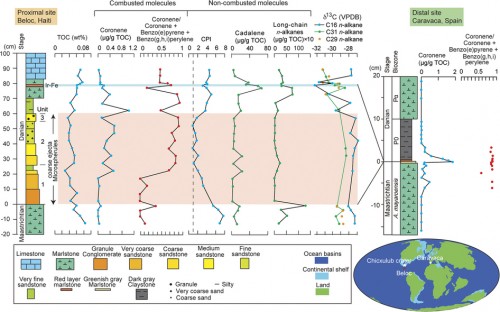
These hydrocarbons are similar to ones found in rock at the crater impact site. The particular hydrocarbons indicate extensive combustion. The depth of the deposits found in association with the iridium layer at one of the sampled sites varies from 2 to 4 centimeters, and at other sites further from the impact crater dissipate. From measuring these sampled sites the researchers have calculated that the total amount of black carbon ejecta amounted to between 500 and 2,600 teragrams which equals between 551 million and 2.9 billion tons. And although the researchers believe the lower figure of ejecta would not lead to a dinosaur extinction event, the upper number when entered into climate models would be consistent with their demise along with significant marine extinctions.
The prior nuclear winter scenario of prolonged darkness, the researchers argue, would have led to much more significant extinctions including crocodilians, birds and mammals. But that didn’t happen. Hence the black carbon soot-aerosol explanation is a better fit for what actually ensued.
Recently I wrote about short-lived climate pollutants of which black carbon was one. The appearance of this research paper in juxtaposition with that posting makes this cause of extinction relevant to us in our contemporary world where we humans are producers of soot-aerosols that are contributing to climate change. So maybe we can learn something from history, after all, even one 65 million years in the past.