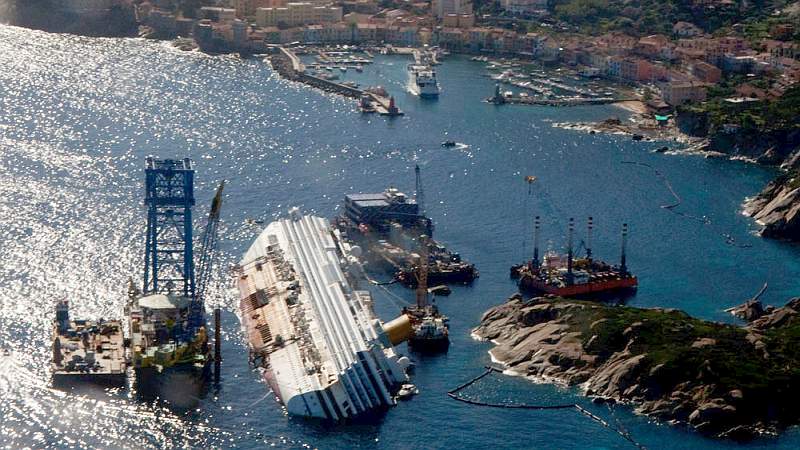
Tomorrow begins the final operation to remove the 290 meter (950 foot) vessel, 114,500 tons, more than twice the size and weight of the Titanic, from the rocks upon which it settled on January 13, 2012. Of the more than 4,000 passengers on board, 32 died. Nothing can be done for those who lost their lives but at least the ship can be removed from the watery grave where they lost their lives.
The Costa Concordia salvage operation has been ongoing for more than two years and has involved a parbuckling process on a scale never conceived before. It includes building a platform near and under the ship, attaching flotation tanks to the ship sides, righting the vessel to a vertical position, and refloating it off the rocks before towing it away.
All of this technology had to be installed on site and custom designed. Some had been applied to previous shipwrecks but much of the technology had to be developed from scratch. The company chosen to accomplish this enormous task is Titan Salvage, an American leader in salvage operations.
Before Titan could begin its work the remaining fuel on board the Costa Concordia had to be removed with bunker fuel leaks contained by booms while skimmers removed as much of the fuel as possible from the vicinity of the wreck. Titan then proposed a multi-step operation involving:
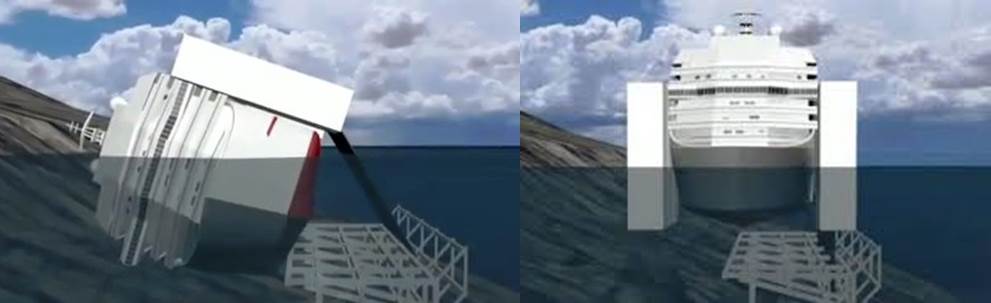
The operation was designed to minimize the environmental impact on the wreck site, the Island of Giglio. Even the water pumped from the caissons during refloating would be filtered to ensure no contaminants entered the local marine environment.
In the past we would have seen a salvage operation done on site, cutting up the ship where it lay, and possibly leaving subsurface parts where they lay. The threat of contamination to the local environment would have been significant.
But in the 21st century we have technology that allowed us to do what seems to be the impossible. We could create an accurate site map of the wreck within millimeters using sophisticated underwater scanning technologies. We could simulate the planning of the salvage operation and test various scenarios to perfect the process. We could constantly monitor the environment beginning with a baseline survey shortly after the ship tore a 70 meter (230 foot) long hole in its hull before it keeled over on its side and settled on a rock shelf. We could place monitoring sensors in the environment to do continuous sampling of ecotoxicological, hydromorphological and biological data through the entire water column and sea floor in the vicinity of the wreck. And then we could execute on the operation to the point where we have almost seen a successful completion of what seemed a near impossible task.
All of this had to be done while the ship rested on a precarious ridge of rocks while subject to the changing weather, waves and tidal action of the Mediterranean Sea for a period of more than two years.
Could we have accomplished such an operation in the 20th century? Not a chance. Let’s hope we don’t have to be so creative with 21st century technology for a future wreck.
If you think of the most recent disasters that made headlines in 2010 and 11 you can begin to envision how robots can play a part in prolonging life in emergencies. From the earthquakes in Haiti and South Island, New Zealand, to trapped miners in Chile, the tsunami in Japan, and most recently the foundering of the cruise ship, Costa Concordia, engineers get inspired to come up with new ways of supplementing human intervention and rescue efforts using robotic systems. In some of these recent tragedies robotic devices were deployed. But that is not the only use for robots in emergency medicine.
The Robot Will See You Now
Robots are used in emergency medicine in many ways. One is as patient screening tools, marrying robotics with computing science. Hospital emergency rooms represent bottlenecks with patients spending long hours waiting for a doctor or nurse. Shortening the wait times using a triage robot has inspired engineers at Vanderbilt University to develop TriageBot,

A smart kiosk, TriageBot takes a medical history, measures vital signs and detects problems. The robot prioritizes patients based on severity of symptoms and history and can connect to on site staff even outside the emergency department should they be needed. The form of TriageBot is still under development. It could look like the fanciful and friendly robot displayed above or resemble an airport check-in terminal, or it could be built into a hospital waiting room chair. Designed to continuously monitor the patient before being seen by a member of the medical team, TriageBot represents an innovative use of robots in hospital settings.
But not all emergencies happen in the waiting room of hospitals. TriageBot systems when hooked up to a telecommunications network can provide both screening as well as monitoring of patients in remote areas. As the software evolves this type of emergency medical robot should prove invaluable.
The Japanese have a way with robotic systems and not to be outdone, Kyushu University has been experimenting with a robot prototype mobile monitoring system. (Click on the hyperlink in the last sentence to watch the movie. Although the narrative is in Japanese, you quickly get an understanding of how this apparatus works.)
Built for AICHI Expo 2005 this mobile chair features remote control driving done by emergency medical staff off site, vital signs monitoring, emergency first aid and even a defibrillator. The remote operator can talk and see the patient, communicate with bystanders and give them information on how they can help a person having a seizure, fainting or heart attack.
The Robot Will Find You Now
CRASAR is the Center for Robot-Assisted Search and Rescue at Texas A&M University. On its website it lists participation in using rescue robots going back to the collapse of the World Trade Center buildings in 2001. One area of development focuses on using robots as human proxies to provide communication with a trapped person that cannot be reached immediately after a disaster.
Survivor Buddy can work with medical staff to interact with a survivor during the period when help is not yet able to extricate the person. The robot includes a monitor that displays non-verbal human attributes by rotating and moving in a human-like way.
Sandia National Laboratories have been working on robots that can deliver food, water, oxygen and medical supplies to trapped miners underground while encountering environments that could prove lethal to human rescue workers. Designed to withstand flooded areas and explosions from pockets of methane gas the Gemini-Scout Mine Rescue Robot comes equipped with a range of sensors as well as pan-and-tilt, and thermal cameras that elevate to see over obstacles. It travels on flexible treads that climb over obstacles. Using a game controller, Gemini-Scout is designed to work with first responders and can be outfitted for earthquakes, fire and other disaster scenarios.

The Snakebot employs biomimicry to do search and rescue for trapped victims of disaster. An active scope camera that slithers, this robot was used to find trapped people under the wreckage of the 2011 earthquake and tsunami that struck Japan.
But snakebots can even go beyond search and rescue. Carnegie Mellon University roboticist, Howie Choset, has designed a snakelike camera device that with 102 joints is capable of imaging and mapping internal organs such as the heart muscle. Although not a search and rescue application, these types of robot designs demonstrate flexibility with capability to serve multiple biomedical applications.
Nowhere have emergency medical robots been studied more than in the military where they are seen as extraction and evacuation tools that reduce collateral casualties. The United States military increasingly uses robots in all of its field operations including drone aircraft as surveillance and strategic strike weapons, as well as robotic land vehicles. With the goal of having 1/3 of its land vehicle fleet unmanned by 2015, robotic medical evacuation will become a common feature. The American army is testing both robotic evacuation and extraction vehicle technology to move patients from fire zones to hospitals. This includes using humanoid robot designs like the one pictured below.

Using robots capable of picking up an injured soldier on a battlefield represents a way of reducing deaths associated with casualty recovery operations.
The military is also testing unmanned aerial systems that can land and working with casualty extraction robots, remove wounded soldiers from environments where radiation or toxic gas would make it impossible for human intervention. Unmanned aircraft are also being tested to provide surveillance and medical response. To provide the human touch, robot extraction systems include telepresence so that a soldier remains connected to a medical support person even though they are not physically on site.
In our next blog we look at the emerging field of robot exoskeleton technology and its biomedical uses.
]]>

