It should be no surprise, therefore, that Polman in the last week called on all companies to do climate change reporting as a mandatory part of their business and that companies need to hold each other to account to ensure the goals of the Paris COP21 climate agreement are met.
Disclosing climate change risk has not come easily to many corporations. In the United States Boeing, General Electric, Procter & Gamble and many others disclose no or limited information on climate change in their regulatory filings. This is despite regulations that specify companies must provide details on significant risks to their operations. ExxonMobil is probably one of the most noteworthy of the companies choosing to mislead its shareholders about climate change risk. In recent disclosures the company has been cited by government prosecutors and attorneys general for hiding evidence of global warming’s anthropogenic cause allegedly known to the company since its own scientists reported it internally as early as the 1970s. Of the oil giants ExxonMobil doesn’t stand alone in ignoring its risk reporting responsibilities. Chevron, ConocoPhillips and others have been equally remiss in telling the truth in public filings.

Unilever under Polman’s leadership (he came to the company from Procter & Gamble in 2009) has set out in its strategy to use 100% renewable energy in its operations by 2030. Waste reduction to eliminate product contribution to landfill has become a company mission. Polman hasn’t completely transformed Unilever. The company’s legacy of Bhopal India in 1984, when 3,800 died and many thousands more succumbed later to the isocyantate gas leak at a pesticide plant, continues to linger.
Polman talks about corporate social license and that “companies must look to increase their positive social impact as integral part of their core business strategies.” He argues that, “the very essence of capitalism is under threat as business is now seen as a personal wealth accumulator. We have to bring this world back to sanity and put the greater good ahead of self-interest.” In his call for mandatory climate change risk reporting Polman is taking a business leadership role. It should be hard to ignore the CEO of a company with a market capitalization of $142 billion one would hope. The company is ranked 41st on Fortune’s annual list of most admired corporations.

In North America the number of companies assuming a price on carbon has risen to 97, double the number from the previous year. And companies are not just following the guidelines of the states and provinces in which they reside. Where carbon is priced at $15 a ton in Alberta and $30 in British Columbia, some energy companies are doing financial planning that forecasts carbon to rise from $65 to $125 a ton in the near future. Enbridge for one has forecast a future in which carbon pricing will reach $200 per ton.
It is expected that another 583 companies plan to join the existing ones in the next two years creating internal carbon pricing whether governments choose to implement a carbon tax or not.
What is interesting is that the companies are ahead of countries in recognizing that carbon needs to be priced. Carbon taxes have yet to be adopted by most national jurisdictions even though the Paris climate talks are just a few months away. Those that have some form of levy at the national level include Costa Rica, South Africa, Denmark, The Netherlands, Norway, Slovenia,Switzerland, Ireland, Chile, Sweden, Finland, the United Kingdom, and New Zealand. India levied a tax on coal in 2010, not on carbon. it amounts to 50 rupees a ton which is inconsequential. Carbon cap and trade systems have been implemented in California, Quebec and in the very near future Ontario.
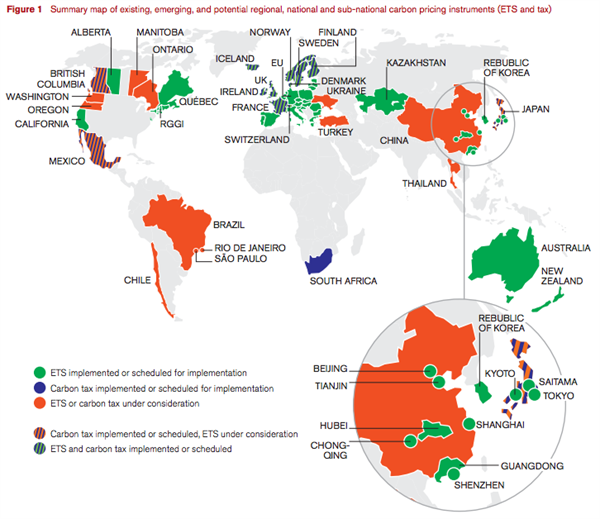
The European Union has also instituted a cap and trade system but not all European Union countries have instituted carbon floor pricing. So it seems that corporations acting in their best interest and that of society are beating governments to the punch.
Mind you not all. Here are three exceptions.
Exxon-Mobil – in the latest revelations it has been disclosed that Exxon knew about global warming and the role fossil fuels played in creating it based on internal research dating back to 1981. Yet the company chairman recently mocked climate models as unreliable in his most recent message to shareholders. Internally Exxon puts a price on carbon. They just speak out of both sides of their mouth when looking at their role as a fossil fuel producer and the relationship this has to global warming.
Royal Dutch Shell – has produced internal documents for business guidance in which the company forecasts a 4 Celsius (7.2 Fahrenheit) global temperature rise and intends to operate within this context. Shell has been given permission by the American government to drill for oil in the Arctic and the company sees nothing wrong with continuing business as usual with no thought of consequences. Shell too has put a price on carbon, $40 per ton, but it seems the company has no concern about its actions in contributing to global warming through aggressive exploration and exploitation of remote fossil fuel sites. It seems totally incoherent to be pursuing more fossil fuel development knowing the accepted 2 Celsius limit that the world is attempting to achieve isn’t even a thought for Shell.
British Petroleum – is known in Europe as the climate policy wrecker, lobbying the European Union at every chance to stop any action on climate change. BP is described by some as being the strongest advocate for “dirty energy” and opposed to any carbon levies. BP has pushed the European Union to scrap renewable energy and energy efficiency targets. It has pushed natural gas as the answer to Europe’s energy needs while trying to stop the expansion of wind and solar projects. And BP internally has adopted a $40 a ton carbon price. It just doesn’t seem to want to acknowledge that with pricing should come action to reduce carbon emissions.
All three of these companies use carbon pricing as a project means test – whether future investments remain profitable if and when they pollute the air. Not exactly corporate social responsibility.
]]>
In my experience with IKEA I questioned their excessive packaging. I had concerns about where the company sourced its wood products and if the forestry being practiced worked on a sustainability model. I found out that I wasn’t alone in expressing these concerns. The company’s own internal polling showed that only 41% of its customers thought it was both socially and environmentally responsible. That was well below a company goal of 70% by 2015. But even if a majority of customers thought IKEA was not quite up to the standard of being socially and environmentally responsible, it didn’t stop them from coming back. Last year alone the company global revenues approached 30 billion euros.
But this week CEO, Peter Agnefjall, announced a global corporate initiative to tackle climate change and challenged other companies to do the same. Agnefjall stated it was no longer going to focus on getting better polling data from customers about its image but instead would aggressively help to combat global warming. In the end whatever IKEA did would not impact prices to customers. It would, however, in the words of the CEO, be “good for customers, good for the climate and good for IKEA too.”
The equivalent of $1.13 billion U.S., 1 billion euros will be spent. How?
The company in making its corporate social and environmental responsibility pledge intends to put in place sustainable forestry practices by 2020. Today lumber in IKEA products comes largely from 5 countries: Poland, Lithuania, Germany, Russia and Sweden. By 2020 every tree harvested in these places will be replaced.
IKEA has also undertaken a sustainable cotton initiative in partnership with the World Wildlife Fund. It is helping more than 100,000 farmers in India, Pakistan, China and Turkey to implement sustainable farming practices including halving the amount of water consumed to grow cotton, and reducing pesticide, herbicide and chemical fertilizer use. These practices have resulted in reduced costs and greater income for the farmers.
IKEA is also tackling packaging in an effort to eliminate unneeded material and therefore reducing CO2 emissions. It is also tackling transportation CO2 emissions by becoming more efficient in the way trucks, trains and ships receive and deliver products. Wooden pallets have been replaced with space-saving and lighter paper pallets. Fill rates in containers and trucks have less air and more product increasing from 63 to 70%.
To reduce CO2 emissions from customers coming by automobile to IKEA warehouses the company is making increasing investments in eCommerce for online purchases, and providing home delivery wherever it operates so that customers don’t have to make the drive to buy IKEA products. And more and more IKEA is offering shuttle services in cities to bring customers and not cars to their warehouses. Those buses are powered by biogas made from cafeteria waste in IKEA stores.
IKEA’s Chief Sustainability Officer, Steve Howard, (one wonders how many companies have a person with this type of title today) is quoted in the British Financial Times stating, “carbon is a significant risk so if you can eliminate that risk, or a good share of it, that’s a good thing….if every business and organization did what we did, we would flip electricity generation into being renewable-based by 2020 or shortly thereafter.”
Calling on many more companies to emulate IKEA’s initiative and investment in carbon reduction.


