The Mainz researchers in studying paleoclimates came across two climate change events. The first was the Paleocene-Eocene Thermal Maximum (PETM) which occurred 55.9 million years ago when global average temperatures rose 5 to 8 Celsius (9 to 14 Fahrenheit).
They describe what occurred in findings recently published in the journal Nature Geoscience. The paper describes the significant environmental changes that occurred during the PETM including rapid atmospheric warming, ocean acidification, and changes in the water cycle leading to a mass extinction event in the deep ocean, and major changes to ocean surface biology.
PETM had a rapid onset phase coinciding with significant increases in volcanic activity and persisting for 200,000 years. The volume of greenhouse gasses (GHGs) entering the atmosphere included massive amounts of carbon dioxide (CO2). PETM was followed by failry rapid climate cooling.
The mechanism for this restoration to cooler times is linked to evidence the Mainz researchers found in silicate rocks which at the time showed high levels of chemical weathering occurring during and after volcanic activity. The weathering appears to have been facilitated by acid rain.
Why was the rain acidic? Because it contained high levels of CO2. Meanwhile, the warmer conditions establsihed by the high levels of CO2 in the atmosphere caused precipitation amounts to exceed the norm which then accelerated the weathering. Leached minerals containing lithium, calcium, magnesium and more combining with carbonic acid rain entered the oceans to form insoluble limestone. The CO2 was permanently sequestered in the rock. The cooling followed. Philip Pogge von Strandman, a professor at Johannes Gutenberg University Mainz calls the PETM event a lesson to learn about natural climate control mechanisms.
The Mainz researchers compared the PETM event to a similar period of heightened volcanic activity that occurred 15 million years later. It also led to another spike in atmospheric CO2 and a period of global warming. Called the Middle Eocene Climatic Optimum (MECO), it lasted twice as long as the PETM event. The cooling also took much longer.
The Mainz University researchers wanted to know why these two climate events differed. They were able to pin the differences on changing natural conditions in the 15 million years between the two events. At the time of MECO, the fossil record shows extensive rainforests covering most land surfaces. More vegetation meant increased soil. That meant less weathering of rock surfaces, and where chemical weathering occurred, the soils absorbed the leached minerals. The evidence during MECO is heavy clays throughout the fossil record. With fewer minerals ending up in the ocean, less limestone was created. The CO2 contained in the acid rain instead contributed to ocean acidification with some of the gas returning to the atmosphere through evaporation. That’s why after MECO global atmospheric temperatures stayed warmer longer.
The differences between the two climate events led Pogge von Strandman and his fellow researchers to suggest a potential way to deal with our present elevated levels of atmospheric CO2. They could recreate the weathering observed during the PETM event by plowing finely crushed rock into fields. If the crushed rock dissolved over time then it would mimick what happened during the PETM event. But if the minerals in the rocks got trapped in the soils, then the results would be similar to the MECO event.
Mainz University isn’t the only place where crushed rock being added to soil was being studied to remove CO2 from the atmosphere. As I researched background to this posting I came acrosss a University of California Davis and Cornell University study that appeared recently in the journal Environmental Research Communications. The researchers there were field testing adding crushed silicate rocks to soil to see if it would remove CO2 from the air. In their experiments carried out over three months during a period of extreme drought in California, they showed a 2.6 to 2.9-fold increase in bicarbonate creation within the soil, suggesting enhanced weathering even in low-moisture environments removed CO2 from the air. No deluge of acid rain was needed to create these results.
So maybe, we can learn from paleoclimate events how to deal with our present climate change crisis. Just how much rock will be needed to drawdown a megaton or gigaton of CO2? It would be interesting to do the math.
]]>The key is shrinking the battery elements to nanoscale so that by the time you plug the recharge cable into a power outlet the charge is instantaneous. The architecture is based on block copolymer self-assembly. Joerg Werner, a lead author of the article, proposed to take work he was doing on “self-assembling filtration membranes” and applying “the same principles to carbon materials for energy storage.”
In an article appearing in the May 16, 2018 issue of the Cornell Chronicle, Tom Fleischman describes just how the nanotechnology of the battery’s architecture was conceived.
“The gyroidal thin films of carbon – the battery’s anode, generated by block copolymer self-assembly – featured thousands of periodic pores on the order of 40 nanometers wide. These pores were then coated with a 10 nanometer-thick, electronically insulating but ion-conducting separator through electropolymerization, which by the very nature of the process produced a pinhole-free separation layer.”
The nanofabrication technology currently is in proof of concept is not without potential problems. It appears that discharge and recharge cycles gradually degrade making parts of the battery inaccessible for reuse. But the promise of a lithium-ion battery that charges in seconds makes this work at Cornell exciting. So much so that the engineers involved have applied for a patent.
If the proof of concept can turn into a real product this means lithium-ion batteries because of the nanoscale architecture can decrease in size by orders of magnitude. And at the same time, the instant charge capability will alter consumer electronics, sensors, electric vehicles, the power industry, robotics, and any other industry sector where instantaneous energy from stored devices would be advantageous.

What’s involved?
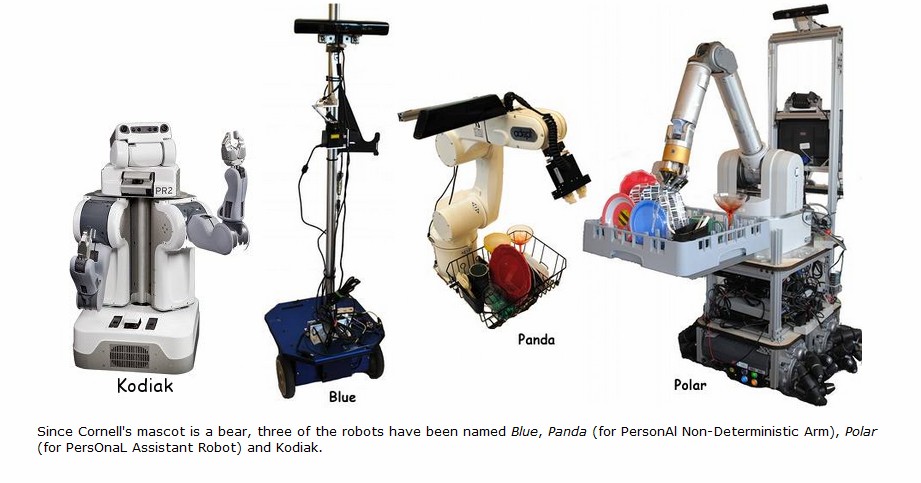
These are just three of the many attributive projects the Learning Lab is tackling using Kodiak, Blue, Panda and Polar, the current test robots, seen in the videos in the links provided, being put through their paces by the team led by Ashutosh Saxena, an Assistant Professor and Microsoft Faculty Fellow at the university. The ultimate goal will be the creation of robots that operate autonomously in unstructured environments.
In tests so far the robots have made correct predictions 82% of the time when looking one second into the future. At three seconds accuracy drops to 71%, and at ten seconds, to 57%. So the Lab still has a long way to go in designing artificial intelligence that can predict human unpredictability. The key will be to develop intelligence built on observation over time and the end result will be the robot companions we have read about in works by authors such as Isaac Asimov.
To understand the implications you need to know a little more about plant anatomy and physiology. Plants use photosynthesis to harvest the energy from sunlight and CO2 and convert these two into sugar. Plants over time have evolved two different methods of photosynthesis. One is called C3, the predominant method. The other, C4, is an adaptation that gives those plants with it a more efficient production mechanism with the added benefit of being able to better deal with more intense sunlight, high levels of heat, low nitrogen soils and prolonged drought. The C3 photosynthesis mechanism evolved early in Earth’s history when there was much more atmospheric CO2 and less free oxygen. The C4 adaptation came later after C3 plants added considerable amounts of free oxygen to the atmosphere.
C4 plants feature an extra layer of bundle sheath cells encircling the core cells involved in converting sunlight and CO2 into sucrose. And C4 plants, unlike C3 produce no byproduct associated with handling oxygen that needs to be further degraded, making the latter 50% less efficient in making sucrose. And although researchers have understood the difference in the two mechanisms what they didn’t know was the underlying genetics responsible for C4. The discovery of Scarecrow means that scientists through genetic modification can begin to introduce C4 into C3 plants.
Why is this important? Because wheat and rice, two principle food staples are both C3. With 7 billion human mouths to feed today, and projections of population growth to 9.5 billion by mid-century, and with the increasing impact of global warming on weather patterns, the promise of 50% higher crop yields is significant. C4 versions of C3 plants will grow in a hotter, drier world and will need less nitrogen-based fertilizers.
For those who oppose genetic modifications to food crops, this discovery may further spook them. But I am increasingly convinced by the hard science that GMO represents a key strategy for our species as we progress through the 21st century. Without it we will find the limits imposed by changing climate and finite agricultural land a potential death sentence for billions.

]]>