When I was born in 1949 the world had less than 2.5 billion. I’m 66 and in those few short decades we’ve seen a tripling in the number of humans on the planet. This is unprecedented. The food and freshwater crises, the burning of fossil fuels, all of these issues are manifestations of a runaway growth in humanity, proving my reader’s argument he would assert.
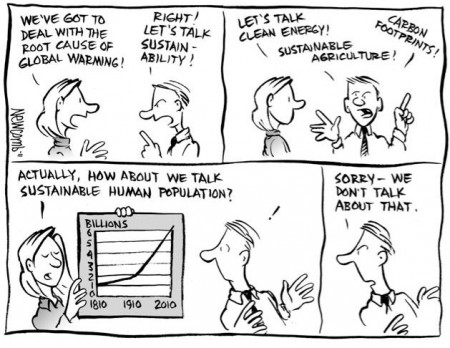
It is hard to blame national governments for wanting to eradicate disease, improve reproductive health care, and raise the quality of life for citizens. But in doing so whether in the Developed or Developing World, the results have created explosive growth in human numbers.
Back in the 1990s the United Nations sponsored a conference in Cairo to come up with answers to the Earth’s growing population. At the time governments in concert agreed to provide:
Many governments in the Developing World back in the 1990s were just beginning to see rural to urban migration within their countries. Today we are witness to this mass movement by the rural poor to mega cities. Far sighted planners thought that this alone would lead to a decrease in human population growth based a similar phenomenon observed much earlier in the Developed World with urban families having fewer children. But this is not yet observed in some Developing World states, particularly those in Sub-Saharan Africa, Central and South America, and South Asia. All of these regions are expected to contribute the greatest population growth to mid-century adding more than 2 billion of us to the planet.
Now we know that humanity is technologically ingenious. We are inventive. We can improve crop yields to feed more mouths. We can grow things on roofs, inside buildings, and even turn marginal lands into crop producing fields by applying our technological wizardry. We manipulate the genes of plants to grow more of them. We invent new medical technologies to defeat infant and maternal mortality, conquer disease, and extend our age limit. We build more energy generating plants to heat, cool, and light homes so that we can live in greater comfort. The end result is the hockey curve we see in the graph above. Far too successful for our own good!
What comes with all this ingenuity? Urban centres that are growing uncontrollably. Overcrowding, underemployment and poverty, crime and other socio-economic problems, pollution and war. Witness the increasing desire by people in many parts of the Developing World to find refuge in the Developed one – crossing the Mediterranean Sea by the tens of thousands and dying by the thousands in an attempt to flee their failed state homes.
So what is the world’s answer to the human population challenge, a measure of our technological success as a species? It certainly is not technology. The science fiction scenarios of “Logan’s Run” or “Soylent Green” are solutions that come from the darkest depths of our imagination. We cannot cull humanity or turn our surplus population into food for the rest of us.
The Worldwatch Institute with a vision focused on sustainability has on its website “Nine Population Strategies to Stop Short of 9 Billion,” the estimated mid-century population based on more “optimistic forecasts.” I say optimistic because the expected decline in birth rates from rural to urban migration has yet to happen which would suggest 9 billion is an underestimate. I share with you these nine strategies:
For humanity, what is the alternative to what the Worldwatch Institute is recommending? We can try “one child” policies like the great experiment that China underwent in the latter part of the 20th century. It certainly stabilized that country’s human numbers but it also had unintended consequences – an outbreak of female abortions and female after-birth infanticide, a society where men today greatly outnumber women, a population that by mid-century will have a disproportionate number of elderly with more than 25% over the age of 65, and a decline in the number of workers available to industry as a consequence of negative population growth.

]]>