The post Turning The Bouncy Castle Into Inflatable Concrete-Filled Homes appeared first on Techso Mogro.
]]>The inflatable is brought to a building site and blown up. Concrete is then pumped into the walls. A house constructed this way can be built in an hour at a cost that is 20% of cast-in-place concrete methods (not including the finishings). What we are talking about is $107 to $321 per square metre ($10 to $30 per square foot compared to $1,076 to $2,152 per square metre ($100 to $200 per square foot) for new construction in the U.S.
Your building framework is a flexible plastic fabric that includes an internal shell with reinforcements and three-dimensional structures. The air pump takes 15 minutes on site to inflate. The concrete then is pumped into it in a little more than an hour. The concrete used can be ready mix, air crete, sustainable cement that sequesters carbon dioxide, or other pumpable building materials. As it fills the inflatable the air holding the frame is slowly removed leaving a 4-inch-thick walled building laced with polyester threads called drop-stitch fibres. This same material is currently used to make paddle boards and kayaks because the threads provide structural reinforcement.
Once poured the inflatable can be removed, rolled up and used again. Meanwhile, the internal shell remains with the concrete curing in two days. The structure is both airtight and waterproof. It meets the highest building code standards for insulation. Finishings are then added such as flooring, drywall, electrical, plumbing, windows and doors.
Automatic Construction has plans for inflatables to be used in all kinds of building infrastructure including pools and tunnels. It sees inflatables for high-rise building construction, military installations, and even future settlements on Mars.
In an October article appearing in Fast Company, written by Elissaveta Brandon, she remarks that the world is “mired in a housing crisis…by 2030, the UN estimates we will need to build 96,000 affordable homes per day to house the 3 billion people who will need access to adequate housing.” It would seem, therefore, that the timing for this type of building solution couldn’t be better.
So far Automatic Construction has built a 9.3 square metre (100-square-foot) (seen in the picture at the top of this article), an 18.6 square metre (200-square-foot) structure and is working on a 60.4 square metre (650-square-foot) single-storey home in Upstate New York.
In its 2021 patent filing, written by Alex Bell, CEO of the company, describes the construction method as a fillable container that can be configured to suit different needs and that can include reinforcement components like rebar to be added in suitable positions as the structure is filled.
Who would have thought bouncy castles could lead to a breakthrough idea in home construction?
The post Turning The Bouncy Castle Into Inflatable Concrete-Filled Homes appeared first on Techso Mogro.
]]>The post Can We Recycle Concrete to Reduce Emissions? Researchers and the Industry Accept the Challenge appeared first on Techso Mogro.
]]>The inspiration for this discovery comes from observing how shelled organisms become fossilized over time. This natural process doesn’t require a carbon-intensive process to heat crushed limestone in the making of cement. Instead, the reaction occurs when waste concrete is exposed to water to form calcium carbonate. It doesn’t make as strong a concrete as that which is presently being used in large building construction, but it is durable and resilient enough to be used for small single-family homes.
The goal states Professor Noguchi is to increase the strength and the amount that their new production process can create. Carbon-neutral calcium carbonate concrete could be one answer for the planet in our desire to reduce greenhouse gas emissions and to lower the rise in atmospheric temperatures to keep the mean below 1.5 Celsius (2.7 Fahrenheit).
Why is concrete such an important part of our fight to mitigate global warming?
From a headline on a website come the following words:
“Global Warming Has Concrete Problem When It Comes to CO2.” Why is that? Because, if the production of concrete were a country, it would be third in CO2 emissions only surpassed by China and the U.S., and amounting to more than 2.5 Gigatons annually. Concrete produces 8% of the CO2 emitted annually into the atmosphere. That’s slightly less than emissions from agriculture.
Will concrete come up at the COP26 conference in Glasgow this coming week?
At COP24, a climate conference held in Poland, cement industry guidelines were announced by the GCCA, an organization that represents companies responsible for 30% of cement producing capacity around the world. The guidelines were designed to achieve a 2050 Net Zero decarbonizing result for the cement and concrete industry by mid-century.
The guideline document notes that its industry members have already reduced CO2 emissions in cement production by 20% over the last three decades and plan to accelerate decarbonization to achieve a similar reduction amount by 2030.
To achieve a 25% CO2 reduction per cubic metre of concrete and a 20% reduction per ton of cement by 2030, GCCA members will reduce fossil fuel use, fly ash, and other components of clinkers used in the firing of cement kilns, and increase carbon-capture (CCUS) infrastructure in 10 production facilities.
To get to 2050 there will be a lot more of the same with the wide-scale deployment of CCUS, and implementation of circular economy processes throughout the industry. GCCA members will commit to carbon pricing mechanisms to create a level playing field for the industry. In addition, the industry will prioritize the use of waste and by-products as alternative fuels and materials, will implement a ban on concrete in landfills, and promote the collection, sorting, pre-treatment, recovery, recycling and co-processing of cement and concrete waste.
The GCCA will advocate standards for the adoption of low-carbon cement and concrete products using new chemistries and compositions. That’s one of the areas where Maruyama and Noguchi’s research may pay off big time. (The other impact will be on the reusability of demolished concrete).
A national greenhouse gas accounting and lifecycle analysis mechanism will be implemented for natural CO2 uptake in concrete over its lifetime and at the end of life through recarbonation into permanent CO2 sinks. And finally, the GCCA wants to implement standards for energy performance in buildings that take into account properties such as thermal mass.
Achieving a limited rise of 1.5 Celsius to global mean atmospheric temperatures means business as usual is no longer an option. This is as true for concrete and cement makers around the world as it is for those who produce fossil fuels. One hopes that the latter can take inspiration from the former in making similar commitments to help mitigate anthropogenic causes for global warming.
The post Can We Recycle Concrete to Reduce Emissions? Researchers and the Industry Accept the Challenge appeared first on Techso Mogro.
]]>The post A New First: A 3D-Printed Concrete Bridge Using No Steel Reinforcements appeared first on Techso Mogro.
]]>Striatus measures 12 by 16 metres (40 to 52 feet) and is constructed using a combination of concrete blocks and 3D-printed concrete. Its designers note that it is the geometry of the design that provides its stability.
Professor Philippe Block of ETH Zurich states, “the name Striatus reflects the bridge’s structural logic and fabrication process. In arched and vaulted structures, material is placed such that forces can travel to the supports in pure compression. Strength is created through geometry, using a fraction of the materials used in conventional concrete beams. This, furthermore, opens a breadth of opportunities to build with lower-strength and in a more ecologically friendly way.”
Unique to this structure which uses no mortar, is the ease in which it can be deconstructed and reassembled at a different location. If no longer needed, the materials can easily be separated and recycled.
The use of 3D printing for the bridge doesn’t follow what we normally think of when looking at additive manufacturing processes. The material used, the concrete ink has been developed by Holcim, a building materials and solutions company that is a leading supplier of cement, aggregates, ready-mix concrete, and now low-carbon material solutions.
CEO of Holcim, Jan Jenisch, notes in a media release that the bridge “was designed by some of the best architectural and creative minds in their fields. It demonstrates the infinite possibilities of 3D Concrete Printing to enable more sustainable, faster and effective building structures, without compromise on aesthetics and functionality. Its digital and circular design uses concrete at its best, with minimal material use and blocks that can be repeatedly reassembled and infinitely recycled.”
The concrete ink was custom-made by Holcim’s research team. It is among a generation of new inks for 3D printers that are a part of the company’s green building solutions which include ECOPact green concrete, ECOPlanet green cement, and recycled construction and demolition waste.
Holcim’s ink recently was used in the construction of a 3D-printed school in Malawi. The walls for the building were erected in 18 hours using 70% less material than if traditional concrete construction techniques were used. Holcim’s concrete inks are also being used to increase the height of wind turbine towers to harvest more energy, partnering with GE Renewable Energy and COBOD, a designer of 3D printers for the construction industry.
If you plan to visit Venice, you have up until November of this year to see Striatus in the Marinaressa Gardens on display during the Venice Architecture Biennale. My guess, it will be deconstructed and recycled after the event.
It was interesting to see the announcement of Striatus, shortly after a 3D-printed steel pedestrian bridge made its debut mid-month over the Oudezijds Achterburgwal canal in Amsterdam.
The trend to 3D-printing using a range of materials now seems well established in architecture and construction. I suspect we will see many more novel materials emerge for builds as this technology matures.
The post A New First: A 3D-Printed Concrete Bridge Using No Steel Reinforcements appeared first on Techso Mogro.
]]>The post Concrete is the Second Most Consumed Material on Planet Earth and an Enormous Contributor to Global Warming appeared first on Techso Mogro.
]]>No other Earth material usage matches these two. But unlike water which is essential to life on Earth, concrete materials have a Jekyll and Hyde relationship with us. The Jekyll side of concrete is its use in almost everything humans build on the planet. Its Hyde side is the amount of greenhouse gas emissions created when we produce it.
Today’s process of producing concrete begins with the mining of raw limestone and clay which is then crushed, mixed with other materials and then fed into kilns to be heated to 1,450 Celsius (2,640 Fahrenheit) degrees. The output yields clinkers, a greyish chunky output that is cooled, ground, and mixed with additional limestone and gypsum to make the raw cement that goes into concrete. The industrial process produces lots of carbon dioxide (CO2) amounting to 8% of total greenhouse gasses emitted into the atmosphere today.
For those who raise the issue of water vapour being a far more visible greenhouse gas, it should be noted that Earth’s atmosphere long ago accommodated the water cycle. What the atmosphere, in accommodating today’s industrial emissions, is doing is heating up with concrete representing number four in the list of biggest greenhouse gas sources, trailing only coal, oil, and natural gas.
Concrete producers are well aware of the Paris Climate Agreement and the goal of countries and the industry to achieve net-zero emissions by 2050 and to be in negative emissions after that to draw down on existing CO2 in the atmosphere. What that means is a dramatic change in every aspect of the production process. Retrofitting older cement plants to burn blue and green hydrogen as fuel for kilns is one solution. Capturing CO2 is another.
A company based in Canada has made CO2 part of its end product. CarbonCure Technologies’ recipe for concrete turns its finished concrete blocks and pavers into a carbon sink. Another company, HeidelbergCement, a German company recently announced plans to build the first CO2-neutral cement plant in the world to be located in Sweden and operational by 2030.
The alternative to these types of solutions is for architects and builders to stop using concrete materials which would be better for the atmosphere, but for the industry, disastrous.
But what about all those concrete buildings and structures already in existence? Is there something that they can do to contribute to achieving a low-carbon future? Researchers may have come up with just the right idea: to turn concrete into rechargeable batteries.
Using concrete to store electricity is an idea that is gaining ground and although the material is far less efficient in storing electricity than traditional chemical and solid-state batteries, its abundance makes it a very attractive option. What would be great is to be able to turn existing concrete building inventories into battery storage for renewable energy producers. Imagine a building with solar arrays pumping out electricity and its concrete walls acting as battery backup when the sun is no longer shining.
We are not there yet, but Emma Qingnan Zhang and Lu-Ping Tang, of the Division of Building Technology, Department of Architecture and Civil Engineering, Chalmers University of Technology, in Gothenburg, Sweden, have a cement-based battery with energy densities of 7 Watt-hours per cubic metre. To use cement as a battery the researchers have incorporated anodes of iron and zinc, and cathodes of nickel-based oxides along with carbon fibres into the mix. And although their battery doesn’t generate a lot of power when compared to chemical and solid-state ones, with concrete as a primary construction material, turning buildings into storage batteries while serving as living accommodation would be a game-changer.
The post Concrete is the Second Most Consumed Material on Planet Earth and an Enormous Contributor to Global Warming appeared first on Techso Mogro.
]]>The post Headlines: The Secrets of Roman Concrete Finally Revealed After 2,000 Years appeared first on Techso Mogro.
]]>Geologists and engineers, however, are finally unlocking the secret of Roman concrete.
The Romans made concrete by mixing lime with volcanic rock and seawater. The mineral characteristics of the rock contained pozzolan, a substance derived from volcanic ash. Pozzolan today can be found in lots of places around the globe.
In addition the binder in Roman concrete contains a substance given the acronym CASH, standing for a combination of Calcium, Aluminum, Silicate and Hydrate.
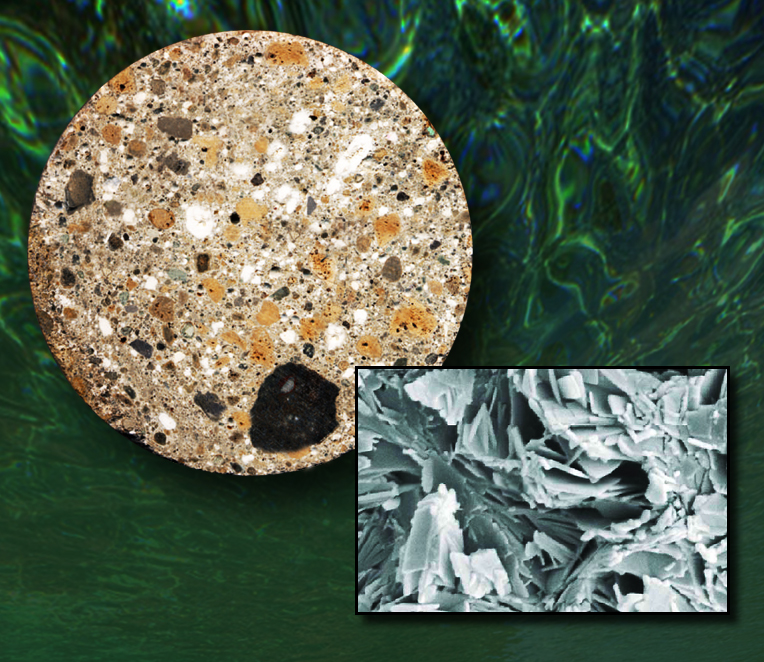
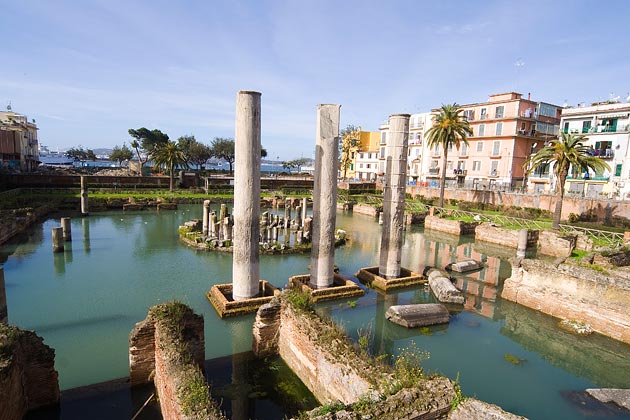
The researchers, in extracting a core from a 37 B.C.E. concrete breakwater found in the port of Baiae, Bay of Naples, across from Mount Vesuvius, found aluminum-tobermorite crystals. The crystals appear to have formed as the concrete was set by Roman engineers when poured into wooden forms. It is these crystals that produce the concrete’s superior quality. You can see them in the electron-microscope inset image on the right taken from the core. The latter appears to the left in the image below.
Other unique characteristics of Roman concrete:
Back in February concrete was the subject of one of my blog posting in which I talked about concrete and climate change. In that posting I indicated that today we produce 12 billion tons of the stuff annually and that concrete is the third largest contributor of human-produced greenhouse gases on the planet today. That 12 billion tons number may be low balling it. In the latest information I have read the number is more like 19 billion tons. That’s a lot of concrete accounting for 7% of the CO2 industry puts into the air annually.
What Rome’s engineers produced, however, has not only stood the test of time, but also may be one answer in our current quest for a sustainable, greener future.
The post Headlines: The Secrets of Roman Concrete Finally Revealed After 2,000 Years appeared first on Techso Mogro.
]]>The post Headlines at Techso Mogro for March 29, 2013 appeared first on Techso Mogro.
]]>In this week of personal upheaval what were the headlines that caught my eye?
How Can I Not Own My DNA?
Interesting question but apparently companies have filed more than 40,000 patents related to the human genome. In a published report on March 25 authored by Dr. Christopher Mason of Weill Cornell Medical College, and Dr. Jeffrey Rosenfeld of the University of Medicine & Dentistry of New Jersey, they reported that the entire human genome has been patented by for-profit companies. Of these DNA patents, 41% cover long sequences and whole genes.
The U.S. Supreme Court will be reviewing genomic patents in an upcoming hearing on April 15 related to ovarian and breast cancer gene discoveries. If the Court upholds the company patents it will mean you and I no longer own our own DNA and that any business that finds a useful application from genetic research will have more rights than we do. The implication of such patents will be profound for doctors and patients who are fighting diseases. Imagine having to get permission from a company to do a medical test for a cancer that infringes on one of these patents? The cartoon by Cathy Wilcox says it all.

Connectivity Everywhere as 1 Billion Devices Shipped in 2012
According to IDC latest estimates for 2012, shipped PCs, laptops, tablets, and smartphones surpassed 1 billion units globally and estimates by 2017 predict that number to grow to 2.2 billion (see the chart below). This revolution in ubiquitous computing and communication is driving innovation right around the planet. And what is so interesting about the trend is the move to smaller high-powered devices like smartphones with significant growth in the Developing World. Who are the businesses delivering the technology for this incredible growth? Number one and two are Samsung and Apple.

Clinical Trials Using Modified T Cells Destroy Leukemia
Re-engineered immune cells to attack chronic lymphocytic leukemia (seen in the image below) are proving to be therapeutically effective in destroying cancer cells according to a five-patient clinical trail reported in the journal Science Translational Medicine.
What’s involved? T cells are extracted, genetically modified and then re-inserted into a patient. The engineered modification tricks the T cell to identify a protein and receptor found in the cancer cells. So far all patients in the study experienced rapid clearing of the cancerous tumors. Doctors believe that this approach is very promising for chronic leukemia but still aren’t certain it will be as effective on acute lymphoblastic leukemia. The next step is to widen the clinical trials to more cancer centres.

Will Fast Growing China Witness the Collapse of Some of its Tallest Buildings?
According to a report in Wired in the last week there is a growing concern that the concrete being used in Chinese construction may prove to be the undoing of a number of buildings in major cities throughout the country. The culprit can be found in the sand used to mix concrete.
The recipe for concrete, a Roman invention going back over 2,000 years, is straightforward. You take cement, aggregate (sand, gravel and crushed stone) and water and mix them all together. The proportions are critical as is the quality of the aggregate. And the latter is what is in question.
Inspections by state officials are finding unprocessed sea sand in a number of buildings and untreated sea sand in concrete can lead to a building becoming dangerously unsafe within a couple of decades. When you consider that China plans to be topping off a new skyscraper every five days between now and through 2014 you can imagine the potential danger that lurks in the near future for those who occupy these buildings.
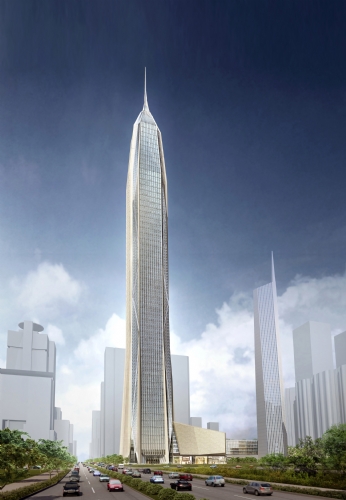
One of the new skyscrapers, the Ping An Finance Center in Shenzhen has had construction halted because testing has revealed sub-standard sea sand concrete has been used. The Ping An building (seen below in architectural drawing) was to top out at 660 meters, the second tallest building in the world.
Is There Money to be Made Bringing Extinct Animals Back to Life?
De-extinction is a new term, and a new start up company named Ark Corporation is out to make the term part of everyday conversation.
In a video posted on YouTube entitled Are We Playing God? various talking heads discourse on the subject.
The company has been co-founded by Robert Lanza and George Church, both experts on DNA and stem cells. The de-extinction, that is, the idea of reviving extinct species, could bring back the Woolly Mammoth, or the Passenger Pigeon (seen below). The key to doing this is to harvest DNA from well-preserved specimens that could then be cultured and implanted in a surrogate species to incubate and birth. The technology is very similar to cloning.
But why would we do this? The founders of Ark see enormous downstream practical applicability to advances in cell biology and genome engineering. Lanza has stated that he hopes to not only revive extinct species but improve breeding of livestock, or extend the lifespan of our pets.

A Postscript
If you want to receive Techso Mogro blog postings in your inbox remember you can subscribe on the blog site home page. As always comments, questions and ideas for postings are welcome. If you come across a technology you feel should be part of this conversation please let me know by writing to [email protected]. Now back to packing and preparing for garage sales.
– Len Rosen
The post Headlines at Techso Mogro for March 29, 2013 appeared first on Techso Mogro.
]]>

