Before graphullerene we had the following:
The three above are precursors to the latest discovery of two new materials coming out of research being done at Columbia University. These are graphullerite, a crystalline form of carbon that is stronger than graphene and fullerene. Graphullerite crystals are pure carbon and charge-neutral which makes them very attractive for use in semiconductors. And graphullerene is a superatomic cousin of graphene consisting of superlinked fullerenes that form a spherical mesh which can be combined in layers of pure peelable carbon crystal.
Graphullerenes incorporated into new kinds of optical and electronic devices will be able to withstand much higher currents and temperatures with the material an effective dissipator of heat. This thermal conductivity property continues to be critical in semiconductors’ evolution as more transistors get packed into tinier spaces.
It is likely that graphullerene will replace fullerene in many future solar, wind, battery, and sensor products, that is until the next big carbon material advance. This new form of carbon, state its discoverers, being both light, and strong will make photonic and electronic devices more durable and capable because the tunable superlattice structure is better suited to where superconductors and electronics are headed.
A description of the work done by the Columbia University researchers appears in the January 4, 2023 edition of the journal Nature in an article entitled “A few-layer covalent network of fullerenes.”
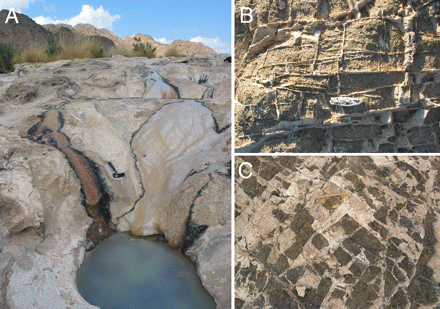
]]>Natural formations of carbonate rocks called peridotite can be found wherever there are igneous rocks formed from magma reaching the Earth’s surface. Peridotite is quite common for a rock type that most of us have never heard of. Where you find peridotite surface deposits, from igneous upwellings you have the means to sequester carbon by creating solid carbonate minerals.
Peridotites are easily weathered when exposed to water or low temperatures and it is this characteristic which has made the rock an interesting candidate to become a significant carbon sink. In a 2008 published paper in the journal PNAS, Proceedings of the National Academy of Sciences of the United States of America, scientists Peter Kelemen and Jürg Matter of the Lamont-Doherty Earth Observatory, Columbia University, describe the processes of natural carbonation in peridotite and how it can be enhanced to become a significant sink for atmospheric carbon dioxide (CO2). They then go on to discuss ways to enhance the rock’s carbon sequestration properties through drilling, hydraulic fracturing and pumping liquefied CO2 into mineral formations. An additional step, heating the CO2 could increase in situ carbonation. Kelemen and Matter’s work in Oman where large exposed peridotite deposits can be found. They estimated that with little expenditure of energy these Oman rocks could store in excess of 1 billion tons of CO2 annually. That is equivalent to about 2.5% of the current annual output of CO2 produced by human activity on the planet today.
If we found 40 similar world sites similar to the one in Oman we could remove the CO2 annually produced by human activity, permanently sequestering it in rock formations. It should be noted that we would still be left with current CO2 levels of greater than 410 parts per million. But by adding additional peridotite sequestering sites we could bring that number down to levels considerably lower, ensuring the planet’s atmospheric temperature would not continue to rise.
What is the process by which rocks sequester carbon?
It is called mineral carbonation, a process where atmospheric CO2 in the presence of water binds with different types of rocks to form stable carbonate minerals, such as calcium carbonate (calcite and limestone), and magnesium carbonate (magnesite).
Is this a better carbon sequestration solution than current CCS technologies?
Undoubtedly because all we would be doing is enhancing a natural process and fixing the carbon into a stable mineral. That sure beats capturing CO2 from the smokestack of a coal-burning power plant and then pumping the gas in high-pressure liquefied form into oil wells to enhance petroleum recovery such as is being done at Boundary Dam in Saskatchewan.
Peridotite carbon sequestration would involve applying an incidental amount of technology to a natural process to speed it up. No more, no less.
In the September 2013 issue of the Journal of Petroleum Science and Engineering, the costs and methods for mineral carbonation are laid out in an article entitled “A review of mineral carbonation technology in sequestration of CO2.”
What blows me away about the discovery of peridotite’s natural carbon sequestering capabilities are the dates associated with the research. I’m citing journal articles from 2008 and 2013. But the New York Times on the weekend published an article about it as if it were new science. Considering the billions of dollars that have gone into CCS projects globally, wouldn’t mineral carbonation of naturally occurring peridotite found on the Earth’s surface have been far less costly? And wouldn’t we by now have created pilot projects and fully operating sites for mineral carbonation for a fraction of the cost we are currently spending on CCS and other carbon emission reduction strategies?
We measure the base or acidic state of the ocean on a scale that chemists have been using for centuries. It goes by the name pH. The origin of the term “pH” is disputed but generally it is agreed to stand for the “power” of “hydrogen.”
When I was in high school we would dip litmus paper into different concoctions in the chemistry lab to measure their base or acid levels. If the paper turned blue or purple that meant its pH value was more alkaline or base. If it turned yellow or red it meant the pH value was more acidic. I used pH testing on my aquariums to ensure the chemical balance was right for my tropical fish. And if I went to the doctor for a checkup, he or she would have me provide a urine sample which a lab would test using the same pH scale.
The pH level of the ocean is an important measure of its health. Normally the ocean is more alkaline so a litmus paper dip in seawater produces a blue result. But there are subtleties in the values and a great deal of variation based on where you are on the globe when you test the water. In a new study from Columbia University the current state of our ocean acidity levels is revealed. Here are some notable facts:
The map below plots 2005 data displaying winter Northern Hemisphere values for the world’s oceans. The most acidic region appears purple – the Bering Sea between Russia and Alaska. The equatorial Pacific appears blank because of highly variable conditions caused by El Nino and La Nina events.

A second map from February 2005 shows saturation levels of aragonite across the world’s oceans. Without aragonite shell-building animals would be compromised and corals would be unable to build reefs. The data displays red in the South Pacific indicating a high concentration of aragonite. And corresponding with higher levels of acidity, the polar seas appear blue indicating less aragonite.
The pink lines appearing on both maps delineate the approximate edge of the ice packs for both polar seas.

These maps are disturbing on so many levels. We are witnessing an unprecedented alteration in our oceans. Why is it unprecedented? Because the past geological record shows that ocean acidification levels have changed but not in time periods of a couple of centuries. Past alterations have occurred measured in thousands if not millions of years. And as we tackle climate change it is imperative that we recognize the importance of dealing with ocean acidification as well. If we don’t find a way to mitigate it the consequences to our existence and ocean life may prove unsustainable.


