The post The Reality of Climate Change is Hitting Home With the Latest Headlines appeared first on Techso Mogro.
]]>Another headline spoke to the growing water crisis in the U.S. Southwest. This one stated that Phoenix cannot support the fact that like Las Vegas and other cities in the region, it is facing growing freshwater scarcity. A report from the Arizona Department of Water Resources stated that the metropolitan area with 4.6 million residents will not have enough groundwater reserves to meet demand as the century unfolds.
From where does Phoenix get fresh water? Most of it comes by canal and pipeline from three river sources, the Salt, Verde, and Colorado Rivers. Groundwater makes up the rest and is accessed by drilling wells. The report notes freshwater limits will lead to “unmet demand.” As a result, the metropolitan area will be living on borrowed time.
Arizona developers looking to add new subdivisions to the city’s growing population have been told they must guarantee freshwater sources last a century. That’s just no longer possible using local resources so developers are scrambling to find more water and looking to the Colorado to help meet demand.
But the Colorado is in trouble as global warming continues. For every 1 Celsius (1.8 Fahrenheit) increase in mean temperature, the river water volume is depleted by 9.3% as evaporation and prolonged drought at its mountain sources continue.
Recently, the states that use water from the Colorado agreed to reduce the amount of water from the river in the hope they can stabilize its flow and continue to supply fresh water from it to Phoenix, Las Vegas, Los Angeles, and the farms of the Central Valley of California, the market garden centre of the U.S.
Phoenix, as well as other cities in the U.S. Southwest, face a problematic fate. Over the next 100 years, water demand will exceed what can be harvested from groundwater by a significant amount even with conservation measures in place. And where there is no water, humans cannot stay.
Ignoring nature is not serving humanity well, whether talking about wildfires or groundwater. Phoenix and Ontario both need a reality check. This begs the question, where will it be safe to live in a future where climate change exerts itself negatively?
The post The Reality of Climate Change is Hitting Home With the Latest Headlines appeared first on Techso Mogro.
]]>The post Global Warming and the Colorado River appeared first on Techso Mogro.
]]>The river is slowly dying because the sources that feed it are receiving less precipitation, and because of agricultural, urban and industrial water being drawn from it. Seven U.S. states compete for water rights along the Colorado, as do Indigenous American tribes, and Mexico. The jurisdictions from south to north are Mexico, California, Arizona, Nevada, New Mexico, Colorado, Wyoming, and Utah.
Since 2000 the Southwestern United States has experienced temperatures above normal causing excessive evaporation in the Colorado River basin from the snowpack sources, tributary streams, and the two artificial lakes created behind the Hoover and Glen Canyon Dams. Both Lake Mead and Lake Powell have seen dramatic drops in water levels over this period of time. A recent study calculates the drop in flow by as much as 19% below pre-2000 levels.

With current global mean temperatures having risen 1 Celsius (1.8 Fahrenheit), that translates to a 10% decline from norms in the mountain snowpack. And each additional degree will see that decline grow even further, something climatologists believe will happen well before 2070 even if global greenhouse gas emissions are reduced from current levels. The latency of accumulated greenhouse gases in the atmosphere will put the entire Colorado River basin at risk with significant river flow declines.
Scientists no longer call what is happening in the U.S. West as drought or megadrought. A new term, aridification, they believe is a better descriptor. That’s because the U.S. West in the age of climate change is overall becoming drier and that means the mountain snowpack is migrating to higher elevations and declining in size.
States Doug Kenney, Director of the Western Water Policy Program, University of Colorado – Boulder, the Southwest will have to learn to live with less water. The threats to Lake Powell and Mead aren’t just about the water. They are also about the power generation that comes from the hydroelectric facilities that rely on the head, the vertical drop in elevation created by the reservoir that creates the forces to drive the turbines to generate electricity. If the water levels in these dams drop below a critical level, it will expose the water intake and leave the penstocks, the pipes that channel the water, high and dry.
On January 24, the Salt Lake Tribune reported that Lake Powell may be doomed. One proposal has farmers selling their water rights back to the federal government and giving up farming to ensure there is enough water in the reservoir behind the Glen Canyon Dam so that the hydroelectric facility can remain online.
A drought contingency plan for Lake Mead includes mandatory cutbacks to water use from the farms, communities, and cities that rely on the river basin. That includes Las Vegas, Phoenix, and Los Angeles. The future of this part of the United States and its prosperity is tied to the Colorado. Without reductions in water usage from the seven states that share the basin along with Mexico, this part of America may produce climate change migrants who will be moving north and east to find a sustainable future.

The post Global Warming and the Colorado River appeared first on Techso Mogro.
]]>The post Colorado River Flows to Sea of Cortez as U.S. Southwest Deals with Drought appeared first on Techso Mogro.
]]>How has this come about?
The United States and Mexico have a water agreement, known as Minute 319, to revitalize the lower reaches of the Colorado River delta. As a result the floodgates of a dam on the border of Arizona and Mexico were opened last year and eight weeks later the water made its way 60 kilometers (37 miles) to the sea. It represents 1% of the total river volume but even that small percentage is reviving the wetlands at the mouth of the river, home to more than 300 species of animals and birds including some endangered species. On 53 hectares (130 acres) of protected land the Mexican government has planted a forest of 200,000 cottonwoods and willows which will serve as a migratory haven for birds not seen in the last half century.
In the agreement both countries recognized the value of cooperation managing the Colorado in light of climate change. The agreement which has an end date of 2026 states that the United States will deliver 1.8 billion cubic meters (1,500,000 acre feet) of water from the Colorado River to the lower basin in Mexico annually. This provision is subject to Lake Mead maintaining a surface elevation of 349 meters (1,145 feet). Current surface elevation is 372 meters (about 1,220 feet).
The current drought in the Southwestern United States may lessen the amount of water delivered to Mexico should Lake Mead’s elevation decline further. There are provisions for water reductions should the lake drop below 328 meters (1,075 feet).
As if Lake Mead isn’t already under siege from California and Las Vegas who both heavily draw on the Colorado River water. California has begun water rationing and has an estimated 14 months of remaining capacity. Those cities and farms dependent on the Colorado are facing similar challenges. But at least for the moment there is freshwater once more flowing into the Sea of Cortez and that is bringing life back to the Colorado River delta. The pictures before and after say it all.

The post Colorado River Flows to Sea of Cortez as U.S. Southwest Deals with Drought appeared first on Techso Mogro.
]]>The post Shocking Study Results for Colorado River’s Viability appeared first on Techso Mogro.
]]>In the latest study researchers report the Colorado has lost 65 cubic kilometers (2.3 trillion cubic feet) of water since 2004. Much of it has been lost because of groundwater depletion from aquifers in the Basin. A 14-year drought in the American Southwest is to blame.
The groundwater decline is equal to six times the water lost in the Colorado’s two human-made reservoirs, Lake Mead and Lake Powell. This puts the freshwater security of the western United States in jeopardy.
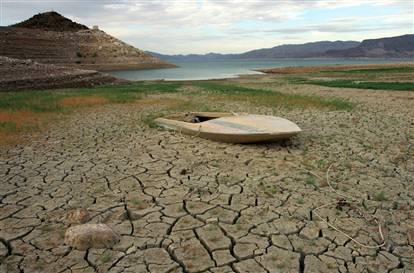
If you have visited Lake Mead recently you would note the bathtub ring of calcium that lines the shoreline as the lake level continues to drop by a much as 0.3 meters per week in recent months. As of July 2014 the water level is at its lowest since the Hoover Dam was completed in the 1930s. The picture below was taken in June. The Lake itself is only 39% full and the bathtub ring evident in the picture is almost 40 meters (130 feet) thick. Lake Powell to the north, the smaller of the two reservoirs is at 52% capacity.

This is impacting power generation and in addition has forced the United States to construct an $800 million U.S. tunnel under the Lake to maintain water flow below the dam site. The 2 million people of city of Las Vegas and the 40 million who annually visit are completely dependent on Colorado water. And seven southwestern states and Mexico are equally dependent. The only thing left to do with this depleting resource is to reduce usage and that spells a coming environmental crisis never seen in modern times.
But this region of the planet has seen similar prolonged droughts. Historians point to the Anasazi culture which experienced a similar prolonged drought eventually leading to the collapse of their cliff-based villages and cities by the year 1200 A.D. Although the native Americans of the southwest claim heritage from the Anasazi, know one knows with certainty what happened to this civilization when the water ran out.
And what happens when the Colorado runs out of water? No one has an answer for that either.

The post Shocking Study Results for Colorado River’s Viability appeared first on Techso Mogro.
]]>The post Headlines: Colorado River More a Trickle as 14 Year Drought Continues appeared first on Techso Mogro.
]]>Lake Mead, the man-made water source seen below, a crucial water resource for both Las Vegas and Los Angeles, is showing a giant bathtub ring along its shoreline, made from white mineral deposits as the water level drops. This is threatening 70% of the people in Nevada who may lose their primary freshwater source.

The American Meteorological Society has released a study in preliminary format entitled, Understanding Uncertainties in Future Colorado River Streamflow. It describes the importance of the river as a freshwater source to more than 30 million Americans and Mexicans, and provides evidence from climate models that predict a decrease between 10 and 45% in river volume by 2050. The variability in the models occurs because GHG emission levels may not escalate to 450 ppm during the time frame indicated, and climate models vary in predicting the impact of elevation on precipitation, snow pack, runoff and temperature. But one thing is consistent throughout all the models – a decline in freshwater river volume with the greatest risk a multi-decadal drought, something the basin is currently experiencing with no end in sight.
A summary of the Colorado’s future includes the following:
What is projected to happen to the Colorado is consistent with climate models for much if not all the U.S. Southwest from Texas to California and as far north as Oregon, Wyoming and Colorado. The Colorado has experienced droughts in the past. The most recent occurred in the 1930s and 1950s. In addition there is plenty of paleoclimate evidence to show that drought in the U.S. Southwest may have played a significant role in the decline of the Anasazi civilization with its cliff abode cities.

What does this mean for planning? For the many cities that rely on the river as a freshwater source and for the farms that draw upon it for irrigation it means implementing significant water conservation policies, developing grey water strategies to recycle and reuse water many times, and finding drought tolerant alternatives to existing crops so that farming can continue. This will stretch the resource and ensure every drop coming from the Colorado is not wasted.
A postscript having nothing to do with the Colorado River: A hiatus in postings occurred last weekend, consequences of Toronto’s recent ice storm and following deep freeze. A water pipe to the outside wall of our apartment cracked open and flooded us out. I was able to save my computer although it did get wet. A few days of drying and the application of a hair dryer seems to have done the trick and we’re back blogging. Our floor is a goner and will have to be replaced. And of course there is a gaping hole in our vestibule wall. But those damages can be fixed. I would have been pretty bummed out if I had lost the computer even though I backup regularly.
– Len Rosen
The post Headlines: Colorado River More a Trickle as 14 Year Drought Continues appeared first on Techso Mogro.
]]>The post Urban Landscapes in the 21st Century – Part 5: The Evolution of Cities appeared first on Techso Mogro.
]]>The Drinking Water Dilemma
In a 1996 published paper the author provided statistics showing that freshwater consumption was 40 times greater than consumption in 1700 and that half of that increase had taken place since 1950. With human population continuing to grow this may mean cities in the Developed and Developing World may find themselves without enough freshwater to sustain their populations.For the cities of the Developing World, growing faster and with less freshwater infrastructure the crisis will be unlike anything we have seen before.
In a 2010 published article in 24/7 Wall Street, the authors listed 10 of the largest American cities most likely to run out of freshwater. In order of most likely to least likely they are:
Note that these cities occupy the southern areas of the U.S. and many are in the Southwest where migration over the last half century has resulted in increasing water demands for growing populations. Los Angeles long ago ran out of local freshwater and relies heavily on water from the Colorado River basin. Los Angeles receives less than 380 millimeters (15 inches) of rain annually. But its population continues to grow attracting low-income migrants from Mexico and Central America.
Houston, the second city on the list, receives a lot more rain than Los Angeles, 1,400 millimeters (53 inches) annually. This sounds like more than enough to meet population demands. But that’s not the case. Houston is growing rapidly and the withdrawal of water from the local aquifer under the city is causing the land to subside leading to rising sea levels and salinization of freshwater sources.This is a problem for coastal cities in Florida as well.
Many cities on this list are in semi-desert and desert climate zones already water deficient. As these cities continue to grow because of their favourable climate they are depleting all the freshwater sources close by as well as those far away. Like Los Angeles, the cities of Phoenix, Tucson and Las Vegas rely on water from the Colorado River. At their current rates of growth the Colorado River may run dry by the mid-century.

Drought in the Southern U.S. has put other cities at risk. Atlanta, Fort Worth and Orlando have depleted freshwater reservoirs and aquifers through droughts that seem to be longer in duration. Proposed solutions include piping water from wetter areas of the United States and even Canada. This type of solution has led to pushback from local populations at the source who fear that their freshwater resources will be depleted by this growing demand.
For coastal cities like Los Angeles, San Francisco and Houston, desalinization of seawater represents a technological solution that comes at a pretty steep price. Like their Australian urban cousins, most which hug the coastline of that country, desalinization is in their present or near future.
The Freshwater Crisis in the Developing World
In a 1995 study, 31 countries representing almost 500 million population were classified as freshwater stressed or scarce. What is the definition of “stressed” and “scarce?” Hydrologists use the following benchmarks to measure freshwater availability.
Most countries of the Northern Hemisphere are classified as Category 1. The exceptions are countries in Central Asia (former republics in the Soviet Union) and regions within very large countries like Russia and the United States (see discussion above on U.S. cities running out of water).
Countries in the Southern Hemisphere more often fit Category 2 and 3. For these countries scarce is becoming more common, and particularly reaching dangerous levels in countries defined as part of the Developing World where migration to cities is continuing to accelerate along with water consumption.
Category 3 has many implications. Freshwater scarcity puts agriculture, the environment, population health and economic growth in jeopardy.
What is even more disturbing is what is forecasted for the Developing World between now and mid-century. By 2025 based on current consumption trends, the number of Category 2 and 3 countries will grow to 50 affecting 3.3 billion people. And by 2050, Category 2 and 3 countries will number 54 and 4 billion people. Almost all affected countries will be in Africa and the Middle East.
In our next blog on the urban landscape we will look at how new urban models, water usage patterns and technology can help avert the growing scarcity of freshwater supply.
The post Urban Landscapes in the 21st Century – Part 5: The Evolution of Cities appeared first on Techso Mogro.
]]>The post Agriculture – Part 5: Water appeared first on Techso Mogro.
]]>In the 20th century our world population grew from 1.6 billion in 1900 to over 6 billion by 2000. In that same period our freshwater usage increased by a factor of 6. It is estimated by 2025 that 1/3 of our human population will reside in freshwater scarce countries. As we approach 9 billion or more by 2050 freshwater will become even more scarce.
As freshwater demands increase the volume of water which is finite will lead to a decline in the amount per human inhabitant. Based on a recent UNESCO report, the availability of freshwater will decline from an average of 7,300 cubic meters in 1995 to 4,800 in 2025 per person.
Conservation techniques can help us manage freshwater resources better. Applying technology to create water from air, or to desalinate it from the ocean can increase availability at an increased cost. An equivalent to a cap-and-trade system on freshwater usage can stimulate improved handling of freshwater resources, change agricultural practices and land usage patterns, and stimulate innovation. Through necessity, the 21st century will have to address freshwater with the same energy it puts into implementing energy conservation, renewable energy, and mitigation of climate change.
Freshwater Usage in Agriculture Today
The World Bank keeps data records on agricultural usage of freshwater by country. The statistics are revealing. Many of the poorest countries in the world are using water for agriculture at unsustainable rates. The following partial list groups countries by categories of my choosing:
Areas with ongoing wars, and civil unrest:
Afghanistan 99%
Egypt 86%
Eritrea 95%
Iran 92%
Iraq 79%
Israel 58%
Libya 83%
Pakistan 94%
Somalia 99%
Sudan 97%
Syria 88%
Areas stressed by over population
Bangladesh 88%
China 65%
India 90%
Indonesia 82%
Although the lack of freshwater may not be the primary creator of stress for the countries mentioned above there appears to be a correlation between war and over population, and the scarcity of freshwater.
On the other hand there are countries that have industrialized farming and are net food exporters. Their agricultural freshwater usage patterns are different. Here is a representative sample:
Argentina 66%.
Australia 74%
Canada 12%
United States 40%
Having lived in Canada all my life, a country that has never faced a freshwater shortage it is difficult to appreciate the challenge that so many countries face when because of freshwater scarcity. Increasingly even net food exporters like Australia and Argentina are experiencing drier conditions and are drawing on freshwater resources in much higher amounts than in the past. So scarcity is a growing problem everywhere.
Climate Change and Freshwater
In our last blog we talked about the impact of climate change on agriculture. Where climate change will have its greatest impact is in the distribution of freshwater. This will affect aquifers, snow packs, mountain glaciers, lake levels, river flow and volume, and the quantity and intensity of storms.
Atmospheric warming will shift growing zones. Sub-tropical vegetation will migrate further north. Arid regions will get drier leading to increased desertification. Wet areas are expected to get far wetter. Seasonal variation in precipitation will become more extreme. As glaciers and snow packs shrink the rivers that rely on them as water sources will experience greater fluctuations in volume. As sea levels rise coastal aquifers will be invaded by seawater and coastal land under tillage will be lost either through increased salinization or inundation.
Human Land Use, Migration and Freshwater
For more than 50 years in the United States human migration has steadily increased the population of southwestern states while depleting Great Lakes and northeastern states. The population shift is away from where freshwater exists in abundance to where it is scarce.
Increasingly humanity resides in cities. Most of our urban population lives along coasts whether by lakes and rivers or by seas and oceans.
Increasingly humanity puts forest land under cultivation removing trees and affecting groundwater tables and soil stability.
Canada which has more freshwater resources than any other country on the planet is thinly populated and even it is experiencing freshwater challenges in the Prairies as urban centres and agriculture compete for finite surface and subsurface water resources. Add to that the use of water in mining, oil sands extraction, and industry and you have a growing freshwater challenge.
Global Distribution of Freshwater Sources
Earth has water in abundance yet we face a freshwater crisis. That’s because most of the water we have isn’t fresh. And the freshwater that we do have is not distributed evenly or in locations where our largest human populations live.
The surface of the planet features oceans of saltwater, in fact 97.14% of the water on the planet. The preponderance of the remaining water, around 2% is locked up in polar and mountain ice and snow packs. Lakes, streams and rivers represent just 0.014% of the total. The rest is groundwater at 0.592%.
When you view Earth’s northern hemisphere from space you see the dominant features on the planet’s surface, water and ice.

Other than the large lakes and river systems visible on the lower left in North America most of the freshwater in this picture is in sea ice or glaciers. At the South Pole Antarctica is locked in ice surrounded by an endless ocean.

Where the Farms Are Today is not Necessarily Where Freshwater is Abundant
The Case of the United States
The American Mississippi-Missouri-Ohio River basin, California and Florida represent prime agricultural areas in the United States. These areas are increasingly feeling the demand for freshwater from urban centres, and for industrial use in addition to agriculture.
Freshwater usage as a percentage of precipitation amounts to about 30% in much of the American Great Plains. In some areas experiencing prolonged droughts such as Texas and parts of Oklahoma, Arkansas and Louisiana, that usage exceeds 100%.
California produces 400 different agricultural products including almost 50% of the fresh fruit, vegetables and nuts consumed in the United States. Much of what California farms produce goes to export representing 15% of the United States total exports. California farms rely for freshwater on the river and groundwater of the San Joaquin-Sacramento River system fed by glacier and snow pack melt from the Sierra Nevada Mountains.
Much of the land under tillage in California would not be producing crops if it weren’t for major irrigation projects started in the 1930s moving water from Northern California to farms in the southern part of the Central Valley. Increasing urban growth and industrial freshwater demands have led to additional water projects to move freshwater from locations outside the state. As a result Southern California receives 60% of its freshwater from the Colorado River.
For such an important agricultural centre of production the growing challenges of declining freshwater sources is leading to major efforts to conserve water through a variety of changes in agricultural practices. This is leading to new irrigation techniques to deliver water more directly to targeted crops, recycling and treatment of grey water for use in irrigation, and fallowing of land.
For Florida the threat to citrus crops comes not just from cyclical drought but also from increased salinity in the aquifer from which much of the freshwater is derived. Urban demands in Southern Florida compete directly with agricultural requirements. In recent years Lake Okeechobee has experienced declining water levels. Because so much of Florida is at or near sea level, any decline in water levels in the lake means gravity cannot assist in moving the water and imposes an extra cost in getting it to cities and farms.
Florida agriculture suffers further from its near sea level elevation. In some coastal areas, because of excessive drawing of groundwater, salt water from the ocean is making its way into the aquifer leading to high salinity levels.
The Case of Australia
Australia is at the forefront of the consequences of climate change. The country has experienced every extreme weather event over the last few years including flooding from precipitation in excess of the norm tp prolonged heat waves and drought conditions leading to firestorms.
The cities of Australia are already feeling the scarcity of freshwater with acute shortages predicted by 2030. Since 2008 Australia has been closely monitoring water usage for agriculture and urban centres. By imposing severe limits on water use, increasing household water charges, developing reverse osmosis desalinization plants, investing in new farm irrigation technology and pipelines to eliminate leaks, $10 billion have led to a 40% reduction in urban freshwater consumption.
Already the driest continent and country in the world, Australia has more to lose than most as climate change alters rainfall and temperature patterns.
The Future of Agricultural Water Management
Climate change is one of a number of drivers that is altering farming practices and leading to dramatic proposals to shift freshwater from where it falls and collects today to where farming and urban centres are and will be located in the future.
Among the solutions are the following:
An Update to this posting:
In this blog I talked about methods for extracting water from the air. One of these ideas has recently received the James Dyson Award.
The technology is called Airdrop, developed by an Australian industrial designer Edward Linacre. Inspired by studying the way the Namibian Beetle survives in that desert by collecting water from early morning dew using its hydrophilic skin, Linacre designed a low-tech solution that extracts water molecules form the air by lowering its temperature so that condensation occurs.
The technology is inexpensive to implement and can be scaled for domestic or large-scale agricultural use. Using a turbine driven by wind, solar power or another external power source, warm air is driven underground. When the air reaches a depth of 2 metres (6.5 feet) the surrounding soil’s cooler temperatures (5C or 9 F degrees) causes the water in the air to condense.

Airdrop uses copper coils as the condensation medium. The water is collected in an underground storage tank and is then pumped underground to plants using subsurface drip irrigation. The Airdrop requires very little power to operate.
The post Agriculture – Part 5: Water appeared first on Techso Mogro.
]]>


