The Fraser Institute describes itself as independent, and a non-partisan research and educational organization. It’s fiscally conservative. It has received grants from billionaires like Charles and David Koch, who have actively supported The Heartland Institute, an organization that supports climate change disinformation activities. It also receives grants from fossil fuel giants like Exxon Mobil.
In the Fraser, progressives and those left-of-centre see the Institute as a neo-conservative or libertarian organization posing as non-partisan. Most of the time when I read its research bulletins I tend to view its content through a lens of skepticism. But this paper intrigued me because its main argument is that climate change is fundamentally a CO2 emissions problem (I agree) that knows no political or economic boundaries. CO2 molecules produced by growing food, generating energy, driving, heating, cooling and so on are all the same. It is CO2 emissions that we are fighting against to mitigate global warming.
In the last week, Steven Guilbeault, the Canadian Minister of the Environment and Climate Change met with representatives of the country’s fossil fuel industry to discuss CO2 emissions caps that along with carbon pricing are the government’s principal pathways to achieving a 42% 2030 reduction target and the 2050 net-zero CO2 emissions outcome. In a CBC interview, the Minister talked about capping CO2 and methane (CH4) from fossil fuel operations and tax incentives the government was offering to subsidize the building of carbon capture and sequestration (CCS) infrastructure.
Watson argues that a different approach would mean no subsidies and tax incentives are needed. He also noted that singling out any industrial sector, in this case, fossil fuels through new regulations and a cap would not be the best strategy. Instead, he believes a better approach would be to engage Canadians across all economic sectors to tackle CO2 emissions collectively.
There is merit to this argument although most of my environmentalist friends would disagree. Why is that? Because in Canada, the obvious villain of the piece when it comes to CO2 emissions is the fossil fuel industry.
To some degree, I agree with Watson, that all Canadians can work together to tackle CO2 through better consumer decision-making. And I believe this is possible if we equip all Canadians with the right tools.
In a posting a few days ago I called for the national adoption of carbon labelling. By labelling “cradle-to-grave” carbon content for all the goods and services Canadians buy, lower emissions could be had. Faced with two different products or services, Canadians could see which caused more pollution and avoid them. Through this approach to emission reduction, the public would be engaged and become better educated when shopping for food, products, and services.
As Watson states in his Fraser paper, “the subject here is not whether to reduce carbon emissions but rather how best to reduce them.” He proposes that common sense can dictate that we start with “the easiest reductions first and then, as the sacrifices become greater and greater, make sure every unit of emission reduction involves the same sacrifice across all…activities.”
In sales and marketing, there is an expression “go for the low-hanging fruit.” That essentially is what Watson is proposing. He warns of the danger of “carbon-reduction policies that focus on specific sectors, regions, or activities” which call for greater sacrifices from these activities rather than looking to solutions that encompass the entire economy.
Carbon labelling gives every consumer a means of tallying his or her carbon footprint. A person or family that knows its carbon footprint can start to do something about it. Fortunately, there are many carbon calculators out there to choose from. Many are smartphone apps. The combination of carbon labelling, a smart app that keeps a running track of your carbon consumption, and that provides carbon reduction strategies can work wonders to reduce consumer-based emissions.
Watson’s paper includes the calculation of his family’s carbon footprint. He describes the exercise of reducing it by 10% using the “equate-at-the-margin” rule (incremental changes to produce optimal results). It doesn’t mean decreasing the carbon content of all activities, but rather choosing the ones that would least impact the family’s lifestyle. Pick ones that hurt the least and then repeat the process with the next and so on to eventually achieve the 10% reduction.
Watson speculates that this type of low-hanging fruit strategy can achieve a 10% reduction conceivably without having to give up using fossil fuels to heat the home, or to drive the car. He goes on to state that what works for a household could equally be applied to the larger society, that Canadians could work on these low-hanging fruit emission opportunities that are the least costly and achieve them first. Then they could move on to the next least costly and so on.
In his conclusions, Watson argues that this approach does not necessitate the government having to come up with new rules or regulations for CO2 emissions. He believes the need for subsidies or tax credits for any sector of the economy including the fossil fuel industry would simply not be there.
When I finished reading Watson’s paper I kept thinking wouldn’t carbon labelling make all of this work and make the effort to calculate and reduce our carbon footprint so much easier?
]]>CCS was deemed nice to have thirty years ago when global climate scientists were first educating the world about anthropogenic climate change and CO2 atmospheric levels. But now the United Nations sees CCS is critical to keeping global atmospheric warming to no more than 1.5 Celsius (2.4 Fahrenheit).
To achieve a state where we are drawing more CO2 out of the atmosphere than contributing to it, in other words, negative carbon emissions, the installed capacity of CCS facilities must grow by a factor of 100.
In recent days, billionaire Elon Musk, launched a contest under the umbrella of the XPrize, a $100 million US competition to come up with innovative technologies and solutions to remove CO2 from the air and oceans. Lasting four years, teams will be asked to demonstrate solutions that pull CO2 directly from the atmosphere or oceans that can scale to gigaton levels, locking away carbon permanently. Appropriately the contest competition guidelines will be fully revealed on Earth Day this coming week, April 22, 2021. The Grand Prize winner will receive $50 million. Second and third-place finishers will earn $20 and $10 million respectively. There are also milestone awards, $1 million to go to the 15 top teams after 18 months in the competition, and 25 $200,000 scholarships to student teams competing.
The reality of our modern global economy suggests that we will continue to live with fossil fuels for the products we can create from them, and the energy we derive from them. Hence CCS is essential to carrying on our 21st-century economy and lifestyle. Whether we apply the technology at the emission source (think smokestacks) or draw it from the atmosphere, we have backed ourselves into an environmental corner requiring CCS to get us out. We can switch transportation from internal combustion engine vehicles but the conversion cycle is not a decade. It is much longer. Capturing CO2 from tailpipes isn’t feasible. But capturing it from the air around us can become that. And certainly, capturing it from smokestack emissions regardless of the energy or industrial source must become mandatory.
Driving down costs is the key. The engineers who built Quest, the Shell CCS project in Northern Alberta that has sequestered 5 million tons of CO2 to date, have stated that they can build a future similar project for half the cost. They are not alone in finding cheaper ways to reduce CCS costs.
Researchers at the U.S. Department of Energy’s Pacific Northwest National Laboratory, along with Fluor Corporation, and the Electric Power Research Institute, have developed a solvent they call EEMPA, the captures CO2 using 17% less energy and at a cost reduction of 19% per ton. They recently published their findings in the March edition of the International Journal of Greenhouse Gas Control. They plan to continue working on the solvent’s chemistry to refine it and increase its scalability to meet a U.S. Department of Energy goal of commercial CCS capable of capturing CO2 at a cost of no more than $30 per ton by 2035. Current costs of smokestack CCS are estimated between $43 and $95 Per ton according to a 2018 study by Harvard and Yale researchers. Direct air capture is more expensive with Carbon Engineering, a Canadian company, pulling CO2 out of the air at a cost of $100 to $150 per ton captured.
]]>
The increasing concentration of CO2, altering the chemistry of the oceans, drove evolution in marine biota faster. The species chosen was ostreococcus (seen below), a picoplanktonic green algae, and researchers noted 16 physiologically distinct lineages evolving over 400 generations. These were categorized by cell to nuclei ratios and by overall cell size. Successful adaptation appeared better when CO2 levels fluctuated rather than when they remained stable.
The reported study is not the first that indicates algae will thrive in a changing ocean environment where more CO2 is present. In fact the adaptation of marine algae to CO2 level changes shouldn’t be too much of a surprise. Life that uses CO2 as a fuel is going to find a way.
But what this study didn’t look at is impacts of CO2 on zooplankton, far more vulnerable to increases that change the pH balance in the ocean. A more acidic ocean threatens animals that form exoskeletons and shells. That includes corals, shellfish, crustaceans and arthropods, the base of the ocean food chain.


In the section of the report entitled “Low emissions fossil fuel” the authors talk about capturing CO2 before it is released to the atmosphere where it “can either be utilised in other products….such as carbonated drinks.” Obviously the authors are referring to carbon capture and sequestration (CCS) as the means of collecting CO2 from fossil fuel sources. But really? Are they serious that putting in in a bottle of coke equates with sequestration.
Now before you accuse me of taking words out of context, here is the entire phrase appearing on page 56 of the report which states that there would be “opportunities to utilise CO2 in products such as carbonated drinks and plastics or to enhance the growth of oil-rich algae in solar bioreactors to produce biofuel.”
I thought maybe this was a prank, an April Fool’s joke on the part Minister MacFarlane. I assume he has read this report in endorsing it. But sadly, this is no April Fool’s prank and MacFarlane is some kind of April fool.
The truth is that Australia’s government is fixated on strip mining the country of coal to feed Asian markets so that it can continue to grow its economy while increasing its contribution of greenhouse gases to the atmosphere.
The country has one CCS project under development, the Gorgon LNG project which will start operations in 2016 and store 3.4 to 4 megatons of CO2 underground annually. Compare that to Australia’s 373 megatons of CO2 output in 2013 and you can see that CCS has a long way to go to be any kind of factor in reducing the country’s contribution of carbon to the planet’s atmosphere.
As for bottles of coke as a CCS tool. A typical soft drink contains about 2.2 grams of CO2 per can, a little more from a bottle. To sequester that carbon you can never open the bottle, pop the can or ingest the liquid in it. Any of these actions will return the CO2 to the air. Now look at just how much Australian’s drink soft drinks and the absurdity of the report becomes even more grotesque. Australia consumes 944 million liters of soft drinks a year amounting to 2,000 tons of CO2.
Minister MacFarlane, you and your Prime Minister, Tony Abbott (the man seen to the left in the image below), should be up for some kind of award granted to stupid people. I thought the Darwin Awards might be appropriate but the actions of these two politicos unfortunately won’t lead to their immediate demise. Instead their ignorance as leaders making policy will drag all of us down in time.
For Americans who are just learning who will be running in the next presidential election more than a year-and-a-half away, please take note. Should one of the many Republican candidates suggest drinking coke to sequester carbon you can say you read it here first.

An MIT team from the Department of Earth, Atmospheric and Planetary Sciences, studied how CO2 reacts with native rock when injected into the ground. What they found was that only a small percentage of the gas bonds permanently while the rest remains gaseous or liquid. In the case of the latter two, the CO2 can find its way back through cracks to the surface and out gas back into the atmosphere. Their research results appear in the latest edition of the journal, Proceedings of the Royal Society A.
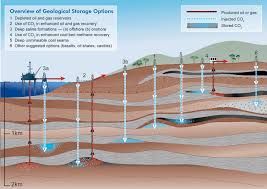
Typically carbon sequestration uses deep saline aquifers and gas fields like those depicted in the above image. The CO2 is concentrated and liquified before injection. Once it is trapped the injected fluid percolates into the rock, typically sandstone, where it can undergo a chemical alteration in association with the rock’s chemistry. But no rock formation is uniform. There are cracks and small pockets where the CO2 can remain as a gas with no bonding or chemical alteration taking place. This means within the underground sequestration field solidification rates are likely much lower than theorized by those who practice CCS.
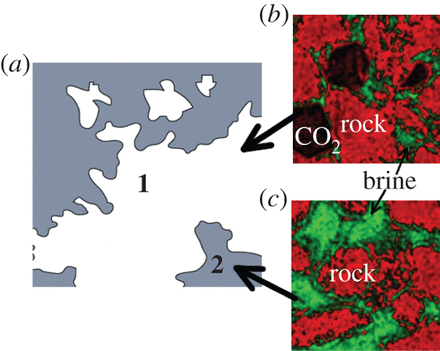
The illustration above appears in the study and shows how CO2 when sequestered can move from a (a) briny solution in the rock to two end results. The (b) result in the upper picture on the right shows a combination of gaseous CO2 and brine-laced CO2 , while the (c) result on the lower right shows the CO2 remaining in the brine but separated from the rock in which it is sequestered.
In their conclusions, the researchers, Yossi Cohen and Daniel Rothman, geophysicists, state:
“Our results suggest that only a small fraction of the injected CO2 is converted to a solid mineral. The remainder stays in its dissolved ionic form or is trapped in its original form. Whether a domain will go into dissolution trapping or mechanical separation depends on the concentration gradients, the properties of the rock and the porosity available for transport.”
Prior to this research the expectation among CCS engineers was that most of the CO2 when interacting with deep rock formations solidifies. Cohen and Rothman state, “Our work suggests that significantly less will precipitate.”
So if CCS isn’t the engineering panacea to reduce CO2 from human-generated sources it would seem that reducing energy from emission-generating fossil fuels represents the best way for us to decrease the global warming impact. To meet growing energy needs our focus, therefore, must be on rapid expansion of CO2 neutral renewable energy sources. We can’t continue to “eat the CO2 cake” without dire consequences.
In the last week here in Toronto scientists gathered at a conference entitled, Bio-Inspired Ideas for Sustainable Technology. The goal of those gathered was to learn from plants how to better utilize solar energy by replicating photosynthesis through technology. Artificial photosynthesis is an important goal. With it we could produce ten times the energy needs of humanity state the scientists attending this conference.
But what the conference didn’t discuss is how mimicking another physiological feature of plants could also help us deal with the current concern about CO2 and correlated atmospheric warming. That’s because, next to the ocean, plants are the biggest carbon sink on the planet. They breathe in CO2 and expel water vapour and oxygen.
So while scientists are grappling with artificial photosynthesis, others are looking at capturing CO2 directly from the atmosphere just like plants. Three of the latter, Peter Eisenberger, Graciela Chichilnisky and Edgar Bronfman are leading a team to do just that – create a technology that sucks the greenhouse gas out of the air. They have launched a new company, Global Thermostat, and have built a pilot plant in Menlo Park, California, that is currently in operation demonstrating what they describe as a low-cost solution to atmospheric warming that can be grafted to existing industrial facilities to capture carbon.
Eisenberger, a physicist at Columbia University, first presented his carbon dioxide-capture idea to the American Physical Society in 2009. He was greeted with skepticism. Eisenberger told his audience at the time that he was working with amines, chemicals that can capture CO2. Amines were being used in carbon sequestration experiments to bind concentrated CO2 being emitted in the outflow stack at fossil-fuel burning power plants. But he went on to describe how they could be used to directly capture the gas from open air where concentrations were far more diffuse. He even told his audience he could recycle the amines used to continuously perform carbon capture. Considering the correlation between rising atmospheric temperatures and the rise in CO2 levels over the last 50 years it seemed that Eisenberger’s observations should have resonated with his audience. Apparently it did with some who were working at the U.S. Department of Energy and five years later with funding from the department an operating prototype (seen below) is demonstrating the technology.
The technology is patent pending in more than 100 countries. It can be installed at power plants, cement smelters, refineries and other CO2-emitting industrial facilities. It uses far less energy than any other carbon sequestration technology. The CO2 captured can be sequestered underground, incorporated into cement, plastic and other industrial products, fed to algae to enhance biofuel production, or be sold for carbon credits.
If widely distributed it may prove to be a key innovation in our pursuit of carbon negative solutions.

The study also looks at how aerosols, both naturally and human produced, are contributing to climate change. Aerosols can have both a positive and negative effect on atmospheric temperature. In the Northern Hemisphere, preponderantly industrial, we see the largest human contribution of aerosols. The study suggests that these aerosols may contribute an offsetting cooling effect countering to some degree the impact of CO2. That cooling is factored in to the projections mentioned in the previous paragraph.
The study’s projections are very much in line with those produced by the Intergovernmental Panel on Climate Change (IPCC) even taking into consideration the new research on human-produced aerosols and their impact on global warming. The conclusion – Earth will likely experience 20% more warming than what we have observed through the last 150 years of record keeping by 2099. And based on the NASA Center for Climate Simulation map of the Northern Hemisphere, seen below, that warming will be far greater in upper latitudes.

A new company, Liquid Light, may have an answer in the fight to reduce our global carbon footprint. The company has developed an electrochemical process that takes CO2 and converts it to turn it into chemicals and fuels. Based in New Jersey, the company’s technology uses low-energy catalytic electrochemistry to convert CO2 to industrial chemicals such as glycol, alcohol, olefins and organic acids. The technology can be installed at industrial sites where CO2 is emitted.
Recently the company demonstrated its electrocatalytic reaction cell for the production of ethylene glycol highlighting the economic and environmental advantages the technology brings to this $27 billion per year industry. Ethylene glycol today is used to manufacture plastic bottles, antifreeze and polyester.
The technology has the capability to produce more than 60 different chemical products using CO2 feedstock. British Petroleum is one of its investors.

The latest research using climate simulation models has led to some startling conclusions. The work done by Princeton University scientists has appeared in the journal Nature Climate Change. It shows that if were to reduce CO2 output to zero emissions today that we would initially see Earth’s temperatures stabilize and then begin to decline over the next century, but then the long term impact would show the decline reverse with temperatures increasing over the next 400 years (as depicted by the red line on the graph depicted below while the blue line indicates declining atmospheric CO2).

Why would a climate model show such contrary results?
One of the reasons state the scientists has to do with latency. The ocean is the principle culprit. It is not only a carbon sink but also a heat sink. Initially the ocean is great at absorbing both. The polar oceans are showing us that right now, with Arctic seasonal ice thinning and shrinking and atmospheric temperatures over the Arctic rising faster than anywhere else on the planet. But the ocean only has so much absorptive capacity and the climate models show that over time it slows down. So although ceasing to burn fossil fuels today may buy us a century of cooling according to the research, the next four centuries that would follow would see the temperatures rise even higher than those at CO2 atmospheric peak.
These conclusions contradict scientific consensus which states that global temperatures once we stopped emitting CO2 would hold steady and then begin to decline. But the consensus has not accounted for the role the ocean will play.
The researchers also show that another point of consensus may be wrong as well. Scientists had thought that the tipping point of atmospheric carbon would be 1,000 billion tons before we would see temperatures climb by 2 degrees Celsius (3.6 Fahrenheit). But with the Princeton climate model it appears that warming at this level will occur with the atmosphere taking up 750 billion tons of CO2. Today we have already reached the 500 billion ton mark so we are much closer to the climate change benchmark than previously thought particularly when you consider the rapid growth in demand for energy by Developing World countries in their aspiration to live like those in the Developed World.

In the past few days our political leaders have been meeting in Warsaw to try and formulate a common set of policies for dealing with greenhouse gases with controlling CO2 the major task. That won’t be easy because we have built our energy infrastructure on a bed of carbon for the last two centuries using coal, oil, and gas for heating, cooling, transportation and industrial manufacturing.

Our leaders have met before on this issue. In 1997 the Kyoto Protocol was signed by most of the Developed World countries. It established greenhouse gas limits for these countries. These targets have proven illusory. My country, Canada, has withdrawn its commitment to Kyoto and will fall far short of meeting any of its carbon reduction targets by 2020. This type of result is shameful and irresponsible. It cannot continue if all of humanity is to successfully address rising CO2 levels. So what needs to happen at Warsaw by this Friday, November 22, 2013. Here are five outcomes that would put us on the right track:


