I was born in 1949. A year later the world’s population topped 2.5 billion. This week the United Nations announced that humans on Earth had just surpassed the 8 billion mark. That means in my lifetime, humans have increased by 320%.
When listening to a satellite radio station yesterday, the announcer did a drum roll and celebrated the 8-billion milestone. My immediate thought was, is this a good thing, a statement about human resilience? Or is it a sign that human population growth is out of control?
In some respects, the number is a positive. It reflects the improvements humanity has made in the fields of medicine and agriculture. If this growth were evenly distributed over the Global North and South, humanity could handle it. But that is not the case.
The largest growth is happening in places least able to feed the population, where freshwater scarcity is the greatest, and where climate change and extreme weather events are unleashing an enormous toll. We are talking about Sub-Saharan Africa and other parts of the Global South which are relying on food imports to meet the 2,000 calorie-a-day measure that humans need to thrive.
What is the planet’s carrying capacity for our species? Some time ago I worked out the numbers and you can read what I wrote ten years ago on this subject. But here is a quick summary.
If we planted on every hectare of arable land on Earth enough food crops to produce 2,000 calories per day, the planet does have more than enough carrying capacity to handle 8 billion. In fact, the number is closer to 66 billion, give or take 10 billion. That’s well above the 8 we have today. So should we be worried when forecasters tell us we will hit 9 billion in the next 15 years, and 10 billion by mid-century?
Without climate change in the mix, we would probably be okay. But we don’t have a handle on global warming and based on what is happening at COP27, it is likely years before all the nations of the world will be sufficiently aligned to mitigate and adapt to climate change while dramatically reducing its human-produced causes.
What exactly have we been doing to our atmosphere? In 1950, atmospheric carbon dioxide (CO2) levels hit 310 parts per million (PPM). That was 60 PPM above the number in 1850. Today, we have surpassed 419 PPM. So in my lifetime, atmospheric CO2 has risen by 35%. And since the Industrial Revolution, CO2 in the atmosphere has increased by two-thirds.
The last time CO2 was this high was 2 to 20 million years ago before Homo sapiens had evolved from our hominid ancestors. And CO2 levels in Earth’s past history didn’t rise at the speed we are seeing today. Al Gore called it a hockey-stick curve with humans responsible for the shaft.
A third number to consider is the rise in representation by fossil-fuel companies at the current COP27 climate conference. At COP26, 536 fossil-fuel lobbyists showed up. This year like rising CO2, fossil fuel lobbyists have grown to 636. That’s 19% more coming to ensure that coal, oil, and natural gas continue to flow and produce greenhouse gas emissions into the foreseeable future.
These lobbyists and fossil-fuel company sponsors (18 of the 20 COP27 sponsors are associated with the energy sector) prominently on display at COP27 want the rest of us to know that the energy they produce that pollutes is necessary for the foreseeable future and part of the low-carbon energy transition process. Of course, it means they can continue to operate and profit from polluting the atmosphere and further adding to the conditions responsible for climate change. As one COP27 delegate put it, the talks in Egypt are turning into a rehabilitation exercise for fossil fuel companies.
This last number represents the total number of heads of state and countries in attendance at COP27. That’s a drop from the 197 who attended Glasgow’s COP26 and not a good sign. Considering that Glasgow was held when COVID-19 pandemic restrictions were being enforced globally, it drew over 30,000 attendees from across the planet. And although COP27 has 14,000 more registered attendees, where have all the countries gone?
]]>
António Guterres, the United Nations Secretary-General, described the results as a lost opportunity for financing, mitigating, and adapting the world to the ongoing climate crisis. There is little doubt now that a 1.5 Celsius temperature rise ceiling in the 21st century has gone by the wayside.
For pure effrontery and dissembling of the facts, a number of nations have stood out for their lack of concern for the entire planet’s future. In this basket of ne’er-do-wells are Australia, Brazil, Russia, Saudi Arabia, and the United States (federal government only).
The mechanism that Paris saw as the means to drive down carbon emissions, a global carbon market, got steamrolled by the United States. It makes you wonder why 197 countries back in 2015 signed any kind of deal without providing a means of implementing effective policies that could be measured, and policed by the United Nations and its members.
The carbon market mechanism has been a disaster from the get-go. There are old carbon credits and new proposed carbon credits. There appears to be no mechanism for carrying over credits from the past. Countries that had the most to lose because of their dependence on exploring and mining of fossil fuels found ways of making the trading and valuation of carbon credits indecipherable. These credits date back to the Kyoto Accord and giving them a continued valuation seems to have become a roadblock for moving forward on using carbon markets to drive down emissions.
Meanwhile, the Earth doesn’t seem to be waiting for political leaders to catch up with scientific reality. We are seeing data from Greenland and Antarctica that tells us the atmospheric buildup of carbon is causing unprecedented ice sheet melts. Arctic permafrost is thawing at an accelerated rate releasing carbon dioxide (CO2) and methane (CH4) at increasing volumes with these added gases accelerating overall warming. Sea ice levels in the Arctic continue to trend downward. Australian bushfires and temperatures have reached record highs. Megadrought is becoming highly likely both in central Australia as well as in southern Africa.
The indirect involvement of humans in what is described above in the previous paragraph is accompanied by our direct involvement in deforestation in places like the Amazon basin where we are negatively impacting the tropical rainforests of the Earth and the role they play as carbon sinks, oxygen generators, and atmospheric flow.
We are seeing atmospheric CO2 at a level not seen in four million years during the Pliocene when global mean temperatures were much higher than 1.5 Celsius above our pre-Industrial Revolution past. It is likely that CO2 levels will accelerate with permafrost melt pushing us well beyond 3 or 4 Celsius above current mean temperatures by century end.
Are our governments preparing for the disruption atmospheric warming will bring? Not even close to getting started. Even if we can reduce carbon emissions to net-zero by mid-century (which means we will produce no more carbon than we capture by natural or other means) the effect of what we have already done will continue to be felt for centuries into the future.
No governments that I know of in the Madrid talks proposed a negative-emissions scenario with policies and processes in place to achieve such an outcome. Other than those who posit a geoengineering solution as a way to save civilization as we know it, there seems to be a lack of international will or cooperation in stabilizing the planet’s climate.
In 2020, the nations of the Paris Climate Agreement will meet again at COP 26 in Glasgow, Scotland. Will the leaders have a sense of urgency as they go about creating a future sustainable economic model that is consistent with managing the climate? Although net-zero would be nice, it no longer should be the goal. We now need a negative-zero plan and we need it fast.
The appointment of Mark Carney by the United Nations as special envoy for climate could be the spark that drives a new sense of purpose for the 197 nations of the Paris Agreement. Carney as the former Governor of the Bank of Canada, and then the Bank of England, brings his financial acumen and his understanding of risk, of which he has spoken many times, to reconciling business, government, and the climate crisis. In accepting the United Nations job, Carney stated that his new position “provides a platform to bring the risks from climate change and the opportunities from the transition to a net-zero economy into the heart of financial decision-making.” He went further, “The disclosures of climate risk must be comprehensive, climate risk management must be transformed, and investing for a net-zero world must go mainstream.”
Carney’s appointment may be the best stocking stuffer this Christmas 2019.

]]>
How familiar this sounds to what has been happening since the inauguration of Donald Trump and the approval by the Senate of his choice, Scott Pruitt, to head up the Environmental Protection Agency (EPA). Pruitt considers the EPA, according to an article written in yesterday’s New York Times, to be the equivalent in the public’s mind of the U.S. Internal Revenue Service (IRS), a predatory and regulatory regime that imposes its will on honest American citizens just trying to make a living. EPA regulations force automobile manufacturers to make cleaner cars that go further on less gasoline and diesel. EPA regulations cause the closure of coal-fired thermal power plants. EPA regulations are based on scientific data that runs counter to everything Pruitt believes. That’s because Pruitt, a former Oklahoma state attorney general is very much a climate change denier, pro fossil fuels, and an enemy of science.
EPA regulations force automobile manufacturers to make cleaner cars that go further on less gasoline and diesel. EPA regulations cause the closure of coal-fired thermal power plants. EPA regulations are based on scientific data that runs counter to everything Pruitt believes. That’s
EPA regulations cause the closure of coal-fired thermal power plants. EPA regulations are based on scientific data that runs counter to everything Pruitt believes. That’s
EPA regulations are based on scientific data that runs counter to everything Pruitt believes. That’s
That’s because Pruitt, a former Oklahoma state attorney general who made a habit of suing the EPA regularly, is very much a climate change denier, pro fossil fuels, an enemy of science, and an appointed fox now in the environmental movement’s henhouse.

Between the President’s requests to dramatically cut the EPA budget and Pruitt’s stocking of administrative positions with like-minded individuals, Americans will no longer have a watchdog monitoring the excesses of mining and utility companies as they pollute the air and water. The watchdog agency’s gloves have been tied up and put back on the shelf for a 4-year interim. There is no more EPA punch to stop polluters. This President, who during his campaign promised clean water and clean air, will deliver neither as he moves on scientists and programs studying climate change. This represents a reprehensible step backward and existential threat to all Americans and the rest of the planet, the only one we know with certainty, that is inhabitable.
How can I say this?
In the headlines the last few days we received an ominous forewarning of future global warming. Scientists, at the Mauna Loa laboratory in Hawaii, reported carbon dioxide (CO2) levels, the greenhouse gas most associated with global warming, will for the first time, surpass 410 parts per million (ppm), a threshold not seen in the geological record since humans first appeared on Earth.
Richard Betts, climate scientist, noted that April or even sooner will see CO2 reach 410 ppm. That follows a record rise last year that put us permanently over 400 ppm. And although 10 ppm seems like a small increment, the greenhouse gas impact of CO2, cumulative over time, will undoubtedly happen, raising global temperatures, and lingering well into future centuries.

Even more frightening is the trending that shows CO2 levels rising at a faster rate than in the 20th century. It wasn’t that long ago that we were at 350 ppm, what many scientists felt was a safe level for atmospheric CO2, creating conditions that were far more benign to human existence. But now at present rates of CO2 contributions made by us, will take us to 450 ppm within 20 years. With levels that high, the forecast for global mean temperature will exceed 2 Celsius (3.6 Fahrenheit), the upper limit target agreed to by the nations of the world at the Paris COP21 Climate conference.
Pruitt, a fossil fuel man all the way, has appointed climate science deniers (think Senator James Inhofe, for one), to help him try and find alternative facts to the science, ignoring the evidence that abounds. He will declare the news that 2016 was the warmest since human recordkeeping began in the 1870s, to be false. He will argue that everything observed to date is part of the natural cycles of the Earth. He will point to the Sun and blame warming on changes in the solar cycle. He will tell you that axial wobble is the real science responsible for climate change, and not CO2. He has no intention of looking at the real science and data that those in the EPA have compiled for several decades.
So many U.S. scientists have tried to find a safe haven for their research. Recently Canadian universities and companies have volunteered to archive data collected by American environmentalists. Researchers at University of Toronto have been backing up science data from U.S. EPA, NOAA, NASA, the Center for Disease Control, the Department of Agriculture, and other agencies in a race to retain the information before it gets trashed by Trump, Pruitt and their minions.
So what else to do?
In Australia, people and scientific community got together and created a non-government body, the Climate Council, to monitor climate change. The funding came initially from a crowdfunding campaign which in three days raised enough money to allow those laid off or fleeing positions in government to find a place to do their work.
The same can be done in the United States where crowdfunding got its start. To me, an Indiegogo or Kickstarter campaign to create an Environment Climate Council, sounds like the route to go over the next four years or until President Trump is impeached, and his science-denying cadre gets dumped from office.
Although I am not an American, I would be happy to get this started, and invite my readers to give me a shout out to make this a reality.
So that explains why the May 2013 400 ppm level was only temporary and seasonal. This May the annual oscillation in CO2 levels exceeded 404 ppm. But on November 1, 2015, CO2 levels had dropped to 399.06 ppm. Now compare those numbers with the same date in 2014 when CO2 levels were at 397.7 ppm. A year before that the level was 396.78 ppm. A decade ago it was 377.72 ppm. And for final comparison go back to 1750, before the Industrial Revolution got started, and look at CO2 levels from air trapped in ice cores taken from mountain and polar glaciers. The reading then was 278 ppm. We’ve gone up 122 ppm, an increase in CO2 concentrations of 42%.
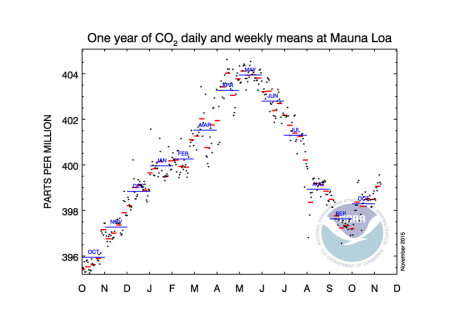 In the run up to COP21 in Paris where the nations of the world are hammering out a climate change agreement the hope is to limit further increases in CO2 to not exceed 450 ppm by mid-century. That’s an increase from 1750 levels of 62%, and 12.5% greater than current CO2 levels . At the 450 mark governments hope to keep global mean temperatures from rising no more than 2 Celsius (3.6 Fahrenheit). Scientists are quick to remind us that above 350 ppm we trigger global warming with 400 ppm already heading us into “uncharted waters.”
The second bit of science news “coincidentally” reported in the last week is that 2015 will be the hottest year on record for planet Earth if the remaining two months continue the trend of the first 10. According to climate scientists temperatures this year are beating past records “by a country mile” with 1 Celsius (1.8 Fahrenheit) the milestone being surpassed.
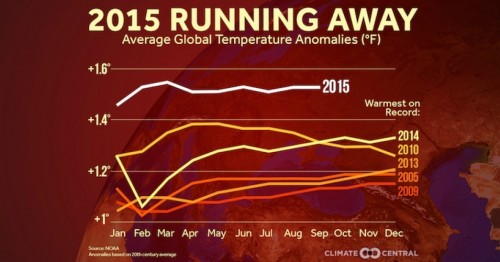
Now if you live in Eastern North America you may think this is nuts. After all didn’t we pass through a second frigid winter in a row? And this summer’s heat seemed unexceptional. So how can the scientists state this as the hottest year ever recorded? That’s because world mean temperatures are not governed solely by what happens in a single part of the world. The numbers being crunched are collected from all around the globe. In addition they reflect daytime highs and evening lows. And it is the lows that provide the biggest indicator of rising temperatures. We aren’t experiencing lows that are that low anymore. And so recorded temperatures are creeping up at rates previously unforeseen.
Then there are oscillations that we have witnessed for several decades. One of those is the mid-Pacific El Nino which this year is a further contributing factor to an exceptionally warm 2015. The impact on North and South America has been enormous and yet the El Nion has yet to peak which usually occurs just before Christmas.
Europe and Asia have not been spared the warmth. Having come back from a vacation in Central Europe, where my wife and I were witnesses to climate change first hand, we saw countries experiencing unprecedented warmth both day and night, evidence of extensive drought conditions with crops dead in the field, and a Danube River with water levels so low that our on the water cruise turned into a bus tour.
In India and Pakistan 2015 has proven unkind as well. Record heat in both day and night was described by the Indian weather services this summer, the 5th deadliest heatwave ever recorded. 2,300 died in India from the heat. In neighbouring Pakistan more than 1,000 deaths were recorded with scientists there describing it as the worst heatwave in three decades. Imagine daytime temperatures of 49 Celsius (120 Fahrenheit) in Karachi with nighttime temperatures dropping into the mid-30s (plus 90 Fahrenheit). Karachi is a city with little in the way of air conditioning.
Yes as our leaders convene in Paris we are heading into uncharted waters. And it is what we don’t know about future greenhouse gas concentrations that requires our focus because it is the one thing we humans can control if we make the effort and sacrifice.
]]>
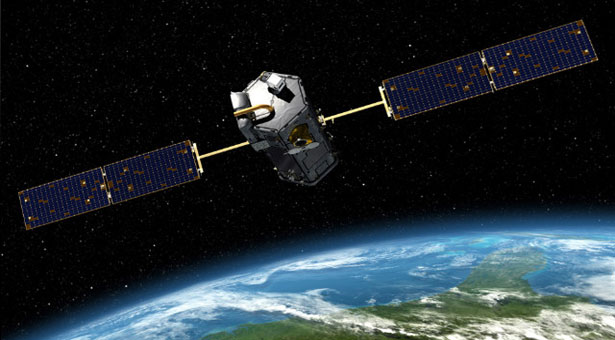
Onboard OCO-2 are three high-resolution spectrometers to measure atmospheric CO2. Why three? To measure Nadir Mode, Glint Mode and Target Mode.
Nadir Mode views the ground directly beneath the spacecraft. Glint Mode tracks locations where sunlight directly reflects off the Earth’s surface, particularly the Ocean. And Target Mode looks at specified surface targets each time the satellite passes over. The satellite will provide a detailed picture of emissions by scanning 2.59 square kilometers (one square mile) at a time.
Measuring CO2 is in fact measuring how the plant and animal life on our planet breathe as well as measuring our human activity contributions. The Ocean, forests and plants of the Earth absorb about 50% of the 40 billion tons of greenhouse gases added every year through burning fossil fuels, and human industrial and domestic activities. Today, because of the enormous amount we pump into the atmosphere, it takes 1.5 years to absorb just annual CO2 contributions. This is the reason CO2 levels continue to rise.
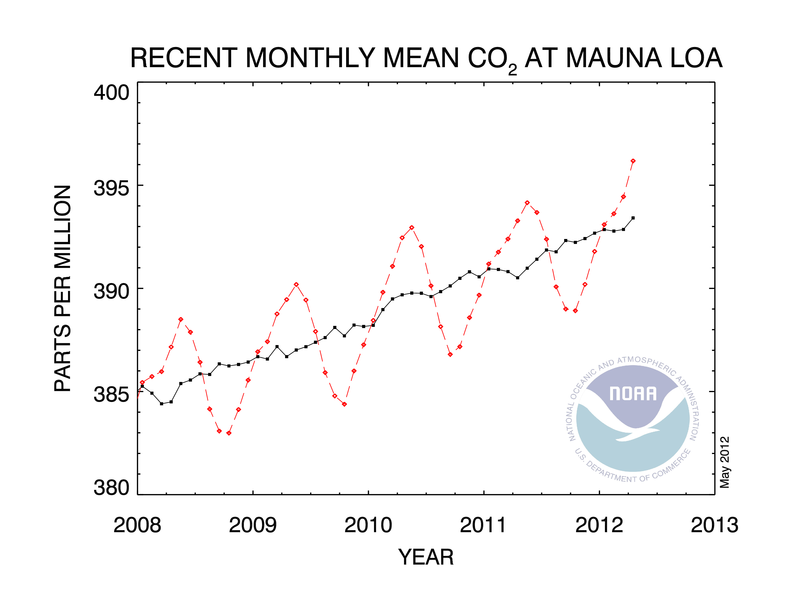
But annually we see a rise and fall to CO2 levels. That’s caused by seasonal changes which impact how CO2 gets absorbed. When winter in the Northern Hemisphere, less gets captured on land and sea, on land because deciduous trees enter dormancy and even the evergreen-dominated boreal forest is less capable of absorbing CO2 at this time of year. Add to this colder water and sea ice in the Oceans and we see as a result higher atmospheric CO2 levels.
Meanwhile the Southern Hemisphere, mostly Ocean, becomes the primary carbon sink during the southern summer. But with less forest mass, the dip in CO2 is not as pronounced as it is when summer returns to the Northern Hemisphere. Hence atmospheric readings of CO2 cycle up and down over the year as seen in the red tracings from data collected at Hawaii’s Mauna Loa site. And because the bulk of the continental land masses lie north of the equator, CO2 expresses its highest levels when winter is in the north.
So if we already know this why do we need OCO-2? The justification is this. The satellite will help identify carbon sinks. It will also give us precise readings of human and natural CO2 emissions across the entire planet. This will give scientists the means to make more accurate projections about climate change.
OCO-2 data will be compared to Japan’s Greenhouse Gases Observing Satellite (GOSAT) which is monitoring methane and CO2. And it will add to the data from ground-based observations currently being conducted by the U.S. National Oceanic and Atmospheric Administration which has been measuring atmospheric CO2 since the 1950s.
The OCO-2 mission is budgeted to last two years. Considering the importance of the data it provides we can only hope that it will remain funded well beyond that expiry date.
By any measure and in every way we are failing. Our governments are failing us. And we are failing the rest of the species of animals and plants on this planet.
Here are some statistics all of us need to know:
In terms of feeding our human population here’s some more facts:
In terms of moving from fossil fuels to renewable energy:
In terms of the environment:
Five Actions YOU Can Take to Create a Sustainable World
In a previous blog I proposed 13 actions that governments around the world must take to address the future of the planet. But what can you do as an individual to change the score card?
From the teachings and sayings of Mahatma Gandhi I have drawn on 5 tenets that you can follow:


