As always enjoy the read and please consider commenting or asking questions about anything posted here.
Evolving technology simplifies daily operations. Communication gets easier. Inventory tracking and management becomes less time-consuming and training no longer seems to go into a blackhole void. Adopting technology should make day-to-day operations easier. The bonus comes when it significantly reduces a company’s carbon footprint.
Adopting smart technology improves efficiency and sustainability. Companies, today, have to understand that making a profit isn’t the only measuring stick of performance in a world dealing with climate change.
Smart technology deployment can reduce carbon emissions. It can improve waste management, create greener supply chains, and increase energy efficiency. The two case studies that follow show how smart technology adoption is achieving profitability and environmental sustainability.
Transportation accounts for a huge percentage of greenhouse gas emissions. At the same time, inefficient transportation produces unnecessary added costs. United Parcel Service (UPS) has made environmental sustainability in operations a measurable goal. The company implemented the UPS’s On-Road Integrated Optimization and Navigation System to address transportation inefficiencies. Initially, the system analyzed every planned delivery route. The goal was to minimize the number of turns, directing drivers to pick-up and drop-off points that weren’t visible from the road to reduce fuel consumption and vehicle maintenance costs. The system provided real-time route updates based on changing conditions and commitments and saved the company 160 million kilometres (100 million miles) in vehicle travel and almost 38 million litres (10 million gallons) in fuel annually.
Recently UPS added a feature called Dynamic Optimization which uses advanced algorithms and artificial intelligence (AI) machine learning (ML) to analyze traffic patterns, weather conditions, package volumes, and driver availability. The goal was to find even more efficient routes. Adding AI gives UPS the ability to make route decision-making adjustments on the fly, address unexpected changes in route conditions, and minimize the environmental impact of delivery operations, a good example of improving workflow optimization to save costs and cut carbon emissions.
In India, Tata Power is making solar energy production smart. In a report entitled Unlocking a Sustainable Future produced by Schneider Electric, it states, “Tata Power has convinced thousands of early adopters to generate renewable energy and benefit from cost savings while protecting the environment.” Tata’s network operating system monitors its customers’ solar arrays remotely, tracking their performance in real time and using predictive analytics to anticipate maintenance issues. The result is Tata managing over 421 MegaWatt/hours (MwH) of clean, renewable energy across 90 cities in India. The company is now providing solar-powered microgrids to underserved communities, reducing total carbon emissions by 1 million metric tons per year while generating electricity for 25 million users.
The Tata model is all about leveraging renewable energy technology. Other companies can do the same in the current environment with governments providing incentives to build renewable capacity, offering energy tax deductions and credits.
Tata is providing a solar-energy-as-a-service operation and maintenance business model. Companies can build solar arrays and charging stations to power up fleets of electric vehicles (see the picture at the top of this posting) while having a company like Tata monitor performance. That’s a smart technology Tata Power has adopted yielding green benefits.
We are awash today in innovative technological applications that can help the world get greener. Whether operating an assembly line or running a farm, smart technology can vastly improve a business and the environment. Green and low-carbon business practices can be cost-effective.
Why is this important? Climate change caused by humans is the reason. Businesses cannot ignore it any longer. Governments are no longer ignoring it and are enacting environmental legislation and policies that include punitive tax measures against big polluters while providing tax breaks and other incentives to those deploying greener practices.
How can a company measure its effectiveness in implementing a low-carbon strategy? One way is to track energy usage and assess sustainability practices in its operations. Adopting Impact Measurement and Management (IMM) software can help yield data about the environmental impact of an entire business, from trash and device disposal to energy usage and carbon outputs. IMM can ascertain how well investments in sustainability are performing. The following illustrates how using IMM has helped.
Lime Rock New Energy partners with entrepreneurs whose businesses specialize in key sustainability verticals such as grid modernization and energy efficiency for the built environment. Before Lime Rock started using IMM software, it tracked data by email outreach and Microsoft tools. It couldn’t gather reliable data on the impact of sustainability investments consistently.
Now, however, Lime Rock uses IMM to view and update all data from multiple partnerships through a single dashboard. It gathers data and shares it with important stakeholders. The company sees how new technology implementation helps its bottom line. If a partner company’s share price increases because it has launched new microgrid technology successfully, Lime Rock invests more into that company.
What IMM software is doing is gauging the success of sustainability investments. Any green technology initiative can be measured against sustainability and efficiency goals. By creating a strategy to achieve goals and a consistent set of metrics to track them, a company can manage the performance of its technology investments, monitoring the data and using feedback from employees and customers. This is an iterative process that can measure all new technology acquisitions.
Another sustainability practice involves businesses migrating operations to the cloud. What does that mean? The cloud refers to computing services delivered over the Internet. These include software, hardware, data storage and technical support services. Cloud computing goes by many different names: Infrastructure-as-a-Service (IaaS), Platform-as-a-Service (PaaS), and Software-as-a-Service (SaaS).
Using the cloud eliminates the need for large physical investments in hardware, software and bricks and mortar (buildings). All that’s needed is high-speed connectivity. Employees can work remotely.
The arrival of AI in the cloud is pushing “the frontier of cloud supercomputing technology.” Microsoft’s partnership with OpenAI is creating a cloud infrastructure where OpenAI uses it to train ChatGPT, DALL-2, and Github Copilot. Microsoft’s Azure OpenAI Service allows developers to build proprietary AI applications for its cloud infrastructure. Businesses can optimize processes, and improve efficiency and sustainability with cloud-based AI that learns as it gathers data. This is exactly what UPS is doing with ORION.
A business using cloud-based AI reduces its local carbon footprint. Cloud providers and their large data centres, however, are large carbon emitters. According to MIT’s Steven Gonzalez Monserrate, “The Cloud now has a greater carbon footprint than the airline industry. A single data center can consume the equivalent electricity of 50,000 homes.”
When network devices are included, the current cloud footprint produces 2% of global carbon emissions. So, if sustainability and a reduced carbon footprint are a company’s goals, in moving to the cloud, it needs to find a provider that is pledged to go carbon neutral. Monserrate notes that giants like Google and Amazon are investing in renewable energy projects to get to carbon neutrality and zero emissions.
A final word. Making environmental consciousness a significant part of a company’s brand shows consumers that you’re willing to do your part to save the planet, and it shows employees that you care about them and future generations. Environmental consciousness is a good thing.
]]>
So what cybersecurity steps can every business take to make sure they have the latest protections against hackers and other means of exploitation penetrating corporate defences?
IoT refers to devices linked to the Internet. Think smartphones, smartwatches, digital cameras, notepads, computers and more. Hackers target these more vulnerable devices as a way to gain access to an organization’s network and its data. It’s easier than trying to attack the system through a head-on attempt to hack the firewall and other defences. Once inside a device, cybercriminals can use it to gain information which ultimately gives them access to the larger corporate network.
Companies are especially vulnerable to this if they allow employees to BYOD (bring your own device) to use for work. As opposed to secured company devices, businesses find it much harder to track private device data movements easily. Employee-owned devices serve multiple purposes because they are used for personal reasons as well as for business. This can mean exposure to social media accounts, apps downloaded from online stores and may lead to data breaches that penetrate a company’s firewalls and other defences.
Cybersecurity programs are written by software coders. Every innovation or adjustment made to the code is inserted manually. Programs can identify and report problems, but they don’t have the computing power to adjust themselves.
However, with advancements in AI and machine learning, programs now can be written to be self-learning and capable of making on-the-fly alterations to code to provide hacker and malware protections. That means shrinking the window between problems arising and solutions being created.
Only a couple of years ago this technology was out-of-reach in terms of cost and computing power for smaller companies. But now cutting-edge cybersecurity development is being offered at rates that meet small business budgets. You can choose from cloud computing services or cybersecurity providers that already have proven AI systems in place.
Cloud computing refers to using an Internet or third-party locale-based solution for storing a company’s data. Today it is being used by companies both large and small. Cloud computing providers have the technological resources, storage, and security protections that typically are not available to the average small and growing business. That’s what makes them so appealing.
Using a cloud computing service for data storage such as Azure security protects a company’s online assets by decentralizing data and creating multiple redundancies to prevent attacks.
No doubt, the landscape of the Internet will continue to evolve and staying ahead of cybercriminals is in a company or organization’s best interests. No hospital should be held to ransom because its patient data records are compromised. No pipelines should be shut down by a ransomware attack. And yet these types of occurrences seem to be happening with increasing regularity. That’s why it’s vital for businesses and organizations to stay informed about cybersecurity steps they can take to make sure best practices are in place.
]]>The research found that the training of a series of AI models emitted almost 284,000 kilograms (626,000 pounds) of carbon dioxide (CO2), five times the average lifetime emissions of an automobile including the CO2 released during manufacturing.
New AI models based on neural network computing require many hours of training and exposure to vast amounts of data. In many cases, the hardware used is top-of-the-line supercomputers or multiprocessor server farms. The energy requirements to power the hardware, plus the manufacturing of the systems themselves, if not sourced from renewables produces net new carbon emissions. This is particularly true when the hardware being used to develop the AI models is sourced from often, energy-intensive in-house data centers, and not from cloud sources which more recently have become greener by developing accompanying wind, solar and battery storage farms.
For the purpose of the study, the authors looked at model training for natural language processing (NLP), teaching AI to understand human language. The training of NLP models has involved mega datasets of scraped pages from the Internet, computationally expensive, and an enormous energy consumer. In studying the four models that represent state-of-the-art NLP performance, they were able to calculate resource usage, and total energy consumed over the model training process. They then converted the energy and resources consumed into CO2 equivalents.
What they found was that the more complex the AI model, the higher the environmental cost in CO2 equivalent emissions, with the most costly model of the four producing a carbon footprint equal to 635 kilograms (1,400 pounds) of CO2, equal to a single fare round-trip flight from New York City to Los Angeles. The CO2 amount described here covers only one modeling effort. So imagine when you are testing a number of options, how quickly the emission equivalent values would rise. For example, in a six-month AI training effort involving 4,789 modeling options, the amount of CO2 emitted equaled 35,800 kilograms (78,000 pounds). Multiply that last statistic by the geometric growth in AI research, and particularly, using large neural networks, and you have a growing and massive carbon footprint issue that needs to be addressed.
In the paper, the authors address this issue by looking at the shared computing resources offered by companies such as AWS, Google, and Microsoft, looking at advantages and disadvantages of doing the research using third-party commercial data farms. What they found out is that in most cases, the economic benefit is not immediately apparent using cloud-based commercial server farms proving to be twice as expensive as relying on home-built resources. And once built, the home-based servers can be repeatedly used for subsequent projects for the cost of energy and operational maintenance.
The authors post for consideration that because of the burgeoning field of AI research, a good national strategy consider cloud-based data farms built by governments for common use and that these facilities be powered from renewable energy sources. Continuing down the current path, the authors conclude is not feasible because the computational resource requirements for advancements in AI will in time become environmentally, energy, and cost prohibitive.

When it comes to business, ever-evolving technology is constantly impacting day-to-day operations. From helping companies to accomplish more by changing the way employees do their jobs, innovations in technology contribute to productivity improvements. So what are some of the technologies that are changing the way business operates? Here are five I have selected.
Any discussion of technology’s positive impact on business has to include a mention of drones. Also commonly referred to as unmanned aerial vehicles (UAVs), drones feature some amazing capabilities from onboard devices including:
As for how drones are being used in the business world, an excellent example can be found in the world of photography. Rather than spend money to rent a helicopter, pilot, and photographer to get aerial shots, drones can do it all on the cheap. Real estate agents, wanting to get overhead shots of a for-sale property as well as the surrounding neighborhood, are using drones to get the perfect picture. And videographers can capture gorgeous footage whether it is for an outdoor wedding or for capturing images of wildlife.
As businesses grow and customer demands increase, implementing a call center in the cloud offers an efficient way to enhance the customer experience. Whether a company is big or small, personalized customer service tools are available today in an easy-to-manage cloud platform. Inbound and outbound calls can be handled easily. Customers can get answers to all of their questions through self-service, live chat, phone, social media connections and more. Many industries are using this type of technology effectively including banks where virtual agents in a cloud call center typically answer questions about outstanding payments, provide account balance information, and assist with transfers.
In the fast-paced world of today, customers hate standing in lines to buy things. They would rather complete the transactions themselves. That’s where new self-service technology is giving consumers the ability to take matters into their own hands. Airlines come to mind when thinking about self-service kiosks. Whether you like it or not travelers today can:
The kiosks print their boarding passes and luggage tags. They never have to deal with an airline employee throughout the entire process..
Artificial Intelligence (AI) is already being used by business. AI helps manage warehouse operations. AI sorts out problems in production processes. AI recognizes patterns and learns from them. Today your bank and credit card providers use AI to detect fraud and outwit cybercriminals.
PayPal uses AI to boost its security by doing real-time analysis of transactions. When the AI detects a certain pattern it transforms it into a “rule” that can be used to halt any other suspicious transactions that fit the rule profile. AI comes in many shapes from machine learning engines to natural language processing and speech and facial recognition.
Chances are you’ve read about Bitcoin and whether this and other types of cryptocurrency are legitimate. The technology behind Bitcoin is called a blockchain. It is likely that the blockchain, a form of public ledger, may be the more important invention than the cryptocurrencies that use it in transactions. Business News Daily recently noted that the blockchain has the potential to have big impacts on all kinds of businesses. For example, no matter whether you run a startup or large company with hundreds of employees, if you take orders from clients who live overseas and receive payments from them, or if you pay international workers or vendors and have to make cross-border payments as a result, with the blockchain you no longer have to go the slow and expensive bank route. The blockchain securely handles payments and payroll quickly for a trivial cost.
Technology innovation refuses to stand still. In this posting, we have talked about call centers, drones, self-service options, AI, and blockchain. But there is surely another technology around the corner that will emerge to give companies new ways of doing business. And I might add that this blog site is probably a good place to find about them first.

One of the problems large utilities face trying to adapt to the changes brought on by rooftop solar and renewable energy power generation is how to track the energy flows. For example, if a home has solar panels and battery storage it may feed surplus power back to the utility company, reversing the meter tracking energy flow. Even electric vehicles could feed back power to the grid and the utility company that owns it. Utilities dealing with this paradigm shift have to account for customers’ power contributions, something they never had to consider in the past. Similarly a building or building cluster can install solar rooftop panels that let them become self-sustaining power generators, keeping the lights, heat and AC on without using any power generated by the utility. What does that leave a Con Edison? They like other utilities facing this paradigm shift still need to be connected to customers that may no longer need the power they produce, and at times they need to pay the customers for contributing power back to the grid. It’s more than just a revenue loss issue. It’s an accounting one as well. And that’s where blockchain, which I have recently written about is proving to be the technology of choice.

To handle the complex nature of power input and output and who bills whom and how much, a blockchain cloud-based general ledger seems like the right technology for the times.
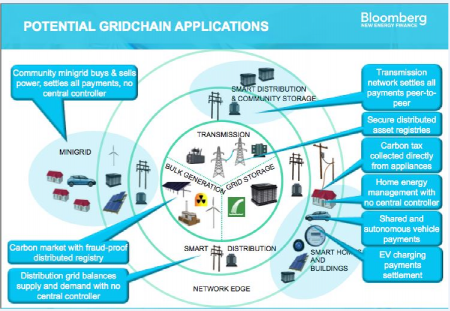
In an article this week appearing in Bloomberg Technology, authors Anna Hirtenstein and Weixin Zha, write, “Utilities are shifting away from a century-old arrangement where they monopolized both supply and distribution.” This changing business model is leading these companies to look to blockchain to create “more nimble and decentralized” transaction systems. The world of distributed energy needs a new accounting tool. New York City based LO3 Energy is a company developing a number of community-based microgrid projects, local energy networks that can operate on their own when power failures occur in the larger power grid. In one project, the Transactive Grid, a combination of software and hardware is used to buy and sell energy automatically using smart contracts and blockchain. Surplus energy produced locally spins meters in reverse and tracks the energy and its value providing an accounting for every watt.
Joining LO3 are companies like Vienna-based Grid Singularity and Finland’s Fortum who are trialing blockchain-based platforms for buying and selling energy from consumers to utilities and back.
States Michael Liebreich, chairman of Bloomberg New Energy Finance, “the old system of a few big power plants and vertically-integrated utilities didn’t really need blockchain.” But a decentralized, high-volume transactional evolution to community-generated power and microgrids requires systems capable of handling the information about diverse energy flows.
“Blockchain doesn’t mean the end for utilities, but their role will change,” states Axel von Perfall, Senior Manager at PricewaterhouseCoopers AG.
Lawrence Orsini, founder of LO3 believes energy flows will be the largest user of blockchain technology in the end. He states it will be “larger than financial services by several factors….The world runs on energy. It doesn’t run on money.”
Bloomberg has aptly named blockchain for power, Gridchain. The infographic below shows exactly what Gridchain is all about, a world where where power is no longer just centrally produced and distributed.
]]>
The intelligent machine future is now. Our existence today is being augmented by Siri, Cortana or Ask Google. We ask questions and these voice assistants provide answers by searching the data that is publicly accessible to us from the Internet. But the questions Siri can answer are simple ones. The more complex ones we ask get are getting answered by advanced machine intelligence technology such as Deep Learning with platforms like Cloudera and IBM’s Watson.
Google, probably the most invested company in the use of AI in the cloud today, allows users to tap into translation in over 50 languages, speech recognition that can turn almost any audio file into searchable text, and advanced computer vision that can parse images whether still frame or video.
Joining Google and not to be outdone is Microsoft with its offer of cognitive cloud services that include:
Data in the cloud can now be analyzed and integrated from a wide range of sources and intelligence can then be extracted in ways never thought possible. This is providing public services like never before. But nothing compares to what AI in the cloud can do for business decision making. And the business at hand is not necessarily commerce. We are talking about knowledge bases that can be mined by the public as never before.
Whether you are a manufacturer of airplanes or a researcher studying ways to cure cancer, cloud AI represents a revolution which seems to have no limits.
In an article in the Wall Street Journal that appeared in 2011, author Joe Mullich wrote a piece entitled 16 Ways The Cloud Will Change Our Lives. In it Mullich makes the following predictions:
It’s a good list that was true in 2011 and remains so today.
Are there risks in this new paradigm? Will we lose control to the machines themselves or suffer from human hackers who hijack our data? We’ve already seen one university lose control of its email server to a hacker asking for ransom. So it is not inconceivable that this vulnerability poses a potential danger. But are move to the cloud seems relentless and s few security breaches do not seem to be stopping us from this shift.
Whether IBM, Google, Apple, Microsoft or Amazon, the companies that dominate the Internet today, all see cloud computing as transformative and disruptive and the way forward for human society in a complex world facing enormous challenges.

———-
Information technology research and advisory firm Gartner predicts that by 2016, roughly 48 million applications will be available on the cloud. Meanwhile, cloud computing management firm RightScale reported 93% of organizations surveyed are already running applications and experimenting with infrastructure-as-a-service in the cloud. Enterprises and individuals alike are rapidly adopting to the cloud and changing the landscape of how we do business and store our information. Soon relying on hardware and drives will become a thing of the past. Here is what the future of cloud computing and storage has in store for us as the industry continues to evolve.
An Increase in Hybrid Multi-Clouds
Businesses have traditionally used private clouds to run applications and house their digital information. This can prove costly both in terms of equipment used and IT staff needed to maintain it. We’ll see an increasing amount of enterprises switch to hybrid clouds, combining both private and public until the latter becomes the industry standard. Businesses can use multi clouds to efficiently scale up as their needs grows; keeping the process cost effective and fluid.
A Decrease in Computing Hardware
Computers like the Chromebook [Editor’s note: I have one and it is fantastic] already rely on cloud-only applications to stay up and running. Word processing is done in the cloud with Google Docs or Microsoft Word Online. More services from video editing to project management all offer cloud-based applications instead of downloadable apps. With the rise of cloud computing, the need for hardware and related computer processing will fade. Instead, the computing process will happen in the cloud without the need to manipulate hardware to keep businesses up and running.
New Advances in Video
Instead of relying on third parties to help host content, companies can run their own on-demand video and streaming needs on the cloud. Live video has already steadily grown in popularity with the ability to watch sports and shows in real time. More online media channels and services like Amazon Prime instant video will continue to crowd the marketplace. While major networks already offer some streaming video, they’ll no longer be the king of television content as more players democratize the market.
A Spike in Demand for Better Cloud Security
Security has always been an issue for weary cloud converters who fear their personal information and customer data will be compromised. While public cloud computing can reduce costs and streamline efficiency, a business has less control over it. Cloud security will need to evolve along with cloud computing and storage to keep up with the sensitive demands of both company and individual cloud use. Encrypted passwords will need to grow stronger and evolve to deter hackers and lock down vulnerabilities. Identity theft protection services like LifeLock will only grow in demand and popularity and become the norm when working with the cloud.
More Personal Storage Options
As enterprises explore more options with the future of cloud computing and storage, we’ll also see a rise in personal use. According to Global Cloud Index forecast, over half of the global population will use cloud storage as personal storage by 2018. More people will adopt services like Dropbox and Amazon cloud storage instead of storing personal photos, videos and other information on their devices or hard drives.

Today although there are bills and charters of rights, and personal privacy laws on the books in so many countries, it seems privacy is a thing of the past. Everything we do digitally leaves a trail of bread crumbs for those who seek the bits of data. Mobile communication has become ubiquitous. And with it so have listening posts that can gather every thread of every conversation or transaction undergone on the web.
I do all my banking online as I am sure do many of you, my readers. The banks have made significant investments to ensure that transactions of a commercial nature are secure. And we trust that what they have put in place is effective. But the emails that you and I trade, or the short messages we share over our smartphones, or the web pages we view, or the phone calls we make – all can be scrutinized by those who have the tools and training to intercept the data stream. Add to this the personal information we post about ourselves voluntarily on social media sites like Facebook, Google+ and LinkedIn and we have the makings of a treasure trove of data for those same trained data snoops with their bevy of tools.
The recent revelations about the U.S. National Security Agency’s listening in on the private conversations of heads of foreign states is a symptom of technological overreach in the post-9/11 world. Communications technology makes it possible for governments to listen in on citizens. Data storage technology makes it possible to grab zetabytes (that is kilobytes to the 7th degree) and filter it to find “the bad guys.”
In Italy, a democracy, government uses a tool called the Redditometro which tries to find income tax evaders by studying the purchasing habits of its citizens. Every swipe of a credit card, every purchased subscription, mobile phone usage, vacation spending, all are analyzed to determine who is evading taxes. Some describe this new government program as an “act of psychological terrorism.” The Italian government claims that through this program they have uncovered 8,600 tax evaders and $53 billion in undeclared income from both domestic and foreign sources. They further claim that the program analysis shows that 20% of Italian households are suspect tax cheaters.
We are willing victims of the technology we purchase or get free and use. Apps we put on our smartphone can become data collectors for third parties who may have good or bad intent. Those who track their health using a smartphone app (there are at least 50 out there right now) may be unwittingly sharing this information with insurance providers. Cloud computing apps like Gmail, the email system I use, read and tag words and phrases and wrap our inboxes with context-sensitive advertising and promotions. Even this blog which I write using WordPress as the tool is sensitive to context and places advertising appropriate to the messaging of the postings I write.
So here is my question for all of you. Is there a difference between a Google or Microsoft shaping the advertising that wraps around something I write on a Cloud-based web platform because it reads words in context, or a government that uses similar tools to do the same type of data mining but for a different purpose?
We value our privacy in one sense yet at the same time billions of us in the Internet Age are sharing much about ourselves quite openly without much thought about rights. Think about just how much of us we share. Every financial transaction that involves electronics leaves an audit trail. Every bank payment effects our credit status impacting our ability to borrow. How is it possible that an Equifax can know so much about us that it can effect whether we get a mortgage or not? For it is the ubiquitous nature of the Internet Age that is subjecting us voluntarily to prison walls of our own making because we are waiving our right to privacy.

Add to this institutional erosion in our perceptions of democracy. In the United States we see a confrontation between branches of government and political parties that is leading to dysfunction at the federal level. In my city, Toronto, we have urban paralysis because of vacuous and criminal leadership and few means to correct the situation except the periodic election process. Governments like the United States and Italy are perceived as spying on us. Governments are seen as unresponsive to the larger challenges that democracies face like youth joblessness and climate change. Democracies have political parties within parties that appear to be committed to ending the effectiveness of democratic government. Add to this non-government activists focused on issues of relevance to our futures, exerting influence through the reach of worldwide social media.

We have choices to make to ensure we gain the benefits of the Internet Age without losing what we essentially feel should remain private, unassailable by government intrusion. We need to be judicious in allowing technology to be overly intrusive in our lives. We can influence those who create the technology by demanding that information sharing be an agent for improving our lives, not shaping the advertising we are subjected to, or influencing our thinking to meet someone or some party or ideology’s political agenda. Some have proposed that all of us need an electronic servant, an application that negotiates with websites on our behalf and shields us from exposing personal data that we do not want to share. Will that shield us from the probing data sniffers of a National Security Agency or some other body focused on extreme security? Will that ensure that our democracies continue to work on behalf of citizens here in the 21st century? Do we need to rethink how we organize collectively to address global challenges in light of non-state players becoming centers of action and influence approaching that of state actors?
When George Orwell wrote 1984 it was 1944 and his present included Adolf Hitler and Joseph Stalin where thought shaping was an instrument of statecraft. Big Brother was more than just a figment of Orwell’s imagination. Today we have the NSA and other security players watching all of us ostensibly to protect our democracies from the “bad guys.” But in increasingly dysfunctional governments who is determining the definition of “bad guys?”