climate scientists – Techso Mogro https://techsomogro.com/ Science, Technology and the Future Fri, 01 Jun 2012 19:15:22 +0000 en-US hourly 1 https://wordpress.org/?v=6.5.3 Climate Change Update – Probability Not Certainty is the Cautionary Conclusion of European Climatologists Studying Recent Weather History https://techsomogro.com/climate-change-update-probability-not-certainty-is-the-cautionary-conclusions-of-european-climatologists-studying-recent-weather-history/?utm_source=rss&utm_medium=rss&utm_campaign=climate-change-update-probability-not-certainty-is-the-cautionary-conclusions-of-european-climatologists-studying-recent-weather-history https://techsomogro.com/climate-change-update-probability-not-certainty-is-the-cautionary-conclusions-of-european-climatologists-studying-recent-weather-history/#respond Tue, 27 Mar 2012 17:49:34 +0000 http://21stcentech.wordpress.com/?p=3479 Does the recent warm spell over the eastern half of North America reflect climate change induced by increased greenhouse gases? When Europe experienced an extreme heat wave in 2003, two scientists at the Potsdam Institute for Climate Impact Research began a study to see if that event could be related to global warming. Dim Coumou and Stefan Rahmstorf have published an article entitled, A Decade of Weather Extremes, published in Nature Climate Change, cataloguing extreme weather events since the year 2000 including the European heat wave, the drought and heat wave that hit the American Mid-West and Southern Plain States in 2011, the rain and flooding events that struck Pakistan and Thailand in 2010, the tropical cyclone of 2007 in Oman and others.

In their conclusions the scientists stated that no single weather event proves that we are experiencing human-induced global climate change. But the frequency of unusual weather events may be an indicator of a shift away from normal climate patterns. In their cataloguing of extreme weather events one thing became exceedingly clear. The Earth is experiencing more extreme weather events than at any time in recorded history and that the events are more extreme – heavier rain and flooding, more violent storms, larger and more frequent tornadoes, and more prolonged droughts and heatwaves.
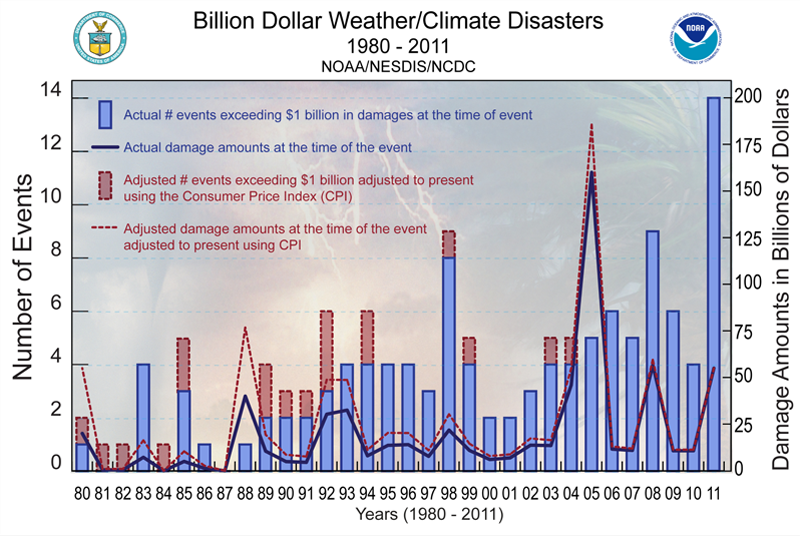
The graph above shows the increasing frequency and cost of extreme weather events in the United States from 1980 to 2011. Source: National Oceanic and Atmospheric Administration

Coumou and Rahmstorf’s data shows that globally we are experiencing three times higher monthly heat records in the 21st century than at anytime in our past. Like other climate scientists they recognize that local weather variation is not proof of global warming, but the pattern that is emerging suggests something is happening with the most likely variable in the climate model being us. We are the influence that is causing global temperatures to rise. And when the atmosphere gets warmer, weather gets more active and weather events become more extreme. So although we cannot unequivocally state that extreme weather reflects climate disruption, we can see cause…not certainty….but high probability.


]]>
https://techsomogro.com/climate-change-update-probability-not-certainty-is-the-cautionary-conclusions-of-european-climatologists-studying-recent-weather-history/feed/ 0
Bioengineering Update – If the Climate Changes Wouldn’t it be Easier to Change Us? https://techsomogro.com/bioengineering-update-if-the-climate-changes-wouldnt-it-be-easier-to-change-us/?utm_source=rss&utm_medium=rss&utm_campaign=bioengineering-update-if-the-climate-changes-wouldnt-it-be-easier-to-change-us https://techsomogro.com/bioengineering-update-if-the-climate-changes-wouldnt-it-be-easier-to-change-us/#comments Tue, 20 Mar 2012 13:59:27 +0000 http://21stcentech.wordpress.com/?p=3311 Re-engineering the planet may be tougher than re-engineering humanity argues S. Matthew Liao, of New York University, in an article, Human Engineering and Climate Change published in Ethics, Policy & Environment. With the impact of greenhouse gases and rising atmospheric temperatures, and with the growth in human population expected to exceed 9 billion by mid-century, Liao and his co-authors, Anders Sandberg and Rebecca Roache, of Oxford University, create an argument for altering our species to better adapt to a changing world.

The arguments for this approach include:

  1. Human engineering may be potentially less risky than geo-engineering the planet to mitigate climate change.
  2. Human engineering could decrease human-induced climate change.
  3. Human engineering could solve many of our social and health problems and contribute to a more sustainable planetary footprint.
  4. Biomedical modification is already within sight with the mapping of the human genome and our ability to insert genetic information into the DNA of individuals suffering from genetically induced diseases.

Why would re-engineering us be better than re-engineering the planet?

  1. Geo-engineering is a very imperfect science and climate scientists are still trying to perfect models to explain the interaction between atmosphere, solar radiation, our oceans and land masses.
  2. Geo-engineering requires all nations to commit to a common strategy for reducing our carbon footprint. Humans have shown a disinclination to achieve any kind of consensus on a common approach to date.
  3. Ge0-engineering could have unforseen consequences that further damage the environment globally. We could create a runaway cold event or induce more rapid heating if we choose the wrong technological solution.

What kinds of changes would we consider making to humans?

  1. Make humans smaller so they need less to eat and use fewer resources.
  2. Make all humans vegans by genetically modifying them to not tolerate meat and thus free up land currently used for the meat industry and repurpose it for crops.
  3. Make humans less prolific in reproduction to reduce population.
  4. Make humans more sympathetic and altruistic to reduce war and conflict.

I recently read Margaret Atwood’s messianic novel of the future, Oryx and Crake.  If you are not familiar with it, the subject focuses on bioengineering with outcomes darker than that suggested by the proposals made by Liao et al. The authors freely admit that human engineering solutions may be considered preposterous but if we are to survive as a species in a habitable Earth, it is an option worthy of debate.

]]>
https://techsomogro.com/bioengineering-update-if-the-climate-changes-wouldnt-it-be-easier-to-change-us/feed/ 5