As part of plans to build a climate-resilient future, governments around the world are investing in smart technology to significantly slash urban carbon emissions. Currently, cities account for a staggering 70% of greenhouse gas emissions (GHGs) globally. Switching to smart public lighting can reduce GHGs by 1.4 billion tons annually, eliminating the need for 1,250 new power plants worldwide.
Aside from simple illumination, smart technology experts see more than just providing illumination. These smart devices can be built to do a wide range of applications from charging electric vehicles (EVs) to providing directional assistance during emergencies and extreme weather events.
The Düsseldorf Fürstenwall has been designated the German city’s “future district” and has served as a test bed for building a sustainable city of the future. One of the futuristic projects has focused on urban lighting with a pilot project that involved installing 3,000 public light fixtures. These LED street lights have lowered energy use by 60%. The city’s electric utility, Stadtwerke Düsseldorf, has been working with the Dutch lighting supplier, Signify. The Philips LumiStreet luminaires are managed remotely using the Interact dashboard computer system. They have worked perfectly. The plan is to renovate 3,000 fixtures per year with the completion of a digitalized lighting network by 2035.
Signify provides LED lights that are more powerful than traditional sodium bulbs and produce far less light pollution. They use smart sensors that fade and brighten as needed. When a pedestrian or vehicle approaches, the lights brighten. The Interact dashboard allows for remote management of the lighting system. The smart lights send real-time status updates to Interact and identify when repairs are needed. The smart light fixtures are also compatible for use as EV charge ports.
With the growing number of EVs globally, charge station infrastructure is a growing requirement. The American government spent $25 million last year to acquire smart charging ports for its federal properties because of growing EV demand. The number $25 million is a drop in the bucket when compared to the annual energy budget of $50 billion for the U.S. government. Smart lighting is almost a rounding error, but the Düsseldorf test bed is providing a compelling case for the U.S. and others to consider installing smart light-EV charge stations like the ones in Düsseldorf. Combined with Interact, drivers can be guided to the nearest open charging port that will light up upon their arrival.
Another novel lighting technology comes from Toronto-based Clear Blue Technologies. This company has been developing smart lighting technology systems since 2011. They operate off-the-grid in any environment, urban or rural. The company manages its light installations around the world using the Clear Blue Ilumience cloud app. The lighting fixtures can install anywhere. They are off grid. No trenching or cabling are required making installation costs low.
The llumience cloud app is accessible by computer or smartphone. Lighting profiles are customizable to meet time of day and day of the week requirements. Adjustable light intensities can be provided for streets, roads, parks, and bridges around the clock. Illumience also provides customized alarm thresholds linked to the performance of each component within the light fixture and sends messages and email maintenance alerts. System maintenance can be remote, lowering the need for on-site visits and reducing maintenance costs by 70%.
A recent Intel report forecasted that the street lights of the future will be equipped with smart sensors to help people in emergencies, including road accidents. It appears the future is now, looking at what Signify and Clear Blue Technologies have accomplished in the present.
The Intel report described lighting fixtures equipped with IP cameras to live-stream video showing vehicle and pedestrian traffic around the clock. The lights could be used to dispatch police, fire and medical emergency staff to an accident or emergency. The lights could automatically adjust their brightness to help with rescue requirements.
With extreme weather events fuelled by climate change on the rise, by 2030, the U.S. expects to see more heatwaves, storms, floods, and droughts. Smart street lighting can help with lights programmed to flash on and off, display different colours, highlight safe evacuation routes and more. Speakers integrated with the light fixtures could be used to provide audio warnings. Off the grid and wireless Internet features also mean smart lights that can continue to operate even in the face of power outages.
The energy savings, the multipurpose capability of smart lighting fixtures to serve the growing EV-support infrastructure, their emergency safety features that can be added, the remote management capability, and the low installation and maintenance costs, make widespread adoption of smart lighting inevitable as the 21st century unfolds.
]]>Almost any area on this planet, that’s who. When I spoke with Miriam Tuerk, CEO of the company this week, she talked about managing the power and operation of sites in 36 countries, and 30 U.S. states where off-grid infrastructure, much of it remotely placed, is already using Clear Blue to ensure high levels of reliability. Through the company’s operational centre in Toronto, it monitors tens of thousands of devices from street lighting to Internet-of-Things (IoT) smart sensors critical to telecommunications, oil and gas pipelines, and lighting operations.
The company has hauled its technology across the Andes Mountains into Peruvian Amazonia to sites where it installed telecommunications and lighting systems technology backed up by battery storage which they it then immediately began monitoring continuously from Toronto, thousands of kilometers away.
In Africa, the company is partnering with Facebook and local telecommunication providers and has doubled deployments in recent months.
Tuerk describes EaaS as one of the fastest-growing businesses in the emerging field of smart power. Customers, by paying an annual subscription fee for energy services says Navigant Research is a market expected to grow to $221 billion USD by 2026.
Tuerk states, “Just as cloud services like Amazon Web Services transformed the IT industry, EaaS can transform the power industry.”
How so?
By ridding customers of having to operate and manage powered assets, a significant saving.
Clear Blue, in announcing the launch of EaaS notes that more than 70% of new electrical power connections in the next decade will be off-grid or on mini-grids. And one of the biggest points of failure and costs will be battery storage ensuring equipment at these sites remains up and running 24×7.
With battery reliability a big issue, and limited warranties from the manufacturers, Clear Blue in the last five years has collected massive amounts of data on battery performance, testing more than 50 different providers. Comprehensive data analytics has given them the ability to choose the best battery options for working in a variety of remote environments with highly varied climate conditions. Tuerk told me that they have identified three batteries out of the more than 50 which are best in class and ensure installations they implement get reliable, continuous, clean power.
Today, 4.39 billion people on the planet have Internet access. The vast majority live in locations where power comes from the grid. But it is the next 3 billion that when connected will largely be off the grid or receiving local distributed power from mini and microgrids. These are the Clear Blue and EaaS customers of the future, and with the launch of this new service, the company is providing a positive disruptive technology that will change the lives of many of those 3 billion still disconnected from the 21st century as the next decade unfolds.

In 2014 the United Nations predicted that 50% of the planet’s population would be on the Internet by 2017. But the latest figures show that the 50% mark will not happen until the middle of 2019 if not later. The definition for being on the Internet as far as the U.N. is concerned means a user has access to a device with connectivity at least once in three months.
Throughout the period from 2005 to 2017, growth rates for Internet access have increased annually at an 11% clip. But in the current year, the rate has slipped to 6% leaving 3.8 billion currently unconnected.
So what’s slowing connectivity? A lack of affordable telecommunications and the power to connect in many countries. The expense of putting infrastructure in place has made it difficult for Developing World countries. There is little in the way of return on investment for large utilities and telecommuncation providers when the customers are largely poor. Hence, the infrastructure doesn’t get built unless the government gets involved. And once done, telephone and data connectivity may have little appeal to users unfamiliar with the technology, or unable to pay.
What is the value proposition that Internet connectivity is bringing to areas of the Developing World where it currently doesn’t exist?
Does affordable connectivity to the Internet automatically change Developing World societies that get it?
According to Manjira Sambuli, of the World Wide Web Foundation, “technology is not a silver bullet” to societies where economic inequality is part of the social dynamic between women and men. “In some communities, the whole idea of women owning anything of their own, even a mobile phone, is frowned upon.” So wherever Internet connectivity goes, the hope is that it begins to break down social divides to address economic and educational inequality which remains pervasive in many parts of the Developing World.
A company in Toronto, Clear Blue Technologies, has made central to its business mission, the ability to deliver and remotely manage off-grid telecommunications and power to digitally isolated communities in the Developing World. It has partnered with a number of companies including Facebook and telecommunication providers working in Africa, Asia and Central and South America.
Just how difficult can it be for telecommunications companies to bring the Internet to digitally isolated communities?
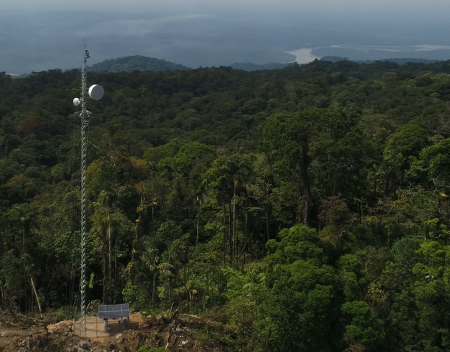
In a recent installation in the Peruvian Amazon, Clear Blue Technologies, working with Telefonica and May Telecommunications, had to carry 20 tons of equipment over a roadless landscape to a digitally isolated town of 25,000. All equipment had to be hand carried on hiking trails, taking over three hours to reach mountain tops where the systems were installed (see picture below). This deployment was for 25,000. Now imagine many of the 2 billion expected to have access being in locations equally challenging.
I am convinced that the Peter Diamandis prediction for 2025 is off by hundreds of millions if not a billion. It won’t happen without the deployment of technologies like the one Clear Blue has developed. And that means a concerted partnership among governments, utilities, software companies, telecommunications providers, and charitable foundations to help fund, deliver and operate in conditions unlike any that existed for the first 3.5 billion. In the current state of our planet, I am not sure there is the collective will or the money to connect and empower the next 2 billion before 2030.
Most of the time when I write about a positive disruptive technology it is because I find them doing a Google Search. And most of the time the companies are far away from my Toronto home base. But in the case of Clear Blue, it is right in my backyard which gives me the opportunity to have some face time with what I consider to be a company that understands the paradigm shifts happening in this century around power and connectivity.
Clear Blue builds smart off-grid power systems designed to light up villages and streets, power wireless base stations, and provide a reliable energy source to security cameras, and Internet-of-Things (IoT) sensors and devices anywhere in the world. The technology comes in different flavours beginning with installations capable of delivering 25-watt base power and growing to the low-kilowatt base load range. Clear Blue has technology solutions that work with solar, wind and battery, managing the power and load, with the company remotely monitoring every site in real time. Its installations can be found in 34 countries around the globe with many of the sites in remote locales where off-grid low-watt power systems can make a significant difference in the lives of people who have never had access to reliable, continuous power and connectivity.
Their latest project is just one example of just how much a difference off-the-grid can make. Located in Delta State, Nigeria, Clear Blue has been involved in the deployment of a power and remote management system for 280 lights over 20 kilometers of rural road. Where a traditional utility provider would have had to build a hard-wired transmission infrastructure to reach the location, Clear Blue’s solution was dropped in, deployed smoothly, and provided results in less than a month.
The company’s modus operandi is to work with local telecommunications and infrastructure development companies at most global sites. In the case of the Delta State project, the local partner is Raeanna Nigeria Limited. Jay Ogor, the CEO of Raeanna, describes the challenges to deliver reliable power where needed with more than 80 million of Nigeria’s 186 million who have no access to electricity. He states: “Many previous projects in Nigeria have struggled to deliver reliable, high-quality power solutions…The success of Clear Blue’s Smart Off-Grid power technology on…previous collaboration made it an easy decision to utilize it for…street lighting in Delta State. Our plans and focus are to expand our rollout across Delta State and other regions of Nigeria, as it is key to the long-term betterment of Nigeria by bringing back a vibrant street life.”
This is not a unique story. A lack of rural electrification is a symptom of an overall deficit throughout much of Sub-saharan Africa. Solving the continent’s perennial power shortage problem is critical with more than half the people of Africa living without electricity. In a recent World Energy Outlook, it reported that number to be 26% of rural Sub-saharan Africa. The lack of reliable continuous electricity holds back the continent, and the economies of every one of its nations impacting commerce, education, health and more. As a result, Africa cannot fully take advantage of other transformative technologies that would raise all boats including reliable and continuous Internet access, adoption of smartphone technologies on mass, development of a thriving fintech and micropayment system independent of and in cooperation with banks, and more. That’s why dropping off-grid power systems into rural Africa and other remote locales around the world makes so much sense.
Clear Blue’s unique ability to remotely manage every installed site means implementation can be put in place quickly with continuous 24 x 7 monitoring. The Illumience cloud management system is Clear Blue’s secret sauce turning power system solutions into a subscription service. From its Toronto headquarters, Clear Blue manages and monitors the performance of every street light, telecommunications base station, security camera, and IoT device and sensor at all installation sites around the world. Every node is visually mapped and seen in real time. Automatic alarms get triggered by any light or other device not performing to the criteria established at the time of installation.
Tuerk described to me a recent installation site which required bringing the hardware into a remote cross-Andes Amazonian area of Peru. That meant transporting the equipment over mountainous terrain where no roads existed and dropping it into the upper Amazon jungle. Once it arrived the installation was straightforward and the system was able to provide base power for lighting and telecommunications while back in Toronto operators more than 6,000 kilometers away remotely monitored the site the moment it went live.
Tuerk describes how the various hardware and software management solutions the company offers is, in fact, turning power delivery and the associated technologies the company supports into a subscription service. And although the company remains relatively small, through its Developing World partners, it is seeing rapid growth in its customer base with demand for its unique value proposition continuing to grow.
This summer the company went public and today trades on Toronto’s TSX Venture Exchange (TSXV?CBLU), where it represents one of the first cleantech companies to be listed there. Clear Blue is truly representative of a rising number of positive disruptive technology companies bringing change to the 21st century, and helping to solve its many challenges. I promise to keep you informed about its progress in future postings.

]]>
As the 20th century unfolded we witnessed the development of centralized power generation and voice distribution systems operated by utilities with growing networks of wires and transmission towers that first spanned cities, and then entire continents.
The latter half of the 20th century saw the emergence of the computer. Suddenly electrons flowing down wires weren’t limited to just power and voice. Data had joined the mix. And then as the last two decades of the century unfolded, the wires got cut with wireless transmission evolving from radio to telephony and data transmission. And data networks made the Internet possible.
Was all this connectivity evenly distributed across the planet? No. Vast areas of the Developing World, sub-Saharan Africa in particular, continue to remain in the dark. In fact, over one billion on the planet have no access to reliable electricity. Connectivity to the power grid comes at a very high cost.The problem is not limited to Developing World communities. In my country, Canada, more than 200 indigenous communities largely in remote and northern locales remain without access to power from the electrical grid. Instead, they are dependent on diesel generators.
For utilities operating from centrally-located generation facilities, meeting the needs of the disconnected last billion with 20th-century technology remains problematic and costly. And then there is anthropogenic climate change requiring power generators to consider distributed power generation and renewable energy alternatives.
We may be witnessing the beginning of the end for the ubiquitous power grid as the 21st century unfolds. What will replace it? Last week, I went to find out when I visited Clear Blue Technologies, a Toronto, Canada-based company, founded in 2011, whose CEO, Miriam Tuerk sat down with me to talk about the future of electrical power generation and distribution. She and her husband, John, are well versed in understanding the future of the power grid and the role off-grid will play in providing electricity to wireless, standalone applications.
Clear Blue Technologies represents a new generation of companies focused on providing a hardware-software service for off-grid power delivery and management. The company’s technology optimizes power to any off-grid installation requiring a reliable continuous electrical feed. This applies to everything from street lighting to telecommunications towers supporting mobile wireless.
Tuerk’s company has built the world’s first, smart management system for off-grid systems. She uses the word “nano-grid” defining the types of power requirements of these off-grid devices as being in the low kilowatt range, in comparison with microgrid megawatt range.
Tuerk also notes that Clear Blue Technologies is built as a service. So it is not just shipping a product to its customers, but rather, offering management of the energy powering the lights, or the wireless base stations, or other infrastructure requiring off-grid power.
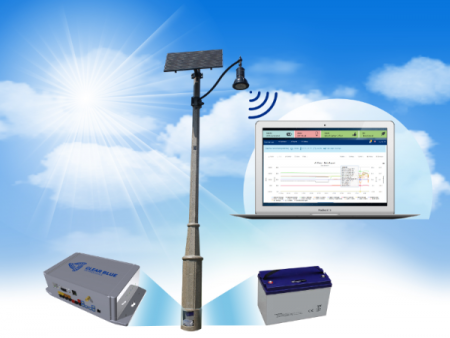
One of its more recent installations in Hamilton, Ontario, received the Canadian Outdoor Lighting Project of the Year award. Clear Blue technology was deployed to manage 40 solar-powered lights. Solar-hybrid controllers mounted on the light poles, connected to remote management software at Clear Blue providing real-time dashboard views of the power to the lights, tracking performance, and flagging and correcting potential disruptions before they happen.
Lighting today poses a particular challenge for cities. It is their number one operating expense and is largely managed through periodic visual inspection neighbourhood by neighbourhood and block by block. United Nations calls for cities to be dark sky compliant will require them to rethink the lighting deployed. Clear Blue’s technology can certainly help through the remote management and monitoring of off-grid light sources turning them off when conditions are appropriate. That is the degree of granularity possible using Illumience, Clear Blue’s cloud-based software application.
Facebook, the social media giant of the Internet, has made Internet connectivity to areas of the world still disconnected, a major initiative of the company. Tuerk describes how Facebook approached her to help in this effort. The social media company identified Clear Blue as the only company today capable of making it possible to deploy and remotely manage thousands of small sites using off-grid energy sources to power up the technology being deployed to connect these remote communities to the Internet.
Clear Blue can do this because of Illumience, its cloud-based open-source compliant software that features continuous remote monitoring, proactive maintenance sending alerts as text or email, predictive weather analysis, and remote changing of off-grid power feeds to match changing local conditions.
Ultimately what Clear Blue is doing today is a reflection of the fundamental change occurring worldwide as more technology becomes powered by off-grid sources in a world increasingly no longer dependent on power over wires. In this new wireless world, energy will be sourced from solar, wind, battery, and other standalone technologies replacing utility-based delivery and leading to the democratization of power generation. It cannot come soon enough for those sites on our planet today that are held back by the lack of reliable, sustainable energy, and Internet connectivity.
]]>