Why is this a legitimate fear? Because on Earth we have discovered life capable of surviving Martian conditions. We call this type of life extremophiles, organisms that thrive in environments so extreme that it defies our understanding.
Our view of life is anthropocentric. We visualize it through a human lens. When we talk about life on exoplanets we refer to the Goldilocks Zone, not too warm, not too cold, a place where water exists in a liquid state. This is our definition of planets suitable for life. And yet here on Earth we have life thriving in environments that are clearly not within that definition.
There are lots of examples of extremophiles on Earth. They include:
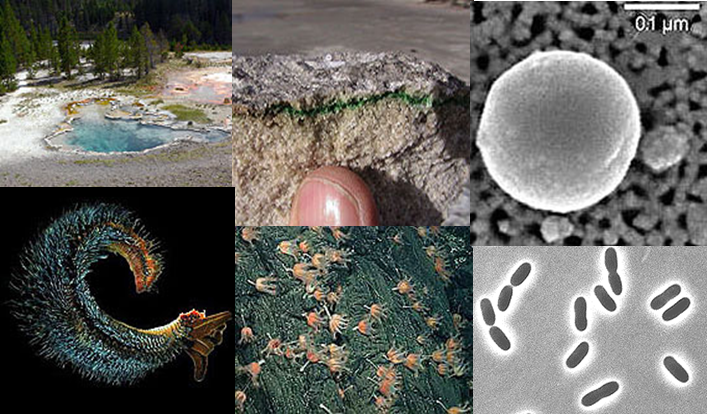
On Earth extremophiles thrive in hot springs, in the vents of volcanoes, in hydrothermal undersea vents called black smokers, in intensely alkaline or acidic solutions both natural and industrial, in spent rod storage tanks within nuclear power plants exposed to high radiation doses, in lakes buried under hundreds of meters of ice in the Antarctic, within rocks thousands of meters below the surface, in caves, on mountaintops and free floating in the upper atmosphere. Some examples of the environments and extremophiles that thrive in them can be seen in the images below. As one researcher commented, “we didn’t know if anything could grow at 7 millibars.” Now we do.
So if life on Earth can thrive in what we humans would consider impossible conditions what would stop it from hitching a ride on what of our robotic spacecraft that lands on Mars or any other planet or Moon we choose to visit? Earth scientists do take precautions to try and prevent contamination. At NASA spacecraft are assembled in what are called Class 100 clean rooms in which scientists and engineers where bunny suits with hoods, masks, gloves and booties. The rooms are equipped with microbial barriers. Clean rooms have air pressure higher than ambient pressure to ensure that air flows to the outside rather than the reverse. Air filters, fallout strips and other technology collect samples to ensure the assembly environments are microbial free. And once assembly is complete the spacecraft are either baked in an oven at temperatures exceeding the boiling point of water for 30 hours, or placed in a low-temperature chamber and exposed to multiple treatments using hydrogen peroxide vapour. Throughout assembly the surfaces of all materials going into the spacecraft are repeatedly tested for presence of spores and bacteria.
But with all of these precautions there are no guarantees. Think about the Phoenix Lander which discovered water ice and a salty perchlorate brine when it landed near the polar ice caps of Mars. The data received from it indicated an environment in which some of the extremophiles I have described above could find a biological niche and thrive. Curiosity in a much more benign Martian environment could inadvertently test biology that hitched a ride on board on the long voyage to Mars, surviving the extremes of space, and Martian atmospheric entry. That’s one of the reasons scientists are cautious about data coming from the robots we send to explore Mars in the search for conditions that could support life. It could be Earth life that they find.
In a recent study here on Earth using a non-extremophile bacteria, Serratia liquefaciens, scientists subjected cultures to Martian conditions (low temperatures, atmospheric pressures of 7 millibars, no oxygen and the absence of water). Surprisingly the bacteria survived. In a complimentary study six types of Carnobacterium, recovered from permafrost core samples, were exposed to the same conditions. All survived and grew. The study on Carnobacterium appeared in theProceedings of the National Academy of Sciences published in December. The one on Serratia liquefaciens appeared in Astrobiology.
]]>