COP22 in Marrakech preceded and has followed the U.S. election. Its proceedings conclude at the end of this week. For the attendees the victory by Donald Trump changed the dynamic from business as usual to one of renewed purpose to implement negative emission strategies and technologies to speed up global efforts to decarbonize. Trump’s triumph is being viewed as a catalyst for smaller nations to step up and take charge. Overall there appears to be renewed commitment to meet global carbon neutrality by 2050, 34 years from now. The community of nations remains committed to phase out coal-fired power, to attain 70 to 80% of electricity from renewable sources, and to implement carbon capture and sequestration (CCS) eliminating emissions by as much as 16% all by 2030. It is an ambitious plan and the question in many minds now is will we need the United States on board?
For Donald Trump, as a business person, his frame of mind is not oriented to sustainability. His mindset doesn’t focus on global impacts. Because he is not in the energy field he doesn’t have experience looking at the issue of carbon risk and its impact on his business model. But now he has to head up a government with global responsibilities. His country is the world’s largest economy and its second largest carbon emitter. Now he has to look at carbon risk and its impact on relationships with other nations. That means a change in mindset is needed.
The question is can he do it? If he is incapable will his actions stop global progress on carbon emission reductions?
There is a growing consensus that at his best he may suddenly grasp the difference between business and government and begin to address global consequences of ignoring the scientific evidence and the actions of other nations. At worst he may remain a business person who has no concept of global risk. That person can appoint the wrong people in positions of authority. That person can end the United States involvement in global greenhouse gas elimination initiatives, climate mitigation and adaptation. The world’s best hope is that the hiatus of American non-involvement on the climate file will only last four years. Then a new American president can rejoin the world community but at a significant bump up in cost that will probably amount to trillions of dollars.

The biomethane produced by Clean Energy is 90% cleaner than diesel. Extracted from organic waste it is processed, purified and dispensed through pipelines to the company’s fueling infrastructure where it is then compressed or liquefied. It then gets transported to stations where it is sold as fuel. The company has plans to produce 56.8 million liters (15 million gallons) of the stuff over the next year.
On the company website it claims that using Redeem will allow a car fleet consuming on average 3.8 million liters (1 million gallons) per year to reduce its carbon footprint by 9,700 metric tons. That is equivalent to taking 1,940 cars off the road.
Redeem is lower priced than gasoline or diesel, ans should be a very attractive offering particularly to vehicle fleet operators.
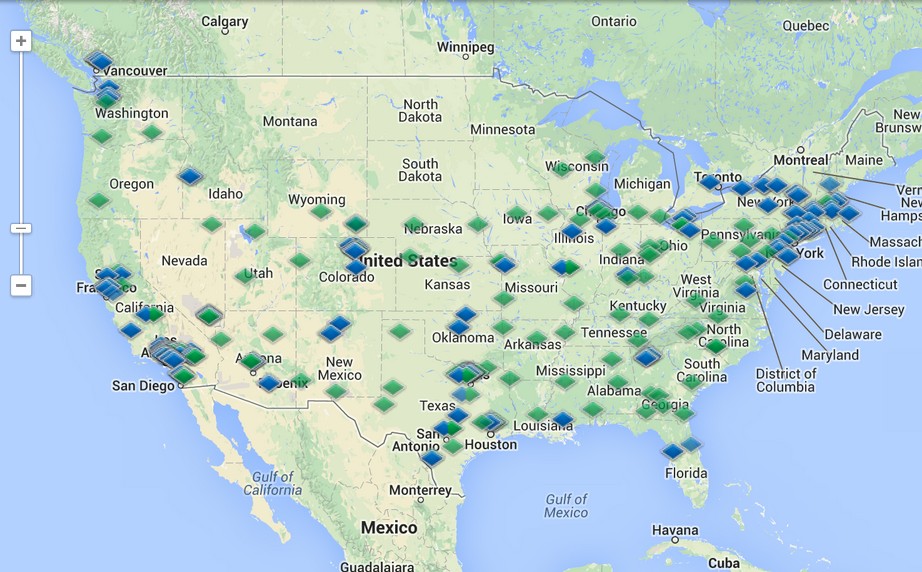
The map below shows where current and future Redeem supplied stations are located. Current ones are in blue and dark green. Future stations are in the lighter green.