Businesses impact the environment and have a responsibility to make sustainable changes to reduce the adverse effects of poor environmental performance. This is a 21st-century mantra likely to become the way businesses operate and sustain themselves shortly and beyond. Either adoption of circular economic principles will happen by choice or government and societal pressure will compel them to act.
With this in mind, adopting new economic principles encouraging circular and sustainable best business practices is a game-changer and likely the key to survival.
What’s involved? Specifically, strategic planning, circular supply chain management, cost management, logistics, and research and development are examples of areas where circular economic practices can drive businesses toward innovation and sustainability.
In this article, we’ll look at each of these strategies, but first, a definition of what is a circular economy. An article in The Guardian that appeared in 2016 provided ten things to know about a circular economy. Simply put, circular economies reuse and regenerate materials or products so that things are constantly being cycled back through the business to create more sustainable practices that leave a small environmental footprint.
A primary benefit of adopting a circular business model is that it drives innovation. There is economic value in adopting sustainable practices through the revamping of policies and processes. Sustainability practices also help reduce carbon emissions, improve energy conservation, and provide more efficiency in the use of resources.
In other words, a business helps protect the environment and helps itself. One company, Ginkgo Sustainability, develops living roofs and living walls that use plant power to lower energy use in buildings while improving inside air quality. Using its systems makes a business site eco-friendly and more sustainable. Living walls is better for those working within them. And green roofs don’t contribute to heat island effects.
As I have previously written in postings to this site, financial benefits come from adopting eco-friendly business models. Increasingly, consumers are demanding more eco-friendly goods. So going green attracts the more eco-conscious. And then there are the tax benefits and incentives, rebates and tax breaks that governments are offering businesses to get greener.
Circular business models are about building and rebuilding the overall health of a business. They are based on the idea that the economy is like an ecosystem with co-dependencies that need businesses, organizations, and individuals to do-no-harm in their interactions.
Circular business models involve adopting the following practices:
One of the primary sustainability concerns is the overconsumption of materials. So instead of procuring or developing new material sources which use up dwindling resources and contribute to waste, businesses find ways to use what they already have such as using recycled plastic, for example, instead of using new plastics, or in building projects using sustainable construction materials such as recycled wood, bamboo, or faux wood made from recycled plastic.
It is important to establish ways to recycle and reuse the materials and products a business has already created and put into circulation. For example, some companies offer programs that enable consumers to return products when done with them so the materials can be reused or refurbished to create new products. Another example is to use everything that comes onto a factory floor for creating a product. This means scraps left over that in the past would be thrown out, instead get used in innovative ways rather than being thrown out.
Continuing with the topic of waste, implementing more sustainable waste management processes is essential to circular business models. Landfill sites are significant contributors to pollution producing greenhouse gas emissions that are bad for the climate and damaging to human health.
Companies can find ways to reduce waste output by being more mindful of reusing and recycling materials. They can make operational changes as well that reduce waste and pollution through the adoption of automated technologies that optimize energy consumption, and eliminate the wasteful use of single-use plastic and paper.
Changing consumption habits covers more than materials. It also includes energy a business uses. If electricity comes from fossil fuel-burning power plants which release greenhouse gas emissions that’s a no-no to sustainability. It is crucial for businesses adopting circular economic principles, therefore, to find other energy sources such as utility providers that use wind and solar. Roofs can become energy generators by installing solar panels. Where once there were many barriers to achieving zero-emission energy access to 100% renewable sources today is far more attainable. Costs have dropped and government tax incentives make implementing this attractive.
Though going green and adopting a circular business model is much easier today, businesses still face challenges. But the more companies make sustainable choices and changes the more they will drive down sustainable resource costs making the move self-reinforcing. At the outset, there may be higher cost outlays as a business transitions to circular economic principles. But the long-term financial benefits and the benefit to the environment and society will be worth it.
]]>The energy industry is no longer on a quest alone to reduce its carbon footprint. Climate change concerns are making businesses everywhere look at greener strategies, processes, and investments in their operations.
As a result, the opportunities to transition today’s marketplace to a more climate-friendly economy are increasing. Businesses, today, can reduce their carbon footprints and build profitability which can lead to increased investments in more green initiatives. Let’s look at how low-carbon goals can change our global economy to better support environmental responsibility.
As businesses work to reduce their carbon footprint, global leaders in government and finance are taking notice. Planning for circular economies, more efficient systems to reduce waste in products and materials, is no longer isolated and one-off. Adopted circular economic practices are changing manufacturing processes, and reducing their environmental impact. Governments and financial institutions enacting green regulations and guidance are change agents.
Today, companies are working within an ESG (Environmental, Social, and Governance) framework which has roots in environmental compliance and the application of safer environmental industry standards. ESG has become a bellwether for businesses attempting to attract top-flight investors, employees, customers, and suppliers. Companies that strive to be environmentally focused are reaping the rewards.
Investing in climate-friendly initiatives benefits companies. Here’s what firms can do.
Governments are encouraging green initiatives and implementing new environmental regulations and plans. In the United Kingdom, these include:
The United Kingdom isn’t alone. The American Inflation Reduction Act, the European Union’s commitments to net zero even sooner than 2050, and Canada’s new federal environmental initiatives cannot be ignored by businesses if they wish to be seen as good environmental stewards.
Governments are creating environmental business taxes to promote a cleaner marketplace. The taxes penalize industrial processes that pollute, carbon emissions, and gasoline and diesel usage. In the United Kingdom, these taxes are relatively high, but at the same time, the government is providing tax incentives to help companies make the transition. Smaller companies that lack sufficient capital to easily make the transition can access programs to help them offset these new taxes.
Every company seeks to build brand awareness and reputation, and one of the ways they can do this is by committing to a reduced carbon footprint as a core business value. For example, adopting an ESG framework with measurable scorekeeping sets a company apart from competitors, particularly when integrated into every aspect of the business.
Communicating ESG goals to customers and prospective employees is good for both the business and the brand. Businesses dedicated to climate action need to let the world know why and what they are doing using all the communications tools in today’s arsenal: press, social media, sponsorships, and other forms of public engagement.
Research shows that companies that support climate action are of interest to today’s investors, consumers, employees and markets. Consumers are willing to pay more for companies that offer environmentally-responsible products and services.
Profits generated by such demand are just one of the financial benefits of an eco-friendly business. Governments in both the U.S. and the U.K. are working to provide subsidies, including grant programs and financing options to boost businesses enacting green initiatives through the U.S. Inflation Reduction Act, Environmental Protection Agency regulations and work being done by the Small Business Association.
Promoting green initiatives such as waste reduction, energy conservation, material recycling, and application of circular economic principles can save money by driving down the cost of doing business.
Employing greener measures has the potential today to make business more profitable. One promising move a company can make is to look for a green energy provider or become its own renewable energy supplier. Businesses increasingly can find solar, wind, and energy storage options to fit the company’s footprint.
In 2016, Tesla, the electric vehicle manufacturer, merged with Solar City, a solar power system provider and together, built a microgrid for Ta’u, a small Pacific Ocean island. This real-world experiment in solar power demonstrated lower energy costs for the entire island with output far exceeding daily demand.
Businesses today can find many green energy investment opportunities from existing renewable sources as well as nascent technologies that are available now. These include seeking out renewable providers of hydroelectricity, wind, and geothermal energy.
With the future pointing to a low-carbon economy, businesses now can make investments in the above options to ensure their sustainability and a safe and healthier environment both in the present and future.
]]>It is not easy to practice the “do no harm” principle when you’re a small business. Having operated one myself as a consultancy for two decades I am sympathetic to what usually dominates small business thinking: flying by the seat of your pants, operating day to day, and looking backward rather than forward knowing you have survived another year.
Does sustainability enter the equation? Maybe if you are a publicly traded corporation with investors like BlackRock issuing sustainability marching orders or face divestment, but certainly not when you are business with a few employees or even a hundred. For the latter, the idea of sustainability is “a nice to have” more than a reality.
But that may be changing as consumers become more cognizant of the environmental impact that climate change is making around the world. To attract future customers, therefore, small businesses are starting to take the first steps to achieve sustainability goals. Their customers are thrilled.
But what is sustainability? Our definition is as follows. Sustainability is a business approach designed to create long-term value by taking into consideration how an organization operates in the ecological, social and economic environment. The assumption is that such strategies contribute to a company’s survivability and longevity when competing with others in the marketplace.
Note that nowhere in the definition does it state “do no harm.” So why bring it up? Do no harm means for every operational aspect and business decision, from the selection of suppliers, the sourcing of materials and services, the manufacturing, the distribution, the consumption and the post-consumption, businesses need a plan. You may not be familiar with the term the circular economy, referenced in an article posted on this site last year that focused on decarbonizing industry. Whereas the article looked at the macro impact of applying circular economic principles, in this case we are applying it to small business. No business, however small, operates in a vacuum. Its relationships are numerous and in creating true sustainability needs to embrace the larger universe in which it operates, the global business ecosystem.
Reaching the goal of not harming the planet requires significant changes to the operational mindset, business structures and culture. It can be very challenging for a small business that doesn’t have lots of investment capital to alter its way of doing things. But small businesses can begin to incorporate best practices in sustainability incrementally as they work towards full circularity within their business ecosystem.
Many businesses begin their sustainability journeys through small changes: things like like starting a recycling program and removing disposable utensils and cups from the breakroom. Over time the business might become more ambitious by encouraging employees to work more from home to limit carbon emissions from driving, by installing energy-efficient building upgrades, or by encouraging customers to bring their own bags.
Evena small business can seek to influence its suppliers to be more sustainable, or it can search for more sustainable alternatives. This is where sustainable supply chain management comes into play, cleaner, eco-friendlier management is a big driver of circular sustainability regardless of industry.
Then there are the social and government policies, pressures and incentives to make these changes easier than ever before. Although many would have never dreamed it to be a reality, the green movement is making a real difference with consumers willing to make sacrifices to support businesses trying to do the right thing for the environment. Taking steps to become more sustainable may end up being the most important decision a small business can make in the 21st century.
But just because your small business is taking steps to become more environmentally friendly doesn’t necessarily mean that customers will know about it. This is where sustainable marketing comes in. Marketing sustainability is a means to communicate a company’s values and achievements to its customers as well as a way to attract them to its products.
Many argue sustainable marketing has become more important than ever. This is something customers are looking for and if the business isn’t telling this story then no one else will. That’s why any long-term marketing plan needs to include sustainable goals and strategies with messaging to keep customers engaged in the process.
Interacting with customers can also mean asking them to become participants in meeting the sustainability challenge. For example, customers can be asked to bring their own bags when they shop. It can also mean explaining why some products come shipped with less packaging, or cost a bit more than similar items sourced elsewhere. It is all about adhering to the principle to “do no harm.”
]]>The report looks at both the supply and demand side of world business. It introduces technologies and policies that include energy efficiency, carbon capture, electrification, and zero-carbon hydrogen feedstock for multiple industrial, residential, commercial, and transportation purposes.
The focus is on eliminating the 33% of GHG emissions contributed by three key industries (see graph below) that are among the main contributors to global warming. They are the cement, iron and steel, and chemicals and plastics industries. Alternative net-zero carbon methods to produce these critical materials exist. Acceptance to move to these methods for these primary industries has been the challenge.

Many on this planet are concerned about material waste. It is pointed out to us that our oceans are filled with single-use plastic, that our landfills are home to materials that can be repurposed. We are becoming more aware of the need to create circular economies within industries through better design, reusability, refurbishment, and recycling.
So how do you get industry to make the move to net-zero and adopt a circular economy business model?
A well-designed policy is an innovation accelerator.
Industries are looking constantly for productivity and process improvements to gain competitive advantage. But now the focus of that improvement can include low-carbon and zero-emission technologies which can become competitive advantages as well, and potential revenue-generating products to be offered to the global market. And we already have many of the breakthrough technologies at hand, from 3D-printing to new materials, chemical catalysts, and innovative automation processes that can contribute to GHG emission reductions.
Renewable-electricity-sourced hydrogen created through electrolysis is seen as critical to industries transitioning to net-zero emissions. Hydrogen that is not produced from fossil fuels is seen as key to decarbonizing transportation, heating, and industrial production. But hydrogen requires the rapid scaling of its production and the building of a hydrogen distribution and storage infrastructure equivalent to what oil and gas have today.
Cement – production exceeded 4 billion tons in 2018 with carbon dioxide (CO2) release occurring both at the beginning of the process in terms of energy input as well as during the manufacturing process. Cement’s contribution to GHGs globally is 8-9%. Changing the energy used for production from thermal coal and natural gas to renewable can remove input emissions. But in manufacturing, it becomes necessary to reformulate the chemistry of cement production to create significant CO2 reductions. There are solutions out there that bind CO2 into cement turning it into a carbon sink through capture during production. And then there are manufacturers who produce cement using captured carbon from third parties. A Halifax-based cement manufacturer has proven the efficacy of the latter in developing green cement products.
Global steel – production amounted to 1.8 billion metric tons in 2018 with 71% produced using blast furnaces, and the balance largely using electric arc furnaces. A blast furnace produces from 1.8 to 2.8 tons of CO2 per ton of steel. Arc furnaces if using a decarbonized electrical power source produce as little as 0.7 tons of CO2 per ton of steel. Most of these producers are operating at the limit of what is practical in terms of efficiency which means to reduce CO2 emissions will require one of two things: implementing CCS in production processes, or creating a new process that uses hydrogen.
Chemicals and plastics – produce nitrous oxide and CO2, both potent greenhouse gases. These end products largely come from fossil fuels. One way to significantly reduce the GHGs coming from this sector is to source the feedstock not from fossil fuels but from elsewhere.
Substituting biomass for fossil fuels may be the answer. Biomass contains lignocellulose, the dry remains of plant materials and the byproduct of saw and paper mills, is the most abundant source of organics materials on Earth. Creating commercial technology capable of turning lignocellulose into chemicals and plastics represents one way of dramatically reducing this sector’s CO2 contributions.
Used plastics represent another feedstock for chemicals and new plastic. The challenge for this to become commercially viable lies in ensuring a steady source of usable feedstock materials. Poor implementation of recycling programs, and contaminants in the waste plastic, have made this material source problematic.
CO2 itself can be used as a feedstock to produce chemicals. This is where carbon capture combined with hydrogen can become a significant contributor to the chemical and plastic industry. But using CO2 as a material source to become commercially viable requires a significant increase in energy produced from renewable sources exclusively.
Separation technologies can also be used to produce chemicals. These processes use thermal distillation, drying, and evaporation. The energy input represents the largest source of GHG emissions. But switching to renewable energy input can make separation technology more efficient. And where will this have the greatest impact? In desalination plants where increased water scarcity from climate change is an impetus to improve separation processes.
What gets produced in all three industrial sectors must keep in mind that less new is better for the environment. That means extending the life of the products that get produced whether raw steel and concrete, cars, trains, or buildings. Today, a typical building in the Developed World has a life of between 60 and 80 years. Most buildings can last far longer than that but the cost-effectiveness of keeping them decreases over time for a number of reasons including rising land value, and the cost of upkeep. Increasing the longevity of buildings and making them easier to maintain and more flexible for repurposing and expansion is therefore, an important way to reduce GHGs. The same can be said for cars and trains. And buildings don’t have to be made largely of steel and cement. Today wood is emerging as a sustainable material substitute and serves as a permanent carbon sink.
3D-printing fits well within the discussion of the circular economy. Also known as additive manufacturing, it changes the entire process involved in making things whether buildings or cars. It eliminates metal casting, milling, drilling, and grinding. It is flexible in terms of the raw materials needed and the amounts used. There is little to no waste and what is produced as a byproduct can be reused as feedstock for a future project.
The roadmap for policy and implementation to achieve net-zero emissions will likely occur in waves following these approximate timelines:

So what is it? If you are anything like me you may have accumulated quite a trove of digital devices that have outlived their use.
When I got Jenna’s article I took a look around in our home to take an e-waste inventory and discovered my wife has almost every cell phone she ever acquired from clamshells to smartphones. I, too, have some lying unused in my desk drawers. In our basement storage locker in the apartment building, we have a router, a range extender, a working micro-laptop, an electronic writing to digital text tablet, and an old but still serviceable audiovisual projector. All of these items take up space and fill a large sealed tub. I don’t need them but don’t know what to do with them. I know there are e-waste depots here in Toronto but all these devices still work. I just don’t have a use for them anymore now that we have downsized and I have retired from consulting.
Feeling like a packrat with all these devices made me wonder how others are handling their obsolete or discarded digital technology. I went online to find out just how much is out there. The World Counts website states “we generate about 50 million tons of it every year. This is equivalent to throwing out 1000 laptops every single second.” That’s an astounding amount. So with no further ado, I give you Jenna’s look at e-waste and what we can do about it.

Recycling is a major factor in the push for sustainability and green living. In recent years, you may have heard the term e-waste in discussions about recycling. If you’re not sure what it means, you’re not alone. E-waste is simply electronic waste. It can include anything from cell phones to laptops to refrigerators and more. Anything with an electrical aspect to it can become e-waste.
The problem lies with its handling. Recycling e-waste comes with a whole set of issues but there are ways to combat this environmental threat.
E-waste affects the environment in numerous ways from the presence of toxic materials and pollutants within it to its transportation.
Producing electronics relies on the mining of materials such as gold, silver, platinum, lithium and more. In extracting these raw materials there are process byproducts including toxic chemicals and heavy metals. Lead and mercury are among these.
The housings of electronic devices are often manufactured using polyvinyl chloride (PVC) plastic which in itself can prove to be hazardous in disposal.
Most electronic e-waste ends up in landfill where it breaks apart over time exposing the toxic materials inside to pollute the air, ground and water supply. This type of pollution produces many different health risks for people let alone harm to the environment.
Some e-waste gets incinerated which can also be a source of airborne toxins and emissions.
And some is recycled to prevent some of these risks. But even in recycling, there are problems because most of these operations take place overseas.
Many countries in the Developed World export their e-waste to the Developing World. The practice has environmental consequences releasing greenhouse gas emissions during transportation and if recycled can release toxins into the environment. Workers in some Developing World countries often attempt to refurbish and sell salvageable e-waste but in the process they are exposed to dangerous chemicals and substances during the sorting process.
Then there is the issue of e-waste containing digital content that has not been removed by former owners potentially creating security issues and identity theft.
You can no longer separate technology from your life, which is not necessarily a bad thing. The e-waste that is a byproduct of our technology dependence, however, is something that human society has to consider as we continue to be lured into buying a growing number of new devices. It seems that one can never keep up with the latest smartphone model with all of its bells and whistles making the device you already own seem obsolete when in fact it isn’t.
Manufacturers feed the demand by shortening the life cycle of their products. It often becomes easier to replace a device rather than repair it, and manufacturers making fixes more expensive than buying something new.
Raising awareness is an important first step. Consumers have a say and can let manufacturers know that e-waste is a problem for which they need to participate in finding solutions. That means improving production methods, replacing harmful materials in manufacturing with eco-friendly ones. And it means recycling e-waste has to be built into the product lifecycle.
Standard recycling is a beneficial way to help the environment. E-waste recycling is no different with those who do it implementing safety precautions and the wearing of protective gear during disassembly, cleaning, and sorting for material recovery. This type of recycling needs to be adopted globally to be effective and brings us to the issue of product lifecycle management.
The concept known as the circular economy is built around an industrial model involving not just material sourcing, manufacturing, and distribution, but also in the managing of a product after it is no longer being used. It is a solution that has become a growing practice for waste management and the electronics industry. In a circular economy, 100% of the materials going into a product get reused reducing waste and pollution significantly.
Today, there is a disproportionate gap between what society produces and what it discards and e-waste is no exception. This, however, is changing as more manufacturers and waste management companies adopt circular economy principles within their operations. The mantra is repair, reuse, remanufactured and refurbish with non-recyclable and single-use materials being removed from production processes.
The growing demand for new technology is not going to slow down. So the future of e-waste will require a revolutionary change. A move by manufacturers to a circular economy offers a sustainable model for recycling and reuse. And finally, each of us individually, by changing what and when we buy, can save the environment from piling up an increasing amount of e-waste.
]]>The deal will have a consortium of companies processing 500,000 tons of municipal waste and 200,000 tons of construction and demolition waste annually beginning in 2020, to provide heating to the city of Belgrade, and reducing natural gas consumption from the city’s largest thermal-energy plant by 80% during the cold season. It will also lead to the closure of a 40-hectare (98-acre) active landfill site, one of the 50 largest in the world.
3-Stage Membrane for Biogas Upgrading Plants Coming to New York State
A Dutch company, Bright Biomethane, is upgrading biogas produced from manure in Upstate New York. The gas will be compressed and then injected into pipelines to be used to generate energy. The 3-step membrane technology provides maximum methane (CH4) recover exceeding 99.5%.
Japanese Ministry of Economy Trade Backs Plastic Waste to Hydrogen Tech
A United Kingdom-based company, Powerhouse Energy, is bringing is DMG process to Japan, a method to convert plastic waste to hydrogen to generate electricity. Under the name Waste2Tricity, the goal will be to create a zero-carbon emitting energy source while removing waste plastic from the environment. Japan is currently investing in the development of a Road Map for Hydrogen Infrastructure.
First Large-Scale Organic Waste to Energy Facility to Go-Ahead in New Zealand
New Zealand is launching its first large-scale waste-to-energy plant to take food waste and turn it into renewable biogas energy. The energy derived will be used to power greenhouses as well as New Zealand homes. The government noted that every year 327,000 tons of food waste enters landfill sites in the country. By turning it into biogas, it is hoped it can help lower overall national carbon emissions. The Reporoa Organic Waste Recovery Facility will receive its first supply of organic waste from a neighbouring greenhouse tomato grower, amounting to 1,000 tons of tomato vines per year. The facility’s capacity is 20,000 tons annually and should be more than adequately supplied by neighbouring dairy processors, commercial bakeries, milk sheds, and fruit grading facilities.
The world of waste management these days talks about the circularity gap. The gap is defined as the delta between what our modern society creates and discards, and what can be achieved by repair, reuse, remanufacturing, refurbishing, and recycling. This is what is meant by a circular economy arguing that climate change and material use are inheritably linked. It is estimated that 62% of global greenhouse gas (GHG) emissions, not including what is produced from land use and forestry, comes from the extraction, processing, and manufacturing of what we consume. The remaining 38% of GHG emissions come during delivery and use. That’s why the waste management world is gung-ho about altering our existing economic paradigm – reducing dependence on new extraction of resources by reusing what is already in our hands, and ensuring that any residual waste products can also be repurposed. In this way, economic growth no longer has to be tied to rising carbon emissions.
The C40 cities group, of which I have written often in the past, (just type “C40” in the site search window to find currently, 16 different articles) currently has 94 members. And they are into a zero-waste initiative in which city members have pledged:
The actions that C40 members have agreed to achieve the above three milestones include:
For local readers of this blog, Toronto is a C40 city. Are we living up to the C40 circular economy pledge?
In its latest email, the publishers of Waste Management World note that with much of Europe gripped by an unprecedented heatwave, “there’s no better time to reflect on the consequences of global warming” and how the waste management industry can help to significantly reduce GHG emissions to mitigate anthropogenic climate change.
“Letting nothing go to waste,” and “no time to waste” should be humanity’s marching orders.

June 9, 2018 – IKEA, the Swedish-based global home furnishings giant this week announced a commitment to alter the way it does business with a goal of being “planet positive by 2030,” that is by living within the sustainable limits of our planet.
Announced commitments based on fulfilling the goals of the Paris Climate Agreement include:
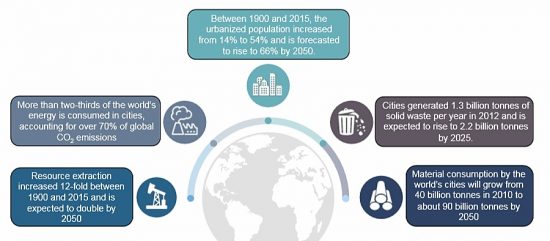
In its press release of June 7, 2018, IKEA describes this change as “becoming truly circular,” referencing the notion of a circular economy where there is no waste, no pollution, and where humanity co-exists with the rest of life on the planet. At the most recent World Economic Forum gathering in Davos, Switzerland, a white paper presented highlighted innovative solutions that apply circular principles to the world economy through 100% recycling of waste from our existing buildings, and infrastructure, to harvesting rainwater, generating clean and resource-efficient energy, treating medical waste, and the procurement of sustainable goods and services. The paper illustrated the baseline of where we are today (see infographic below) and where we are going if we don’t adopt circular principles as the 21st century unfolds.
Circularity, as opposed to linearity, is not a new concept when talking about economic models. We can witness it today in cities where garbage collection employs recycling strategies to remove plastic, metal, and newsprint from being dumped into landfill. That’s far removed from most of the current industrial and manufacturing processes on our planet which apply linearity, from beginning to end, starting with resource extraction, production, consumption, and finally waste disposal. And circularity reconceptualizes through transformative thinking the way businesses, cities, and all other types of human organizations work from how they source, design, produce and reuse by developing new technologies and sustainability processes.
IKEA has drunk the Kool Aid on circularity as Lena Pripp-Kovac, IKEA Sustainability Manager, describes it.
“Becoming truly circular means meeting people’s changing lifestyles, prolonging the life of products and materials and using resources in a smarter way. To make this a reality, we will design all products from the very beginning to be repurposed, repaired, reused, resold and recycled.”
To become “climate positive” by 2030 the company is focused on the following:
In The Globe and Mail yesterday, author Anna Ringstrom notes that IKEA is not alone in applying circularity principles to operations in an effort to meet Paris climate agreement goals. H&M, Coco-Cola, and Sony have pledged to achieve sustainability based on the Science Based Targets Initiative, a collaboration that includes the Carbon Disclosure Project, World Resources Institute, World Wide Fund for Nature, and the United Nations Global Compact.
]]>So what is the Circle Economy? On the organization’s website it states it is a social enterprise and cooperative focused on developing “practical and scalable solutions” to spread the “circular message.”
The site offers tools and programs for government and business decision making and action.
Its team of more than 40 members are committed to an outreach strategy engaging international businesses and government. Hans, in her correspondence to me stated that companies like Philips, ABN AMRO Bank and Heineken, and cities like Amsterdam, Glasgow and Brussels are already using the tools and programs Circle Economy provides.
Hahn writes, “The circular economy is becoming a part of the conversation when it comes to climate change and developing a future-proof economic model that provides not only economic but also environmental and social benefits is now key. At Circle Economy we seek to inspire the hearts and minds of the main stream, from cities and corporations, to entrepreneurs and innovators and we strive to create the conditions for disruption, innovation, and opportunity.”
What are the tools Circle Economy provides its clients?
Circle Portfolio – provides investment managers with a diagnostic tool to match current practices with circular objectives
Circle Assessment – an online survey to allow organizations to measure themselves against circular objectives and provide recommendations to minimize future risks.
Circle Market – an online marketplace for value chains to close the loop on waste turning it into a resource with a focus on the textile industry, “the second most polluting…in the world.”
Circle Business Case – a tool that assesses value chains from sourcing to production to end-of-use identifying areas in which a company can measure the value in applying circular economic methods to business processes.
Circle Scan – an assessment tool for identifying opportunities within an organization to implement circle economic practices. The scan provides a visual map of the organizations systems and processes with the goal to develop pilot circular economic projects.
Circle Scorecard – a method of measuring the direct and systems impact of applying circular economic best practices within an organization.
In a series of past postings on this site I have written about social networks and their role as citizen mobilizing response mechanisms aimed at specific causes which appear to be neglected by power brokers in business and government. Well it seems if Circle Economy is an example of how social networks for cause are evolving, then spreading the word about the value proposition they represent for a sustainable future is a cause in itself.
For government and business leaders trying to figure out a path to a sustainable, low carbon economic future, I urge you to make the connection.


So who in the business world is applying circular economy principles?
Speedo is making swimwear from recycled textile factory scraps.
Ford is taking old floor mats and turning them into engine components, and in partnership with Novelis is recycling much of the aluminum used to build its vehicles.
Eveready is manufacturing new batteries partially from old.
Patagonia has a common threads initiative it applies to making its gear.
Levi’s is recovering and reprocessing fibres from old jean materials.
Dell is collecting damaged and used computers and accessories from consumers to reprocess plastics in building new products.
Caterpillar is re-manufacturing and refurbishing parts for use in the equipment it sells.
Rolls Royce is re-manufacturing marine engines for use in river craft.
All these companies are applying circular economy strategies which include:
The following infographic provides examples of other companies applying circular economy strategies.

So why all this effort?
According to Ecofys, an environmental consultancy with headquarters in the United Kingdom, applying circular economy standards globally could make it possible to reduce carbon emissions to a point where the 1.5 Celsius (2.7 Fahrenheit) desirable warming target set at the COP21 Paris conference could be cut in half. That means we could stop the rise of mean average temperatures which today are approaching 1 Celsius (1.8 Fahrenheit) above pre-Industrial Revolution levels.
In its research, Ecofys believes the Paris targets are achievable and can even be superseded through implementing circular economic principles on a global scale. Doing this would “decouple unsustainable material use from prosperity” while addressing climate change.
]]>