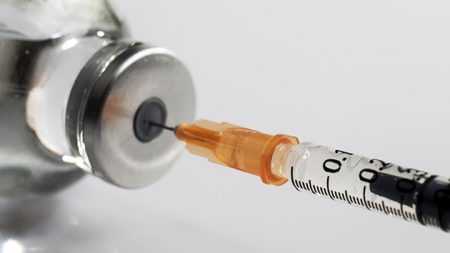
More recently, researchers from the University of New Mexico School of Medicine have described their work to develop an inexpensive vaccine targeting high levels of LDL cholesterol. Their research is described in an article entitled, “A virus-like particle-based bivalent PCSK9 vaccine lowers LDL-cholesterol levels in non-human primates,” published last September in the Nature journal NPJ Vaccines.
The research team behind the vaccine is led by Bryce Chackerian, Regents’ Professor in the Department of Molecular Genetics and Microbiology. He is one of the authors of the paper. In a university press release, Chackerian states that the vaccine’s goal is to become an affordable treatment for high LDL cholesterol levels administered once per year.
High cholesterol is a key risk factor in the development of ischemic heart disease (IHD) also known as atherosclerotic cardiovascular disease (ASCVD), a condition where cholesterol, fat, calcium, and other substances form plaque that build up on arterial walls eventually causing narrowing and blockages. Statistics from 2019 estimate that nearly 200 million people globally are living with IHD which is a major cause of death worldwide and the leading cause of it in both men and women in the United States and Canada.
Abinash Achrekar, a cardiologist and Vice Chair at the University’s Department of Internal Medicine, has seen his fair share of patients with IHD. He has a personal and clinical perspective on the subject, having treated high cholesterol, and being diagnosed with it since the age of 16. He sees the work being done by his colleagues as revolutionary.
Today, the most common treatment for high cholesterol is the daily taking of statins. Statins work to lower cholesterol levels in the blood by inhibiting the HMG-CoA reductase protein which controls cholesterol production in the liver. Statins are generally well tolerated. I have been on one for more than a decade and my wife recently was put on the same statin as well. Fortunately for me, I have been able to adjust to taking a daily dose with a Co-Q10 supplement which has eliminated the muscle pain side effect of the statin. My wife has experienced far more side effects. And although statins are not expensive, the issue of side effects, some quite serious, makes looking at developing alternative treatments very important.
One alternate treatment is a monoclonal antibody administered through twice-monthly injections to block high levels of another protein, called PCSK9, linked to LDL cholesterol. This treatment is expensive making it unaffordable for those without health insurance coverage. Hence, finding a more affordable treatment and one that produces fewer side effects than a statin, has become a target of medical researchers. Vaxxinity has produced its alternative vaccine and now Chackerian and his fellow researchers believe they have found one as well.
The University of New Mexico vaccine uses a non-infectious virus shell as the medium to deliver tiny pieces of the PCSK9 protein into the bloodstream to cause the body’s immune system to develop protein-targeting antibodies. Chackerian states, “In the animals that we vaccinated, we see strong reductions in cholesterol levels – up to 30% – and that is going to be correlated with reduced risk of heart disease.” These animal tests and vaccine development have taken a decade. The animal subjects have included mice and monkeys.
The next step for the vaccine developers is to find funding to manufacture it followed by the setting up of human clinical trials. Chackerian estimates that the vaccine could be delivered to patients for “tens of dollars a dose,” and remain effective for a year. He notes, “This is a vaccine that we think can have a global impact. So, not just in the United States, but around the world where heart disease is a significant problem.”
What’s the estimated timeline to see general availability? It should be on the market as an alternative treatment for high LDL cholesterol within the next 10 years if the human clinical trials go well.
]]>
Back in April of this year, I wrote about the first large-scale attempt to immunize children against malaria in three African countries. Malaria is a global scourge affecting the lives of hundreds of millions in tropical countries. With climate change, the mosquito-born disease is migrating towards the poles into more temperate latitudes with implications, not for hundreds of millions but for billions. The protocol involves four monthly injections and the results so far show a significant drop in young children contracting the disease.
But a vaccine for cholesterol, currently in phase-1 trials could help produce antibodies capable of targeting the enzyme, PCSK9, that regulates levels of low-density lipoprotein or LDL, considered the bad blood cholesterol. The vaccine goes by the acronym AT04A. In mice studies fed a Western, high-fat diet, the vaccine lowered cholesterol levels by 53%. Lowering LDL reduces the potential buildup of fibrous deposits on arterial walls leading to atherosclerosis.
If the trials are successful, at-risk patients may replace statins, the most commonly prescribed drugs taken daily, with a once-a-year vaccine. But before the vaccine can be released to the larger population, initial trials need to be expanded to larger numbers. The proof of successful translation from mice to humans will lie in data that shows the persistence of antibodies for many months after a single treatment.
In another story, cancer is being tackled using specifically-targeted vaccines that stimulate the body’s immune system. Two classes of cancer vaccines are currently under development. The first type or prophylactic, that is they are intended to prevent cancer from happening in a normally healthy person. The second types are therapeutic, that is they treat existing cancer through immunotherapy, stimulating the body’s immune system.
It is the latter category where targeted vaccines are expected to provide major changes in treatment. Genetically engineered inhibitor therapies can be manufactured to meet a large population of cancer patients, and in some cases, individual specific cancer profiles. In the latter case we are talking about engineered personal treatment vaccines.
Currently, the human papillomavirus (HPV) vaccine is the most commonly prescribed preventive on the market which addresses cervical, oropharyngeal, vaginal, vulvar, and penile cancers. The other preventive vaccine treats Hepatitis B which can cause liver cancer.
Therapeutic vaccines enhance the body’s natural T cells, primary components of the immune system. The vaccines do one of two things: they stimulate cytotoxic T cells to recognize cancer cells and attack them, or they produce antibodies that bind to cancer cells which then triggers the immune system to attack. A customized therapeutic vaccine for types of prostate cancer was introduced in 2010. Unlike normal vaccines, the process of its creation involves harvesting and culturing specific proteins from the patient which then can be reinjected to enhance the immune system response. In 2015 a therapeutic vaccine for melanoma was added to the anti-cancer arsenal. In this case, the vaccine involves a virus which serves as a delivery mechanism when injected into a tumor mass triggering an immune response.
Soon to join the therapeutic vaccine list are bladder, brain, breast, colorectal, cervical, kidney, lung, leukemia, myeloma, and pancreatic cancer treatments of which many are in phased clinical trials testing biomedical technologies similar to the ones developed for prostate and melanomas. And in the case of the latter two, further advances are being made to refine the vaccines so they can be used in earlier stage treatment of the disease.