And what do plants do?
They take in sunlight and CO2 through leaves and water through roots. They capture the carbon by breaking the CO2 molecular bonds. They also split water molecules releasing the hydrogen and oxygen as well as free electrons that produce energy. The plants use the products of these process to build and fuel themselves. And while doing this they expel oxygen as an unwanted byproduct. Plants do this using a cellular engine called a chloroplast. Each chloroplast when exposed to sunlight generates chlorophyll, a complex molecule consisting of carbon, hydrogen, magnesium, oxygen and nitrogen. Because plants do this we, the birds and the bees are the beneficiaries.
But if we could technologically do what plants do we could create a perfect solution to capturing carbon while generating an unlimited source of energy. Typically plants convert the energy from sunlight at an efficiency rate of less than 1%. Can we do better?
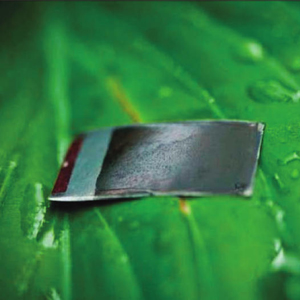
Artificial Photosynthesis in the Lab – Can We Transition to a Commercial Product?
In a 2010 article published in Popular Science an MIT scientist described an artificial photosynthesis technology using a silicon solar cell with a catalytic coating made from indium tin or fluorine tin oxide. The technology when immersed into water demonstrated an ability to split water molecules into hydrogen and oxygen. The yield from these laboratory experiments approached efficiencies of 2.5% better than an average plant. But the technology has yet to turn into a commercially feasible artificial leaf.
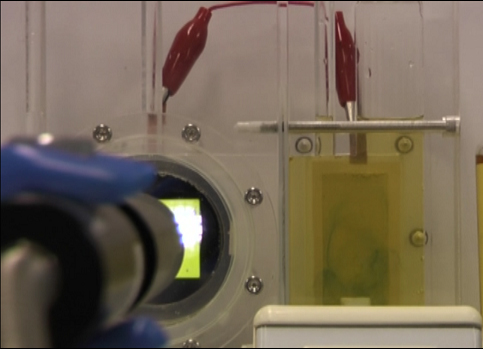
So the quest to move from the lab to the real world remains. That is until now if you can believe today’s announcement by Panasonic of the development of an artificial photosynthesis system as efficient as a real plant.
What the technology comprises of is a nitride semiconductor and a metal catalyst immersed in water. Direct sunlight or another focused light source causes CO2 reduction yielding formic acid (the chemical ants and many stinging insects produce) and releasing oxygen. The materials used in the process are inorganic and relatively inexpensive making conversion to a commercial product more feasible. The formic acid output from the process has an after market in the chemical industry.
Unlike the MIT research with its focus on producing unlimited energy, Panasonic sees the primary use of its artificial leaf technology at industrial sites to sequester carbon.
A commercially available artificial leaf will truly be a 21st century technology breakthrough with enormous implications for energy and the environment. It’s hard to imagine such an unlimited source of power so easily obtained. But that’s exactly what plants have been doing for hundreds of millions of years.
And for want of a good lyric, we are getting much closer to doing what plants do.
]]>
Today’s solar photovoltaics are made from crystalline silicon and cadmium-telluride. These cells continue to be expensive to produce, use both scarce and toxic materials, and are at best 20% efficient in converting light into energy. The cells are inflexible and limited in deployment to rooftop surfaces or in ground-based arrays.
The ultimate goal of the industry is to develop solar technology that works like plant cells. This means finding an equivalent to chlorophyll. A first step was made in 1991 with the development of Gratzel Cells. These cells use an organic dye and nanoparticles composed of titanium dioxide to mimic chlorophyll. The dye acts as a solar absorber converting sunlight into free electrons. The inventor is Michael Gratzel, Director of the Laboratory of Photonics and Interfaces at the Ecole Polytechnique Federale de Lausanne.
Gratzel Cells have unique advantages that include:
But Gratzel Cells have suffered from a number of challenges including:
The first commercial product using Gratzel Cells came out in 2009, a solar array backpack for charging portable electronics.

Researchers at Northwestern Universityhave been experimenting with a replacement to the organic liquid dye using a solid electrolyte. The result is the Kanatzidis-Chang Cell, named after two of the research scientists who developed it, made from cesium, tin and iodine. Each cell measures 0.5 centimeters (less than 1/4″) square and about 10 microns thick. A cell contains billions of nanoparticles, each 20 nanometers in diameter, creating huge surface areas for interaction with sunlight. Current performance is half the efficiency of top-of-the-line silicon-based photovoltaics but improvements of 1% per month have been demonstrated in the University’s lab.
The new cells have many advantages over Gratzel Cells.

]]>