But none of these legal maneuvers by the United States can stop China’s efforts to become the leading technology provider in the telecommunications space giving American and European firms a run for their money.
The latest news reported by Frank Chen, in the Asia Times, describes research being done at the Southeast University, Nanjing, to develop 6G wireless systems technologies even while 5G has yet to be rolled out globally. Chen reports that since 2015 China has been outspending the United States by $24 billion USD in building its wireless communication infrastructure. Telecommunications companies in China have erected 350,000 new cellular communication towers versus the U.S. with 30,000 in support of the country’s 5G rollout.
When will the first signs of 6G emerge from China? As early as 2020 when the first trials will begin to work out the kinks in the technology. China may even stop 5G rollout if it can accelerate 6G development even sooner.
In North America, telecommunications companies talk about 6G being at least a decade away. These types of pronouncements are a bit disconcerting to say the least. But work in Finland at the University of Oulu is focused on what it calls the 6Genesis project where its researchers talk about 6G emerging by the mid-2020s. The Finns are spending about 250 million Euros on 6G research. Meanwhile, Qualcomm, Dell, Intel, and Ericsson have committed more than $326 billion USD to 5G research and development and something they call 5G+, a precursor to what could become 6G.
Compared to 5G which eclipses 4G network speeds of 1 Gigabit per second by a factor of 10, 6G will deliver speeds of 1 Terabyte per second. So what will that mean for we cellular users? Well other than the speed thing, it means that rather than billions of devices being interconnected in the Internet of Things (IoT), we are talking about devices in the trillions. It means artificial intelligence applications will become even better in support of initiatives such as the development of autonomous vehicles, smart cities, smart roads, smart energy, and virtual and augmented reality may bring us closer to the Star Trek holodeck. It will also mean feeds and speeds can vary with a move away from the one-speed-fits-all pipe we have today. That will mean a more nuanced Internet that fits the specific feeds and speeds needs of every application.
With 6G the world will become one giant telecommunications network from the depths of the ocean to near-Earth orbit. The fact that the Chinese research community is hellbent to make this a reality shows just how far the country has come since the passing of Mao Zedong.

]]>
The end result of all this coal production is what we see in China’s major cities today – coal and transportation-derived smog that is leading to more than 1.2 million deaths in China annually. It would seem that China’s government is in a no win situation. But the Communist Party policy makers are hell bent on continuing to grow the economy and to do this they need the energy they get from coal. So what to do?
In decisions that run counter to efforts to implement carbon taxes and a reduction of the country’s carbon footprint, policies that China has recently announced, the country is building a synthetic fuel infrastructure based on converting coal to synfuels.
China isn’t the first country to build coal to synfuel plants. Germany was the first beginning in the 1920s and accelerating with the ascension of the Nazis in the 1930s. The Germans gave the technology to the Japanese who were allies during the Second World War. Similarly, an isolated apartheid South Africa relied heavily on synthetic fuel production from coal. The conversion technology in both these cases is called the Fischer-Tropsch process. Since then a number of different coal liquefaction technologies have emerged.
It is interesting that when you go to the World Coal Association and read about coal conversion there is little discussion about its carbon footprint. Instead you are sold on coal liquefaction’s many benefits including:
The advocates for coal conversion even attempt to argue that as a fuel source synfuels produce as little as one-fifth of the greenhouse gas (GHG) emissions of conventional oil. There are, however, conditions to that statement. First there is an acknowledgement that coal conversion is energy intensive producing more CO2 than conventional oil refineries. But the advocates go on to state that carbon capture and sequestration (CCS) can mitigate emissions and describe it as a low cost solution to the problem. If you are a regular reader of this blog you may have trouble believing in the accuracy of that last statement since sequestration projects have turned out to be anything but low cost.
And herein lies the problem with China’s plans. In the effort to clean up pollution in the major cities, the government is building an enormous number of coal conversion plants and erecting them in remote parts of the country. Currently 16 are under construction or already operational.
Climate scientists believe that GHGs from these plants which resemble the largest oil refinery complexes you have ever seen will add 10 billion tons of CO2 annually to the atmosphere. China hopes by 2020 to have CCS technology in place to mitigate 10-20 million tons of that CO2 annually. But that will only lessen emissions from these new plants by a fraction of their total output pushing GHGs to new high levels.
A consequence of building these plants, an illustration depicting one planned for Mongolia below, within China is the forced migration of the local population to newly built urban communities within China. All in all this is a massive experiment for both China’s energy sector as well as its indigent population. The cities of China’s coastal plain may be the beneficiaries in the short term, but the planet over all will suffer because the emissions from coal conversion will increasingly contribute to atmospheric warming.
To learn more about China’s expanding coal conversion plans and synthetic fuel from coal technologies check out the additional links provided below.

Here are just a few examples from some recent press clippings:
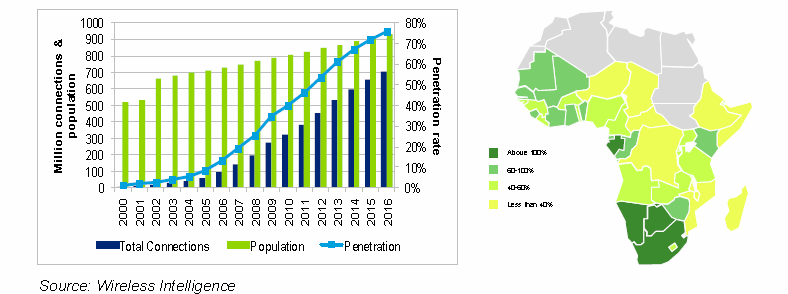
Of course there remain pockets where 21st century technology has yet to make a significant impression. In Bangladesh, one of the poorest countries on the planet, Internet usage has only reached 5% of the population of its 160 million citizens. And in places like North Korea the 24 million of its people remain isolated from the global conversation.
Another dark side is the propagation of 21st century technology without safeguards. China is the one country where this phenomenon is quite visible. A good example can be seen in the transportation sector where there is a rising demand for automobiles. The Chinese have caught the North American and European bug about cars. Beijing, Guangzhou and Shanghai are the hottest markets and have had to resort to a lottery to allocate vehicle registrations. To service this demand, the country has added 32,000 kilometers (almost 20,000 miles) of new paved highway in the last 5 years, a rate 4 times faster than the speed with which the United States built out its Interstate highway system. The bicycle, once the principal means of transport for so many in China, has receded as automobiles have taken over. Where 60% of trips taken in Beijing back in 1986 were by bicycle, today that number is 17% today. The result for China is 300 traffic fatalities per day, the highest rate in the world, and smog in its urban centres caused by automobile tailpipe emissions.

The 21st Century Electricity Capacity Challenge
Today 1.3 billion of us have no energy security and 2.7 billion lack clean cooking facilities. Electricity consumption in Sub-Saharan Africa, excluding the Republic of South Africa, is about equal to that used by the State of New York. That means 20 million New Yorkers consume the same amount of electricity as 850 million Africans. To deal with this challenge the International Energy Agency estimates we need to invest $48 billion U.S. annually to achieve 100% penetration by 2030. Interestingly, money spent by governments on fossil fuel subsidies is nearly ten times this amount.
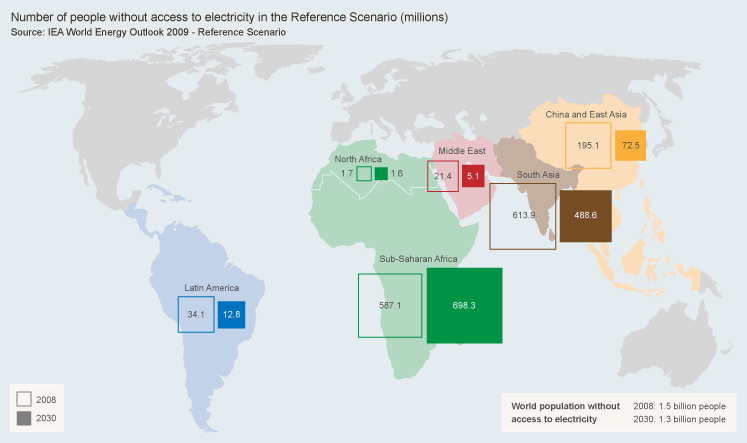
What would universal access to electricity mean for the world’s population? Less burning of carbon, not more, as poorer countries move away from cooking fires to cleaner energy sources.
What will it take to get to universal accessibility? Global political will that includes building financial capacity in the Developing World to ensure investment are made in energy projects and in urban and rural infrastructure to deliver energy everywhere.
Mobile phone penetration and Internet growth are leading the way and showing us just how hungry the Developing World is for 21st century technology. If we can duplicate the 21st century revolution happening in communications by making electrical power accessible and ubiquitous we can involve the entire planet in collective progress. Wouldn’t that be a great New Year’s Resolution?
]]>


