At the Paris climate meeting known as COP21 back in 2015, 196 countries set a goal to limit atmospheric warming to below 2.0 Celsius (3.6 Fahrenheit), with a preference to not exceed 1.5 Celsius. To achieve this, the signing countries pledged to rapidly reduce greenhouse gas (GHG) emissions to achieve net-zero by 2050. Sadly, just six years later, it appears we are likely to see global temperatures exceed the 1.5 Celsius lower limit. The WMO noted that in 2020 we had already hit a 1.2 Celsius (2.16 Fahrenheit) rise.
Breaching the 1.5 Celsius rise before the decade ends was unforeseen by many in the political community, but not by scientists. The WMO’s 40% probability assessment may help make governments do more in terms of policies to accelerate mitigation and adaptation projects and programs. Let’s hope so, particularly from the largest GHG emitters – China, and the United States. And let’s hope the companies that have most profited from emitting GHGs into the atmosphere are finally brought to heel by global citizenry. The air we breathe knows no boundaries. Nor do the oceans we depend on that as primary carbon sinks continue to slowly acidify and deoxygenated.
Citizens initiatives, courts and shareholders are beginning to push back against current fossil fuel company behaviours. In the past week, a Dutch court (The Netherlands is the home of Royal Dutch Shell) ruled on behalf of 17,000 Dutch citizens, that one of the world’s largest energy companies had to meet a deadline to cut its carbon dioxide (CO2) emissions in 2030 by 45% from 2019 levels.
The court’s ruling applied not only to the company but also to its suppliers. In other words, the engineering contractors doing the exploration and extraction of oil and natural gas, the tankers involved in distribution, and the refiners and pipeline operators. The company plans to appeal arguing that it has accelerated its efforts to achieve net-zero emissions by 2050 in compliance with the Paris Agreement.
Two other energy giants, ExxonMobil and Chevron in the past week both found themselves under attack by shareholders who didn’t like the two companies’ carbon emission strategies. In the case of Exxon, the shareholders replaced two members of the board with “green” candidates. And with Chevron, the shareholders voted by 61% for more vigorous action to cut GHG emissions. These two actions were preceded this month by similar shareholder assaults at ConocoPhillips, and Phillips 66.
BlackRock, an institutional investor that owns a 6.7% stake in Exxon, joined Engine No. 1 (EN1), a hedge fund activist group, in supporting the campaign to replace two board members with greener choices. BlackRock’s Chairman and CEO, Larry Fink, had recently announced its conversion to a greener future asking companies in which it held shares to apply climate risk metrics in their business plans, to provide details and milestones to keep global atmospheric warming below 2 Celsius by century end. EN1, launched in December of 2020, has been purpose-built to apply sustainability principles to the companies in which it invests. Exxon has been a target of its efforts from the get-go.
The action of the court in The Netherlands and the shareholder revolts underway in the oil patch represent a small victory for our planet and those of us dependent on it. It cannot come soon enough considering the forecasts of the WMO.
]]>
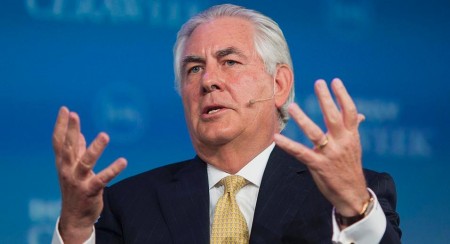
He also made it known that the company believes that climate change science is “not that good” and that “engineering solutions” should address any problems that emerge just in case he’s wrong. The latter point is interesting. No doubt Tillerson is referring to technologies like carbon capture and sequestration (CCS) and carbon capture utilization and sequestration (CCUS) the two most notable industry initiatives that to-date have produced one operating facility, the Boundary Dam project in Saskatchewan, and it is sequestering CO2 from coal. All other CCS projects to-date have been heavily subsidized by government with the fossil fuel companies pulling the plug on many before design completion.
The fact that government has been heavily involved on the financial side of these “engineering solutions” directly contradicts another of Tillerson’s comments to the shareholders. He stated that oil companies “don’t receive any subsidies.” Really? Then I guess the CCS projects don’t count and nor does the $37.5 billion the U.S. government provides the industry as an annual subsidy. And as for global subsidies estimates vary from $600 billion to $1 trillion annually. I guess Exxon isn’t getting its fair share.
A group of shareholders, the Roman Catholic Sisters of St. Dominic, Caldwell, New Jersey, proposed that Exxon set a company goal to reduce greenhouse gas emissions. When taken to a vote the motion gained less than 10% of the vote from shareholders and proxies attending the meeting.
Exxon wasn’t the only company to hold a shareholder’s meeting. Chevron, another big U.S.-based giant was faced with a shareholder resolution that challenged the company’s investment in risky new projects, referring to unconventional oil such as the Alberta oil sands, asking that it increase dividend payments rather than make such spending commitments in light of future government action to reduce the global carbon footprint. The proposal received a mere 4% of the votes.
On other shareholder resolutions, 21% at Exxon voted to add someone with climate expertise to the board of directors. At Chevron the vote garnered 20%. Tillerson argued that “to set aside one seat for an environmental specialist or for any single attribute or area of expertise would, in our view, not be in the best interests of the company or its shareholders because it would dilute the breadth needed by all directors to make informed decisions for the company.” I gather having such expertise close at hand would make it more difficult to keep corporate heads buried in the sand.
It should be noted that Exxon’s profits were down 14% attributed to lower oil prices. What will happen when the company suddenly faces carbon limits imposed by international agreement? Exxon has put a price on carbon in its financial reporting for several years but no government has as of yet made them pay. And in direct contradiction to its CEO the company has set in policy significant views on the issue of climate change. These appear on its website and I have repeated some of the content here.
Entitled Principles and Policies to Manage Long-Term Risks from Climate Change it states that Exxon believes “it is prudent to develop and implement strategies that address the risks to society associated with increasing GHG emissions.”
To this purpose the company believes effective strategies must be implemented that include policies to start the world on a path to reduce emissions while recognizing that GHG emissions are just one among other important world priorities, such as economic development, poverty eradication and public health. Yet the company continues to state a series of near-term objectives including:
The company further states that “strategies should promote fundamental shifts toward energy-efficient technologies and practices across the economy, and the more prominent use of fuels with lower carbon intensity — such as natural gas, nuclear energy and renewable fuels — within the overall energy mix.” Note that the CEO in his statement to shareholders directly opposes such investments because in his words, “we choose not to lose money on purpose.”
The company also declares that if policymakers do move to impose a cost on carbon, it believes that a carbon tax would be more effective than alternatives such as cap-and-trade. And it believes that revenues raised from such a tax should be directed to investment, and to assist those on lower incomes who spend a higher proportion of their income on energy very much in line with what British Columbia has imposed in its carbon policy.
The ExxonMobil statement concludes with the following “It is rare that a business lends its support to new taxes. But in this case, given the risk-management challenges we face and the policy alternatives under consideration, it is our judgment that a carbon tax is a preferred course of public policy…”
The above comes from the same company whose CEO in front of shareholders appears to disavow climate change science as “not that good.” One wonders if it is such bad science then why should the company go to all that trouble addressing and even calling for a carbon tax as preferential policy?
It’s interesting to compare Exxon and Chevron’s approach to that of the European energy giants at their recent shareholders’ meetings. Quite a contrast.