Whether a slow ooze or a bomb, the question I ask in the title of this posting has yet to be answered by government policymakers. Is permafrost included in carbon budget calculations? My guess is, it is not and that’s a huge mistake.
The northern community of Tuktoyaktuk is built on top of permafrost and located on the Arctic Ocean coastline of Canada’s Northwest Territories. Permafrost is described as being harder than concrete in its frozen state. But when warmed the subsurface thawing causes landscapes to shift. Houses and buildings begin to tilt precariously as concrete and wooden pilings give way. A more ice-free Arctic Ocean is a more active sea with winds driving waves onshore contributing to growing coastal erosion. This in combination with rising sea levels is nibbling away at Tuktoyaktuk.
A September 2021 report noted that the cost to save Tuktoyaktuk was $42 million and rising. This money is budgeted to cover the next thirty years. The plan involves shoring up the Arctic Ocean coastline with a barrier of stone very much the way it is done on Pacific and Atlantic Ocean coastlines further south. Everyone knows this is a temporary fix. No one has a long-term plan that might require a retreat from the coastline and a movement of the town to a more stable inland site where only permafrost melt would be the threat.
What’s wrong with the stone barrier plan? There isn’t a lot of rock to harvest locally near Tuktoyaktuk which means hauling rock in from further inland and south over a road infrastructure that is also threatened by permafrost melt.
Of course, none of these plans speaks to the issue of CH4 release from melting permafrost and the contribution this greenhouse gas (GHG) will make to atmospheric warming in the short term.
Canada has a CH4 leak strategy. Unfortunately, it focuses entirely on CH4 emissions from fossil fuel sites. The following words come directly from a September 23, 2022 government policy statement that notes the country will:
Notice, there is no mention of permafrost CH4 leaks in this policy statement. Yet another government site discusses the issue of Arctic melting and notes that “Canadian scientists and community members have long raised concerns about how rapid climate change affects permafrost in Northern Arctic communities.”
The page comes with a link to a report that raises alarm bells about the amount of GHGs contained within an increasingly destabilizing permafrost zone across the country’s north. It also discusses other issues related to melting permafrost including increasing coastal erosion, ground subsidence, landslides, altered surface water dynamics (kettle lakes vanishing overnight), damage to buildings, roads, power distribution networks and more, and a growing number of health risks.
Recommendations include the implementation and budgeting for:
Also recommended is a better use of the knowledge gained from local and native observations that can serve to advance strategies and provide solutions to contain the worst of anticipated future damages to the Arctic way of life. Unfortunately, there appears to be no budget estimate to finance the above recommendations and nothing on the website to suggest Canada’s Ministry of the Environment and Climate Change has a specific one in mind to underwrite the cost of implementing these recommendations.
Back in February of this year, I wrote about the immediate climate change threat from rising CH4 levels in the atmosphere. At the time I referred to two studies, one highlighting agricultural sources of CH4 leading to atmospheric spikes, and another linking unusual increases to oil and natural gas operations.
The U.S. Environmental Protection Agency states that pound-for-pound CH4 is 25 times more potent than carbon dioxide (CO2) as a contributor to global warming. NOAA quotes statistics showing CH4 to be 80 times more potent over a 20-year period. The saving grace is that CH4 degrades much faster than CO2 but while it is in the atmosphere contributes to immediate impacts on temperature. That short-term impact is considered by climatologists as a major challenge.
Onboard the ISS is NASA’s Earth Surface Mineral Dust Source Investigation, known as EMIT. Its initial purpose was to study airborne dust and its contribution to climate change. But as NASA Administrator Bill Nelson states, “EMIT is proving to be a critical tool in our toolbox to measure this potent greenhouse gas [referring to CH4] and stop it at the source.”
Nelson sees reining in CH4 as an immediate priority. EMIT’s imaging spectrometer sees the gas as it absorbs infrared light to leave a unique spectral fingerprint. In the image below, on the left, you can see CH4 plumes highlighted in purple, orange and yellow. The ones in this image were detected over Turkmenistan. The graph on the right displays two lines, one blue, and the other red. The blue represents actual CH4 levels detected. The red is an atmospheric simulation of expected CH4 levels.

EMIT can scan wide swaths of the Earth’s surface at a time and can zero in on features as small as a football field. The instrument provides pinpoint accuracy in attributing methane sources to human activities. States Andrew Thorpe of the Jet Propulsion Laboratory in Pasadena, “Some of the plumes EMIT detected are among the largest ever seen, unlike anything that has ever been observed from space.”
What has EMIT discovered? A representative sample includes:
EMIT is expected to find hundreds of previously unknown super-emitter sites. States Robert Green, of JPL, “As it continues to survey the planet, EMIT will observe places in which no one thought to look for greenhouse-gas emitters before, and it will find plumes that no one expects.”
EMIT isn’t alone in the quest to measure how our planet is changing largely because of human activity. It is one of 25 different scientific packages in orbit around Earth giving us an up-to-date picture of the planet’s climate health. Seven of these reside aboard the ISS.
]]> The latest data from October 2021 shows global monthly means reaching 1,907.2 PPB. The uptick has been steady with current levels triple those from the pre-industrial period. How do we know what those pre-industrial levels were? Through the analysis of ice cores taken from Greenland, scientists have measured the concentrations of gasses in trapped bubbles giving us a record of both CH4 and CO2 levels and how they have changed over 2,000 years.
What could be causing the recent rise?
The likely source of rising CH4 levels one would think is coming from the fossil fuel industry. But that appears not to be the case according to some scientists who are looking at the volume of radioactive carbon isotopes found in sampled gasses. CH4 molecules contain both stable and radioactive carbon isotopes. The two most notable of the latter are carbon-12 and carbon-13. They are analogous to a more well-known radioactive carbon isotope, carbon-14, which if you remember from studying ancient history in high school, has been used to date archeological, anthropological, and other historical remains and findings.
Those Greenland ice cores show an interesting pattern in the percentage of isotopes found in the trapped CH4. Since the Industrial Revolution, they indicate an increase in carbon-13 over carbon-12, that is, until the last fifteen years when carbon-13 started decreasing. Scientists conjecture that the current CH4 spike coinciding with carbon-13 decreases indicates microbes may be the principal source for the increase, and not oil and natural gas operations. In fact, NOAA scientists working at the Global Monitoring Laboratory in Boulder, Colorado, have estimated that 85% of the recent growth in CH4 levels is microbe related.
Where are these microbes located? In the gut of livestock, in wetlands, landfills, in cultivation (particularly rice the world’s largest staple crop), wild and controlled plant matter fires, and wild animals. The histogram below breaks down the major suspects and their contributing shares.

But fossil fuel extraction doesn’t get off the hook that easily despite the NOAA report. Another data source comes from satellites, and last week the journal Science published a report that points to human oil and natural gas extraction and production as the prime culprit. The data collected comes from the European Space Agency’s Sentinel-5P satellite which has the ability to measure CH4 levels in the atmosphere daily and spot the contributing sources. The data collected shows that two-thirds of CH4 emissions are coming from oil and natural gas extraction and production. The remaining one-third is being emitted by coal, agriculture, and landfill sites. The biggest leaks of the gas are coming from malfunctioning equipment and pipelines. Levels of the gas in some areas are so high, for example, the Permian Basin in Texas, and the oil sands in Alberta, Canada, that the satellite cannot pinpoint which of the fossil fuel operators are the most egregious leakers.
The two aforementioned published reports have surprised me for what they didn’t mention – melting permafrost. Permafrost, found throughout much of the Northern Hemisphere north of 60 degrees latitude, has historically been a carbon sink. But not anymore. The permanently frozen ground in the Arctic is now impermanent and thawing. What is leaking out is largely CH4 with smaller amounts of CO2. Could permafrost be the big contributor to the spike? Based on sampling from Siberian sites, more carbon-12 than 13 is found in melting permafrost samples. So maybe that is an additional biogenic source of rising CH4.
Why are we looking at CH4 when the vast majority of literature on anthropogenic climate change talks about CO2? The U.S. Environmental Protection Agency site includes a considerable amount of information comparing the two greenhouse gasses. It states that CH4 represents about 10% of the country’s overall greenhouse gas emissions but goes on to add, “pound for pound…is 25 times greater than CO2.” That’s why eliminating CH4 would be a climate game-changer. Plugging up CH4 leaks in fossil fuel operations seems comparatively simple, certainly far easier than trying to tackle microbial emissions of the gas.
Last year in Glasgow, at the COP 26 climate conference, 111 countries, representing almost 50% of anthropogenic CH4 contributions agreed to reduce emission by 30% by 2030. This global pledge described that meeting this goal would yield a reduction of 0.2 Celsius in atmospheric temperature rise between now and 2050. The effort will almost exclusively come from the elimination of CH4 in oil, gas, coal, and landfill operations. Trying to cut down cow fart-based CH4 will be trickier. And as for permafrost, with Arctic temperatures rising faster than anywhere else, these thawing parts of our planet represent a ticking time bomb.
]]>I haven’t been totally idle while remaining with my leg elevated. Instead, I have been catching up on my reading about our changing climate, the mystery surrounding the SpaceX Zuma mission, the latest non-science bashing genetically modified organisms, and, of course, Donald Trump.
One study that caught my eye comes from NASA, the agency that the current administration wants to stop looking at the Earth and instead look to the Moon and Mars. NASA’s Earth science portfolio is very deep. Satellites it has launched study greenhouse gas levels in the atmosphere, the state of our oceans and continents, weather and climate, land use, deforestation, and more.
The latest from NASA to be published is a study of atmospheric methane (CH4), a greenhouse gas that doesn’t endure in the atmosphere as long as carbon dioxide (CO2), but nonetheless, contributes to global warming. And CH4 has increased in the atmosphere at a rate of 25 teragrams annually since 2006.
What’s a teragram? One is equivalent to 1 million metric tons (1.2 million American tons). So CH4 emissions have been accumulating at a rate of 25 million metric tons each year for more than a decade. When compared to CO2 accumulations over the same period 25 million tons is a blip. That’s because CO2 contributions amount to more than 25 gigatons annually and a gigaton equals a billion metric tons. That latter contribution accounts for 82% of all greenhouse gas emissions produced from human activities.
So why worry about 25 million tons of CH4?
Here is an interesting statistic. Although CH4 contributes a mere 1% of the amount of greenhouse gases entering the atmosphere, that small percentage translates to 9% when weighing the total impact the gas has on global atmospheric warming. In other words, CH$ has a nine times greater impact per ton than CO2.
CH4 comes from many sources; wetlands, swamps, mangroves, tidal ponds, Arctic permafrost, fossil subsoils, underground natural gas reservoirs, the digestive tracts of ruminants (cows), and from fermented manure used as fertilizer on farms. It also is a common byproduct of forest fires like those that have stricken parts of Southern California in the last two months.
The signature of CH4 from every source can be isotopically isolated. So we know the difference between CH4 from cow farts and CH4 from a gas wellhead. This gives NASA scientists the ability to accurately measure origins which they do using satellite and ground-based imaging spectrometry. The collected data shows that the observed global rise in atmospheric CH4 is largely attributable to oil and gas exploration, production, and distribution. Of the 25 teragrams of CH4 being added to the atmosphere annually, NASA data indicates that 17 is derived from oil and gas.
Should we be worried?
If we continue to expand oil and gas exploration as is evident in the policies of the current Trump government in the United States, then indeed we have a problem.
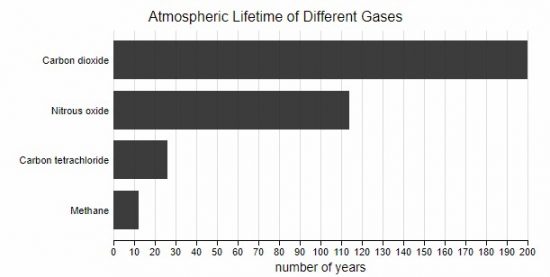
Surprisingly, the study doesn’t include data about CH4 short atmospheric life. When compared to CO2, CH4 hangs around as a greenhouse gas for 12 years before it breaks down through natural processes, whereas CO2 hangs around for up to 200 years if not trapped in natural sinks or by human-created carbon sequestration technologies that have yet to exist.
Scientists describe CH4’s warming as short and sharp while attributing words like “creeping” and “insidious” when talking about increasing CO2 in the atmosphere.
Contributors, other than NASA to this study, include the National Center for Atmospheric Research, Boulder, Colorado, the Netherlands Institute for Space Research, and the University of Utrecht, also in The Netherlands.
This begs the question, why methane and not carbon dioxide?
The latter accounts for 82% of all greenhouse gases emitted from human sources in both countries. So methane is a junior partner as global-warming gases go. In fact it accounts for approximately 10% of all atmospheric warming emissions. Tackling 9% of the problem then doesn’t sound like much of an effort in fighting the causes of climate change. And tackling it from the perspective of the oil and gas sector represents a subset of total methane emissions.
What is the largest source of human methane emissions?
It is not the fossil fuel industry. It comes from the food we put on our plates and the farms that produce it. According to the U.S. Environmental Protection Administration, livestock and livestock waste emissions represent 36% of all methane emissions whereas natural gas and oil production produce 30%. But the President and Prime Minister in their announcement mentioned not a word about agriculture methane reductions.
How much does methane contribute to global warming when compared to carbon dioxide?
Methane produces 100 times more atmospheric heat than carbon dioxide and it does this in the first 5 years after entering the atmosphere. Over a century its total heat trapping impact is 25 times greater than carbon dioxide. But in 10 years methane breaks down so its impact is short lived.
Tackling methane emissions, therefore, is all about the short term whereas hand tackling carbon dioxide may not yield discernible climate change results for decades. Maybe that’s why the President and Prime Minister chose to announce a methane reduction strategy with a hope that reductions would lessen global warming trends.

So why target the fossil fuel industry?
Probably because it is the easier methane challenge to fix. The Porter Ranch leak in California over four months represented the worst methane leak in American history. Some 97,100 metric tons of the gas entered the atmosphere. That is equal to the warming effect produced by 572,000 automobiles over one year.
According to Thomas Ryerson, a chemist with the U.S. National Oceanic and Atmospheric Administration, “Almost every time you have hydrocarbon production and infrastructure you can measure leaks out of them.” At every step of the process from exploring to refining to piping natural gas to customers there is methane finding its way into the atmosphere.
So in natural gas production many mini Porter Ranches are out there releasing lots of gas from production to consumption. And when you consider the last decade in which hydraulic fracturing has opened up new sources of natural gas supply methane has become a much more contentious greenhouse gas problem. It’s everywhere leaking from wellheads, pipelines, storage tanks and rail cars.
Creating regulations to enforce emission cuts would be in addition to new rules being released to cut wellhead emissions. It is not surprising that the industry feels they are unfairly being singled out for their methane contribution. Kyle Isakower of the American Petroleum Association, in response to the announcement stated, “Additional regulations on methane by the administration could discourage the shale energy revolution that has helped America lead the world in reducing emissions while significantly lowering the costs of energy to consumers.” When you consider that agriculture is by far the largest methane emitter you can understand to some degree Isakower’s remark.
In the industry’s favour, between 2005 and 2012 oil and natural gas production decreased methane emissions by 15%. But this success is believed to be short lived because the fracking energy boom is expected to increase emissions by as much as 25% by 2025. It is, therefore, a logical target for the President to address. Is it equally logical for the Prime Minister?
In Canada Alberta is the primary industrial methane emitter largely from venting of natural gas sources. The government of Alberta has already pledged to reduce methane emissions from oil and gas operations by 45% so the Prime Minister in agreeing to meet the President’s commitment is restating Alberta policy.
What’s still missing?
Tackling agricultural methane emissions, a much more difficult challenge. And of course establishing mutual national carbon dioxide reduction targets through the application of a carbon tax and other carbon mitigating policies.
And finally the unknown natural methane challenge of melting permafrost will run its course as the Arctic increasingly warms.

