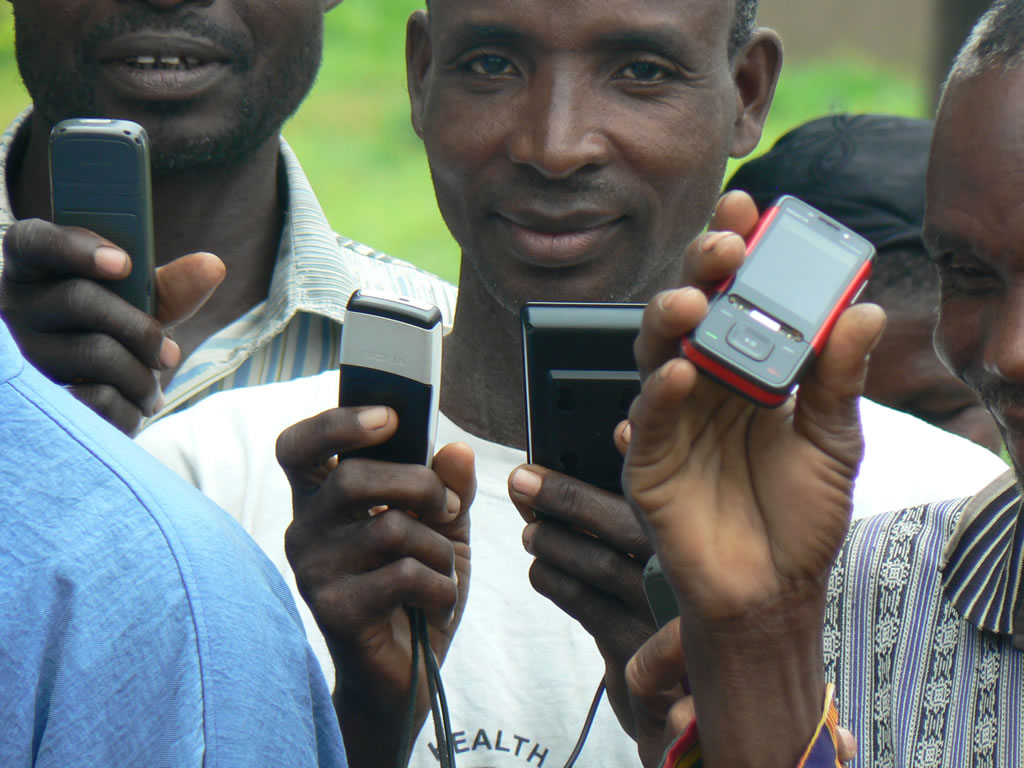
A good example of how ubiquitous the technology has become can be seen in states like Nigeria where in 2000 there were 30,000 cellular subscribers. But today there are 140 million, an 87% market penetration. This growth can be seen elsewhere on the continent and it is leading to breakthroughs for emergency services and the medical community.
How can that be? Here are just a few examples.
Kenyan Study
Last year researchers published a 2008 to 2009 study of 15 million Kenyans tracking their travel habits by cellphone signal. The location data could be gleaned from the 11,920 cell towers in the country. The movement of cellular phone customers was then correlated to incidence of malaria outbreaks. What the study showed was how malaria spread (see map below) from west to east across the country, from Lake Victoria to Nairobi.

This is the type of information that makes it possible to pinpoint source of disease outbreaks and target interventions early to stop its spread. With malaria, for example, although mosquitoes are the source of the parasite, it is infected asymptomatic people that facilitate its spread because they get repeatedly bitten by other mosquitoes who then pick up the infectious agent and go on to bite uninfected people.
Peru and South African Studies
Another study in Peru used ordinary cellphones (not the smart kind) to do field research studying the results of a randomized drug trial. In South Africa recently a number of community health workers used a combination of a web-based application and short messaging services (SMS) on $40 Nokia 2626 mobile phones to gather survey information from 39,665 households related to family wellness.
Cellphones in Africa are also being used to monitor livestock health, to facilitate patient transport expeditiously from remote areas to urban hospitals, and to provide in field support for remote health workers. For overall global health there is no doubt that this type of data collection gleaned from cellphone networks will lead to better data modeling of disease outbreaks famines and natural disasters and should lead to faster responses from the emergency and medical facilities within Developing World countries.

Wysips crystal prototypes are achieving 82% transparency and 8% energy conversion today with the next release expected to improve to 30% efficiency while providing enough power to a cellphone to increase talk time by 50% or keep it fully charged while on standby throughout the day. With several cell phone manufacturers interested the company expect to have its technology in products starting with releases in 2014. Estimated cost for the technology to the consumer will be an additional $2.30 US over current mobile phone sticker prices.
The technology isn’t just limited to cell phone applications. E-readers and tablets as well as billions of low power outdoor devices could use this type of energy-generating technology. Think billboards, road signs, transit shelters, kiosks, parking meters and more.
Wysips can be incorporated into windows and textiles. Imagine the windows in your car generating enough energy to run air conditioning on a hot day without drawing any power from the motor or the battery.Or equipping a stadium roof with Wysips fabric to provide energy for lighting. And Wysips isn’t limited to outdoor applications. It can be incorporated into indoor devices capturing energy from artificial lighting albeit with less efficiency than if used outdoors .
