In the last week, Argo Group International Holdings Ltd., an insurance underwriter, announced it was not renewing its policy for the Trans Mountain Pipeline (TMP). It noted that the pipeline project did not fit within the company’s current acceptable level of risk guidelines. Argo’s move followed Zurich Insurance Group AG, another underwriter that dropped TMP late in 2020.
The TMP is part of the Trans Mountain Corporation which currently operates the only fossil-fuel carrying pipeline travelling from Alberta to Canada’s West Coast. The current capacity of the line is 300,000 barrels a day. The pipeline is 1,150 kilometres (713 miles) long between Alberta and the port o Burnaby, British Columbia. A satellite 111-kilometre (69 miles) pipeline links to a refinery in Washington state.
Expansion of the TMP has been on the planning books for years. The past owner of the line Kinder-Morgan, a U.S.-based energy company, after numerous delays to the project finally bailed out and the Canadian government stepped in to purchase it turning it into a Crown corporation. The federal government’s initial acquisition cost $4.7 billion CDN. The current expansion project will add another $12 billion to the investment and will involve building a 980-kilometre (607 miles) second pipeline along with new pumping stations, and an expanded terminal and dock complex in Burnaby. The expansion will add 590,000 barrels per day of capacity in delivering petroleum products to the west coast for refining and export.
Opposition to the pipeline has come from numerous First Nations in British Columbia, and from environmentalists and municipalities along the route of the project. The company had hoped to complete the twinning of the pipeline by the end of 2022 but that timeline seems to be no longer achievable even though construction is underway. COVID-19 has further impacted the timeline for completion. But now the insurance underwriters are making it harder for TMP to proceed.
When an underwriter such as Argo or Zurich concludes that the risk quotient is too high what are they saying? Insurance underwriters like to make good bets when they risk their money. Clearly, neither of these two insurers feel TMP is that because they have assessed the degree of risk as beyond acceptable levels where even in offering higher borrowing rates or premiums, they don’t see a return on investment. So they walk away.
Recently TMP had won the right to keep the names of the companies providing insurance to it a secret. The request had been made by the Crown corporation because it felt that underwriters were increasingly being pressured by environmental groups and Indigenous peoples, Canada’s First Nations, to reject supporting continued investment in projects related to the Alberta Oil Sands.
TMP was described in a letter penned by 140 organizations back in August of 2020, as facilitating the spread of “the dirtiest forms of fossil fuels” on Earth and asked underwriters to step away from the project. They stated, “The companies insuring the Trans Mountain pipeline are accelerating climate change and violating Indigenous rights.” They went further, “The world is changing, the financial sector is beginning to act on climate change and projects that drive it.”
The largest insurance underwriters on the planet today, MunichRe, and SwissRe, already understand the message. They have demonstrated thought leadership when it comes to understanding the cost of anthropogenic climate change to them and the planet. They understand that in assessing potential investments they need to be guided by environmental sustainability and good governance (ESG) principles.
In the last few weeks, a G7 meeting of environment ministers concluded that fossil fuel projects needed to be wound down. This meeting followed an International Energy Agency report that called for the immediate end to any new fossil fuel projects stating that without a full-stop the planet would be unable to keep global atmospheric temperatures from rising above the Paris 1.5 Celsius (2.4 Fahrenheit) Climate Agreement limit established at COP-21 in 2015. It would seem Argo’s underwriting decision-makers understand there is more than profit at stake, and that this is about the future survival of the planet and to “do no harm.”
]]>
Today I want to summarize a report prepared by Morgan Stanley Capital International (MSCI) for investors assessing the potential impact flood risk poses to investors.
In the executive summary MSCI states, “The devastation caused by Hurricanes Harvey and Irma may re-ignite investor interest in measuring their exposure to physical risks, particularly flooding.”
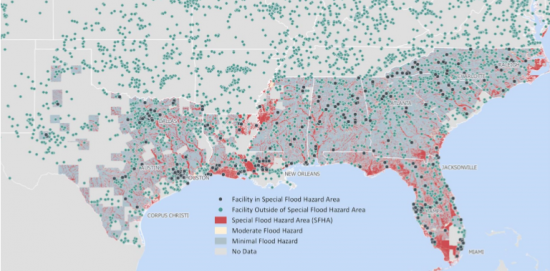
The study looks at flood hazard zones defined by the Federal Emergency Management Agency (FEMA) and assesses the risk to 13,600 facilities owned by companies represented in MSCI portfolios. This covers Florida, Louisiana, Mississippi, Alabama, Texas, Georgia, and South and North Carolina. Collectively these are the states where 85% of hurricanes have made landfall between 1851 and 2015.
In its key findings, it reports that:
The map below represents the facilities described as most at risk within this study. Note the special flood hazard areas appearing in red.
The study gives examples of damages to industry and infrastructure from past floods associated with hurricanes such as Sandy in 2012, Matthew in 2016, and Harvey, this past month.
In describing the risk to power plants, given lifespans of 30 to 125 years, and located in 100-year floodplains, it states that likelihood of inundation over 30 years is calculated at 25%.
The greatest risk states the study lie in Florida, North Carolina, Louisiana and Texas.
With the two recent hurricanes, Harvey and Irma, the inadequacy of U.S. flood insurance programs has been exposed. Going back to 1968 when the National Flood Insurance Program (NFIP) was originally established in the absence of private insurers willing to take the risk, this FEMA-based program has been accumulating debt. It is still making payouts for Hurricane Katrina and is $26 billion in the hole. That doesn’t include anticipated payouts for Harvey and Irma.
In an article appearing in The Financial Times on September 1st, it states that “scientists specializing in the modeling of catastrophes were unprepared for what we should really call Flood Harvey” referring to the incredible amount of rain that was dumped on Texas and Louisiana before the storm headed inland.
A weather agency expert is quoted stating “The precipitation was close to the thermodynamic maximum possible level, and not just for one day but for three days.” Why is this comment so significant? Because insurers and reinsurers rely on modeling as well as historical data to calculate risk and the models were no longer valid because Harvey was off the charts. How much? Over 6 days, 132 centimeters (52 inches) of rain fell with most of the damage well beyond areas that FEMA had designated as 100-year floodplain. Harvey showed that FEMA maps were no longer valid.
And as for Irma, the full extent of its impact on power plants and other industrial facilities is still being tallied. NFIP should see its debt hole more than double between the two storms. The Harvey-Irma combination should smash all previous damage assessment records. Munich Re, the world’s largest reinsurer, which at the time of the hurricanes described its catastrophe budget as in good shape, sees the two events as wiping out its short-term profits and impacting its year-end
Munich Re, the world’s largest reinsurer, which at the time of the hurricanes described its catastrophe budget as in good shape, sees these two storms as wiping out its quarterly profits and impacting year-end earning estimates negatively by several billion Euros.
Much of post-Harvey and Irma coverage focuses on residential losses. Certainly, energy companies have deeper pockets and probably better flood insurance coverage than an average homeowner. But nevertheless, the MSCI report points out that 100-year floodplain inundation risk, which today is rated at a 25% probability over 30 years, will more likely, in the future, be exacerbated by climate change and rising sea levels leading to increased frequency of these catastrophic events. And as for 100-year floodplains, the maps that we see such as the one above, need to be redrawn. And I think investors need to have a conversation with money managers about their portfolios with investments in companies that continue to bet against climate and extreme weather occurrences.
Consulting actuaries working within the reinsurance industry have access to weather and climate data and track the frequency of extreme events as well as sea level rise kept in an Actuaries Climate Index (ACI). Created first in North America by the American Academy of Actuaries, the Canadian Institue of Actuaries, the Casual Actuary Society, and the Society of Actuaries, the ACI is the primary tool by which underwriters assess financial climate risk for any client. Its six components cover disasters associated with:
In 2016 in the United States, natural disasters (including extreme weather events) resulted in $210 billion in losses. $62 billion of that was for flooding alone. But only a small portion of these losses was underwritten by reinsurers. That represents a significant and growing financial risk. In fact, it is estimated that the difference between natural disaster losses and the amount insured is leaving a growing gap which in 2016 amounted to $100 billion.
Today 116 global insurers are responsible for $15.3 trillion in investments. But of those 116 only 8 manage climate risk, and only 8% of the total have assigned staff measuring climate risk within their portfolios.
But with the emergence of CAT bonds in the mid-1990s following Hurricane Andrew, (considered the worst hurricane to hit the United States mainland in terms of total damages) insurers now have an instrument that covers risk beyond the norm. Risk beyond the norm is so severe that insurance companies would never consider selling coverage. The CAT bonds, however, provide a capital pool large enough to cover claims for these exceptional risks.
The U.S. isn’t alone in creating CAT bonds. China in 2013 began issuing them as a financial resource to cover climate-change associated natural disasters.
To an institutional investor, a CAT bond looks no different than a corporate bond. The bonds pay dividends quarterly and maturity ranges from one to five years. If a catastrophe exceeds the predetermined threshold before it matures, the bond is in default and the investor may lose a portion of the principal or all of it because the money value of the bond gets used by the reinsurer to cover its exposure to those insured for disaster costs. To ensure fewer defaults, most CAT bonds are designed not to cover the entire risk associated with the likelihood of a catastrophic event like Hurricane Andrew. They tend to be capped in billion dollar slices.