In choosing Facebook as the medium for gathering COVID-19 research data, the University was able to get a million people responding over a 2-week period. Responders were asked to self-report symptoms of the flu or the coronavirus for themselves or people living with them from the previous 24-hour period. Each day a sample was gathered from different users age 18 or over within the United States. All results were given a weighted value to correct for sample bias. The results don’t represent actual COVID-19 cases but do suggest that the virus may be far more widely distributed than the current number of cases being reported.
As of the writing of this posting, the U.S. has reported more than 852,000 cases and over 47,000 deaths. Testing per million is averaging just over 13,000 and the total number of tests done to date is just over 4.35 million representing 1.3% of the country’s total population. Recognizing the paucity of testing, a survey like this one fills in a gap.
That’s not to say that everyone reporting COVID-19 like symptoms is infected. I think so many of us have become paranoid about the signs of the virus that we are beginning to psych ourselves out. Both my wife and I are debating whether we should be tested based on symptoms we are experiencing in the last few days.
The survey is by county, by hospital referral region, and can be separately viewed for COVID-19 or flu symptoms. The image below shows county information with the data collected up until April 12, 2020. Neither the University nor Facebook are keeping or storing individual responses to the survey. All data is aggregated and anonymized.
Earlier this week I posted a COVID-19 antibodies study based on serology tests being done on volunteers in one California county. The results showed a range of between 2.5 and 4% of those tested as having been infected by the virus. The researchers argue that at that level of presence it is likely that there are 50 to 85 times more cases in the general population than what is being reported. It also talked about silent spreaders of the virus, people infected who are asymptomatic or only experiencing mild symptoms.
So does the Facebook-Carnegie Mellon survey fill a missing information gap? Undoubtedly, until testing of the entire population of the United States is done at least once if not several times and until a vaccine can be developed and distributed.

The latest research appeared in the May 21, 2018 issue of the journal Nature Materials, in an article entitled, “An autonomously electrically self-healing liquid metal-elastomer composite for robust soft-matter robotics and electronics.”
Described as the latest advancements in wearable computing and soft robotics, these newly developed elastomers can deform and reform, taking the worst damage one can throw at them. Composed of liquid metal droplets suspended in a soft elastomer, if bruised, ruptured or cut, the droplets reform new connections. Think about an electric circuit that spontaneously reconnects instantaneously so there is no downtime.
In the reported research, the CMU lab illustrated the effectiveness of the material by demonstrating its resilience using a soft robotic quadruped that continued to operate even after being significantly damaged.
States Carmel Majidi, CMU Associate Professor, “other research in soft electronics has resulted in materials that are elastic, but are still vulnerable to mechanical damage that causes immediate electrical failure….the unprecedented level of functionality of our self-healing material can enable soft-matter electronics and machines to exhibit the extraordinary resilience of soft biological tissue and organisms.” He describes his career mission as one dedicated to creating robots and machines that “behave like soft biological organisms” and that are “safe for contact with humans.”
The elastomer composites containing fluid metals provide a unique combination of properties that can function as artificial skin, nerve tissue, and muscle. This is a significant departure from Boston Dynamics, and its hard-shelled, wired systems containing integrated silicon circuit boards, our traditional view of what robots are all about.
For soft-bodied, self-healing robots that emerge from the CMU Lab I suspect there will be numerous applications including using the soft elastomers to create human-machine interfaces, to develop new biomedical prostheses, to marry soft robot systems with conventional microelectronics for use in all kinds of industrial applications, and to help humans in their efforts to conquer space and even live on Mars.
To learn more about the work of the CMU Lab watch this video.
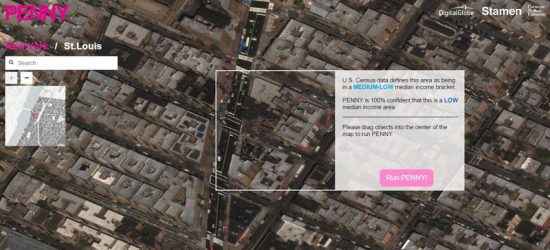
Census data on median household income by district along with satellite imagery is fed to Penny. The AI, a neural network application, looks at the patterns in the imagery and correlates them with data from the census. Penny learns the patterns and begins to discern the characteristics of neighbourhoods that have high, medium and low incomes. For example, Penny defines a digital image showing baseball diamonds, parking
For example:
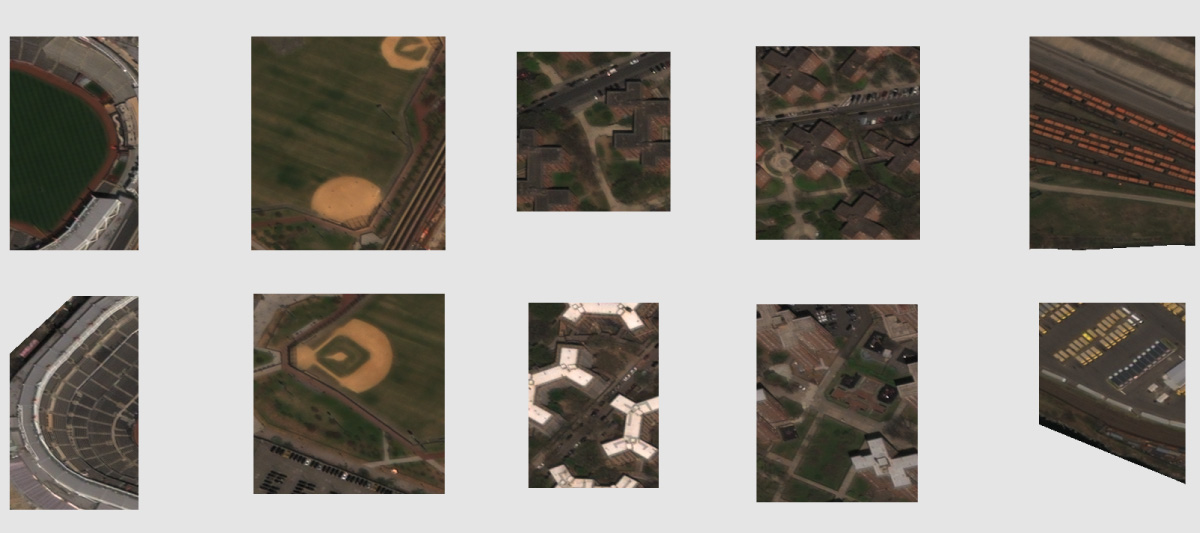

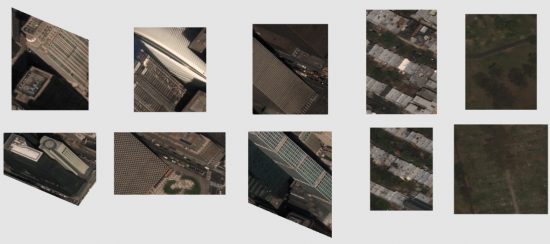
Repeatedly running the census data and images from Digital Globe has trained Penny to recognize these patterns and accurately predict income levels by looking at new satellite imagery.
But that’s just the beginning. Change the images to include a proposed new project and then have Penny take a look. The results sometimes show an intuition that is clearly not human. Add a new park to a neighbourhood and depending on the data and existing images, Penny will surprise you. A poorer neighbourhood may not gain the same income boost as a medium or high-income level area when the park gets plunked down in its midsts.
Ask Penny why its conclusions and it logically explains its interpretation and predictions.
For city planners, land developers and architects, Penny’s predictive capability could prove to be an invaluable tool for tinkering. You can imagine all kinds of “what if” scenarios, create an image and place it within an existing one and let Penny tell you the impact of your idea or project.
Penny’s trainer, Aman Tiwari, a computer scientist at Carnegie Mellon, states about his AI’s predictions, “we don’t know whether it knows something that we haven’t noticed, or if it’s just plain wrong.” As a result, Penny’s developers are studying the AI’s non-human intuition to better understand machine learning.
A next generation of Penny will soon be in the works. We should then know from an AI’s perspective whether putting a new high-rise tower in an already highly urban intensified area will have a positive or negative impact on income levels.
When Claudico lost in 2015, also at the Rivers Casino, the contest lasted 14 days and involved 80,000 hands and $170 million U.S. on the table. In the end the humans came out ahead a little over $700,000, almost a statistical tie. So CMU went back to the drawing board and two years later have their rematch begining January 11 and scheduled to last 20 days and 120,000 hands. The winners will receive a check for $200,000.
AI has been on a run when competing against humans at games, first with chess, then Jeopardy, and most recently Go. Trivia and board games, however, are different from poker which involves the element of the unknown and human emotions. How will Libratus know when an opponent is bluffing?
Derived from the Latin word that means balanced as well as powerful, Libratus’ algorithms are geometrically more advanced than Claudico. Where the latter derived its AI algorithms from 3 million hours of computation, Libratus’ programming has been derived from 15 million hours of effort.
Tuomas Sandholm, professor at Carnegie Mellon, describes the challenge Libratus faces.
“It requires a machine to make extremely complicated decisions based on incomplete information.”
Libratus applies the Nash Equilibrium solution to its poker winning strategy. Named after an American mathematician and game theorist, John Forbes Nash Jr., the concept according to Investopedia is described as follows:
“The optimal outcome of a game is one where no player has an incentive to deviate from his chosen strategy after considering an opponent’s choice. Overall, an individual can receive no incremental benefit from changing actions, assuming other players remain constant in their strategies.”
Libratus has learned to identify when a hand is promising and when to play on, versus not promising, and when to fold early. And unlike Claudico where its human opponents soon learned when it would bluff, Libratus is far more unconventional. It will make moves that Sandholm describes as “weird.”
Are there real world applications? Sandholm characterizes being able to respond to incomplete and misleading information as a fundamental skill needed in many fields from business to medicine. Nick Nystrom, Senior Director at the Pittsburgh Supercomputing Center, when asked about Libratus’ programming states, “Extending AI to real-world decision-making, where details are unknown and adversaries are actively revising their strategies, is fundamentally harder than games with perfect information or question-answering systems….This is where it really gets interesting.”


Atlas is a product of Boston Dynamics of Waltham, Massachusetts. Boston is working with DARPA, the research arm of the U.S. Department of Defense, to develop a wide range of robots including the SandFlea and BigDog. But these two bear no resemblance to a humanoid. Atlas does.
Currently you can watch a video of Atlas as the robot operates at the end of a tether. But plans are afoot to make it tether free. Standing 1.8 meters (6 feet) tall, and weighing 150 kilograms (330 pounds), Atlas is designed to go where it would be dangerous for humans to go while operating with a level of sophistication and autonomy. For example Atlas could defuse a runaway nuclear reactor before a meltdown happens, rescue people from an environmental disaster or battlefield, or even tend to the sick and elderly.
Atlas is designed to climb using both hands and feet. It features actuators and servomotors that give it flexibility and range of motion not seen in previous humanoid robots. The robot can adjust to impacts to keep its balance. Its head incorporates Carnegie Robotics’ MultiSense-SL, a vision system that sees objects in three dimensions and incorporates LIDAR to map its immediate surroundings.
DARPA unveiled Atlas last week with the robot performing calisthenics to demonstrate its flexibility. It will be one of several robots in the DARPA Robotics Challenge, a contest running this year to test a number of robots to see if they can be used for disaster response.
The robots entering the contest will be asked to perform eight tasks to see if they can work in rough terrain and operate human machines and tools. This includes climbing and walking over complex terrain, entering, driving a utility vehicle (seen in the picture below) through an obstacle course and then exiting from it, removing a pile of debris blocking an entryway, opening and entering a building through a door, climbing stairs and ladders, breaking through a wall using power tools like drills and sas, locating and closing open valves, and carrying, unspooling and connecting a fire hose.

The Challenge features robots from many sources including entries from the United States, the United Kingdom, Japan, Mexico, Spain, Israel and Brazil. Universities such as Carnegie Mellon, Drexel, MIT, and Virginia Tech have brought their humanoid robots to the contest as has two divisions of NASA, the Jet Propulsion Laboratory, and the Johnson Space Center. There are even entries from private companies such as Boston Dynamics. These include robots from Raytheon, Schaft Inc., and Boston Dynamics.
Over the coming months as the teams respond to the eight challenges they will develop sophisticated software to tackle each mission. We’ll let you know who are the winners.
]]>