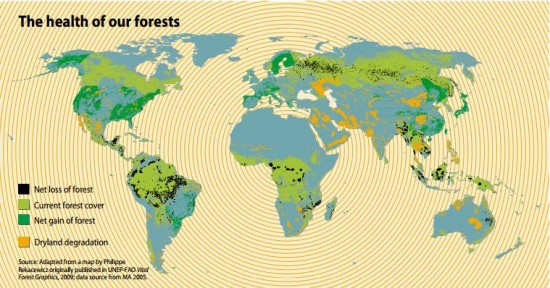
We can’t afford to lose the tens of thousands of hectares that vanish each year and genetic research may provide us with a tool to fix not only the trees but climate change to boot.
Genetically modifying trees can alter the way they grow, how they resist disease, and even increase their carbon sink capacity. But the anti-GMO movement seems to not understand the implications of their resistance to research in this field. Here’s a quote from Rachel Smolker, BioFuel Watch: “This is deliberate, irreversible and completely irresponsible contamination of the environment with unknown and possibly devastating consequences.”
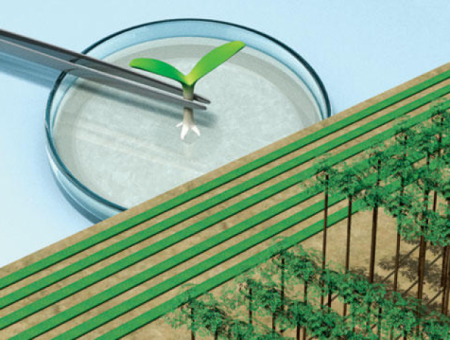
What are the anti-GMO concerns when it comes to trees?
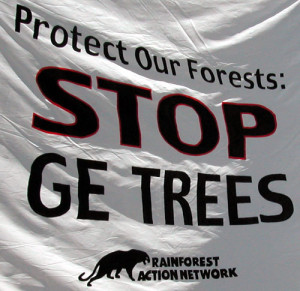
How valid are these concerns?
The only legitimate concern raised by the anti-GMO groups is the first point. Why?
If we use GMO crops as the model, the biggest concern was always cross contamination from genetically modified species to non-GMOs. This has yet to happen after almost two decades of commercial growing of GMO corn and other crops. But these are annual staples that live only one growing seasons. Trees are not the same.
So scientists who are experimenting with GMO trees recognize they have to implement longer timeline studies to ensure the same results occur waiting as much as three years for the trees to reach reproductive maturity. This means longer timelines on GMO-tree studies before approvals are sought from regulatory bodies.
What kind of benefits could be derived from introducing GMO forests?
There are so many including:
If we are to continue to watch our human population rise to levels of 9.5 billion or more by mid-century then more forested land will be cut down to grow food crops.
If we continue to cut down our forests we will see the impact this has on precipitation patterns, aquifers, and land stability with subsequent landslides.
If climate change continues to warm temperate boreal forest areas we will see the spread of insect-borne, bacterial and fungal infections like the mountain pine beetle, ash borer, fire blight, and other agents have destroyed tens of thousands of hectares each year and created fodder for wildfires when combined with climate change-induced drought conditions.
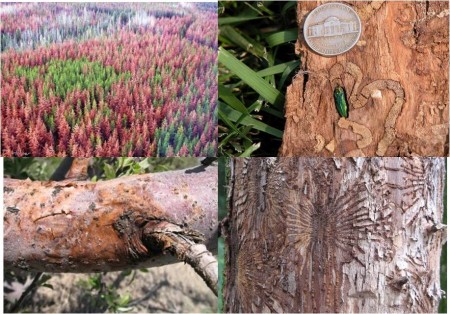
GMO and the science of genomics gives us a tool that can allow us to expand cropland while we enhance forest lands. Enhanced trees can help us mitigate CO2 increases by being more effective carbon sinks.
If we cut off GMO tree research we will lose in so many ways.
What does $1.4 billion buy you? The removal of about 1 million tons of CO2 from the atmosphere each year. Of course, closing the coal-fired power plant would remove even more but that’s not in the equation for now. Although at some point as we come to terms with a low carbon economy it may very well come to pass.
What will happen to that CO2? Some of it will be liquified, transported through a pipeline and then stuck underground in rock where it will be permanently sequestered. Some of the CO2 will get sold to fossil fuel operators to be pumped into older oil fields to improve yields.
The plant has also built into its outflow gas waste management a sulfur dioxide capture technology that converts the gas to sulfuric acid for sale to industry. And finally, the last component in the outflow gas, the fly ash, is also captured for sale to concrete producers.
All in all this is pretty impressive technology for mitigating CO2 but we need to seriously question the rationale for spending so much to justify keeping coal-fired power plants in operation. That’s because CCS is the most expensive approach we can take to CDR, carbon dioxide removal.
There are many CDR strategies we can deploy in pursuit of a low carbon economy. Many don’t require a $1.4 billion investment. With CCS at the high-cost end of CDR strategies, what is there at the low end that we can deploy?
The global management consulting firm, McKinsey & Company, as part of its practice has created a greenhouse gas abatement curve which I have reproduced below, The areas indicated in orange represent relatively inexpensive biological CDR techniques providing significant dividends.
In addition the activities on the left, the conservation side, can immediately create CDR benefits through decreased energy demand. These include replacing energy inefficient consumption technologies such as incandescent lights and internal-combustion-engine transportation.
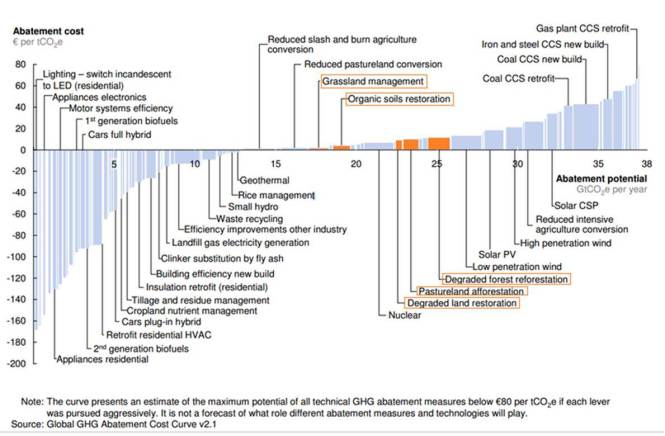
The biological techniques for CDR involve little in the way of expended dollars. Instead much of it is about behavioral change. Better livestock land use techniques help restore grasslands with the benefits of an expanded carbon sink, reduced desertification, restored freshwater balance, and increased biodiversity.
Reforestation of boreal and tropical rainforests creates immense carbon sinks, second only to the ocean. It is estimated that worldwide deforestation today is contributing to 15% of all CO2 emissions. Steps like the one announced in the last week involving Norway agreeing to pay $150 million USD to Liberia to stem deforestation represent a novel financial approach to implementing biological CDR. This type of strategy is just part of a much larger holistic land management movement first proposed more than a half-century ago.
A new study published in the last week looks at the impact of converting forest to agricultural use. It shows in general that converting forest to agricultural land regardless of location destroys the aggregate structure of soils and contributes to increased CO2 in the atmosphere.
The study reviews 119 published papers and creates a dataset of 453 sites where forests have been converted for agricultural use. Sites are assessed by forest type, cultivation stage, climate and soil properties. At 98% of the sites soil sequestered carbon stocks show a decrease. At the remaining 2% carbon stocks in the soil actually increase. On average across all sites sequestered carbon stores show a decrease of 43.1%. Other factors that play a role in the percentage of sequestered carbon decrease include temperature, precipitation, soil pH, clay content and density. The more dense and clay soil types the less the loss of sequestered carbon.
In almost every case the conversion from forest to agricultural use has led to a significant initial decrease in sequestered carbon. After several cycles of cultivation the rate of decrease has slowed. Land use change in temperate forest regions causes the most significant soil carbon loss. Tropical forest areas are second and boreal forests last.
These results were expected since mean annual temperature in temperate and tropical regions produces accelerated breakdown of organic matter. In cooler climates organic matter takes longer to break down and be assimilated by the soil.
Previous studies have for the most part looked at the loss of soil-based carbon in the tropics with the Amazon, Congo and Southeast Asian forests the focus. The data collected and assessed in this study, however, shows that 35% of the global decrease in forest cover globally is happening in boreal regions. These boreal forests are more extensive than either the tropical and temperate forests. Thus boreal forests are a larger carbon sink than either of the other two.
When you consider that it is predicted that the largest increases in atmospheric temperature will occur from the mid-latitudes to polar regions, the domain of boreal forests, agricultural conversion in these areas are expected to play a more significant role in contributing to global warming.

For those who believe that the CO2 we produce will actually improve plant growth the study provides a sobering conclusion.
Professor Peter Cox, a co-author of the study that appears in the journal, Nature, states, “What we are seeing is that the tropical forests in particular are becoming more vulnerable to warming and we expect this to continue because we expect to see more warming in the future…..the temperature effect caused by increasing CO2 concentrations is probably becoming stronger.”
Whereas the ocean is a stable carbon sink for sequestering CO2, land-based carbon sinks are highly variable depending on changing seasons, precipitation and weather. The climate models to date have not taken into account land-based carbon sinks impacted by rising temperatures. And drought appears to be the single greatest outcome of these expected temperature changes from increasing GHGs from human activity.


