Already, the ocean is the largest carbon sink on the planet. It has kept a lid on our excess emissions but at a cost. The carbon dioxide (CO2) being absorbed by seawater is making it more acidic which is endangering all shellfish, crustaceans, phytoplankton, and corals.
A new take on the deep ocean storage idea is to sequester carbon in areas where there is a paucity of oxygen-dependent marine life. Instead of giant bags in which to store CO2, the weight of the ocean water column would be enough to keep the carbon sequestered.
Researchers at the University of California in Santa Barbara (UC-Santa Barbara) have identified three potential carbon storage sites that are anoxic marine basins where vast amounts of plant biomass could be sunk to the ocean floor.
What are anoxic marine basins? Oxic and anoxic are opposites. Ocean environments are largely oxic, that is, oxygen-rich. Some areas, however, are anoxic containing little to no oxygen. These areas of the ocean can only support anaerobic life. Anaerobics include many bacteria and fungi. The creatures found near deep-sea hydrothermal vents which scientists call archaea, are anaerobic. They use other types of chemistry within the ocean to harvest energy to sustain them and they predominate in deep sea basins where there is low to no oxygen present.
The UC-Samta Barbara researchers have published a study of three candidate anoxic basins that could become permanent carbon storage sites. Their locations are:
The Black Sea Basin is the largest anoxic basin in the world covering 322,367 square kilometres (124,467 square miles) and sinking to a depth of 2,300 metres (7,500 feet). Below depths of 150 metres (approximately 490 feet), there is no dissolved oxygen. The water in the Black Sea does very little intermixing with the Mediterranean.
The Cariaco Basin is a deep trench with a middle ridge that splits it in two. It covers 2,000 square kilometres (770 square miles) off Venezuela’s Caribbean coast. As seen in the middle picture above, it has no dissolved oxygen below a depth of 100 metres (330 feet).
The Orca Basin covers approximately 10,000 square kilometres (approximately 3,860 square miles). Seen at the bottom of the illustration accompanying this posting, the Orca Basin’s anoxic zone lies 2,200 metres below the surface and extends for 200 metres to the Gulf of Mexico seafloor bordering Louisiana and Texas.
Of the three, the study notes the Black Sea in particular could “accept biomass storage at climatically relevant scales with moderate changes to the geochemical state of abyssal water and limited communication of that impact to surface water.” If done correctly, it could provide safe storage for more than 1,000 years and make a real dent in CO2 atmospheric numbers.
The UC-Santa Barbara research notes that the separation between oxic and anoxic water is very distinct because of drastic differences in density within the water column between the surface and anoxic zones that tend to be hypersaline. One researcher notes that when navigating a submersible underwater it actually will bounce off the demarcation line between the layers.
Why would using anoxic marine basins possibly work? Geoengineering solutions focused on carbon sequestration appear to be an acceptable way to mitigate climate change if you go by the discussions at COP28. According to The Guardian, 475 were in attendance at the Dubai conference.
Plant biomass has become one of the strategies under consideration for carbon sequestration. The sinking of kelp, sargassum, and algae plant biomass was recently covered here at Techso Mogro. The article featured a company called Running Tide which was developing biomass seeding technology to fast-cycle seaweed biomass containing captured CO2 to the bottom of the ocean.
One of the issues raised in the article was a concern about dropping massive amounts of biomass to ocean floors in oxygen-rich zones. It appears, however, that using the technology in the Black Sea, or the other two anoxic marine basins, we could achieve decarbonizing at megaton levels using sunk biomass that would be an effective climate change mitigation solution for a millennium.

Founded by David Keith, a Harvard University professor of Applied Physics, the technology is designed to capture carbon dioxide (CO2) from ambient air. The Squamish plant began operations in 2015 and now has three years of collected data. It was the first of its kind, a complete direct air capture (DAC) system that could be used to capture CO2 and convert it into liquid hydrocarbon fuel to be mixed with gasoline, or permanently store the greenhouse gas underground.
In the journal article, it describes the evolution of CO2 capture beginning in the 1950s and 60s to be used as a feedstock for hydrocarbon fuels. But in the 1990s researchers started talking about capturing CO2 from the air as a means to mitigate climate change. That’s when the term DAC was coined. At the time no one could calculate what it would cost to capture a ton of CO2. Estimates varied from $50 to $1,000 per ton. But since no one had built a DAC plant to see what the real numbers would be these estimates were entirely speculative.

But now we have the reality check after the Squamish pilot plant has operated for three years. And those numbers are looking pretty good. Running the plant, continuously since startup has achieved CO2 capture at cost levels that are now approaching $100 per ton. This is far removed from the $1,000 or $600 per ton of earlier speculations. And in addition to CO2 capture, since December 2017 the company has started converting the captured gas into fuel, not derived from crude oil, using its trademarked AIR TO FUELS process. In describing the latter, Steve Oldham, CEO of Carbon Engineering, notes “Our clean fuel is fully compatible with existing engines, so it provides the transportation sector with a solution for significantly reducing emissions, either through blending or direct use.” He’s not describing a gasoline-blended fuel, but one that conceivably can be used by any vehicles currently on the road. Although the carbon fuel is 25% more expensive to produce than conventional fuels like gasoline and diesel, unlike them it is very low carbon, and as a Carbon Engineering product, part of the net-zero carbon loop that the company is bringing to market since the emissions the fuel produces can be recaptured by the DAC technology.
The company which initially raised $30 million from government grants, and private investors like Bill Gates, is now in the process of seeking an additional $60 million to build a full-sized commercial DAC plant.
In today’s The Globe and Mail, Global Energy Reporter, Shawn McCarthy describes how DAC could fit into a different world paradigm than the one most of us envision for a low-carbon future. Instead of eliminating fossil fuels, DAC could conceivably make it possible to continue using them with the carbon produced being removed from the air to maintain or reduce CO2 levels within the atmosphere. That would mean the complete electrification of our transportation infrastructure would no longer be necessary.
Oldham describes what this means for the planet in a conversation with The Globe and Mail. “Our low-carbon fuel is entirely compatible with any automobile, any truck, any airplane that exists today. By making the fuel carbon neutral, the entire transportation sector can become carbon neutral without changing all of the infrastructure – we don’t have to get a new car, we don’t have to replace every gas station with an electric grid for charging.”

]]>

What is carbon farming?
We know the ocean absorbs carbon dioxide from the atmosphere. But so does land and it does it through the plants that take root on it, and through the soils that trap and sequester the carbon in root systems and the organic material that remains after harvest and in the cycling of the seasons. In the United States alone 762 million tons of carbon dioxide (CO2) is stored in plants and soil offsetting 11% of the country’s carbon emissions.
Agriculture research is no longer just about crop varieties and growing yields. It is now front and centre focused on helping the planet to stay cooler through better carbon farming practices. The areas where new research is yielding results include:
The current administration of the United States Department of Agriculture set out a road map for climate smart practices in May of this year. In it implementation plans were laid out based on 10 building blocks:
The goal of the road map was to achieve carbon sequestration amounting to 120 million tons of CO2 or equivalent annually by 2025, equal to the emissions produced by 25 million cars or 11 million homes. With the new administration it is not known whether this road map will endure the scrutiny of the new President and his appointees.
Nonetheless agriculture and farmers are on the front lines of climate change and will be first victims of global warming’s many tipping points including increased frequency in extremes of heat or cold, prolonged droughts, and episodic floods. So whether the government of the day is proactive or in denial, the vital business of agriculture must go on.
A quick review of the practices described above are, therefore, in order.
No Till, Cover Cropping and Crop Rotation

These best practices all work hand-in-hand. Farmers are learning not to turn over the soil after a crop is harvested (see image above). Instead of disturbing the soil before reseeding, no till the planting gets done in the residue of the previous crop. Only small slit trenches get cut to place the seeds which are then covered. A sample case study report using soybean crops shows yield increases from 25 to 65 bushels per acre.
Cover cropping combined with no till practices ends the practice of fallowing. Farmers stabilize the soil, suppress weeds, reduce runoff, fix both carbon and nitrogen and improve the micro biota when they don’t leave a field to lie fallow after a harvest. At schools like Cornell University, the College of Agriculture and Life Sciences has developed a comprehensive cover crop decision tool for farming vegetables. The tool includes selecting management criteria, planting time and growing time duration to provide guidance.
Iowa State University agrologists have been studying no tillage combined with crop rotation and the role the two play in carbon sequestration. In a paper entitled, “Impact of Tillage and Crop Rotation Systems on Soil Carbon Sequestration,“ published in 2008, it was noted that minimizing organic carbon breakdown by keeping plant residues intact plays a critical role in farming’s contribution to reducing our global carbon footprint. Rotating what gets grown as a cover crop on land reduces the rate of soil carbon decline when compared to continuous planting of a single crop. In the study the research looked at a rotation of corn to oats to meadow yielding better carbon retention.
Perennials versus Annuals
If wheat, corn, soybeans and rice were perennials rather than annuals then the world of farming would be a very different business. Instead of the cycle of planting, harvesting and reseeding we would have a permaculture which would resemble forests. Today there are no perennial grains in widespread use. Back in 2013 I wrote about Kernza, a perennial wheatgrass being developed as a wheat substitute by The Land Institute in Salina, Kansas. Kernza when planted develops a significant root system that goes well beyond that of traditional annual wheat. That root system is key to sequestering carbon as well as stabilizing soils.

Perennial farming would be particularly useful in many of the rice growing regions of the world which often feature hillside farms with terracing. Roughly 45% of the world’s farmland happens on hills with an 8 to 30 degree slope. If these farms were to switch from annual to perennial cereal crops it is estimated that an additional 16.8 billion tons of carbon could be sequestered annually.
We already have perennial agro-forestry success stories in orchard crops like apples, pears, peaches, oranges, grapefruit, coconuts, and avocados, to name a few. Orchards are great at sequestering carbon at a rate from 9 to 228 tons per hectare (3.6 to 92 per acre). The variable is determined by latitude, altitude, and rainfall.
Changing What is Grown in Pasturage and on Grazing Lands
Livestock are a significant source of greenhouse gas emissions. But until we come up with a substitute for beef and other meat protein food sources then we need to address what we feed livestock. A single cow releases between 70 and 120 kilograms of methane (CH4) annually. If we can alter the diet of cows to impact that methane output we could considerably reduce the production of what is a much more potent greenhouse gas than CO2. And CH4 is emitted from almost all livestock and contributes 18% of the total greenhouse gases worldwide. Today 30% of our continental land surfaces are set aside as pasture for livestock.
In a 2011 report entitled, “Raising the Steaks: Global Warming and Pasture-Raised Beef Production in the United States,” researchers looked at ways to lower greenhouse gas emissions by improving the capacity of pastures to sequester carbon. Changing the plants cattle graze on was seen as one way to reduce CH4 emissions. The report suggested a plant like Birdsfoot Trefoil (seen below) would serve well in reducing emissions from cattle as they graze.

Birdsfoot Trefoil is a perennial legume primarily used as pasturage or harvested as hay.It can grow in poorly drained soils. Unlike alfalfa it does not contribute to bloating in grazing animals because of the presence of tannin compounds in the plant. So that means less CH4 emissions from foraging livestock. An added benefit, Birdsfoot Trefoil reduces nitrous oxide (N2O) emissions from soil. Fixing nitrogen is useful in crop rotation where pasturage is in the mix. And finally the plant tolerates marginal grazing areas typically overrun by weeds so in planting it farmers can keep intrusive weeds from creeping into non-forage crop plantings.
Birdsfoot Trefoil is one of several plants that can help reduce CH4 emissions from livestock. Brachiaria increase soil sequestration rates by 3-fold factor and produce similar benefits. Brachiaria is found in sub-Saharan Africa and research shows that dairy cattle grazing on it can yield 40% more milk than on other pasturage.
Integratng Trees
Agro-forestry is helping farms contribute to reduced carbon emissions. In a recent study entitled “Global Tree Cover and Biomass Carbon on Agricultural Land” researchers noted that between 2000 and 2010 increases in tree cover on farmland yielded a 4.6% increase in biomass carbon, that is carbon stored and sequestered by trees. The research suggests integrating woodlots, border field tree plantings and planned silviculture such as fruit orchards would sink four times more carbon than other agricultural land use.
A final word
Eric Toensmeier, lecturer at Yale University, has authored The Carbon Farming Solution: A Global Tookit of Perennial Crops and Regenerative Agricultural Practices for Climate Change Mitigation and Food Security. The book was published in February of this year. Toensmeier states that “carbon farming practices…could play a critical role in preventing catastrophic climate change by removing carbon from the atmosphere and safely storing it in soils and perennial vegetation.” He cites a farming cooperative in Veracruz, Mexico, as a locale where carbon farming is successfully practiced today. An aerial view of one of the farms can be seen in the image below. The sustainable practices implemented at this site mitigate climate change with no negative impacts on food and fodder production.
For farmers this books is truly worth checking out if you are into saving the planet while contributing to feeding it.

]]>
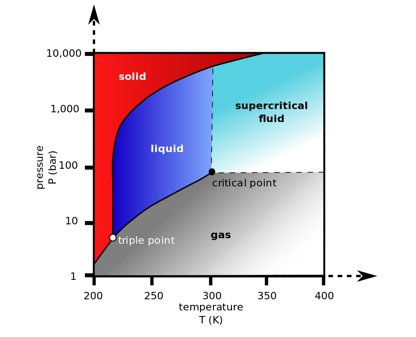
Supercritical is defined as a state above a critical threshold. In reference to a fluid, it is the state when one cannot distinguish between gas or liquid phase for the substance. The graph below shows the critical point when a gas or liquid enters supercriticality. In this state produced by exposure to high pressure and high temperatures supercritical fluids such as ScCO2 display interesting properties. For a demonstration of just what happens watch this YouTube video.
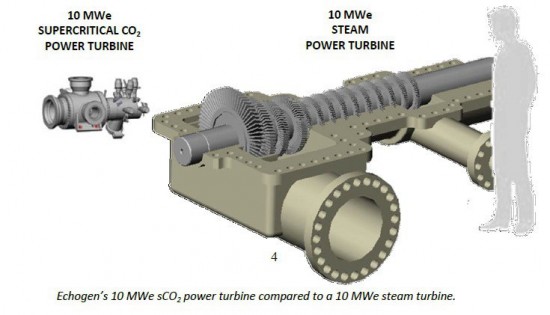
Using ScCO2 in power turbines has been of interest to the energy industry for a number of years. Why? Because as an energy driver ScCO2 remains stable compared to steam. It also packs more punch per square meter because of its small form factor as you can see in the illustration below. In addition to being more stable, ScCO2 turbines produce more energy because of 20% higher efficiency rates than steam.
So why haven’t we seen mass adoption of this technology by power utilities?
The challenge in the past has been to find the right materials capable of withstanding the elevated temperatures and pressures required by ScCO2 turbines. That’s what GE’s engineering team set out to do. And they think they got it right in developing a ScCO2-powered turbine prototype capable of generating 10 Megawatts in a form factor no bigger than a desk. There next step is to scale it to 33 Megawatts.
ScCO2-powered turbines do not require as much energy input to reach supercritical phase and they can be up and running within a minute or two. That’s up to 30 times faster than bringing a steam turbine on line.
ScCO2 has another advantage. It doesn’t corrode or fatigue materials like steam. And the technology is lower maintenance because it has no associated water quality and treatment costs which are necessary for steam-based turbines.
GE believes this technology is a good fit for providing spot-power generation for utilities during peak demand periods. It also sees it as a substitute for storage batteries at solar thermal plants where it can use heat from the molten salt reservoirs to fire up and provide continuous power even when the sun is not shining.
But GE is not alone in using ScCO2-turbine technology. Another company, NET Power has been building a power plant that generates zero emissions employing a similar technology to that of GE.
How does the NET Power technology work?
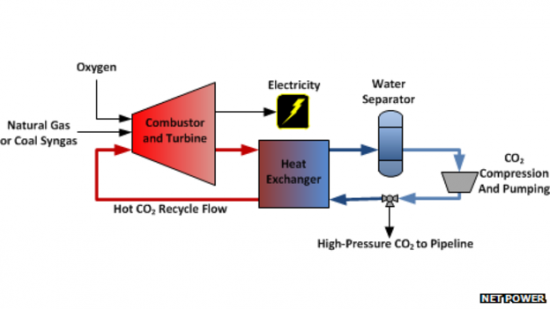
The above diagram illustrates the process. The source of fuel can be coal or natural gas. When burned with pure oxygen produced in an Air Separation Unit it also produces CO2. The latter is subjected to high pressure and heat in an oxy-combustion process. That turns the CO2 into ScCO2 which then powers a turbine.
The byproducts of the energy generation include water and CO2. Both are captured and go through a heat exchanger where the water condenses and is recycled while the CO2 either loops back to the turbine or gets sent through a high pressure CO2 pipeline and pumped underground into oil wells to enhance petroleum recovery.
Like the GE technology, NET Power doesn’t require a large footprint saving significant space compared to traditional coal-fired or natural gas power plants. A 50 Megawatt demonstration power plant, the first of its kind, is expected to be up and running in Texas by the end of 2016.
Imagine the potential this represents for both addressing energy demand while utilizing fossil fuel sources for power. The potential big fly in deploying lots of NET Power technology is the viability of a strategy where sequestration of CO2 is a key component. That may limit site selection because proximity to oil fields or to a stable underground rock formation where the CO2 when pumped underground in a super critical state would bind with the existing minerals. The last thing the industry would want to do is potentially create a CO2 leak to the surface negating the purpose of the sequestration effort.
There are 70 species of mangrove in the world today. They occupy coastal wetlands largely in tropical and subtropical environments (see map below). They serve as nurseries for shellfish, crustaceans, fish, birds and other wildlife. They represent a significant renewable wood source. They absorb storm surges and prevent coastal erosion. They are salt tolerant filters. Their biomass is greater below ground than above which makes them effective sequesters of carbon. And with all these good things they are increasingly endangered by us.

The largest concentration of mangroves is found in Indonesia. In that country’s latest study researchers calculated the amount of carbon stored by these forests to be 3.14 billion tons with each tree storing 3 to 5 times the amount of carbon of any other tree species. And yet Indonesia is seeing massive mangrove deforestation. With 25% of the world’s remaining mangrove forests estimated at 2.9 million hectares (over 4.94 million acres) Indonesia is losing 52,000 hectares (128,500 acres) every year largely to shrimp ponds. The loss of mangrove acreage is contributing 42% to Indonesia’s carbon emissions contribution annually. If the country could stop this deforestation it could immediately see carbon emissions decline from 10 to 35%.
What is happening in Indonesia has already occurred in South Florida where mangrove forests are under pressure from real estate developers seeking beachfront locations for high-rise condominiums. The Florida Department of Environmental Protection describes mangroves as significant contributors “to the overall health of the state’s southern coastal zone.”
For Florida’s commercial fisheries mangroves are essential to the health of snapper, tarpon, jack, sheepshead and other fish populations. In fact without mangroves Florida might not even be there. And yet in many areas along the state’s coast mangroves have been destroyed. In Tampa Bay the loss amounts to 44% of the total habitat. Near West Palm Beach the loss is as much as 87%.
And now climate change is threatening mangroves as weather patterns change and the atmosphere warms. While a warming climate might appear to be beneficial to the range of the mangrove spreading it closer to the poles, with atmospheric warming has come ocean warming, and the latter is contributing to sea level rise and more destructive storm surges. For isolated mangrove forests it is becoming more difficult to hold back the sea.
Add incidents like the Deepwater Horizon explosion and spill of 2010 have seen mangrove mutation rates skyrocket along the Louisiana and other Gulf Coast state wetlands. In addition Deepwater Horizon has contributed to die offs and the weakening of mangrove forests further exacerbated by polluted runoff from coastal factories, cities and farms chemically impairing the trees. The consequence for much of the Gulf Coast – negatively impacted freshwater aquifers extending several kilometers inland.
Other impacts from mangrove duress in the Gulf, Florida and other coastal areas include:
The carbon sequestering property of mangroves is being further compromised as more forests get cleared. In leaving fewer mangroves the trees get larger increasing above-ground biomass. This makes them less efficient for capturing carbon because smaller more dense forests produce much larger sub-surface systems with better sequestering capability. In addition the larger trees means less of a living canopy and less biodiversity below the forest floor in associated waterways. The loss of biodiversity means less filter feeders to clean pollutants. It means the decline in water and soil quality and fewer juvenile fish which rely on the mangrove root systems for shelter from predators.
But there is a change in attitude beginning to make its presence felt in the world of mangroves. For example:
So what is the future for mangroves? With the rise in human population greatest in the tropical and semitropical world, and with most of humanity living at or near coastlines, mangroves are highly endangered. Aquaculture is expected to significantly increase to meet food demand. And where aquaculture sets up shop mangroves vanish.
As for climate change and its byproduct, rising sea levels, scientists are still studying potential impacts. Will forests move further inland as wave erosion and storm surges deplete coastal areas? In one 1997 study a rise of 16 centimeters (approximately 6 inches) in sea level initially caused seedling growth spurts but slowed once the trees reached the sapling stage after 2.5 years. That study didn’t look at erosion impacts from storm surges and coastal flooding.
I leave you with these three final notes and hope you have a renewed appreciation for the unique value that mangroves bring to our planet:
We need robust mangrove forests to grow and prosper in this 21st century, an important piece in our chess set of options to combat climate change.

Transportation is the second largest human emitter of carbon dioxide.
So how to come up with a technology that can sequester all that carbon as trucks and cars go about their daily business?
Well a French-Dutch architectural design firm, The Cloud Collective, has and they exhibited it in Geneva, Switzerland at a garden festival this summer. They erected a vertical garden in the form of fencing on a viaduct overlooking a small roadway.
The fence, constructed of hollow transparent tubes, was filled with water and algae. To keep the liquid moving electricity supplied by solar panels ran pumps. In addition the technology contained filters to both clean and harvest the algae as it multiplied.
Classified as a bioreactor, this fence, deemed Culture Urbaine, feeds off carbon emissions produced by passing cars and trucks. Byproducts of the technology include oxygen and biomass. The former can be recirculated into the air. The latter can be continuously harvested to create green energy, produce biodiesel fuels, medications, cosmetics and even foods. Watch the video to see the technology at work.

In the last week here in Toronto scientists gathered at a conference entitled, Bio-Inspired Ideas for Sustainable Technology. The goal of those gathered was to learn from plants how to better utilize solar energy by replicating photosynthesis through technology. Artificial photosynthesis is an important goal. With it we could produce ten times the energy needs of humanity state the scientists attending this conference.
But what the conference didn’t discuss is how mimicking another physiological feature of plants could also help us deal with the current concern about CO2 and correlated atmospheric warming. That’s because, next to the ocean, plants are the biggest carbon sink on the planet. They breathe in CO2 and expel water vapour and oxygen.
So while scientists are grappling with artificial photosynthesis, others are looking at capturing CO2 directly from the atmosphere just like plants. Three of the latter, Peter Eisenberger, Graciela Chichilnisky and Edgar Bronfman are leading a team to do just that – create a technology that sucks the greenhouse gas out of the air. They have launched a new company, Global Thermostat, and have built a pilot plant in Menlo Park, California, that is currently in operation demonstrating what they describe as a low-cost solution to atmospheric warming that can be grafted to existing industrial facilities to capture carbon.
Eisenberger, a physicist at Columbia University, first presented his carbon dioxide-capture idea to the American Physical Society in 2009. He was greeted with skepticism. Eisenberger told his audience at the time that he was working with amines, chemicals that can capture CO2. Amines were being used in carbon sequestration experiments to bind concentrated CO2 being emitted in the outflow stack at fossil-fuel burning power plants. But he went on to describe how they could be used to directly capture the gas from open air where concentrations were far more diffuse. He even told his audience he could recycle the amines used to continuously perform carbon capture. Considering the correlation between rising atmospheric temperatures and the rise in CO2 levels over the last 50 years it seemed that Eisenberger’s observations should have resonated with his audience. Apparently it did with some who were working at the U.S. Department of Energy and five years later with funding from the department an operating prototype (seen below) is demonstrating the technology.
The technology is patent pending in more than 100 countries. It can be installed at power plants, cement smelters, refineries and other CO2-emitting industrial facilities. It uses far less energy than any other carbon sequestration technology. The CO2 captured can be sequestered underground, incorporated into cement, plastic and other industrial products, fed to algae to enhance biofuel production, or be sold for carbon credits.
If widely distributed it may prove to be a key innovation in our pursuit of carbon negative solutions.

Carbon in CO2 doesn’t have to be the liability it appears to be today. We can through mineral carbonation turn it into useful products with many industrial applications. That’s why a start up company called Skyonic has developed SkyMine, an electrolytic carbon capture process, that can turn captured CO2 into salable products by mineralizing the CO2 from flue gases and waste streams in industrial plants. Its The irst commercial scale installation (seen in the image below) is being built today adjoining a cement plant in San Antonio, Texas. It should be in operation sometime this year.

The SkyMine process, which replaces scrubbers found on some of today’s coal-fired power plants, turns the CO2 into solid carbonates and bicarbonates which represent permanently sequestered carbon useful for landfill or in waste remediation and biofuel plants to stimulate algae growth.
SkyMine technology turns the management of carbon pollution from expense to profit. It is configurable to remove varying amounts of CO2 from 10 to 99%, making it fit many different production and power plant configurations.
SkyMine is the first of a number of Skyonic patented technologies aimed at turning carbon capture into a profitable business. A second technology, SkyCycle (TM) uses thermolytic mineralization technology to capture CO2 and turn it into calcium carbonate, limestone and hydrochloric acid. A third technology, SkyScraper (TM) is an advanced scrubber designed to remove sulphur dioxide, nitrous oxide, mercury and other heavy metals from the waste flue gases.
With the Developing World experiencing significant urbanization the need for concrete structures is expected to double globally over the next decade. That means concrete, the most versatile building material we humans ever invented, poses a significant problem for a planet dealing with human-derived climate change from increasing levels of CO2.
Concrete is derived from limestone and clay. And making concrete produces CO2 two ways. The first is called calcination. That’s when you heat limestone to 1,450 Celsius degrees. This leads to the release of calcium oxide and CO2. The second source of CO2 is in the burning of fuels to heat the kilns where the process of manufacturing is conducted. The ratio of CO2 contribution from the former is 50%. The latter is about 40%. The remaining 10% comes from transporting the finished product.
Since manufacturing is the biggest GHG producer it is the best place to start looking at ways to reduce the CO2 from the process. A Halifax, Nova Scotia company, CarbonCure Technologies, is attempting to address this challenge and has come up with a recipe for concrete that can turn the building material into a carbon sink.
CarbonCure’s solution is to sequester CO2 from industrial sources and inject it into the concrete as it is being mixed to create finished products – concrete blocks, and concrete pavers. The injected CO2 gets permanently locked in the limestone producing a stronger material. Every concrete block CarbonCure produces sequesters 30 grams of Co2. The company states that 3,000 of its concrete blocks can sequester as much CO2 as a mature tree does in a single year. Considering we globally produce 12 billion tons of concrete annually, if all of it were CarbonCure we would sequester a significant amount of carbon.
Today CarbonCure is being used for the construction of many of the buildings and sports venues for the upcoming 2015 PanAm/ParaPan Games to be held in Toronto and surroundings next summer. Most recently it has been used in the United States at UC Davis for construction of the Jesse Jackson Sustainable Winery (see image below).

The low-carbon concrete represents a critical innovation that if applied globally could turn concrete from a net emitter into an effective tool for carbon sequestration. Considering we produce 12 billion tons of the stuff every year, our atmosphere could sure use this technology. It couldn’t arrive at a better time.

Related articles across the web
In his speech he described his vision of the future, one that uses a lot less oil. He pointed out that the decline in usage will have nothing to do with the amount of supply. That’s because hydraulic fracturing and Deep Sea drilling technology have completely turned around the notion that we have passed “peak oil.” Smit believes, that based on the technology of today, there is accessible oil to meet current levels of demand for at least the next two centuries or more. But should demand decline then untapped oil will be around for much longer.
It is the exploration and extraction technologies developed by oil companies like Shell that are key to sequestering carbon. Today oil companies know more about the geology of what’s under the ground than ever before. They can produce detailed imaging of underground stratigraphy. They know where CO2 can be stored in stable rock formations, where sandstone formations can be used to become permanent carbon sinks.

Today oil companies inject CO2 into depleted oil fields to extract more fossil fuel (see image above). So it is no stretch for companies like Shell to turn this into sequestration projects. And in fact Shell is doing just that with the only carbon sequestration project currently on the go in Canada.
According to Smit, oil companies like Shell have the means to make sequestration work but few to-date are actually doing anything about it. That’s because having all those oil reserve barrels on the balance sheet inflates the value of their companies, and until carbon has appreciable asset value equal to or greater than oil it is highly doubtful that calls to action will actually turn companies away from extraction and on to storage.


