Where the Government of Canada has focused on a market-driven solution to price carbon pollution, and additional regulatory frameworks focused more specifically on the energy and transportation sectors, direct engagement with the public is an avenue still to harness.
The first carbon dividend payments to Canadian families that we received in the last week may make citizens take notice of the efforts of the federal government to tackle climate change. But there is more to be done to engage Canadians to understand the emissions issue and how their carbon footprints can alter to contribute to mitigating these emissions. That is one of the purposes of creating carbon labelling.
Today, nutritional and content labelling can be found on packaged foods. The Government recently announced plans to enhance those labels. Why, because of concerns that Canadians need to learn more about what they eat so that they can make healthier choices.
Carbon labelling would serve a similar purpose by allowing Canadians to make healthier choices about carbon emissions. A carbon label would let consumers understand the environmental impact of items they purchase and consume. The label would contain the total carbon footprint of the product.
Is it being done elsewhere? Look for some examples at the top of this article courtesy of the CleverCarbon website.
What every consumer needs to understand is that we all produce a carbon footprint. It’s not just the fossil fuel companies, the energy and power companies, or the transportation sector, manufacturers, and service industries. It is also families. Everything we consume or do produces a carbon footprint. That’s why engaging consumers directly through carbon labelling for products and services is so important.
Carbon labels need to reflect the lifetime contribution of what goods we buy and the services we purchase. This type of labelling is referred to as “cradle-to-grave.”
It should be understood that every carbon footprint is different even if we are talking about similar products. And within an individual product line, if the manufacturer uses more than one supplier for the same finished goods, the carbon footprint of each will differ.
Cradle-to-grave includes:
Currently, there is a body of regulations that can be used to help in the implementation of carbon footprint quantification standards. These include:
Labelling to date comes in three flavours:
In a world where we have access to portable digital technology in the form of smartphones with the ability to scan bar codes, carbon labelling can be linked to apps that provide consumers with personal carbon footprint calculations to track the environmental impact of their goods and services purchases. One of these apps has been developed by an Australian software company Greenswrm. It is one of a growing number that recognizes through carbon labelling we can change consumer behaviour and help mitigate climate change.
]]>No other Earth material usage matches these two. But unlike water which is essential to life on Earth, concrete materials have a Jekyll and Hyde relationship with us. The Jekyll side of concrete is its use in almost everything humans build on the planet. Its Hyde side is the amount of greenhouse gas emissions created when we produce it.
Today’s process of producing concrete begins with the mining of raw limestone and clay which is then crushed, mixed with other materials and then fed into kilns to be heated to 1,450 Celsius (2,640 Fahrenheit) degrees. The output yields clinkers, a greyish chunky output that is cooled, ground, and mixed with additional limestone and gypsum to make the raw cement that goes into concrete. The industrial process produces lots of carbon dioxide (CO2) amounting to 8% of total greenhouse gasses emitted into the atmosphere today.
For those who raise the issue of water vapour being a far more visible greenhouse gas, it should be noted that Earth’s atmosphere long ago accommodated the water cycle. What the atmosphere, in accommodating today’s industrial emissions, is doing is heating up with concrete representing number four in the list of biggest greenhouse gas sources, trailing only coal, oil, and natural gas.
Concrete producers are well aware of the Paris Climate Agreement and the goal of countries and the industry to achieve net-zero emissions by 2050 and to be in negative emissions after that to draw down on existing CO2 in the atmosphere. What that means is a dramatic change in every aspect of the production process. Retrofitting older cement plants to burn blue and green hydrogen as fuel for kilns is one solution. Capturing CO2 is another.
A company based in Canada has made CO2 part of its end product. CarbonCure Technologies’ recipe for concrete turns its finished concrete blocks and pavers into a carbon sink. Another company, HeidelbergCement, a German company recently announced plans to build the first CO2-neutral cement plant in the world to be located in Sweden and operational by 2030.
The alternative to these types of solutions is for architects and builders to stop using concrete materials which would be better for the atmosphere, but for the industry, disastrous.
But what about all those concrete buildings and structures already in existence? Is there something that they can do to contribute to achieving a low-carbon future? Researchers may have come up with just the right idea: to turn concrete into rechargeable batteries.
Using concrete to store electricity is an idea that is gaining ground and although the material is far less efficient in storing electricity than traditional chemical and solid-state batteries, its abundance makes it a very attractive option. What would be great is to be able to turn existing concrete building inventories into battery storage for renewable energy producers. Imagine a building with solar arrays pumping out electricity and its concrete walls acting as battery backup when the sun is no longer shining.
We are not there yet, but Emma Qingnan Zhang and Lu-Ping Tang, of the Division of Building Technology, Department of Architecture and Civil Engineering, Chalmers University of Technology, in Gothenburg, Sweden, have a cement-based battery with energy densities of 7 Watt-hours per cubic metre. To use cement as a battery the researchers have incorporated anodes of iron and zinc, and cathodes of nickel-based oxides along with carbon fibres into the mix. And although their battery doesn’t generate a lot of power when compared to chemical and solid-state ones, with concrete as a primary construction material, turning buildings into storage batteries while serving as living accommodation would be a game-changer.
]]>
How can Canadians or citizens from any country around the world become more involved in moving the planet closer to net-zero carbon emissions by mid-century? Here in Canada, the federal government set a 40-45% emission reduction target by 2030. To achieve this the government is escalating its price on carbon to make it more expensive when purchasing fuel at the pump. But what else can we do?
Three days ago the IEA, International Energy Agency, with 30 countries as members and with participation from industry and 8 associate country observers, provided a roadmap for the planet to get to net-zero emissions to limit global warming to 1.5 Celsius (2.4 Fahrenheit) by 2050. This is the first comprehensive look at how to effect the transition without compromising access to affordable energy, and without impacting economic growth.
The net-zero pathway calls for a global stop in investment in fossil fuel energy. It calls for governments to prioritize research and development in green technologies. And it calls for citizen participation to make the transition to net-zero successful. The IEA report, taking into consideration its purpose, heavily focuses on a green energy transition. But as citizens and consumers, our pathway to net-zero is not limited to tackling fossil fuel dependency.
So what can we do and what can we ask of our governments to help us achieve net-zero by 2050?
For Jews, Passover marks a period of trial, tribulation, and salvation. It is a recounting of the freeing of the slaves that toiled for the pharaohs of Egypt, and the series of plagues and extreme events that beset the Egyptians before those slaves were given their freedom.
In our current pandemic state, where we are practicing social distancing, staying in our homes, and conforming to the restrictions our governments have requested, the story of Passover’s trials and the restrictions placed on a captive people bear relevance to our times. To all my readers I wish you to be safe and healthy as we weather the coming months together. And for those celebrating Easter and the beginning of Ramadan, a Happy Easter, and Ramadan Mubarak.
You would think that a pandemic that grounded transportation around the world when combined with the oil price war between Russia and Saudi Arabia, would destabilize the fossil fuel industry. It certainly appears to have in Alberta, the home of the oil sands, where a barrel of oil is priced at a steep discount. Producers can’t sell their oil and are stockpiling it wherever they can to keep production going. The same is true to some extent for the Bakken fields of the Dakotas and the Permian basin in Texas where oil demand has fallen as well.
Russia and Saudi Arabia may end their squabble and the price of a barrel of oil may stabilize but it is likely to settle at a much lower price point than what we have seen in the past few decades. My guess is a barrel of oil will not exceed 30% of what it was when prices were at their peak in 2008 at $136 US per barrel. The current price quotes on the world market for different crude oil product varies from $28 to $52 US not including oil sands product which is deeply discounted at $20. And when you compare these prices to the high cost of production from fracked wells in the Bakken and Permian basins or oil sands, the industry is hanging on by a thread with each barrel of oil sold a money loser.
Wouldn’t you think, therefore, that the industry would put itself on hold?
Not by a long shot.
Searching for new oil fields is still happening. The Trump administration is continuing its assault on the environmental restrictions set by previous administrations for oil and gas exploration on US federal lands. And offshore drilling and exploration leases are being hawked by governments right around the globe. Drilling rigs can be seen in all the major oceans of the world including the Arctic where Russia, and the United States continue their exploration.
The fly that has entered the oil and gas industry ointment is the pandemic that goes by the name, COVID-19. It, more than low oil prices, has impacted exploration for new fossil fuel resources, and existing operations. In the last week alone, a number of COVID-19 positive cases have been reported from workers located on offshore platforms. In publicly disclosing these positive tests for the virus, every company in every press release has noted that production hasn’t been affected.
For example, on April 1st, the U.S. Coast Guard reported 14 offshore workers from five different platforms in the Gulf of Mexico as COVID-19 positive. All company press releases noted “production remains at normal levels.” Rig workers in the North Sea are COVID-19 positive. Even a BP site on Alaska’s North Slope has reported a COVID-19 positive worker although the company states it had implemented COVID-19 pre-screening.
The arrival of the virus seems to be doing what the crash in oil prices and restrictions on travel didn’t do. It is creating a partial pause for the offshore segment of the fossil fuel industry with one report stating that nine of 22 sites were at risk of being suspended for the rest of 2020. The oil majors from ExxonMobil to Chevron, BP, and Petrobras are citing the pandemic as reason for pulling back on new projects with new resumption dates put on hold.
Should environmentalists take heart that the fossil fuel industry has finally met its Waterloo?
No!
Since the COVID-19 pandemic caused governments to restrict business as usual operations, the environment has been a beneficiary. But it is only a temporary reprieve. A return to a near-state of normalcy will mean carbon emissions will climb again.
So is there a lesson to be learned?
Through a coordinated effort, the global community is coming together to fight the virus putting in place meaningful policies with teeth. With few exceptions we are all rowing in the same direction.
That has not been the case with carbon emissions and global warming. The Paris Climate Agreement set voluntary targets for all signing nations. They largely haven’t come close to meeting those targets.
When the pandemic first started we were asked to voluntarily isolate. But now governments around the world are prescriptive in imposing isolation and fining those who don’t follow the rules.
The question of when we collectively will act similarly for carbon emissions remains to be seen.

Earlier this year Shell’s CEO, Ben Van Beurden, had stated it would be foolhardy for the company to set hard carbon emission reduction targets because of the risk exposure to legal challenges from investors, business partners, and environmentalists. He described such actions as the company sticking its neck out without any assurances that it wouldn’t be sued by individuals and organizations for its complicity in contributing to climate change and the damaging of infrastructure from its effects.
The pressure of institutional shareholders likely precipitated today’s announcement. At shareholder meetings, Shell’s board of directors and executive have faced investors’ questions about climate risk and carbon emissions. The latest annual meeting had the board and executive fielding questions for four hours in which half were related to climate change. At the time a resolution on emission targets failed to be passed in a shareholders’ vote even though seven of the company’s 10 largest asset holders supported it. But a lot seems to have changed since the summer with the Shell executive committing to reducing the company’s carbon footprint and revising their remuneration to link pay and bonuses to meeting the 20% and 50% targets. The new commitment includes carbon emissions from oil and gas burned by Shell’s customers. That means drivers of internal combustion engine vehicles.
Shell has signed a statement along with 310 investors committing to target goals and a review process to measure results over the timeframe. The investors represent $32 trillion US in assets under management and have formed the Climate Action 100+ to exert investor pressure on public companies contributing to carbon pollution.
Climate Action 100+ represents an investor initiative focused on greenhouse gas emission reductions to achieve the goals of the Paris Climate Agreement. Launched in December 2017, it includes investor representatives from AustralianSuper, California Public Employees’ Retirement System (CalPERS), HSBC Global Asset Management, Ircantec, and Manulife Asset Management. At the time of its formation, the group issued a statement recognizing the risks presented to investors and the necessity to transition to a low-carbon economy while enabling society to adapt to the physical impacts of climate change. The statement went on describing how the lack of, the gaps, the weaknesses, and the delays by companies in developing clean energy and climate change policies would lead to the need for more radical policy measures jeopardizing investments and the retirement savings of millions. The statement called for stronger political leadership and a commitment to additional investments in clean energy alternatives of at least $1 trillion US between now and 2050.
The mobilization of the investment community to hold energy companies like Shell to account represents a positive step. Shell committed to the publishing of its progress in its annual report to shareholders with review by an independent academic benchmarking tool developed by the Transition Pathway Initiative (TPI) developed at the London School of Economics.
In Shell’s press release today it quotes Adam Matthews, Director of Ethics and Engagement of the Church of England Pensions Board, and Board Member of the Institutional Investors Group on Climate Change, who states that Shell “sets a benchmark for the rest of the oil and gas sector and shows the benefit of engagement – aligning institutional investors’ long-term interests with Shell’s desire to be at the forefront of the energy transition.”

More and more private business is realizing the need to take climate change seriously and start planning for the impacts it could have on them. Much of the current focus has been on mitigating the effects, but companies now need to start adapting to climate change impacts that are inevitable. Elevated temperatures, droughts, flooding, hurricanes and climate change events are already hurting businesses with these incidents likely becoming more frequent and severe no matter what organizations do to become more sustainable.
Here are six things businesses need to do to adapt to the risks of climate change.
The first step in addressing any vulnerability is assessing risk. Businesses need to evaluate how both gradual and extreme impacts could affect them. The Intergovernmental Panel on Climate Change provides resources that are a great starting point for understanding the effects that climate change could have on a company.
Various factors impact a firm’s vulnerability to climate impacts, including location, the resources it uses and the impact that has on the environment. Moving forward, these considerations should play an integral role in all relevant risk assessments.
Companies must prepare for what climate change will do to weather. That means making physical improvements to facilities and infrastructure to protect against damage from floods, winds, violent rainstorms, hurricanes and other weather extremes. Utilities have been at the forefront in preparing for what a warming atmosphere will bring and are investing heavily in recent years in resiliency upgrades, such as replacing wooden utility poles with steel ones and installing controls that can prevent outages from spreading. In extreme cases, companies may need to move facilities to lessen their risk. They will also have to look at safety standards to incorporate managing climate change vulnerability. And likely they will also have to take steps to mitigate their financial risk including taking on additional insurance.
Businesses are bound to face risks to supply chains from climate change. In assessing these risks they will have to look at jurisdictional regulation of energy. They will also have to look at how extreme weather could impact offshore production. A good example occurred in 2011, when flooding in Thailand caused significant production disruption for technology companies including Apple, Samsung, Acer, and Lenovo, and car manufacturers, Honda and Toyota. The flooding took two months to clean up causing the equivalent of approximately $44 billion USD in economic losses. Ensuring that facilities such as these are more resilient to disasters is critical. Also, businesses need to look at diversifying the supply chain, spreading out to more sites where there is less climate risk so that they cannot be impacted by a single source bottleneck.
Recent assessments estimate that having access to climate and hydro-meteorological information, as well as early warning systems, can save between $596 million and $3.5 billion of assets and hundreds of lives each year. Companies need to become members of organizations that can help them predict potential disasters and to invest in forecasting technology, where possible.
Nonprofit organization, BSR notes that telecommunication companies, particularly, are investing in enhanced forecasting and warning systems. NTT Group provides earthquake early warning technologies to alert employees if a disaster occurs. And KT plans to collaborate with its stakeholders to develop disaster-forecasting systems through real-time monitoring utilizing sensor networks.
It is, of course, not enough to know when disasters may be approaching. You also need to have plans in place for how you will react to recover from climate change events. Putting such policies in place, and training employees on them need to be prioritized.
Collaborating with other organizations by sharing lessons learned can help in developing industry best practices. Various industries have already started cooperating this way.
Companies must respond to a growing public awareness in the marketplace about environmentally harmful products and practices. To address this risk, companies are abandoning fossil fuels as a primary energy source and seeking out ways to make products more environmentally friendly.
Growing numbers of businesses are investing in greener practices with companies like Apple, Google and Ikea, committing to sourcing all their energy requirements from renewables. Companies are also working to produce more sustainable products, both to protect the environment and also because consumers have indicated their willingness to spend more on green products.
Business leaders around the world are waking up to the reality that climate change causes risks to the future of their companies. Taking action to adapt to climate change vulnerability is now seen as an important indicator of their future business success.

Aruba is a little more than 12 degrees north of the equator, sitting very close to Venezuela. The geology like many Caribbean islands is a mix of coral, limestone, and volcanic rocks. The only significant geographic feature is a hill that sits in the centre of the island known locally as The Haystack. It stands 188 meters (a little over 600 feet tall) and looks like a farmer’s haystack. Other than the Divi trees, the most prominent vegetation are a variety of cacti. The soil is largely unsuitable for farming. The only crop I saw being grown was aloe vera. Fruit and vegetables unless grown in containers are all imported. There are no rivers on the island. The Caribbean Sea is the freshwater source used by islanders and visitors through the use of desalination technology.
There are 115,000 living on the island, not counting tourists (over 1.7 million per year). The biggest industry is tourism, followed by petroleum refining and bunkering, and banking. The two major cities constitute 41.7% of the population with Oranjestad, the capital, a home for more than 30,000.
When we took a bus tour of the island I asked our driver how many vehicles were on Aruba’s roads. He told me over 70,000. That means almost 70% of the population have motor transport powered by gasoline and diesel.
When our vacation ended we could only say good things about our visit to the island. Friendly people. Great service. A pleasant vacation climate.
But I couldn’t help going back to the climate conditions I observed, and the vehicles on the road. How could such a small island with perfect conditions for wind and solar power not be 100% clean energy already? And how could there not be electric buses and electric vehicles (EVs) on the hundreds of kilometers of roads? Where were the wind turbines and solar panels? Garbage was being openly incinerated in the outer harbour of Oranjestad. We experienced that first hand when a boat we were on ran through a plume of stinky carbon particulate matter on our way to a submarine ride.
To me, all the free energy capacity available to Aruba from solar and wind was going to waste while the island bore the burden of importing heavy oil from Venezuela for refining and for use in power plants, boats and ships, and ground vehicles.
Some places are perfect fits for renewable energy. This is one of them. Its climate is classified as semi-arid which means rain falls for about two months a year. The rest of the time we are talking about mostly sunny (except at night). And the wind never stops.

The investment in desalination is absolutely vital to the survival of the island’s population. A recent desalination plant upgrade uses reverse osmosis as the process to extract freshwater from coastal saltwater wells. Reverse osmosis is less energy intensive and less carbon polluting than older desalination technology still in use which heats seawater to extract steam condensate. But in both cases, desalination is consuming energy generated by thermal power plants burning highly-polluting heavy oil. These thermal plants are also the source of Aruba’s electricity. Add the 70,000+ cars, trucks, and buses on the roads and for such a small place you have a fairly significant carbon footprint yielding a 1,000,000 Metric tons of pollution annually.
Solar and wind plus EVs would almost wipe out the 1,000,000 tons. That appears to be the government’s ultimate intention. Since 2012 Aruba has committed to achieving 100% clean electricity by 2020. But, to date, I saw little evidence of a transition which is supposed to be ongoing and completed in a little over two years. Plans include an airport solar park, a waste-to-energy plant, and plans for multiple wind farms. The government hopes to introduce microgrid technology to seamlessly integrate solar and wind within the island’s existing energy infrastructure. The government is talking about making its tourist destinations more walkable and accessible. Maybe they have in mind something like the electric-powered tram that runs through downtown Oranjestad, a form of transportation that could be extended to much of the rest of the island. As of yet, there is little mention of converting remaining transportation choices such as tourist buses, cars, and trucks, to electric, from diesel and gasoline. And nor is there any mention of making desalination 100% renewable.
Now that I have experienced Aruba I intend to pay more attention to how well the island succeeds in achieving its 100% clean energy target and hope to report on its successes over the next few years.
And finally, if you have never been, both my wife and I highly recommend a visit to this unique island. The fences made from cactus alone are worth seeing. It is our intention to go back in a couple of years.
A note of caution, for an authentic Caribbean experience, try to stay away from the big hotels on Palm Beach that have the feel of Miami and lack the charm and intimacy of low-rise beach resorts.

The countries ahead of the decarbonization curve include the United Kingdom, China, Mexico, and Australia. All grew their economies while reducing emissions. The first two implemented policies to drive down coal consumption. But coal demand actually increased in countries like Indonesia, India, and Turkey. So declines were offset and coal consumption fell by 1.4% in 2016. Gas and oil demand at the same time grew by 1.8%. Encouragingly, solar output increased by 30%, and wind by 15.9%, but these represented only a fraction of the energy consumed globally.
PwC projections see global economic growth averaging 2.1% over the next few years. For the nations of the world to limit global atmospheric heating to meet the upper end of the Paris target of 2.0 Celsius, it will require carbon emission across the planet to fall by 4% annually.
The graph below illustrates the current state of decarbonization and where we actually are trending versus where we need to go.
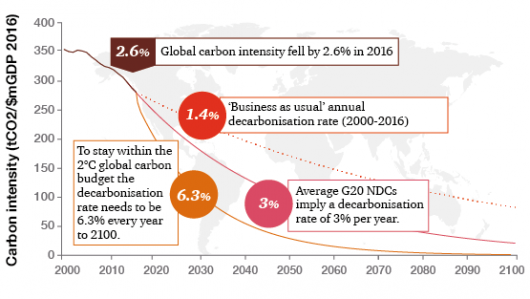
In the report, PwC predicts at current decarbonizing rates the carbon budget will run out by 2036. What does that mean?
The report states all of us need to brace for disruption because of physical risks, market and technology risks, and policy decisions by national governments.
What are the physical risks? Extreme weather events we see today are being linked to a warming atmosphere and ocean. Increased frequency and severity of extreme weather will require businesses to harden their infrastructure to withstand disruptions to supply chains and operations.
In terms of technology risks, decarbonizing our national economies is an experiment that requires technological innovation to help support the transition. We are already doing this with solar and wind power as a substitute for coal-fired power generation. We are seeking new energy storage innovations including better batteries. We are applying sensors and artificial intelligence to infrastructure in buildings, in heating and cooling systems, in transportation, and more, spawning what today is referred to as the Fourth Industrial Revolution.
And as for policy, the challenge remains for governments to implement low carbon solutions. There are many choices from carbon pricing to carbon currency, and from the setting of new standards and regulation.
Even investors and consumers are influencing business policy by challenging company boards of directors to disclose climate risk, and through purchasing power, favouring companies that show commitment to decarbonizing in products, packaging, and supply chain.
Want to know where your G20 country fits in the current index? Check out the graph below.
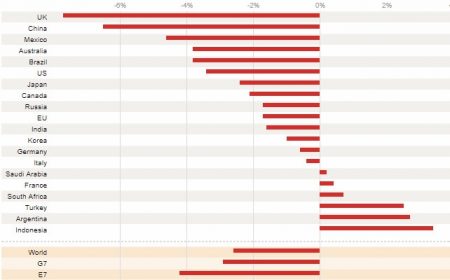
One industry that appears to be absent from the PwC’s analysis, is agriculture. The carbon contribution of this economic sector seems to be overlooked by many assessing the climate change file, a significant failure in oversight.
To read the full PwC current report go to the link provided here.
]]>It is a guide for those who have yet to consider purchasing a new car and are asking the question how he or she can reduce carbon emissions, from more frequent maintenance to keeping tires properly inflated, to reducing the unneeded weight that goes along with you on rides, to removing roof racks or flags of your favourite hockey, baseball, basketball or football team that increase drag, and to better driving habits. You can also check out which new cars are more eco-friendly, as well as cars that are not.

]]>
Professor of Agricultural Economics, Wally Tyner, states, “Some of the same groups that want to reduce greenhouse gas emissions also want to ban GMOs. But you can’t have it both ways. Planting GMO crops is an effective way for agriculture to lower its carbon footprint.”
The research was done using a modeling tool developed at Purdue called the Global Trade Analysis Project (GTAP-BIO). Two hypothetical scenarios were input into the model. These were:
GTAP-BIO predicted overall increases in food costs under a global ban. It also predicted the United States would be the biggest beneficiary of the ban since its agribusiness was significantly more robust than other countries. On the other hand China and other major crop importers would find themselves paying more for food.
Banning of GMO would lead to a 3.1 million hectare (7.7 million acre) increase in cropland.
To the best of my knowledge this is the first time researchers have made the case for GMO crops as a means of fighting climate change.The researchers were not surprised about the economic consequences of a GMO ban. It was the model’s prediction about greenhouse gas emissions that was the unexpected “eye-opener.”
Back in May of this year in an article appearing in Scientific American, the National Academy of Sciences, in a 400-page report, concluded that GMOs are not a danger to the environment or human health. The report also concluded that the significance of GMO in the fight to deal with climate change was specifically related to adapting crops to the changes global warming would bring. Richard Amasino, a member of the Academy who participated in writing the report stated, “If we had the basic knowledge to enable corn to grow at higher temperatures, then we’ve got a buffer to climate change. But do we understand the basic biochemistry of how that might work? No.” In their report which looked at over 1,000 scientific papers on GMO none indicated that GMO could actually reduce our global carbon footprint.
This just adds a new wrinkle to the ongoing debate pro and con related to GMO.


