The sixth synthesis report of the International Panel on Climate Change (IPCC) was published on March 20, 2023. It noted that the technology was critical to CO2 mitigation for power, cement, oil, coal, natural gas and chemical production industrial sectors. It further stated that to keep to the 1.5 Celsius (2.7 Fahrenheit) warming limit, between 350 and 1,200 gigatons needs to be captured. A gigaton is one billion tons.
CO2 removal (CDR), carbon capture and storage (CCS), carbon capture utilization and storage (CCUS), and direct air capture (DAC) are the technologies and terms used by this nascent industry.
The global inventory of CCS projects in 2022 included 30 operational, 11 under construction and 153 in different stages of development. The total capacity of these projects would capture 244 million tons annually or 0.244 gigatons. So we have a long way to go to make this version of CDR impactful.
CCUS projects have been in use in recent years with the International Energy Agency (IEA) stating that of the 231 megatons of CO2 captured annually, 130 megatons are used in the manufacture of fertilizers and urea, and 80 megatons get pumped into old oil fields to enhance extraction. CO2-based synthetic fuels, chemicals, and concrete are estimated to yield 10 megatons annually by 2030.
The biggest challenge for CCUS future projects is the need to capture CO2 directly from the air (DAC) or biogenic sources. The IEA estimates that planned projects by 2030 would contribute 4 megatons annually to the total CO2 captured by these types of projects.
Carbon Orchard is a DAC technology. The company behind it is called Spiritus, a Los Alamos, New Mexico startup with a technology that can remove CO2 from the air at a cost of less than $100 per ton.
The key is the use of a novel, reusable, lung-like material (see the image below) to capture CO2 which then can be released into storage or fed to different manufacturing facilities. The Spiritus Sorbent and novel desorption process make up the Carbon Orchard, a passive system to bind CO2 that uses far less energy than other DAC technology on the market today.

When you think of Carbon Orchard, you may picture a forest of artificial trees. But if the image appearing at the top of this posting is any indicator, that’s not what a Carbon Orchard looks like.
The company’s CEO, Charles Cadieu, states that other DAC technologies need high heat and lots of energy whereas Carbon Orchard does not. He claims that the technology will be far more efficient than trees and require a smaller footprint than a forest. Unlike forests, where trees die or are burned by wildfires which releases the CO2 back into the air, the gas that a Carbon Orchard captures is permanently contained until used for industrial purposes or for putting into permanent sequestration.
A recent press release quotes Cadieu who states that a Carbon Orchard is “able to remove about 1,000 times more CO2 than a forest can….far more efficient than forestry for removing CO2 from the atmosphere per acre.”
Each Carbon Orchard features a tower containing its efficient adsorption ‘fruit’ which are harvested and placed in a low-temperature container where the gas is released. The ‘fruit’ is then returned to the Carbon Orchard for reuse. The adsorption-desorption process uses half the energy of current DAC technology competitors. A Carbon Orchard can be rapidly scaled and deployed to increase the volume of CO2 captured and removed. It is flexible in design to make it easy to locate close to manufacturers who want to use the captured CO2.
In September 2023, the company announced that its technology had been selected by Stripe, Shopify and the H&M Group to meet their CO2 capture and utilization requirements.
When will we see the first Carbon Orchard deployed? At the time of this posting, no target date for the first deployment had yet to be announced.
]]>

Why is curtailing airplane emissions so important?
Because of where the emissions occur. A significant portion of the airplane emissions happen at high altitude. These emissions include more than CO2 including nitric oxide (NO), nitrogen dioxide (NO2), sulfur oxides, water and soot. The NO and NO2 emissions impact ozone both positively and negatively. At lower altitudes ozone levels increase and at higher elevations they decline. Soot destroys ozone as well. There also appears to be a correlation between flight density and condensation trails (contrails) and upper atmosphere cloud formation. The association of cirrus clouds and airplanes is said to contribute to 3.5% of another measure of climate change, the radiative forcing (RF) or climate forcing brought on by human activity. Positive RF is a contributor to global warming as greenhouse gases like water vapour and CO2 absorb infrared radiation and emit it into the atmosphere. And then there is CO2 emissions, which have been steadily increasing since the first comprehensive analysis done back in the 1990s. At that time aviation was estimated to produce 1% of all anthropogenic carbon emissions. But increases in air traffic since the 1990s has increased CO2 emissions by 3 to 4% per year with an estimated growth of 400% by 2040. That’s why an agreement was very much needed.
Olumuyiwa Benard Aliu, President of the ICAO Council, described the environmental measure unanimously recommended by 170 international experts convened by the United Nations 36-state Governing Council, stating, “the goal of this process is ultimately to ensure that when the next generation of aircraft types enter service, there will be guaranteed reductions in international CO2 emissions.” He further stated that by enacting such measures, “the projected doubling of global passengers and flights by 2030” can “be managed responsibly and sustainably.”
What does $1.4 billion buy you? The removal of about 1 million tons of CO2 from the atmosphere each year. Of course, closing the coal-fired power plant would remove even more but that’s not in the equation for now. Although at some point as we come to terms with a low carbon economy it may very well come to pass.
What will happen to that CO2? Some of it will be liquified, transported through a pipeline and then stuck underground in rock where it will be permanently sequestered. Some of the CO2 will get sold to fossil fuel operators to be pumped into older oil fields to improve yields.
The plant has also built into its outflow gas waste management a sulfur dioxide capture technology that converts the gas to sulfuric acid for sale to industry. And finally, the last component in the outflow gas, the fly ash, is also captured for sale to concrete producers.
All in all this is pretty impressive technology for mitigating CO2 but we need to seriously question the rationale for spending so much to justify keeping coal-fired power plants in operation. That’s because CCS is the most expensive approach we can take to CDR, carbon dioxide removal.
There are many CDR strategies we can deploy in pursuit of a low carbon economy. Many don’t require a $1.4 billion investment. With CCS at the high-cost end of CDR strategies, what is there at the low end that we can deploy?
The global management consulting firm, McKinsey & Company, as part of its practice has created a greenhouse gas abatement curve which I have reproduced below, The areas indicated in orange represent relatively inexpensive biological CDR techniques providing significant dividends.
In addition the activities on the left, the conservation side, can immediately create CDR benefits through decreased energy demand. These include replacing energy inefficient consumption technologies such as incandescent lights and internal-combustion-engine transportation.
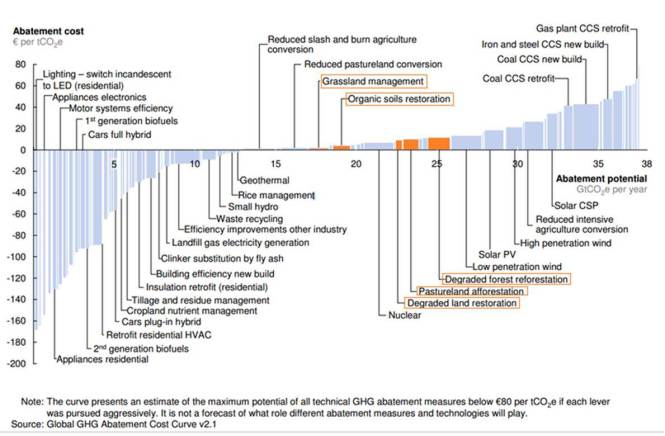
The biological techniques for CDR involve little in the way of expended dollars. Instead much of it is about behavioral change. Better livestock land use techniques help restore grasslands with the benefits of an expanded carbon sink, reduced desertification, restored freshwater balance, and increased biodiversity.
Reforestation of boreal and tropical rainforests creates immense carbon sinks, second only to the ocean. It is estimated that worldwide deforestation today is contributing to 15% of all CO2 emissions. Steps like the one announced in the last week involving Norway agreeing to pay $150 million USD to Liberia to stem deforestation represent a novel financial approach to implementing biological CDR. This type of strategy is just part of a much larger holistic land management movement first proposed more than a half-century ago.