Considering the final statement from the COP, the fossil fuel industry, particularly oil and gas, saved itself for another day and frankly did better than holding the status quo. For the price of committing to sustainable practices and a future transition from fossil fuels, they are to continue to invest tens of billions of dollars in new projects and operations while flirting with carbon capture technology in its current unproven state while making carbon offset purchases.
Carbon capture became a mainstream obsession at COP28. Of the lobbyists and delegates there, 475 represented the carbon capture and storage industry (CCS). Touted by the fossil fuel industry as the planet’s panacea, CCS was seen as a technology that could allow the fossil fuel industry to continue to exist. Whether attached to coal, oil or gas-fired thermal powerplants, or fossil fuel extraction and operations sites, CCS and its cousin direct air capture (DAC) would allow us to have our cake and eat it too. The reality of CCS, however, is a very different picture. When the U.S. Environmental Protection Agency looked at CCS technology to mitigate climate change, in its reports it noted the country would have to bring online a new CCS or DAC project every day between now and 2032 to meet the country’s carbon reduction goals by that year.
Today, there are 40 projects where carbon capture, utilization and storage (CCUS) is presently operational, all the while as many as 500 projects are in various stages of planning and development. Around 50 more should be operational by 2030 which will bring the total to below 100. At the present pace, CCS will capture a pittance of what is needed to mitigate climate change. Putting all our eggs in the CCS basket, therefore, despite the COP28 hype, seems a pipedream.
Dr. Friederike Otto, climate scientist at Imperial College London and co-founder in 2015 of World Weather Attribution told the Financial Times, “The lukewarm agreement reached at Cop28 will cost every country, no matter how rich, no matter how poor. Everyone loses. With every vague verb, every empty promise in the final text, millions more people will enter the frontline of climate change and many will die.” She goes on to describe COP as becoming “a trade fair for fossil fuel companies” and “the last attempt by those who don’t want change.”
]]>
The Executive Director of the International Energy Agency (IEA), Dr. Fatih Birol, (the organization used to be an apologist for the fossil fuel industry, but not anymore) describes COP28 as “a moment of truth” for coal, oil and gas. Almost everything being talked about by these companies and countries indicates they are committed to continue to explore for new finds, increase production from existing assets, and pay lip service to climate change mitigation but only if they receive financial assistance from taxpayers. Becoming “part of the solution” is not in the fossil fuel industry’s DNA.
Dr. Birol is unequivocal in stating the “uncomfortable truth.” To mitigate climate change, fossil fuel production has to be reduced. Demand for oil and gas needs to be curtailed. There cannot be continued expansion and the cutting of new production and exploration deals blatantly being explored at COP28. There can’t be, and yet there are.
To call what is going to take place at this meeting hypocritical is an understatement. COP28 was to be the meeting that would produce the global measuring stick to lower carbon emissions.
With Dubai the host city for COP28, and with the President of the COP, Dr. Sultan al-Jaber being the head of Masdar, the UAE’s state oil company, it shouldn’t surprise us that briefing documents that leaked to the press show plans for discussions on fossil fuel deals involving 15 nations were to be discussed at the upcoming meeting. The nations involved include Australia, Brazil, Canada, China, Colombia, Egypt, France, Germany, Kenya, Mozambique, The Netherlands, Saudi Arabia, the UAE, the UK, and the US.
The leaked briefing documents show that projects being proposed include several to increase oil and gas development. The IEA as I have previously reported here, has stated that no new fossil fuel projects should be developed. The reality today is that the oil and gas industry today budgets hundreds of billions annually on capital expenditures to support its operations. Of that amount, US $20 billion, or 2.5% is allocated to clean energy projects. What’s needed is 50% to be spent on clean energy not including investments to reduce emissions from operations in the run-up to 2030.
The Globe and Mail newspaper recently highlighted commitments by the Alberta provincial and Canada’s federal governments to provide grants and tax breaks covering more than 50% of the cost of new carbon capture emission reduction projects. The IEA has described carbon capture as the status quo solution the fossil fuel industry has proposed would allow it to continue or increase production levels.
To limit global mean temperature rise to 1.5 Celsius (2.7 Fahrenheit), however, the agreed lower target set in 2015 in the Paris Climate Agreement requires the industry to capture 32 billion tons of carbon for utilization or storage by 2050 including 23 billion tons from direct air capture (DAC) projects. Existing carbon capture projects capture 45 million tons annually. To achieve industry carbon capture targets, the IEA has noted that the amount of electricity needed exceeds current power usage for the planet.
At a recent press conference, COP28’s Director General, Majid al-Suwaidi claimed that Dr. al-Jaber “is singularly focused on the business of COP and delivering ambitious and transformational climate outcomes.” The other stuff going on where meetings with oil and gas companies will discuss business opportunities are “fully independent” and have nothing to do with the “meaningful climate action” that Dr. al-Jaber expects to come out of the UAE-hosted event.
In 2022, the fossil fuel industry produced US $5 trillion in revenue. Earlier in 2023, two of the world’s largest companies, BP and Shell, announced they were rolling back previous commitments to cut oil production. The lure of profits was just too great. Meanwhile, President Biden in the U.S., and Prime Minister Sunak, in the U.K., have continued to grant oil and gas exploration permits which certainly sounds like business as usual for the singular industry responsible for the impending climate change crisis we face. In September, global mean temperatures reached 1.8 Celsius (3.2 Fahrenheit) above pre-industrial levels.
]]>Gaurav Sant, Director of the Institute of Carbon Management (ICM) at UCLA describes the invention as a “technology [that] can electrochemically enhance and restore the ocean’s capacity for carbon dioxide removal from the atmosphere at a globally relevant scale.”
Today, we add 37 billion tons of CO2 to the atmosphere annually. The biggest contributors are the fossil fuel industry, transportation, agriculture, buildings, and steel and cement manufacturing.
The world’s oceans absorb much of this CO2 which if there were no oceans would significantly raise temperatures around the planet to much higher levels than they are today. And CO2 can stay in the atmosphere for hundreds if not thousands of years without breaking down.
So seawater’s capacity to hold up to 150 times more CO2 than the atmosphere per unit volume has turned out to be our primary natural carbon sink. Forests and soil don’t come close. The problem with the oceans as natural carbon sinks is that they are working overtime because of the increasing volumes of CO2 we produce. With so much carbon getting into the ocean from CO2, our seawater is becoming more acidic (carbonic acid is the cause). And the more acidic the oceans become, the greater the threat to marine animals encased in shells and exoskeletons made from natural calcium composites. This is a growing threat to the entire food chain from plankton to fish and whales.
What SeaChange technology does is enhance ocean water’s ability to absorb CO2. It does this using a process that emulates what marine animals do when they build their exoskeletons and shells.
How does it work?
It passes seawater through an electrically-charged mesh that turns alkaline to react with the dissolved CO2 turning it into solid limestone and magnesite. These two types of rock make the carbon permanently inert.
The process then returns the water to the ocean but with no CO2 in it which makes the seawater a sponge for absorbing even more of the greenhouse gas (GHG). The solid rock can then be dumped into the ocean with no impact on marine life.
The process provides an additional benefit, green hydrogen, which can be used as a zero-emission energy source.
Why use SeaChange rather than the current carbon and direct-air capture technologies that are being built and operated in a few places around the world? The handful of carbon capture and sequestration (CCS) and direct-air capture (DAC) projects completed to date will not significantly reduce atmospheric CO2. At best, they can capture a few million tons of gas per year. But governments are incentivizing and the fossil fuel industry is clamouring for these types of facilities as global temperatures creep closer to the 1.5 Celsius (2.7 Fahrenheit) rise that the IPCC established as a safe benchmark for warming without dire consequences. How many thousands of these sites will we need to approve and build over the next thirty years to make a dent? Based on current behaviours by industry and government, I wouldn’t hold my breath waiting for them to be our carbon-emission-reducing answer to climate change.
Some academics and industry leaders, as well as policy wonks, have alternative proposals to geoengineer solutions that permanently alter the amount of sunlight reaching the planet so we can cool it down even in the presence of elevated CO2 levels. The impracticality of these geoengineering schemes and the unintended consequences of some of them failing which I have reported on this blog site, make these solutions foolhardy.
So how much CO2 would we need to remove using SeaChange to mitigate climate change? The estimate is between 10 and 20 billion tons annually from 1,800 plants situated in harbours and offshore locations around the world.
Why is SeaChange a better solution in combination with natural initiatives and conservation contributions from all of us? Turning CO2 into rock represents permanent storage. The carbon we capture using it can never return to the atmosphere for hundreds of millions of years. (The only way would be for the rock to be exposed to the air where it would weather over millions of years releasing the carbon.)
To get started SeaChange is launching two pilot demonstrations (see the image of one of these below), one in Los Angeles Harbour, and the other in Singapore. The pilot sites will demonstrate the effectiveness of the technology and be used to measure and optimize results. SeaChange is partnering with AltaSea a public-private institute and partnership, and the Port of Los Angeles for these first two field demonstrations.

]]>
There are several challenges facing us when capturing CO2.
Using the CO2 captured is a fairly recent development by industrial emitters. Called carbon upcycling it can be a way to offset the capture cost. Carbon upcycling where the CO2 gets embedded permanently into cement or is used to produce carbon fibre is catching on. But they represent only a small percentage of the total emitted or captured from the atmosphere to date.
The United States Department of Energy operates the Pacific Northwest National Laboratory (PNNL) located in Richland, Washington. PNNL researchers are focused on decarbonization as one of many fields of study. Finding technologies and solutions for capturing carbon from CO2 and methane (CH4) are central to the laboratory’s work. A specific area of research is to find capture technologies that are far less expensive than anything currently available today.
PNNL believes it has found a promising solvents-based carbon capture and conversion technology that can absorb CO2 cheaply and efficiently from smokestacks. The industry calls this dirty CO2. The solvent process can be added to any existing pre or post-combustion where the CO2 stream is fairly concentrated. The process uses 17% less energy than any current commercial solutions and the cost of captured CO2 can be brought down to $38 US per ton. Compare that to the most advanced carbon capture technologies which come in at best just under $100 US per ton, and at worst as high as $500. Only natural sequestration in forests, estimated at $40 US per ton comes close.
The key to this novel PNNL-developed solution is solvents that grab CO2 molecules and convert them into methanol (CH3OH). And although methanol is often burned as a fuel which does nothing to reduce carbon emissions, it also can and is used as a base material for creating many different manufactured products.
Prior to PNNL’s developed solvents, only highly purified CO2 could be used to make methanol. Now operators of cement plants, thermal power stations, chemical refineries, steel mills, aluminum smelters, and other industries producing CO2 emissions from smokestacks can capture the gas to produce methanol at a very reasonable per ton cost. They can sell the methanol or use it for a side hustle business creating added value products like polyethylene and polyurethane, paint, adhesives, foam insulation, polyester, other textiles, car parts and even construction materials. The PNNL solvents capture 97% of the CO2 and the technology is adaptable to any of these operations where a CO2-concentrated gas stream either pre or post-combustion exists.
]]>Rainforest hopes to produce fuel substitutes not derived from extracting oil or gas, but rather from the waste products of forestry (burn slash) and agriculture, the latter not to be confused with crops like corn purposely grown to produce ethanol. These synfuel-derived alternates would include gasoline, diesel, and propane substitutes.
The company intends to capture the carbon dioxide (CO2) as well from its biorefineries and through partnerships sequester it underground, use it in other industrial processes, or be source material for carbon composites and other high-value products like carbon-infused cement.
Rainforest feedstock includes forestry logging detritus as its main source for biorefinery operations. That means wherever forest operations exist, a Rainforest biorefinery can be operated to divert slash-burn waste into synfuels rather than into greenhouse gas (GHG). It seems to be a worthwhile cause and by the look of it, profitable as well.
How does Rainforest technology work? It begins by dehydrating the forest waste feedstock. It then gasifies that waste in closed chambers where oxygen is injected. Instead of incineration, gasification occurs transforming the waste into a syngas that contains unwanted byproducts including CO2, nitrogen, tars, chlorine, hydrogen and trace metals. The syngas can then be converted into gasoline, diesel, and propane. Chemicals can treat and remove unwanted byproducts and the CO2 can be captured.
As much as Rainforest would like you to believe they are producing a green product, it is not the case. When syngas is used to make synfuel, the downstream end result is that it gets burned in an internal combustion engine. The byproduct of that combustion includes CO2, methane, and carbon monoxide. So that means capturing the GHGs has to happen at the tailpipe in addition to at the point of production to be zero-carbon.
Rainforest acknowledges that the processes it intends to use are not new. The technologies already exist including methane reforming which is used today by fossil fuel companies. CO2 capture is also a growing industry that includes many different methodologies well beyond the concept stage.
But if the timelines experienced by these companies are any measure of how quickly the biorefinery operations can get up and running, my guess is this will not be a quick turnaround. It has taken more than a decade to get pilot carbon capture projects up and running, and another decade to scale them to start capturing millions of tons of CO2 annually. Meanwhile, our industrial civilization continues to pump out gigatons of the stuff contributing to global heating.
It should also be stated that biorefineries that produce syngas don’t solve climate change. What they do represent is a way to harvest the energy potential from waste that today gets burned in slash piles in forests. It redirects emissions from the forest floor to when internal combustion engines use the synfuels, pushing the emissions downstream.
So the big thing I get from learning about Rainforest is that it uses biomass to produce fuel rather than allowing that biomass to be burned where it is produced or carted off to be put into landfills. This is its added value. And capturing CO2 and other greenhouse gas byproducts in its processes also provides value.
But Rainforest is definitely not green. Maybe greener is a better definition because, in the end, the synfuels it produces will cause GHGs. Until there is 100% electrification of transportation and electrification gets adopted across other industrial sectors, Rainforest biorefineries are, therefore, no more than a transitional stopgap.
Don’t get me wrong. Burning forest waste is a significant contributor of GHGs. Wherever forestry is practiced, the burning of slash waste is a common practice. Every Rainforest biorefinery could stop this. Each would be able to take 200,000 tons of slash-burn waste annually and eliminate 404,000 tons of greenhouse gas emissions from forest slash-burn sources. The captured CO2 can be stored underground, or repurposed. And with thousands of sites around the world, Rainforest biorefineries could do some good. But you can’t call the operations green.
Check out the infographic below which summarizes the business case. Through multiple partnerships with government and industry, the company hopes to roll out hundreds if not thousands of these biorefineries. As a transitional strategy to achieve net zero emissions by 2050, there is a place for Rainforest. But calling it a green solution – it just ain’t so.

]]>
Suddenly, carbon capture has legs. Why? Because the Act includes a carbon capture subsidy. Capturing carbon dioxide (CO2) now provides polluters with an $85 per ton tax credit. And even better, the process for getting the tax credit is simpler, and who can apply for it is now open to even very small projects. The cement industry, natural gas producers, and coal-fired power plants are now armed and ready to jump on the carbon capture bandwagon.
What are the expected results in the United States? According to the Carbon Capture Coalition, which represents more than 100 companies, unions, and conservation and environmental policy organizations, carbon capture projects are expected to grow by 1,300% from now to 2035. At a recent virtual briefing held by the Carbon Capture Coalition, Shannon Heyck-Williams, Lead Climate and Energy Policy Advisor for the National Wildlife Federation noted, “we’ll need to deploy a critical mass of carbon capture, direct air capture, carbon-reuse projects, and related CO2 transport and storage infrastructure over the next decade. It’s a pretty big challenge.”
Heyck-Williams continued calling on policymakers to “pursue a three-pronged approach to get to net-zero, of capturing and managing emissions from industry and power generation, offsetting remaining emissions from hard to decarbonize sectors, and removing legacy emissions from the atmosphere.”
| Sep. 4, 2022 | 416.68 ppm |
| Sep. 4, 2021 | 413.43 ppm |
| 1 Year Change | 3.25 ppm (0.79%) |
What, however, does it do to domestic consumption of fossil fuel products? Let’s use gasoline at the pump as an example. The added carbon levy translates to around $0.07 per liter or $0.27 per gallon. Would that cause drivers to pause when considering a choice between using public transit alternatives or their personal vehicles? Again the answer is hardly because that’s well within the normal swings associated with gasoline pricing in the market over the past ten to fifteen years.
The Canadian government plans to raise its per ton carbon levy to $40 CDN ($30 USD) in 2021, and $50 CDN ($37.50 USD) in 2022. It has also announced that it intends to consult with the industry, provinces, territories and Canada’s native peoples about further increases beyond 2022. The carbon pricing policy’s purpose was to help the country achieve its Paris Climate Agreement commitments to reduce greenhouse gas (GHG) emissions by 30% below 2005 levels in 2030. On its own carbon pricing at the current pace of increase is unlikely to help the country achieve the targeted reduction by the end of the decade.
What is climate change costing Canadians today? According to the Insurance Bureau of Canada, extreme weather events in 2018 impacted the economy to the tune of $1 billion, up from an average of $400 million annually in previous decades.
Morgan Stanley, the U.S. investment banker, has done a global calculation for the cost of climate change over the last three years at a total of 650 billion USD, or more than one-quarter percent of global gross domestic product. The banker projects the number to grow to 54 trillion USD by 2040.
So using the market mechanism of pricing carbon as the sole means of reducing GHGs in the atmosphere, what would be the right price to put on GHGs to alter our use of fossil fuels?
In a 2018 study done at UC San Diego, it concluded that carbon emissions’ social cost amounted to approximately $417 per metric ton and that the cost to the United States in terms of damage to the economy came out at about $50 per ton. In the study’s conclusions, it suggested a U.S.-wide carbon price starting at $40 USD per ton to begin altering how Americans consume fossil fuels. That’s equivalent to about $50 CDN per ton, the price that Canada will levy on carbon emissions by 2022.
Capturing carbon has spawned a number of technology solutions that are being used to do direct-air capture and storage, capture from smokestack emissions at coal-fired power plants, and oil-field and oil-sands capture at point-of-production. Most of these projects need carbon to be priced much higher than it is today to scale up the capture and reuse technology to go global.
A market based on a carbon price starting at 100 USD per ton represents a 4 trillion USD opportunity for carbon capture technology states Dr. Wal Van Lierop Executive Chairman and Founding Partner of Chrysalix Venture Capital, a venture capital fund focused on resource-intensive industries, and an investor in Svante, a Saskatchewan-based carbon capture company. He describes the break-even point for a carbon capture marketplace is minimally 50 USD to cover the cost of capture, transportation, and storage. The venture capital investment in Svante has helped the company to build a proof-of-concept that currently is capturing 10,000 tons of carbon dioxide (CO2) annually from an industrial natural gas boiler. Svante will soon be installed in Colorado at a cement plant where it will capture up to 750,000 tons of the gas to store in a depleted oil field.
Another carbon capture venture, Carbon Engineering, also out of Canada, has developed direct air capture of CO2. It has piloted a project in British Columbia and will soon have an industrial-scale deployment located in the Permian Basin (western Texas and New Mexico) where it will capture 1 million tons of the gas directly from the air, and permanently store it in depleted oil reservoirs. Carbon Engineering recently stated that it has been able to reduce its costs to under 100 USD per ton which would suggest that carbon needs to be priced at well over that number to make the industry viable.

How does the technology work?
The device uses particles that have the properties of sorbents, that is, material that can adsorb or absorb gases or liquids and act like a sieve. The particles flow through the device which drops the air pressure to attract CO2 molecules which are then collected. The particles then travel to a desorber that includes a heating source. The desorber when heated releases the CO2 molecules which are then contained. At the University the captured CO2 is being fed to reservoirs containing algae. The device’s net energy consumption is comparatively small. The University estimates that the energy costs to capture 1,000 kilograms (2,200 pounds) of CO2 is about 75 Euros which is deemed competitive in the current market.
One application for this technology, which has a fairly small form factor and can be placed almost anywhere to begin capturing CO2, is in the area of energy storage. CO2 from the air could be combined with hydrogen to produce a closed cycle natural gas heating system for businesses and homes. The CO2 could be injected into concrete to strengthen it, a technology innovation that has been tested in Canada. And deployed on a much larger scale, the technology could help reduce overall atmospheric CO2 with the captured gas being transported to permanent sequestration sites.

Well now Southern Company, a subsidiary of Alabama Power, will play host to a FuelCell Energy, Inc., and ExxonMobil test pilot project at the James M. Barry Electric Generating Station, a 2.7 Gigawatt mixed-use coal and gas-fired power plant located near Mobile.
How does the technology work?
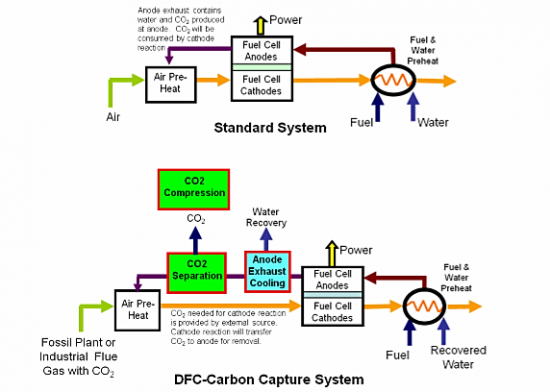
The technology, a DFC3000 fuel cell power plant consists of two modules each with four fuel-cell stacks, eight in total. Each fuel cell stack generates 350 kilowatts. A side effect of the electrochemical reaction between carbonate ions and the electrolyte is that CO2 introduced through an air inlet gets converted to carbonate ions, transfers through the electrolyte to the electrode and then converts back to CO2. This gives the DFC stack the ability to act as a carbon purification membrane without the need for additional technology. In a closed system the DFC stack recycles the CO2 continuously. But when put next to a thermal-power plant emitting CO2 it passes the gas through the fuel cell and then captures it when it has completed the transformation from gas to ions and back to gas again.
The schematic below shows two configurations for the DFC technology: as a standalone seen at the top, and beneath, as a carbon capture system when joined to a thermal-power generator spewing CO2.
Two additional benefits to the technology:
The typical transfer rate of a 2.8 Megawatt DFC3000 in normal operations processes 3,200 kilograms (7,000 pounds) of CO2 per hour with a carbon capture rate of 2,300 kilograms (over 5,000 pounds or 2.5 tons) per hour.
Seen in the image below the footprint requirement is small which makes this type of technology suitable for use as a standalone power generation technology that can supplement the transmission grid during peak period use. A number of utilities are looking at distributed power generation to supplement larger thermal plants.
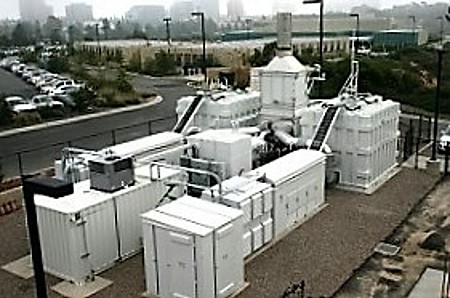
The technology is scaleable and can be installed in modular increments. If the pilot is successful the next phase will include installation of eleven additional fuel cell stacks to generate 27.6 megawatts of power and capture 700 tons of CO2 while generating 648,000 kilowatt hours of ultra clean power daily.
Think about the implications if carbonate fuel cells were installed at all existing coal-fired power plants on the planet. We would decrease carbon emissions and produce a net power generation gain to boot. Makes you wonder why this project isn’t front and centre in the minds of utilities, fossil fuel energy companies and governments around the world.
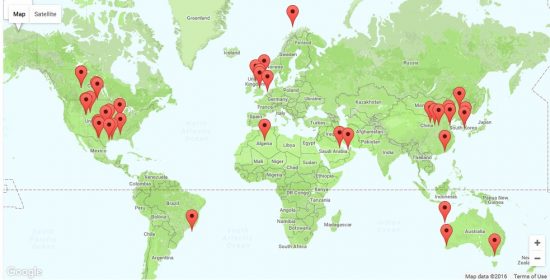
]]>I have mentioned the Boundary Dam Project in Saskatchewan and Shell’s Quest site in northern Alberta. These are complex multi-billion dollar solutions. A third experimental technology is doing small-scale harvesting of carbon dioxide from the air in British Columbia. In total today there are fewer than 20 active industrial carbon capture facilities in operation globally (see map below). This, however, may soon change.
Professor James Davis of University of South Alabama is working with ionic liquids to separate carbon dioxide from smokestack output in coal and natural-gas fired power plants. The ionic liquid uses nitrogen. The flue gases are bubbled through the nitrogen liquid which takes out the carbon dioxide (CO2). The removed CO2 can then be pumped underground while the ionic liquid can be recycled to capture more of the gas. If this laboratory solution can be scaled to a range of applications, from capturing CO2 in non-industrial and industrial buildings, and even be incorporated for use in vehicles then the fossil fuel industry may have found a solution desperately needed to help mitigate carbon’s impact on global warming.
Davis’ research into ionic liquids is looking at their practical use as solvents, electrolytes, high-tech lubricants, propellants and medicines. He first became interested in the properties of these naturally occurring liquids while studying how some ant populations can use the formic acid they produce as a means to tolerate formic-acid based venom from other ant colonies. In identifying the molecular components of the formic acid, Davis was able to identify the role ionic liquids played in inoculating the ants. Now he is using natural-occurring ionic liquids and applying them to industrial processes. His research is partially funded by grants from the National Science Foundation, Chevron and the Petroleum Research Fund.
If I were Exxon-Mobil I’d be putting some big bucks behind Davis and other carbon capture technologies. That and large investments in clean renewable energy may be the only future for these companies if global leadership is serious about tackling anthropogenic climate change.
