A cautionary note. Some readers may find the content of this posting disturbing particularly in its promotion of smoking cannabis. Others will just find any discussion about cannabis, or marijuana, to be inappropriate for a blog focused on science, technology and the 21st century. But the science of cannabis is only now finally beginning to be explored. The lack of understanding of the plant’s chemical constituents and the potential benefits already being derived from some of them, is just the beginning of cannabis science and discovery. Up until now the public has been ill-served when it comes to cannabis. Instead of learning about its potential in treating medical conditions, we have been warned about its addictive nature, about becoming “potheads,” and about it being the first step down a road to harder drugs.
As a cannabis oil user, CBD oil to be exact, I can vouch for the efficacy and medical benefits that the plant’s chemistry provides. I take a twice-daily small oral dose sublingually to treat my advanced arthritis and what it has done for me is to keep me from using stronger pain killers, and maybe saved me from opioids and their high potential for addiction. So I welcome Bojana’s candid description of cannabis, warts and all, and invite readers to comment.

Thanks to scientific research and through the dissemination of information to the public. the stigma about cannabis may disappear in time. Hardly has any plant been more beneficial for people’s health, and yet so much persecuted, prosecuted, and demonized worldwide.
The war on hard drugs because of the involvement of undesirable and violent cartels and gangs has wrongfully encompassed cannabis making it a handy target for governments. But cannabis is far safer than the prescribed opioids that have created a medical crisis in many countries, and has none of the addictive properties associated with cocaine and heroin.
In fact, this is a plant with so many positives going for it, it remains a wonder that it is still seen and treated as a pariah by the federal government in the United States, and in other countries.
In Canada, where recreational cannabis was made recently made legal, has been licensing medical cannabis and widely prescribing its products, while a retail market of smokables, food, and drink, oils, and topicals, is rapidly growing.
So how are we consuming cannabis today?
Combustion of cannabis, followed by inhalation, is the oldest, simplest, and most wide-spread method for consuming cannabis. It doesn’t require a lot of equipment, the effects are almost immediate, and the method of consumption is simple. Cannabis can be smoked using the pure-dried plant milled to fine granules (joints), can be combined with tobacco (spliffs or blunts), or can be inhaled using a vaping device (pipes and bongs).
[Editor’s note: The American Lung Association states on its website that “smoke is harmful to lung health. Whether from burning wood, tobacco or marijuana, toxins and carcinogens are released from the combustion of materials. Smoke from marijuana combustion has been shown to contain many of the same toxins, irritants and carcinogens as tobacco smoke. Beyond just what’s in the smoke alone, marijuana is typically smoked differently than tobacco. Marijuana smokers tend to inhale more deeply and hold their breath longer than cigarette smokers, which leads to a greater exposure per breath to tar. Secondhand marijuana smoke contains many of the same toxins and carcinogens found in directly-inhaled marijuana smoke, in similar amounts if not more. While there is no data on the health consequences of breathing secondhand marijuana smoke, there is concern that it could cause harmful health effects, especially among vulnerable children in the home. Additional research on the health effects of secondhand marijuana smoke is needed.”]
About 13.1% of consumed marijuana products are cannabis-infused foods, while 3.7% are beverages. Edibles take the cake (excuse the pun) as the most enjoyable way of consumption because food and drink can be given enhanced flavor.
Thousands upon thousands of people today receive the benefits of cannabis through sublingual delivery (a few drops under the tongue). Organic CBD oils are being prescribed as analgesics and sedative-relaxants to mitigate the symptoms of many health conditions from anxiety, to irritable-bowel-syndrome, epilepsy, and arthritis.
Cannabis-infused ointments are being used today for cosmetic purposes. Still, at the early stage of this market, slightly more than 1% of cannabis products today are sold as topicals.
Pros of Topicals
There are plenty of other ways to make use of cannabis and its chemistry. These include capsules, tinctures, and vaping. You are encouraged to do further research about this evergrowing industry and what the future of consumption will bring. The road to legalization continues with more countries recognizing that there should be no stigma associated with such a beneficial plant. No cannabis user should have to abandon their product which could be used for pain management or dealing with seizures and other medical conditions when crossing a border as currently occurs between the United States and Canada because of different legal statuses in these jurisdictions.
]]>CBD oil is a compound containing cannabidiol which constitutes 40% of marijuana’s chemistry. It is not the psychotropic component of the plant, THC, which stands for tetrahydrocannabinol. It is THC that is associated with the smoker’s high that comes from using marijuana. The prescription recommended to me contained 98% CBD and 2% THC. Initially, I started taking about 0.6 CCs daily and worked my way up to 1.0 CC. Since I started using CBD oil my reliance on strong painkillers has greatly diminished. It has only been when I have had to travel away from Canada that I have not been able to use my medically prescribed CBD oil.
Why is that? Because marijuana use in Canada is legal for recreational purposes, and is grown for medical purposes and dispensed through government-regulated operators. When my wife and I went to a wedding in California I was unable to bring my prescription CBD oil. Instead, I found a dispensary in Santa Cruz, California, which matched my prescription so that I could continue to use it while in the United States. And before returning to Canada through Vancouver, I had to throw out the CBD oil from California to avoid the potential of being arrested for crossing back into Canada with a U.S. sourced marijuana product. It was two days before we returned to Toronto in which I had to rely on much stronger painkillers to bridge the gap. The absurdity of the regulatory environment for marijuana cannot be overstated.
When I recently spoke with my family physician about the treatment of my osteoarthritis I mentioned I was taking CBD oil daily. She responded that there was nothing in the scientific literature to validate it as a treatment. And yet I continue to run into many people who are using CBD oil to alleviate a number of conditions from osteoarthritis, to epileptic seizures, to anxiety, and PTSD.
The most commonly prescribed painkillers are extracts from plants. Coca leaves contain benzoylmethylecgonine, a natural mood elevator. Poppies contain morphine (the strongest painkiller and the principal cause of opioid addiction around the planet today). And marijuana or cannabis contains 120 chemicals known as phytocannabinoids which interact with different neural receptors in our brains to create a variety of reactions.
The problem with CBD as a medically accepted treatment today for so many different medical problems is the lack of serious research and clinical trials. But CBD oil has been reported anecdotally to be effective in treating arthritis, heart disease, Type 1 diabetes, graft-versus-host disease, and psychosis. Why the medical profession has chosen to largely ignore marijuana is a bit of a puzzle. Maybe it is because of its recreational smoking association as a substance associated with getting high.
The first human clinical trial was done in 1980 to validate CBD oil for use in treating epileptic seizures. A double-blind study using 8 volunteers who received CBD, and 8 who were given a placebo, was administered for 4-1/2 months. All 16 tolerated the CBD with no serious side effects. Of the 8 receiving CBD, 4 were almost seizure-free, 3 showed partial improvement, and 1 demonstrated no effect. The placebo patients results showed no change in 7 and 1 with improvements.
Despite these promising results, no further human clinical trials were conducted until 2015. Since then trials using compounds from marijuana have been a confusing hodgepodge of CBD or CBD-THC treatments with little understanding of what combination of various compounds contained within the plant should be part of any test.
The ongoing prejudice against the plant because of its association with criminality has blinded the profession to its potential uses in treating so many maladies. One hopes that recreational legalization will lead to medical marijuana and CBD and CBD-THC compounds becoming mainstream. For me, I am more than convinced that the benefits I have observed from taking CBD oil are not a placebo effect.

For my Amercian and other international readers, you may not be aware that Canada has recently passed a federal statute legalizing the use of marijuana not just for medical purposes but recreationally as well. The law has authorized Canadian provinces and territories to create retail outlets for the sale of cannabis. Other than Uruguay, no other country in the Americas has given marijuana legitimate status as both a medicinal and recreational product.
When Michael approached me about writing this posting it was with Canada’s legislation in mind that I accepted. The current limitations of the new Canadian law restrict the use of marijuana to ingesting it by breathing it in rather than eating it. By next year even that ban will come to an end in my country.
For the many people living with cancer who use marijuana to deal with nausea that often accompanies chemotherapy, and for those who use it to deal with arthritis and other painful maladies the Canadian government’s move is long overdue even though medical marijuana has been made available here for a number of years.
As always your comments are welcome.
Today, with the opioid epidemic sweeping the United States and to a lesser extent in other countries, many people are seeking alternative remedies to help treat pain. While willow bark, turmeric, and other herbal remedies have been touted to help treat pain, one herbal remedy stands out: cannabis. This plant has been used for millennia to treat pain, melancholy, and various other ailments throughout time. However, it is only recently that science has discovered how cannabis does this. To understand how pain is remediated by cannabis we need to understand the different types of pain individuals suffer of which there are three.
1. Nociceptive Pain
This kind of pain is triggered by injury. When tissue is damaged, cells rush to repair the injury and send off signals through the nervous system to the brain. Those signals are interpreted as pain. There are two common thoughts among medical professionals on how to treat this type of pain: dampen the pain signals as they make their way up the spinal cord, and cut off the inflammatory response at the injury site. Cannabis has shown to be an effective pain dampener relieving nociceptive pain in trials with both humans and mice.
2. Neuropathic Pain
Neuropathic pain stems from direct damage to the nervous system as well as pain from conditions such as multiple sclerosis and diabetes. This is pain not caused by an inflammatory response. As a result, common treatments like Ibuprofen, a non-steroidal anti-inflammatory drug, don’t work. But cannabis has shown that it is an effective treatment in both cancer and non-cancer related neuropathic pain.
3. Central Pain
Central pain arises from disruptions to the nervous symptom. A prime example is a condition known as fibromyalgia. Though there are few studies on the efficacy of cannabis as a treatment for central pain, the relief provided to people who suffer from fibromyalgia is well documented.
Methods of Delivery
Although marijuana is commonly associated with smoking in the style of the conventional cigarette, one of the best methods for immediate pain relief is to deliver it through vaporization.
GotVape.com specializes in vaporization technologies. Taking cannabis and placing it in a portable dry herb vaporizer, or getting an oil cartridge for a vape pen, can provide a user with on-the-go relief as needed.
Do all forms of cannabis provide equal pain relief for these three types of pain?
No. Different strains of cannabis, described below, are proving to be more effective at relieving different pain sources than others.
Blue Dream
Blue Dream is a Sativa-dominant hybrid that combines full-body relaxation with subtle cerebral invigoration. It’s a popular choice for users needing daytime pain relief without feeling stoned which can happen with other strains.
Bubba Kush
This Indica strain has gained prominence for its relaxing effects, which includes muscle relaxation. Also known as a stress-buster it is effective in promoting sleep for those whose pain keeps them awake at night.
White Widow
A balanced hybrid from the Netherlands where it was first bred in the 1990s, this strain promotes energy and creativity, as well as providing relief from stress, depression, and pain. It is cannabis that can be taken in the daytime for these reasons.
Going Beyond Pain
In this posting, we have focused on how cannabis can be used to treat pain, but there are indications that it can help relieve conditions such as post-traumatic stress disorder, generalized anxiety, and depression. In a recent comprehensive study, cannabis has been shown to be effective for all these conditions and may even help ease addictions to alcohol and opioids.

Is everyone susceptible to addiction? It’s a good question because environment may be a strong determining factor.
What motivates someone to try an addictive substance? Often it’s curiosity. Other times it’s stress brought about by circumstances. Sometimes it’s peer pressure, a wish to be a part of a social group, sharing something in common. So circumstances play a role in susceptibility.
What makes an addictive drug work?
Why does our body accept this type of foreign substance?
The chemical structure of most addictive drugs mimics brain chemistry fooling our neurons and in particular neural receptors.
Let’s look at marijuana as an example.
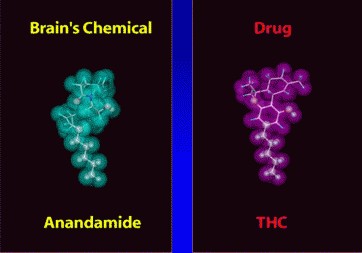
The active chemical in marijuana is THC (tetrahydrocannibol). As you can see from the illustration above THC (on right) is a fairly complex molecule. It is fat-soluble allowing it to slip through the barrier that isolates the brain from the rest of our body systems. THC binds with a neural receptor that is the same one used by a naturally occurring molecule, Anandamide (the molecule on the left).
First identified in 1992, Anandamide was discovered by Dr. William Devane at University of Wisconsin, and Dr. Raphael Mechoulam, at Hebrew University of Jerusalem. Synthesized in an area of the brain that governs memory, higher thought processes and body movement, the two researchers named it after the Sanskrit word that means bliss. Why? Because in finding Anandamide these researchers were identifying the natural human-generated equivalent to THC, a chemical that regulates pain, appetite, mood and short-term memory in the brain.
How do Addictive Drugs Interact with Our Brains?
Neural receptors are the key to nerve cell communication. Chemicals that mimic those naturally produced need a way to take part in that communication. In the example we have looked at THC versus Anandamide, the former binds with receptors on the surface of nerve cells in the same way as the latter.
Anandamide is a “key” molecule because it unlocks a cell by binding with receptors on the cell surface. It does this because its shape fits the receptor like a key entering a lock. When it interacts a door opens through the cell membrane causing a flood of chemicals to enter the nerve cell affecting its positive or negative charge.
THC does exactly the same thing because its shape can also bind with the neuron receptor. The difference in the body response to THC versus Anandamide is one of duration. Where Anandamide is fragile and very short-lived, THC is far more robust. So the bliss effect of Anandamide is short-lived, where the bliss effect of THC can go on for a long time producing the perpetual “high” associated with smoking marijuana.
Most of the drugs we use for pain management work in a similar way. Morphine locks into an opiate receptor in nerve cells. Its natural molecular equivalent is enkephalin. Morphine is addictive because when it binds with a nerve cell receptor it locks even tighter than enkephalin and remains attached. Pharmaceutical companies recognized the addictive nature of morphine and developed less potent substitutes like codeine and demerol.
Addictive drugs elevate another brain-synthesized molecular chemical, dopamine. Dopamine acts like adrenaline affecting the brain processes that govern emotional response, pleasure, pain and body movement. Excessive dopamine creates brain euphoria. Drugs that induce strong dopamine responses are called dopamine agonists. Cocaine is one of these. It binds with the dopamine receptor on the surface of a neuron inducing an excessive dopamine response.
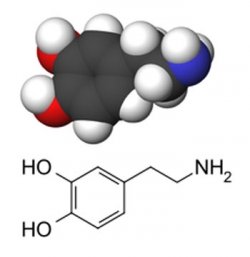
Over time neurons exposed to drugs like cocaine and amphetamines become desensitized or tolerant to dopamine. In these cases each exposure produces less of drug response. The neurons, in anticipation of the drug, stay in a state of stimulation requiring more to create the same effect. How cocaine does this is by binding and hanging on to the proteins that transport dopamine and remaining longer elevating the dopamine response. Amphetamines work similarly leading to over stimulation of the neurons.
Is There an Addiction Vaccine in the Near Future?
Traditional treatments for addiction have involved finding a less addictive drug such as methadone to help reduce heroin dependency, or using a nicotine patch to help stop smoking. Another drug, Vivitrol, has been used to treat alcoholism and opium addiction. There are even anti-smoking pills that don’t act as drug mimics but instead inhibit the neural receptors.
A vaccine approach pursued since the 1970s, has only recently been able to see dramatic progress in creating cocaine immunity. Dr. Ronald Crystal, at Weill Cornell Medical College, has led a team that has produced a vaccine to treat cocaine addiction.
The vaccine was created from a modified version of the adenovirus, the virus for the common cold, discarding the content that causes colds and using the remainder as a carrier medium. A molecule constructed to resemble cocaine is injected into the adenovirus and when a human is vaccinated results in an immune system response. The reason for using the adenovirus is simple. Most addictive drugs are too small for detection by the immune system which allows them to get by the body’s defences. By combining the synthesized drug molecules with a carrier already recognized as pathogen, the immune system learns to attack the smaller drug molecules as pathogens as well so they never reach the neural receptors of the brain. In laboratory tests the vaccine’s effect lasted more than 13 weeks causing an immune response anytime mice “snorted” cocaine.
A similar medical project has used a modified cholera bacteria as a transport mechanism with cocaine creating an immune system response to produce antibodies. In 2009 Baylor College of Medicine in Houston ran clinical trials using this cholera-based anti-addiction cocaine vaccine with 115 human subjects. The results showed a strong antibody response in 38% of patients who received the vaccine, and 45% of remained cocaine free in follow-up examinations up to 4 months after. The vaccine is currently in national clinical trials in the United States. Eventually vaccines of this type could be delivered regularly much the way some people take allergy shots, continually boosting the immune response and eliminating the negative body responses to cocaine ingestion.
Recent researchers at The Scripps Research Institute have had successful results developing a similar vaccine for heroin addiction and have tested it in animal models.
Research into vaccines focused on treating smokers for nicotine addiction is on the way. But alcoholism, the most prevalent addiction, remains untreatable through vaccination.
Considering the cost society bears to deal with addiction, policing the illegal drug trade. and the cost of incarceration for repeat drug dealers and offenders, anti-addiction vaccinations represent a better future.
]]>