———-
The world of 3D printing is growing exponentially with Gartner estimating worldwide unit shipments doubling annually to 5.6 million by 2019. A panel of CSC and NASA experts predict 3D printing will turn manufacturing on its head, replacing traditional operations such as forging, grinding, milling and assembly. The impact should be just as dramatic in the construction industry as 3D print technology impacts not only how buildings are built but their look and their surroundings.
3D Materials, Architectural Design & Building Production
Today the most common building materials consist of wood, concrete, glass and steel. As VIATechnik explains 3D printing introduces a whole new set of materials including mixtures of thicker concrete and composites that are self-supporting during setting. This will lead to a wide variety of new designs. Where traditional materials lead to rectilinear shapes that are relatively weak structurally, 3D printed construction will allow developers to create curvilinear shapes with greater strength. Traditionally to create the curved concrete structures that 3D can do, contractors had to pour the material into solid forms. With 3D-printed concrete, however, the material itself is the form and can be layered on site hollowed out for all internal building sub components. Even the sub components can be printed in situ. That’s because, as Adam Husseini, at NBS explains, 3D printers work from detailed digital models. All major structures and sub components can be quantified and the information sent to a 3D printer which can then select the appropriate materials to render on site. This reduces error risk, lowers material waste and human labor costs, and speeds up production. The process is safer, more eco-friendly and sustainable.
3D Building Prototypes
3D construction is still in its infancy, but pioneering efforts illustrate the technology’s potential. In April 2014, following several years of construction, Netherlands architectural firm DUS Architects publicly unveiled a four-story, 13-room 3D Printed Canal House built of printed blocks that locked together like Lego bricks. During the course of construction, the 3D production process was refined and sped up 300 percent.
Meanwhile Chinese company WinSun printed ten houses in 24 hours at a cost of less than $5,000 each. This year, WinSun followed up by printing a five-story apartment building and a $161,000 11,840-square-foot villa. WinSun says its process reduces production time by 50 to 70%, labor costs by 50 to 80%, and waste 30 to 60%. The company hopes to expand its production to skyscrapers and bridges in the near future.
In another development, this year the United Kingdom and United States government are expected to adopt 3D BIM for all government projects. What is BIM? It stands for Building Information Modelling, a means by which all parties to a project work from a common digital set of blueprints eliminating delays, miscommunication and reducing the likelihood of cost overruns. 3D BIM renders a 3D printed output.
3D City Planning
The next logical step for 3D printing is to take it from individual buildings to whole city plans. WinSun, for example, is using 3D printing to build 100 factories in China and plans to expand its production to 20 countries over the next few years. In Egypt, the government has ordered 20,000 single-story buildings to be constructed out of printer ink made from sand.
What about the United States? Here 3D printing of cities will emerge in conjunction with the rise of smart cities. An example of smart city technology can be found in the City of Los Angeles which is currently modifying streetlights to connect them wirelessly to the Bureau of Street Lighting. The city can instantly learn when a light is in need of repair or can change the traffic signals to facilitate an ambulance in an emergency. Los Angeles is also incorporating 3D construction into new rental apartments which will wirelessly link to each other through a digital ecosystem. These buildings can include features such as smart thermostat controls, voice-activated security, and Ultra HD TV displays with surround sound prebuilt into the walls. Conceivably, 3D-printed neighborhoods could incorporate luxury features like the TV into affordable housing.
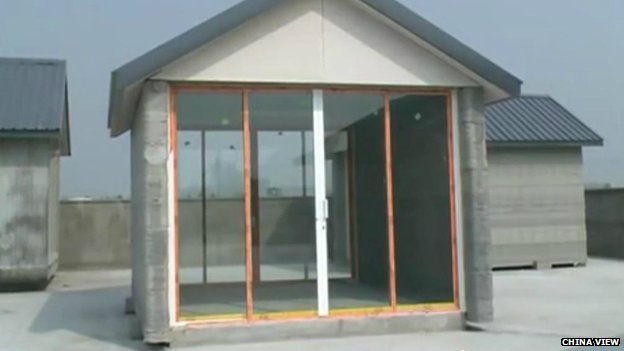
The Chinese houses use recycled construction waste materials mixed with cement which is sprayed by the four 10 meter by 6.6 meter printers. The spray is multi-directional and the material is quick drying. The 3D printers were not deployed at the building site. Instead they built the walls in a factory setting and these were then carted to the construction site for final building assembly. It took 24 hours to complete all ten units.
Walls are designed so that wiring and plumbing can easily be inserted. From the picture below you can see that the homes are functional but not aesthetic.
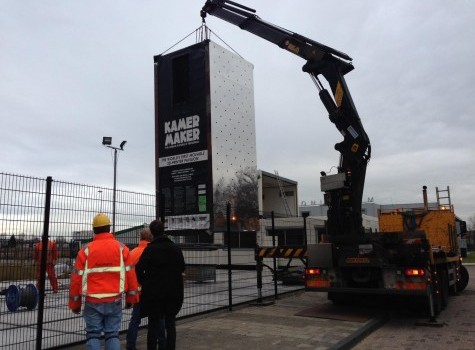
For aesthetics, however, consider the Dutch Canal House being built by Dus Architects. The house is being printed using a giant 3D printer called KamerMaker (see image below). It stands 6 meters tall (20 feet) and does all its printing on the construction site using bio-plastic materials. It can print both small and large objects.
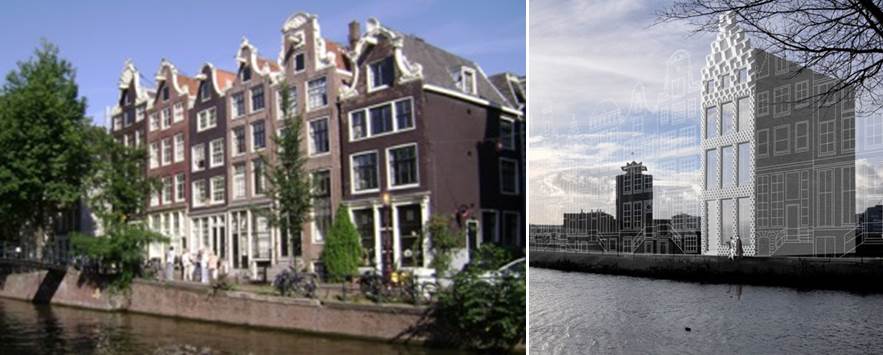
Canal houses are commonly found lining the many canals of Amsterdam. The houses are characteristically narrow, tall and deep. Many date back to the 17th century. The architects in choosing to build a house in this style are demonstrating the versatility of 3D print technology. The rooms are individually printed and can then be stacked and assembled. Rooms can even be disconnected for relocation depending on design changes. All walls are arrayed with smart sensors to provide climate information such as temperature, and humidity. Walls can even be made to vary opacity to alter the amount of outside light entering the living space.
The architects intend the construction of Canal House to be a three-year project. So unlike the Chinese 3D homes described above, speed is not the focus.
What will Canal House look like? In the two pictures below, you can see what canal houses look like in Amsterdam today and how the architects envision their canal house to look upon completion. It should fit in quite nicely.
Dus Architects hope, in building Canal House, to demonstrate the current state of digital fabrication and 3D-printing technology as applied to building design and assembly. They also hope to demonstrate new sustainable building materials for home construction.
They have turned the building site into more than a place of construction so that it more resembles a research and development project. Visitors to the site pay a 2.50 Euros entrance fee for a guided audio tour. The fee will in part go to help fund the project.
For those of you who cannot make it to Amsterdam to see Canal House as it is printed, follow its progress at the link provided here.


