MAPLE is an acronym for the Microwave Array for Power-transfer Low-orbit Experiment which consists of microwave power transmitters designed to transmit energy from the satellite to space-based receivers. The initial tests monitored from Earth show that the technology works. The end game is to demonstrate that the technology can transmit energy collected onboard and send it to Earth-based ground-station receivers.
How does MAPLE work? It contains no moving parts and uses timing control to transmit direct current electricity by using electromagnetic waves. Stated Ali Hajimiri, the Caltech team lead, “To the best of our knowledge, no one has ever demonstrated wireless energy transfer in space even with expensive rigid structures. We are doing it with flexible lightweight structures and with our own integrated circuits. This is a first.”
As the test continues the Caltech team will be assessing the design of the power transmission antennas grouped in clusters of 16 with each controlled by custom integrated circuit chips. It will be six months before testing is complete with the knowledge gained to be used in the building of the next-generation array.
Any solar panel located in space has enormous advantages over the ones we have here on Earth. They can be located so that they never are inside Earth’s shadow. That means 24 hours of continuous sunlight. They never have to deal with seasonality, cloud cover, and other atmospheric conditions that could reduce the energy yield.
Besides the normal challenges that any solar-powered satellite faces in space from space debris, space dust, asteroids, and extreme solar radiation, the biggest challenge is the public misperception of microwave beam transmissions. If a bird flies through the beam will it become toast? What about a beam intercepting an airplane? Could a solar-power-generating satellite be turned into a beam weapon like those portrayed in 007 films?
There are size issues as well. The European Space Agency (ESA) in its research into beaming energy from space by microwave describes the need for solar arrays multiple times larger than the International Space Station (ISS), the largest human-built object in space today. ISS took more than a decade to build at a cost of US $150 billion. ESA believes to get the equivalent energy produced by an average nuclear power plant would require an array ten times the size of the ISS.
Hajimiri and his Caltech team may have a different view from the engineers at ESA. The design they are working with will use lightweight, cheap and flexible structures delivered to orbit that unfurl into arrays 50 metres square from a 1 cubic metre (35 cubic feet) package. He sees wireless energy transfer from space to be as revolutionary as the Internet.
“No energy transmission infrastructure will be needed on the ground to receive this power,” states Hajimiri. “That means we can send energy to remote regions and areas devastated by war or natural disaster.”
The description sounds similar to SpaceX’s constellation of Starlink telecommunications satellites and how they have enabled Ukraine to continue to offer its citizens connectivity even in the face of Russia’s onslaught. In this case, however, instead of data and voice transmissions from Earth to space and back, a space solar power constellation will send energy to receivers to power anything on Earth. Hajimiri calls it the democratization of energy.
]]>
Solar energy from space has been the dream of science fiction writers beginning with Isaac Asimov back in 1941 in a short story called Reason which later was included in a collection that Asimov published in 1950 entitled I, Robot. In the story, Asimov described a space station that collected energy from the Sun and transmitted it by microwave beam to various locations. Asimov recognized the distinct advantage of building solar power generating stations in space out of the Earth’s shadow and therefore continuously being able to harvest the energy of the Sun.
When the first telecommunication satellites were launched into geosynchronous orbits around Earth, it became obvious that not just communications could be offered in a continuous stream using satellite technology. A photovoltaic array parked in a similar orbit would stream electrical energy to Earth ground receivers. And depending on the size of an array deployed at that altitude, a satellite or a few of them to ensure no single failure, could become an endless supplier of all the energy the planet would need. There were technical problems still to work out.
For example, how could a large array be deployed in space? Currently, the International Space Station’s (ISS) latest upgrade of its solar panels demonstrates such a technology. Called the Roll-Out Solar Array (ROSA) its deployment makes it possible to send large arrays to space in small form factors that can physically roll out to extended lengths. Although deployed on the ISS, the potential for this technology to be used in building large solar-power stations in space is considerable.
The second big challenge is how to get the energy collected down to Earth receiving stations. The SSPD prototype includes three component systems that address these two challenges.
An onboard computer system interfaces with all of the components.
The SSPD array of multiple antennae is designed to transmit power phased simultaneously and timed precisely as a highly directed energy beam focused on Earth-based receivers. In SSPD the conversion is to microwaves which are received on the ground and then converted back to electricity.
Caltech isn’t alone in exploring solar power transmission to Earth. Northrop-Grumman is working with a technology it calls SSPIDR in partnership with the U.S. Air Force Research Laboratory (AFRL). The European Space Agency (ESA) has its Advanced Concepts Team (ACT) working on a similar project. And China, last June, announced its plans by 2028 to put a demonstration satellite in low-Earth orbit (400 kilometres in altitude) to test converting 10 Kilowatts of generated solar energy to microwaves or lasers and transmitting a directed beam to multiple targets on the surface.
When will we know the Caltech technology works? Sergio Pellegrino, a Professor of Aerospace and Professor of Civil Engineering at Caltech, in a January 2, 2023 press release states “We should know right away if DOLCE works.” Which photovoltaics prove to be the best will take about six months of tests.
MAPLE is another story. Ali Hajimiri, a Caltech Professor of Electrical and Medical Engineering, is also quoted in the press release talking about the building of this component in the prototype. He states, “The entire flexible MAPLE array, as well as its core wireless power transfer electronic chips and transmitting elements, have been designed from scratch. This wasn’t made from items you can buy because they didn’t even exist.” It will take several months to verify MAPLE is performing to specification.
Could all of Earth’s electricity needs be supplied from space-based solar power stations? The American Society of Mechanical Engineers (ASME) says space-based solar panels can generate 2,000 Gigawatts of power constantly, or 40 times more energy than solar panels on the Earth. The technical challenges include the ability to overcome launch costs to get materials into space (SpaceX is demonstrating reusability which is dramatically reducing payload costs), lightweight easily deployed solar panels (ROSA sounds like a fit), microwave-or laser transmission equipment and receiving centres on Earth to collect and distribute the energy (which Caltech in this prototype should be able to demonstrate.)
So by the summer of this year, Caltech’s design team should know if they have a working prototype for solar power stations in space. The implications for the planet and its energy future are enormous. We could see a significant space-based energy industry in place by the mid-2030s. The fossil fuel industry and utility companies may want to pay close attention to what Caltech is doing.
]]>The developed tool is built on a foundation of studying sea level rise through the 20th and first decades of the 21st century, plus the analysis of data from melting “outlet glaciers” on Greenland and Antarctica.
On a simpler level, one could assume that any significant loss of ice from an Antarctic continental ice sheet would have impacts on coastlines everywhere around the planet. But specific areas of these coastlines could be more at risk subject to Earth’s rotation, the vertical motion of the crust after the ice melts, and gravitational perturbations from the latter. The researchers, therefore, combined seismology, meteorology, and oceanography, and created an Ice Sheet System Model (ISSM) to develop projections of sea level rise at major port cities across the globe.
How do these scientists know?
First, there is gravity which is impacted by massive amounts of ice lying on the Earth’s surface. The weight of continental ice sheets pulls ocean water towards them. When the continental ice melts, ocean water moves away from their mass. And as the ice mass melts, groundwater sources compressed beneath the ice masses come into play expanding and moving upward to add to ocean volume.
Second, there is the rotation of the Earth which includes a wobble. That wobble is similar to what you see when you spin a top. Because of slight imperfections in the manufacturing most tops never spin perfectly evenly. There’s almost always a bit of a wobble. And that is true of the Earth when it spins.
In the case of the Earth, it is the location and mass of the continents, and the distribution of ocean water, that are contributors to its wobble. The continents’ mass can be altered when ice sheets melt. That in turn alters the ocean mass. The combination of the two change the wobble.
With the two phenomena mapped and added to observations in sea level changes and rates of ice melt from data collected throughout the 20th century and the beginning of the 21st, the JPL/Caltech scientists conceived ISSM to build city-specific forecasts for sea level rise. Some examples of observed correlation are provided below:
States Erik Ivins, one of the senior researchers and co-authors of the study,
“As cities and countries attempt to build plans to mitigate flooding, they have to be thinking about 100 years in the future and they want to assess risk in the same way that insurance companies do.”
Combining all of these complex processes ISSM may become very useful for cities along coastlines around the world in preparing to adapt to changes in local sea levels that could impact them noticeably as early as century end.

Researchers tell us that quantum computers will be able to solve complex problems, that they will be faster than the supercomputers we have today, that they will be able to break any existing cryptography while putting in place unbreakable security in all quantum devices.
Quantum computers will analyze the Universe for us in entirely new ways, whether we are studying black holes and supernovas or revealing the latest new particle finds in quantum physics, or unlocking further the mysteries of DNA and RNA. But they can only do this if developers create software that works on quantum computers. Back in January of this year, I wrote about the challenge of developing the programming for quantum computing. D-Wave has developed an open source tool, Qbsolv, to encourage programmers to begin software development. Another developer, Scott Pakin, has created Qmasm, a quantum macro assembler to help with the writing of machine level code. Another company, 1QBit, is also building software for quantum computers, in particular, D-Wave devices.
In the latest Caltech study which was presented at the Institute of Electrical and Electronics Engineers 2017 Symposium on Foundations of Computer Science, researchers provided what they called solutions to “semidefinite programs.”
So what is semidefinite programming?
It is programming designed to solve complex problems where there may be more than one answer, such as solutions that provide minimums and maximums. Think about what kind of software tool would help design a critical component for a rocket to better understand the material constraints under a number of conditions. In conventional computing, this is a complex problem that could tie up a system for hours or even days. In quantum computing with semidefinite programming, the problem can be addressed in minutes providing a range of tolerances and comprehensive risk analysis.
Fernando Brandao and Krysta Svore, are co-authors in the published results of the study. Brandao, a theoretical physicist at Caltech, believes that the quantum algorithm they developed could rapidly describe the quantum states of subatomic matter and its behaviors. Svore manages the Quantum Architectures and Computation Group at Microsoft Research. In their paper which you can access through the Caltech Library Service, it states that the new quantum algorithm they developed achieves an exponential speedup when solving complex linear and quadratic equations.
Real world examples and not theoretical ones where semidefinite programming using quantum computers will prove helpful:
All of these are good candidates for quantum computing but without the programming tools, the value of the advances on the hardware side is moot.

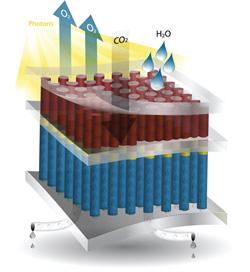
The pursuit of artificial photosynthesis has been one I have written about in past blogs. If we can develop a low-cost equivalent to what leaves do it would yield all kinds of advantages for humanity and the planet, helping us solve two of our most pressing challenges: our need to develop sustainable green energy and the requirement to reduce atmospheric global warming from CO2 and other greenhouse gas sources.
Berkeley and Caltech have created the Joint Center for Artificial Photosynthesis (JCAP), dedicated to develop artificial photosynthesis that is ten times more efficient than what plants do. They are doing this using photocathodes that generate hydrogen from illumination. The photocathodes are made from gallium phosphide coated with a thin film polymer called vinylpyridine. The latter is chemically treated with cobaloxime catalyst which significantly boosts hydrogen output. Gallium phosphide is limited in reacting to the full spectrum of light so the researchers are testing other materials to see if they can further increase yields. The end result will be a solar-fuel generator that also provides net CO2 emission reductions.