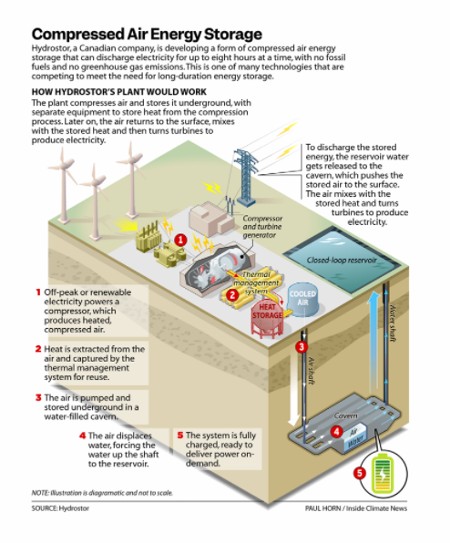
Compressed air storage is a technology that increasingly looks like it will be a part of the energy mix as the planet moves to a renewable-dominant power generation infrastructure to achieve net-zero emissions by 2050.
A-CAES stands for advanced compressed air energy storage. It works this way (see schematic above). During periods when power demands are low, surplus electricity produced from the grid or from renewable sources powers the compressor. This produces heated compressed air. The heat gets extracted as the compressed air is pumped to pressure-sealed storage underground. When would the energy be released? When renewable power generation is less than peak and demand is high, the compressed air storage system can be switched on. The underground chamber is flooded with water stored at the surface. That pushes the air up where it is combined with the extracted heat to drive turbines to generate electricity.
The advantages of A-CAES technology are many:
When the company was founded in 2012 it was able to get Toronto Hydro to fund a pilot project. This was a 1.75 Megawatt system that has been operational since 2015 and provides continuous energy for six hours at a time. The stored air lies in an excavated cavern some 300 metres (about 1,000 feet) underground. A natural cavern would be as suitable if not a better choice. A second facility has also been commissioned in the Toronto area. And now Hydrostor has two more projects to build, both for California. One will replace the power lost when the Diablo Canyon nuclear plant in San Luis Obispo County is decommissioned in 2025. The other will provide supplemental power for Los Angeles.
Today there are compressed air power plants in operation at two other sites. These are not Hydrostor builds. One is located in Alabama, and the other in Germany. Both use natural gas to heat the air. Both don’t capture the heat for release along with the compressed air. The result is both contribute waste heat and greenhouse gas emissions during operation. Hydrostor doesn’t let the heat it gets from surplus grid or renewable energy sources go to waste because it is stored.
In California’s latest energy plan, the state’s Public Utilities Commission mandated energy producers to develop or acquire 11,500 Megawatts of new electricity by 2023 to 2026. In the request, long-duration storage is included with a goal to add 1,000 Megawatts from these sources. California already uses a mix of long-duration storage today with a total capacity amounting to 3.7 Gigawatts.
The two Hydrostor facilities represent a modest increase in that total, but this is just the start of what could become a fixture in the near future for the state’s net-zero energy infrastructure.
The following infographic illustrates what the Hydrostor facility will look like and how it will operate.