Yesterday, researchers from Brown University, in Providence, Rhode Island, had their paper accepted for publication in the Journal of Geophysical Research. Entitled “Porosity and salt content determine if subduction can occur in Europa’s ice shell,” the paper tries to explain observed features on Europa seen in satellite, Hubble, and Earth-based telescope images. The moon bears surface scars that strongly resemble those found on Earth along the margins of continental and ocean plates. In running computer simulations of the moon’s surface features, the Brown researchers hypothesize that forces similar to plate tectonics are happening there. It’s not quite the same as what drives Earth’s plates, but the end result is the same.
Europa’s icy plates are moving and there is evidence of subduction zones where the moon’s surface ends up sinking into the ocean beneath. States Brandon Johnson, Assistant Professor, Department of Earth, Environmental and Planetary Sciences, and lead author of the paper, “If indeed there’s life in that ocean, subduction offers a way to supply the nutrients it would need.”
Tectonics on Earth results from the interaction between our lithosphere, consisting of pieces of the crust forming distinctive plates, and the viscous, hot mantle that lies beneath. As mantle currents cause upwellings we see eruptions occur along the plate edges. The eruptions add new material to the Earth’s surface and push apart the plate edges, while on other parts of the Earth pieces of the lithosphere get dragged beneath into the mantle in a process known as subduction.
On Europa, the equivalent to Earth’s lithosphere can be found on the surface containing an outer and inner layer of ice. The outer layer is very thin with the ice much colder than the layer beneath. It is this second layer which the researchers believe acts like Earth’s continental plates. But figuring out the mechanism is the unsolved mystery. What causes convection of the inner ice layer?
The researchers hypothesize that convection can be explained if the inner ice layer is saltier than the ocean beneath. And if saltier it must, therefore, be denser. The difference in density between ice and ocean then becomes the mechanism driving Europan tectonics with plates of ice akin to the continental plates that compose Earth’s lithosphere. And as on our planet, where subduction immerses pieces of the surface into the mantle, on Europa, a different chemistry and geology produce a similar effect.
The evidence for a denser, saltier ice surface is there states Johnson. Geyser-like plumes erupting from cryovolcanoes bring salt to the surface where it continuously accumulates creating these denser plates of ice and reinforcing the tectonic processes. Johnson notes that the ability to study plate tectonics on Europa may help us to better understand Earth’s plate tectonic processes and how they began in the early history of our planet. And even more exciting, is how this mechanism on Europa could provide the means by which life, if it exists there, can be sustained.
NASA scientists at the Jet Propulsion Laboratory in Pasadena, California, are hellbent on getting to Europa to further investigate it to determine if it could or is harboring life. A mission called the Europa Clipper is planned for as early as 2022. It will send a robotic spacecraft similar to Juno to enter into a series of long looping orbits around Jupiter aimed at repeated flybys of the moon. The instrument payload will include cameras and spectrometers to study the surface, and radar to map the subsurface ocean. A magnetometer will measure the moon’s magnetic field and help to determine the salinity and depth of the ocean. A thermal instrument will scan for cryovolcanic eruptions and other upwellings including water plumes first noted in 2012.
A future mission tentatively scheduled for the late 2020s proposes to put a lander on Europa’s surface in 2031 to search for evidence of life. It would have to touch down near cryovolcanoes or water plumes if it wants to find microbes or other evidence of life expelled onto the surface. Scientists speculate that life on Europa would be similar Earth life observed on our oceans’ floors in proximity to thermal vents called black smokers, or akin to the microbial life found in subsurface glacial lakes.

In Nature Geoscience this month, an article entitled “Remote detection of widespread indigenous water in lunar pyroclastic deposits,” researchers Ralph Milliken and Shuai Li, the former an associate professor at Brown University, and the latter a Brown post-grad doing research at University of Hawaii, describe evidence of “significant water in the bulk lunar mantle.”
They began studying rocks brought back from the Apollo missions and discovered traces of water that could not be explained by contamination. In other words, Moon rocks were a bit wet, similar to basaltic rocks here on Earth. Milliken and Li then studied data collected by the Moon Mineralogy Mapper instrument on India’s Chandrayaan-1, a lunar orbiter that successfully mapped the geology of the Moon from 2008 to 2009. From the images, the researchers were able to deconstruct reflected sunlight and heat while examining pyroclastic (volcanically derived) surface deposits. They were then able to determine the content of the rocks. What they found was water in nearly every pyroclastic deposit including those near the Apollo 15 and 17 landing sites. This confirmed that the presence of water in Apollo Moon rocks was no fluke. The Moon was in fact water rich.
In a July 24, 2017, press release, Milliken notes that water signatures visible in the data were consistent with that from Apollo and Soviet Luna mission samples. He continues, “The distribution of these water-rich deposits is the key….They’re spread across the surface, which tells us that the water found in the Apollo samples isn’t a one-off. Lunar pyroclastics seem to be universally water-rich, which suggests the same may be true of the mantle.”
Based on the impact theories for lunar creation it is a bit of puzzle to explain how the lunar interior could contain so much water, about 0.5% by weight. If the Moon was born from a planet-sized object colliding with the early Earth, one would theorize that any water present, in particular, the hydrogen component, would be lost to space. In such a scenario the interior of the Moon should be bone dry. But these discoveries prove otherwise with some interesting implications. More accessible water resources than those at the lunar poles increases the options available for future locations of human-occupied lunar bases. It means water can be mined rather than having to be trucked from Earth, or harvested from a near-Earth asteroid.
States Li in the press release, “Anything that helps save future lunar explorers from having to bring lots of water from home is a big step forward.”

]]>
Arumugam gives the following examples.
A warehouse worker shares a workload with a robot forklift that is next to him or her. When the worker says “grab that pallet,” how should the robot interpret this? Which pallet for example…the one in front of me, the one to the right, or one across the floor? In addition, “grab that pallet” isn’t the same as “lift that pallet” which may be implied by the worker but not implicitly understood by the robot. A robot receiving such a request may simply do nothing without further instruction.
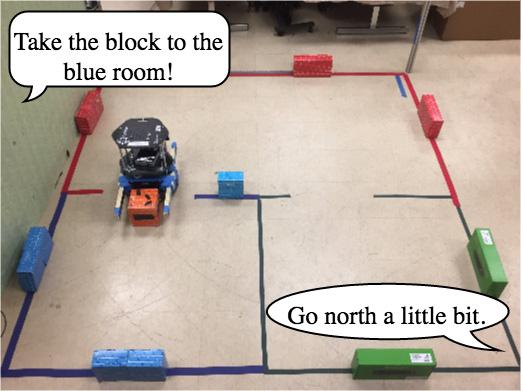
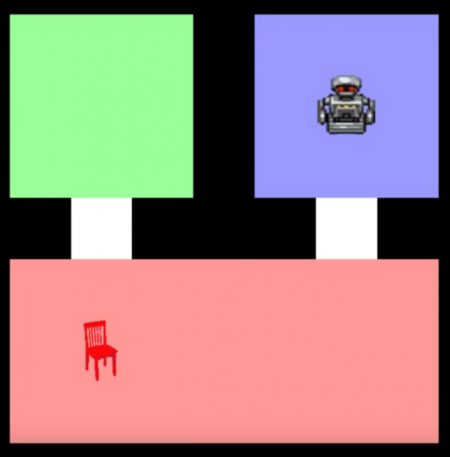
So Arumugam and Karmacheti devised a software program that analyzes the language of inference within the robots spatial reality and gives it the knowledge of abstraction when executing a task. They then ran a virtual test by getting volunteers to instruct the robot software to move a chair image from a virtual red room to a virtual blue room. Instructions varied from a high-level command “take the chair to the blue room,” versus step-by-step instructions such as “take five steps north, turn right, take two more steps, get the chair, turn left, turn left, take five steps south.” In the virtual environment, through continuous testing, the software learned how to apply inference to an abstract spoken request.
The two researchers then decided to use the software with a Roomba-like robot in the real world. When the robot inferred the task objective and was then given specific additional instructions, it responded 90% of the time to the spoken command within 2 seconds. When no specificity was added it took the robot 20 seconds or more to execute on the abstraction.
States Stefanie Tellex, Professor, Computer Science at Brown, “This work is a step toward the goal of enabling people to communicate with robots in much the same way that we communicate with each other.”