The first of the leaps began with the Brexit time clock starting when Britain’s Prime Minister sent an official letter to the heads of the European Union invoking divorce proceedings. The cost to the United Kingdom of this decision may prove to be monumental. Dissolving the EU partnership will have more than financial repercussions. Britain may dissolve as well with Scotland breaking away, with or without permission of the Westminster Parliament. And Northern Ireland also finding its own future in a relationship with Eire, its neighbour.
Then there was the executive order signed by President Donald Trump reversing the climate regulations established by his predecessor. The signed order was only the half of it. Trump’s head of the EPA told the press that he didn’t believe rising carbon dioxide levels in the atmosphere had anything to do with global warming. Trump proposed dramatically cutting the budget of the EPA, and references to global warming and climate change, and programs focused on the science were all on the chopping block. On the Department of Energy’s website, all references to climate change and rising greenhouse gasses were to be excised. And America’s commitment to the Paris COP21 Climate Agreement was in question. Talk about a leap off a cliff that could take the rest of the planet with it.
And finally, there was a positive leap with the successful launch of a reused first stage SpaceX Falcon 9 rocket. SpaceX has been taking leaps off cliffs ever since it arrived on the scene. Its CEO, Elon Musk, dreams of colonizing Mars and sees reusability of hardware as critical to human exploration of space and other worlds.
Considering Trump’s latest venture into attempting to revive coal mining and the burning of it for power generation, a wrong-headed attempt to revive an industry that is no longer cost competitive when compared to natural gas, wind, and solar, and noting the impact that coal will have on global warming in this century, we may need Musk’s rockets in the long run to find us a safe haven from the stupidity of governing leaders here on Earth.

All of these speculations have come into sharp focus following yesterday’s vote in the United Kingdom to reject membership in the European Union. In an act of direct democracy, the people of Britain narrowly have chosen to leave an organization founded in the wreckage of a post-two-world-war Europe, and designed to ensure that national xenophobia never re-emerges as a divisive force on the continent.
The map below is a startling display of the emergence of regionalism as a political force. It shows that the 21st century is unfolding in ways many would have never predicted. Note the regional preferences displayed here. The populations of middle England and a good portion of Wales have opted out of participation in the European Union, whereas Scotland, Northern Ireland, the City of London, Gibraltar and the Isles of Scilly have opted to remain.
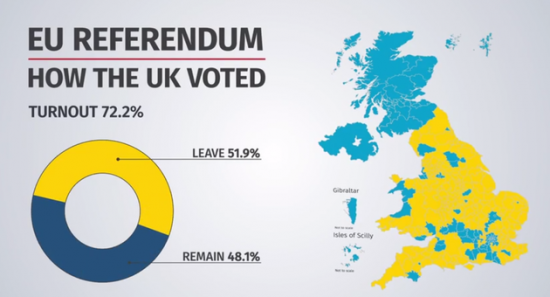
Does this foreshadow even greater devolution from the existing nation-state status quo? Absolutely. In a vote in 2014 Scotland sought its independence from the United Kingdom and at the time the results went 55 to 45% in favour of staying united. Today, a day after the “Brexit” results the Scottish government began a process to hold a second referendum on separation. And the likelihood of independence for the Scots considering the results shown on the map above is pretty much in the bag. Northern Ireland also faces a stark choice. Remain steadfast with the rump United Kingdom that will remain after Scotland leaves, or join its southern neighbour, Ireland, which is a member of the European Union. For Gibraltar it may mean union with Spain. And what about London? Could this be the beginning of the emergence of a city state smack dab in the heart of England?
Could such an outcome have been predictable? Social scientists studying the impact of technology on nation states will say yes. And expect the Brexit vote to destabilize other European states with Catalans separating from Spain, the Flemish opting out of Belgium, the Bretons inevitably out of France. One hopes that these devolutions are not like those that occurred in Yugoslavia but with the rise of demagogues and xenophobic national parties we may see the entire rethinking of what is the European Union. Instead of the progressive movement of the last forty years from economic union to political, it appears that the political may come to an end leaving only a looser federation with a common market.
The vote yesterday has opened a Pandora’s box. The consequences are as of yet unforeseen.

]]>


