How does it work?
The flash battery technology combines gradient layers of nanomaterial with chemically synthesized proprietary organic molecules of non-biological origin. Unliike conventional lithium-ion (Li-ion) battery packs that use graphite and metal oxides, the organic compounds in the StoreDot battery are far less volatile, and retain recharge cycles far longer. StoreDot battery packs are far more heat tolerant, a challenge that still exists with Li-ion technology. Hence we occasionally read about EVs with Li-Ion battery packs that catch fire.
The ability to fully charge an EV in 5 minutes is a game changer for the industry should StoreDot’s technology become widely adopted. That means an EV with a StoreDot battery pack in a one minute charge can be driven 100 kilometers (60+ miles). Five minutes gets you nearly 500 kilometers (300+ miles). No other battery technology delivers this type of performance.
Optimized charging happens because the solutions and materials in the StoreDot battery enable ions to flow from anode to cathode at unprecedented speeds producing high current and low internal resistance.
And as in those ads on TV that offer you the latest in kitchen appliances, “wait, there’s more” from StoreDot.
These batteries can be shrunk to work in almost any mobile device. So smartphones and laptop battery packs are available.
StoreDot claims its battery technology is also much cheaper to build using readily available components (no cadmium, no indium, and in fact, no metals at all).
And yet here we go again, “wait, there’s more.”
StoreDot has developed an innovative MoleculeLED technology for liquid crystal displays (LCDs) that uses the same secret sauce of proprietary organic compounds found in its flash battery technology. But in this case it is using the chemistry to create luminous screens that exceed the standard currently in use for LCD and OLED displays.
The company has received considerable publicity since the 2017 presentation in Germany. The latest announcement comes from BP, the energy giant. It is investing $20 million because it sees the proliferation of fast charge stations as basic to a global EV infrastructure. At BP’s Advanced Mobility Unit, the company is focusing on a low-carbon future. In its recent announcements, it projects rapid growth in EVs throughout the 2020s and sees the StoreDot investment as a means by which it can become the fuel provider of choice for whatever the technology a customer uses.

Both resolutions put current business practices to the test asking the companies what action they intend to take to ensure they comply with a global strategy to keep warming to no more than 2 Celsius (3.6 Fahrenheit) degrees.
Since both companies are actively pursuing Arctic oil opportunities through existing operations and future leases it seems that their current strategies are counterproductive to the goals put forth in the resolutions. Yet both have moved forward to the point where they will be voted on. BP will vote this coming week and Shell at its annual general meeting in May.
Senior executives in both companies stated they welcomed these resolutions because it gave them the opportunity to disclose and demonstrate how they intend to deal with the issue. If the end result is anything like what is happening at Exxon-Mobil, then don’t expect transparency or truthfulness. The latter through its executive has stated it expects no changes to the way it does business regardless of any government regulation related to carbon reduction.
I gather Exxon-Mobil only listens to political leaders it pays, or those receiving money from Koch brother’s billion dollar political action funds. Ted Cruz, Mitch McConnell, Scott Walker, Rick Scott, and others, particularly in the U.S. Republican Party, are attempting to hold back a growing majority within their own country that believes climate change is an issue that matters. Whether the California drought, the drying out of the Colorado River basin, the Florida sinkholes and disappearing Everglades, or the fear of future Hurricane Katrina’s and Sandy’s, the trend to address climate change through policy is becoming widely accepted. Numerous opinion polls show that better than two-thirds of Americans believe action is needed to reduce carbon emissions and that in voting they favor candidates acting to reduce global warming by a two to one margin, and that they are three times more likely to vote against candidates who oppose action to reduce global warming. Well here are just some of them for you to remember.
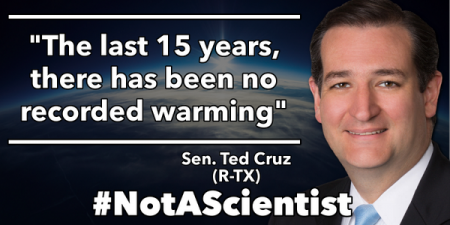
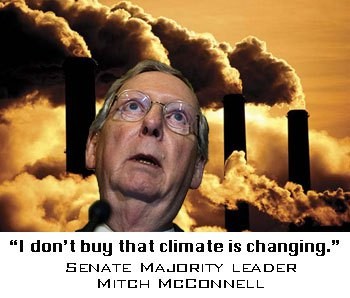

So unless the polls are completely off base, or American voters can be bought by politicians as easily as politicians can be bought by fossil fuel companies, it would seem that Exxon-Mobil may be wrong about its future expectations. And just maybe BP and Shell, with current market caps of $86.4 billion, and $180.5 billion respectively, cannot afford to ignore shareholders holding $300 billion of their stock.
As a Canadian watching the political theater south of the border, as well as our own politicos (for example, Prime Minister Steven Harper, whose picture, if he were American, would appear above) attempting to reconcile oil sands and carbon reduction, two opposites, it is clear to me that the fossil fuel business is becoming hopelessly mired in dysfunctional thinking.
When BP sold off renewable energy investments a few years ago it pretty much was giving the climate change movement the finger. And when Shell once more sent rigs into the Arctic to explore for oil, it was doing the same thing.
And now with the recent crash in oil prices one wonders what justification fossil fuel companies can use to keep plugging away at finding increasingly expensive new fields or bidding on leases in environments fraught with potential danger (think Deepwater Horizon and the Shell rig Kulluk).
It would seem that a “perfect storm” is arising – low oil prices, public awareness of the correlation between energy extraction and global warming, the rise of alternative renewable energy sources, and investors and their dollars seeking answers from fossil fuel companies to the question “can we keep global temperatures from rising beyond 2 Celsius (3.6 Fahrenheit) degrees?
When the world’s politicians meet in Paris this coming December to come to a common carbon reduction agreement, how many will have been bought by the fossil fuel industry, or will most of those be shunted to the sidelines because voters, like shareholders, may soon be divesting themselves from leaders that get paid to mislead.

Ruehl points out that consumption among countries in the European Union today is at 1967 levels, and for all OECD countries, 2012 consumption equals that of 1995. And although demand is rising in the Developing World less involves oil. Instead natural gas is becoming the fuel of choice, gaining ground on both oil and coal.
According to Ruehl by 2035 our fossil fuel energy mix will be far different from today with oil, coal and natural gas consumption roughly equal. And Ruehl forecasts that Developed World economies will actually use less energy in 2030 than they do today.
What is driving these changes? Here are Ruehl’s insights:
Ruehl cites U.S. data pointing to declining emissions, falling to 1995 levels as the American economy switches off coal and replaces it with shale gas, and as new vehicle models become standard fare on American roads.
In his concluding remarks in an article in The Financial Times, he states, “the relentless improvements in energy intensity …. are the main driver of slower emissions growth – without them, emissions in our 2035 projection would be more than 40 per cent higher ….. any substantial change in our energy mix towards lower carbon fuels requires price signals – the same mechanism that drives the relentless improvements in energy efficiency. Without it, the carbon content of the energy the world burns will remain the accidental consequence of other influences.”
These are interesting observations coming from a senior executive at BP and may point to a sea change in our search for a green and sustainable future.


