And just as I was finishing it Peter Diamandis sent one of his missives about robots as friends and employees. Robots and artificial intelligence are finding their way into both our personal and business lives. Peter sees them as entities not to be feared and has provided the following to reinforce his argument. I hope you enjoy the read.
Camel racing is a centuries-old tradition in the Middle East—think the Kentucky Derby for sheikhs—and it’s one of the richest sports on Earth. However, it’s the jockeys who have changed the most.
Twenty years ago, camels were ridden by children—the lightest possible riders—but general principle, injury, and death led to a humanitarian outcry. So, both the UAE and Qatar banned the practice, replacing children with an even lighter saddle occupant: the robot jockey.
Today, in camel racing, robot jockeys are the norm. Exactly like traditional jockeys, these robotic replacements sit on a saddle, steer with the reins, and prod with a whip. The jockeys are small, about a foot high, and light, weighing between five and eight pounds, with skinny hinged arms.
Of course, my point isn’t that there’s a bevy of entrepreneurial possibilities in camel racing. It’s that robotics, another exponential technology long mired in deception, is now heading for disruption.
According to a report by the Littler Workplace Policy Institute: “Robotics is the fastest growing industry in the world, poised to become the largest in the next decade.” Which is to say, robot jockeys are just the beginning.
Consider Moxie, the brainchild of NASA roboticist Paolo Pirjanian, Co-founder of Embodied, Inc. Moxie is a small, Pixar-like robot with large eyes and a cute, dynamic virtual face. Moxie converses with children in a natural, lifelike manner, becoming a personalized companion to them. You can continuously talk to Moxie (as opposed to simply saying “Hi, Alexa”), and the AI knows to take its turn allowing for a fluid conversation and storytelling.
Importantly, Moxie doesn’t try to be too human or perfect—in fact, that’s where many other robotics companies have failed. Instead, Moxie has a key human-like element: it makes mistakes and learns.
Rather than a full prebuilt chatbot, Moxie has an actual personality and learns over the course of multiple interactions which “unlock” new content and behaviours, further engaging a child in a goal-oriented manner. (If you have young kids, or kids with learning disabilities, please check out Moxie at https://embodied.com/.)
Besides human-like, user-friendly robots, we’re also seeing exponential progress in robotic agility, mobility, and diversity.
Enabled by a new generation of sensors and actuators, and driven by near-unlimited computing and artificial intelligence, there’s a Cambrian explosion in robotics, with species of all sizes, shapes, and modes of mobility crawling out of the muck of the lab and onto the terra firma of the marketplace.
Of course, what is driving the current robotics revolution is the convergence of exponential advances in computation and machine learning using neural networks. A lot of what today’s amazing walking, flying, dancing and talking robots can do is simply a result of cheaper, faster and more ubiquitous computation driving artificial intelligence. The second exponential advance is 3D printing, which is allowing researchers and tinkerers to design, build and test robotic parts faster. Finally, it’s all about advances in networks and sensors to collect and feed data to a robot’s algorithms.
Festo, for one example, has created a robot that flies like a bird. Boston Dynamics makes robots that climb, crawl, jump, and hop, and all while carrying heavy loads. Some of their bots can carry more than a hundred kilogram load. And recently Boston Dynamics put out a video showing their robots making really cool dance moves which seems to be even more impressive than watching them unpack boxes from the back of an 18-wheeler.
Incredible companies like Chef Robotics are putting robots to work in the food industry. The National Restaurant Association reported that in 2017, 37% of its members listed labour recruitment as their top challenge, up from 15% in 2015. This means long lines for you, food deserts with little fresh food, and inconsistent orders (aka not enough guacamole). Chef Robotics believes robots are the best solution to this problem.
What’s the allure of robots? Robots don’t unionize, don’t show up late, and don’t take lunch, and they can work on an assembly line for just a few dollars an hour. And as the cost of labour continues to increase there will come a crossover point when robots will be cheaper and better suited for certain jobs.
Indeed, the market for industrial robots has seen double-digit growth annually since 2013, and is expected to continue to grow 12,3% annually through to 2026.
A 2017 report by the McKinsey Global Institute concludes that almost 50% of tasks done by employees today are at high risk of being taken over by computers (AI and robots). Among these are data collection and processing, representing 51% of the activity in the American economy.
In China, Foxconn, the Chinese electronics manufacturer that builds Apple’s iPhone, made news back in 2013 when the skyrocketing demand for cell phones led to labour disputes, reports of harsh working conditions, even riots and suicides. In the aftermath of these reports, Foxconn has moved to automate 30% of its workforce, cutting 60,000 jobs in 2016 and replacing them with robots, a trend accelerated by the coronavirus pandemic.
Besides replacing blue-collar workforces, robots are invading many more fields. Consider the effect autonomous driving will have on the trucking industry, or surgical robots in healthcare, and companion robots for therapy and eldercare.
“If I were an exponential entrepreneur looking to create tremendous value,” says robotics expert Dan Barry, “I’d look for those jobs that are least enjoyable for humans to do … Given that the global market for unskilled labor is worth many trillions of dollars, I would say this is a huge opportunity.”
Startup infrastructure dedicated specifically to robotics continues to grow—the recent announcement of the Founder Institute partnering with the NASA Ames Research Center and MassRobotics to launch an AI and Robotics-focused accelerator is just one example.
At the same time, the continued exponential growth of AI, robotics, and other technologies, along with our improving understanding of human nature, are moving us to a world of true robotic colleagues and friends.
]]>How is it doing it?
A robot dog named Spot (how entirely unoriginal if your as old as I am and had to read “Fun with Dick and Jane” as a child) built by Boston Dynamics, began patroling Bishan-Ang Mo Kio Park last Friday. This is an initial two-week trial in which the four-legged bot wanders through the park and along its many sidewalks to remind park visitors to practice social distancing.
Spot comes with an onboard 360-degree camera and data analytics software that determines the number of people in the park at any time. The initial test is over a three-kilometer stretch during off-peak hours. Spot is accompanied by a human attendant. If the trial is successful, Spot will be deployed regularly during morning and evening peak hours. And other spots will become a part of many of the other parks in the city-state.
Boston Dynamics has been working on advanced mobile robots for a number of years. The company’s early years involved work on robot development for DARPA, the U.S. Defence Advanced Research Agency. For a period of time, Google was a major investor in the company located in Waltham, Massachusetts. More recently the operation was acquired by SoftBank, a Japanese multinational.
Spot is a quadruped robot that can be used both in and outdoors. It walks at a good pace and can manage going up and downstairs as well as all kinds of uneven terrain and obstacles (see picture below). It has wrap-around vision and obstacle detection and avoidance capability. It can operate autonomously and has situational awareness. It also can be operated remotely by a human if needed.

When Boston Dynamics designed the robot it saw it as useful for work in areas that could be deemed dangerous to humans. For example, it could be deployed to inspect hazardous areas at an industrial plant: think nuclear power plants and electrical utility sites. With a human operator, it could be deployed to deal with checking out a suspicious package. Or in a hospital or emergency medical situation could use it in quarantined areas, or have it deliver food and medicine without putting caregivers in harm’s way.
In Singapore, the use of Spot in park patrols means the city-state can stretch out staffing requirements for preventing new COVID-19 hotspots from emerging by enforcing social distancing. And this isn’t the only place where Spot is being deployed in Singapore. A brother to the park robot is being trialed at the Changi Exhibition Centre, a community quarantine facility in the city that his housing people with mild COVID-19 symptoms. That robodog provides a delivery service to the patients including bringing them their medications.
Singapore is figuring out even more tasks for Spot in the future. Meanwhile, it is testing other deployable robots including 30 drones to monitor its parks. Before Spot, the city-state launched a four-wheeled autonomous robot named PUB which was also deployed to one of the parks. But being on wheels doesn’t allow the robot to go off paved paths. Spot can do that.
Singapore seems to have always loved robots. It has the second-highest robot-to-human-worker density in the world, only surpassed by South Korea. Besides the parks, you find robots roaming in food courts, robot greeters in retail stores, and robots providing room service delivery to hotel guests. Robots in the hospital dispense medication. The city’s airport deploys robot cleaners. And there are even robot short-order cooks. More recently an autonomous electric-powered bus was launched with capacity for 80 passengers following a prescribed route. So Spot should fit in quite nicely in the city-state blending in with an increasingly 21stcenturyish environment that embraces new technology like no other.
]]>Siddhartha Srinivasa, Professor of Computer Engineering, Carnegie Mellon University, describes Handle as “one of the most remarkable robots I have seen in a long time.” When you watch the video you will probably agree.
Handle demonstrates capabilities not seen in mobile robots previously. It jumps over hurdles, navigates stairs, handles uneven surfaces, can even lift one of its wheeled feet while rolling across a surface, and does it all at a pretty high speed. This isn’t your trudging, stiff, bipedal robot, but rather a sleek, fast, and flexible machine that almost seems alive.

Vikash Kumar, robotics researcher at University of Washington, describes Handle stating, “nothing like this has been shown before.”
Boston Dynamics continues to be a leader in the development of mobile robots for commercial and military purposes. As for the purpose of Handle, it could be used in warehouse operations, or as a delivery robot carrying packages to customers.
One thing for sure, this is no ordinary machine. The picture below illustrates my point. When you watch Handle jump over a snow bank or fly down a set of stairs, you know we have entered a new stage in robotic technology development.

]]>
6. Microscale 3D Printing is the latest advance in additive manufacturing using a wide variety of materials from living cells to metal inks suitable for laying down integrated circuits. The latest biological experiments in 3D printing include a bionic ear that combined electronics and living cells, retinal eye tissue, and vascular tissue to create networks of blood vessels. These microscale printers have even produced lithium-ion batteries so small they can be integrated into 3D printed sensors and worn by athletes. The scale of printing is so small with structures one micrometer in diameter. Compare that to a red blood cell at 10 micrometers and you get a sense of just how tiny and precise microscale 3D has become. The image below is of 3D-printed blood vessels made from bio-compatible hydro gels. The work was done at the University of California San Diego, Jacobs School of Engineering.

7. Mobile Collaboration takes us beyond the synchronization that allowed device users to distribute and share work they were doing on multiple devices and with some applications with multiple users. Today collaboration has moved full force to the Internet where cloud-based computing is taking over. I remember when I first started using Google Docs a few years ago. I was working with a client in Australia on marketing materials for the launch of an oil spill remediation technology. We worked together on a set of common documents including spreadsheets, business plan, presentations and marketing materials. Later on I duplicated this with another client in the United States by collaborating on the development of a new franchise service delivery model. It was cool at the time but advances have made cloud services even more seamless today allowing for collaborative communication whether on a mobile device like a smartphone or tablet, a laptop or desktop system. And with the spread of publicly-funded WiFi networks within city cores and along transit lines, conversations, comments, and collaboration has never been easier. If you have yet to get into cloud computing here are a few application providers who have the tools you will need: Box, CloudOn, Dropbox, Google Drive, Microsoft OneDrive, QuickOffice and Quip.

8. Virtual Reality which the MIT list has called Oculus Rift a product of Oculus VR, the company that has recently been acquired by Facebook for $2 billion U.S. Rift is one of a number of virtual reality headsets that are entering the market. Sony Morpheus, Vuzix and Nvidia are other 3D virtual reality players in the market. Other than playing video games, to what use can you put Rift and other virtual reality headsets? For people with disabilities, confined to wheelchairs or sedentary, virtual reality opens doorways to participate in the larger world and begin to experience both normal and super normal activities. Virtual reality has application in simulators from creating the means to “walk on Mars” using the visual images collected from Martian rovers, to flying a jet aircraft or standing at the helm of a ship. Virtual reality headsets can let us revisit history and experience it as if “you are there.” Imagine being a participant in the Battle of Gettysburg, or at Cannae riding one of Hannibal’s war elephants into battle, or at Stalingrad in the epic battle between Nazi Germany and the Soviets.

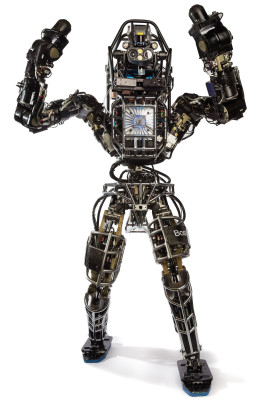
9. Agile Robots are replacing those clunky biomechanical machines of the previous decade. Today we have robots that walk like humans. Companies like Boston Dynamics, recently acquired by Google, have developed two-legged robot, Atlas, seen below, a four-legged robot, Big Dog, and even a one-legged robot that jumps around pogo-stick like without losing balance. In the case of Atlas it has sensate hands that can use human tools, stereo vision, and laser range finder. At the December 2013 DARPA Robotics Challenge, another robotics company from Japan, now part of Google, achieved the highest scores. The robot named SCHAFT beat all competitors performing eight complex tasks. You can watch what we mean by agile as SCHAFT does its stuff.
10. Smart Wind and Solar Power is coming of age through the application of artificial intelligence applied to meteorological data. This is allowing wind farm and solar operators to address the issue of power intermittency from these renewable sources. What’s involved? Adding smarts to adjustable wind turbines and photovoltaic panels so that they provide performance data and power to utilities for integration to the grid. Data mining is proving to be the game changer allowing for more accurate forecasts of power generation from renewable sources. This means utilities reduce their need to keep carbon-polluting backup generators on standby for those times when wind speed and direction changes. It means the utility can adjust the turbine remotely to maximize the power it can harvest from wind. For solar photovoltaic panels the challenges are greater but solar forecasting is getting better using data from satellites and sky imagers. The next stage involves better integration of all those private rooftop solar panels that are being installed on homes and businesses so that the excess energy they produce can be integrated seamlessly into national power grids.

What’s missing from the MIT Top 10 list? Here are some other top 10s that I would have considered.
But who am I to challenge MIT’s picks?
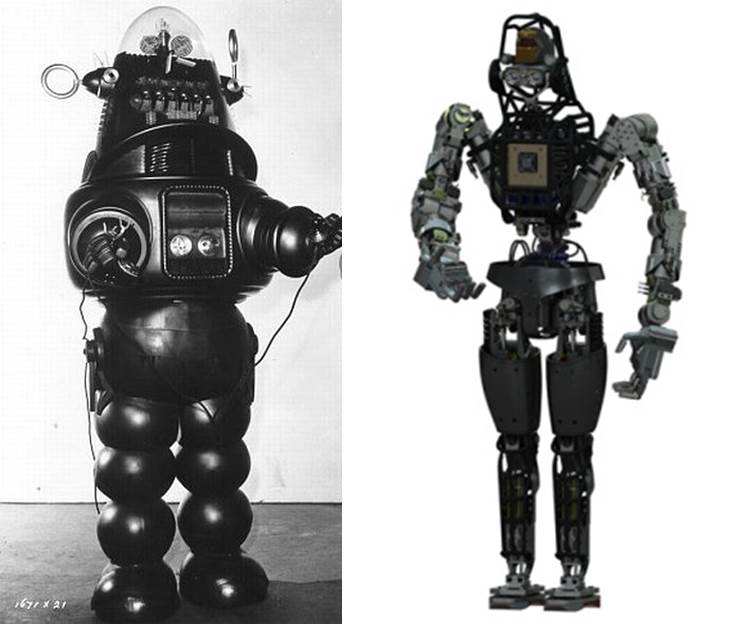
Atlas is a product of Boston Dynamics of Waltham, Massachusetts. Boston is working with DARPA, the research arm of the U.S. Department of Defense, to develop a wide range of robots including the SandFlea and BigDog. But these two bear no resemblance to a humanoid. Atlas does.
Currently you can watch a video of Atlas as the robot operates at the end of a tether. But plans are afoot to make it tether free. Standing 1.8 meters (6 feet) tall, and weighing 150 kilograms (330 pounds), Atlas is designed to go where it would be dangerous for humans to go while operating with a level of sophistication and autonomy. For example Atlas could defuse a runaway nuclear reactor before a meltdown happens, rescue people from an environmental disaster or battlefield, or even tend to the sick and elderly.
Atlas is designed to climb using both hands and feet. It features actuators and servomotors that give it flexibility and range of motion not seen in previous humanoid robots. The robot can adjust to impacts to keep its balance. Its head incorporates Carnegie Robotics’ MultiSense-SL, a vision system that sees objects in three dimensions and incorporates LIDAR to map its immediate surroundings.
DARPA unveiled Atlas last week with the robot performing calisthenics to demonstrate its flexibility. It will be one of several robots in the DARPA Robotics Challenge, a contest running this year to test a number of robots to see if they can be used for disaster response.
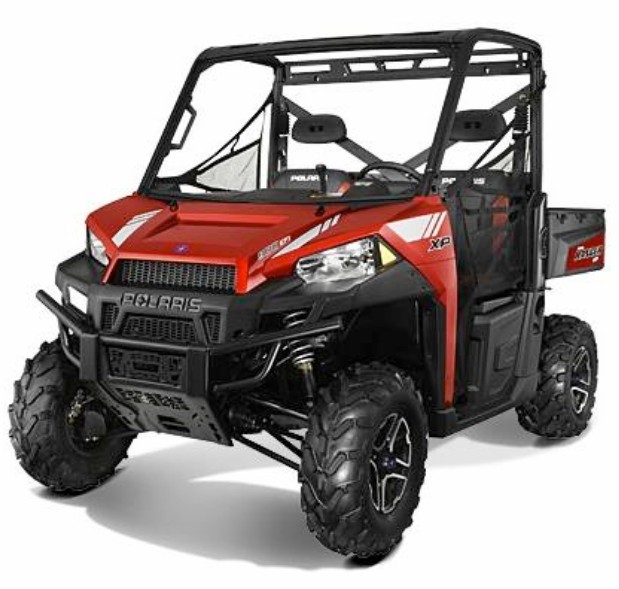
The robots entering the contest will be asked to perform eight tasks to see if they can work in rough terrain and operate human machines and tools. This includes climbing and walking over complex terrain, entering, driving a utility vehicle (seen in the picture below) through an obstacle course and then exiting from it, removing a pile of debris blocking an entryway, opening and entering a building through a door, climbing stairs and ladders, breaking through a wall using power tools like drills and sas, locating and closing open valves, and carrying, unspooling and connecting a fire hose.
The Challenge features robots from many sources including entries from the United States, the United Kingdom, Japan, Mexico, Spain, Israel and Brazil. Universities such as Carnegie Mellon, Drexel, MIT, and Virginia Tech have brought their humanoid robots to the contest as has two divisions of NASA, the Jet Propulsion Laboratory, and the Johnson Space Center. There are even entries from private companies such as Boston Dynamics. These include robots from Raytheon, Schaft Inc., and Boston Dynamics.
Over the coming months as the teams respond to the eight challenges they will develop sophisticated software to tackle each mission. We’ll let you know who are the winners.
]]>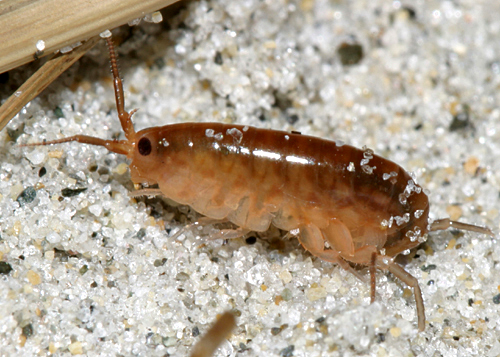
A company spun out of Massachusetts Institute of Technology, in looking at characteristics to meet a request for a mobile robot made by the United States Defense Department studied the Sand Flea’s leaping ability and built this characteristics into a machine of the same name that could operate in battlefield conditions.
The company is Boston Dyamics, developers of the BigDog, a rough terrain robot that I have briefly mentioned in a previous posting. Boston Dynamics are also designers of a number of other robots, most of them with military application. It’s worth a visit to their website to look at some of these – robots that run as fast as a Cheetah and bear that name, and a robot that can crawl and climb almost anywhere called RHex. A visit will give you a glimpse into battlefields of the near future.
Just recently Popular Science named the SandFlea, BigDog’s little sister, the Grand Award Winner in the Best of What’s New for 2012. Weighing about 5 kilograms (11 pounds) with a form factor 33 centimeters (13 inches) by 46 centimeters (18 inches) and standing 15 centimeters (6 inches) tall, SandFlea crawls, hops and jumps using its built-in piston actuator and laser-based ranging to guide each launch. It can leap heights of up to 8 meters (26 feet) landing on big rubber wheels to absorb the shock.

Each SandFlea has an on board camera with live video feed, controlled by a remote operator. It can travel at top speeds of 5.5 kilometers (3.4 miles) per hour. Powered by a lithium-polymer battery SandFlea operates for up to 2 hours and can do 25 hops before needing a recharge.
You can watch the Sand Flea in action here. But if you are thinking of buying one you’ll have to talk to the U.S. Military. They currently are not for sale for commercial operators.
]]>


