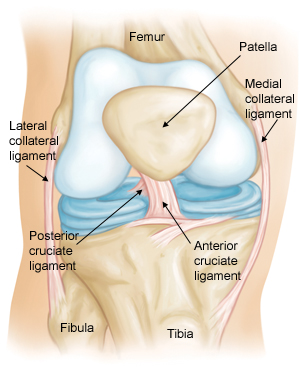
My problem stems back to an injury when I was 20. I broke both of my legs and although I had multiple surgeries my left leg twisted slightly during the healing process putting extra strain on that knee. By age 25 I was already experiencing the first signs of osteoarthritis and I have progressively watched it worsen over the years. Today I have no cartilage remaining in my left knee and manage the pain using an occasional Celebrex. The stress on my left knee has also impacted the one on the right with some cartilage loss, but nothing like what I am experiencing on my left side.
As I said before rather than invasive knee joint replacement I am waiting for advances in stem cell therapy and 3D printing to avoid surgery. Instead I’m reading the latest journal papers describing therapies being tested in small clinical trials like one recently described by researchers at Tehran University using mesenchymal stem cell transplants to reverse osteoarthritis.
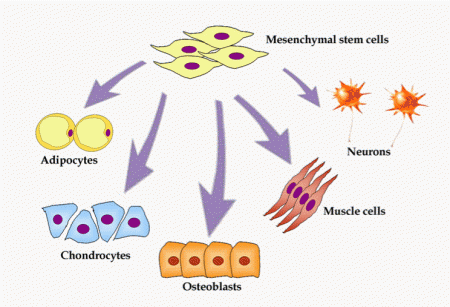
What are mesenchymal stem cells? Also known as multipotent stromal cells or MSCs, they can differentiate into osteoblasts (bone), chondrocytes (cartilage), myocytes (muscle), adipocytes (fat) and neurons. They are typcially found in bone marrow or in umbilical cord blood and are self-renewing. As you can see from above their ability to differentiate is extraordinary. Thus they are excellent candidates for therapeutic repair and tissue regeneration.
In the case of the Tehran study four patients with knee osteoarthritis participated ranging in age from 55 to 65. All had moderate to severe osteoarthritis. Each consented to having 30 milliliters of bone marrow extracted. The bone marrow was cultured to grow MSCs. After 4 to 5 weeks the MSCs were injected into one of the knees of each patient.
The result for 3 of the 4 was the lessening of joint pain. All were able to climb stairs and experience less pain. All experienced less knee joint grinding and cracking. Range of motion was minimally impacted. The clinical study conclusion was encouraging but not excellent.
Regenexx, an American company located in Denver, Colorado, is doing research involving stem cell and minimally invasive joint repair similar to the clinical trial done in Tehran. Regenexx is seeking 50 candidates between ages 18 and 70 for their knee osteoarthritis study. Half will undergo stem cell therapy treatment while the other half will receive knee osteoarthritis exercise therapy. Those in the exercise group will be able to cross over to receive stem cell treatment after 3 months. The Regenexx SD process appears very similar to the one described in the Tehran study with stem cells harvested from trial participants, concentrated in the lab and then reinjected into the damaged joint. 6 week, 3 month, 6 month, 12 month and 24 month post-injection follow ups are planned. End results will be compared against those undergoing arthroplasty.
There are enormous challenges in healing a damaged knee. The main one is caused by restricted blood flow to the joint. That’s why when athletes tear a knee ligament it can take a long time to repair. As a result they opt for surgery. I know from personal experience just how debilitating such tears can be and the length of time it takes for self healing. I partially tore my left medial collateral ligament three years ago while walking my dog. Because it was a partial tear my doctor advised me to let it self heal. It took more than a year.
I will be following the Regenexx clinical trial with great interest over the next two years to see if this presents me with an alternative to arthroplasty. If it does I’ll be glad I waited.
]]>
This week I look at technology headlines in the fields of biomedicine, climate change science, energy, manufacturing, and transportation. Enjoy the read.
Biomedicine: Synthesizing Human Parts Using Nano-materials and Stem Cells
From Russia with love, a story about doctors at the Krasnodar Regional Hospital who recently provided two patients who had lost their larynx and trachea in car crashes with laryngotracheal implants. First the Russian doctors used a nano composite synthetic scaffold developed by Nanofiber Solutions, a U.S. manufacturer. The scaffolds were shaped to fit each patients larynx and trachea. Then they were seeded with stem cells extracted from each patient’s bone marrow. Each scaffold was placed in a bio-reactor and rotated to assist in the regrowth of the tissue using the stem cells. The new tissue was then transplanted into each patient with no threat of immune-suppression.
Research is showing that bone marrow derived stem cells are extremely useful when developing other tissue types. Harvesting bone marrow stem cells is far less invasive than harvesting other stem cell types.

Climate Change Update: The Earth is Absorbing CO2 at Double the Rate since 1960
In the journal Nature this month researchers at NOAA, the National Oceanic and Atmospheric Administration in the United States, reported CO2 uptake by land and ocean is not a constant or declining as previously thought. In fact, net global carbon uptake has increased. Since 1960 human activity has produced 350 billion tons of atmospheric carbon. Of that total 55% has been absorbed by the Earth’s land masses and ocean waters. What’s more interesting is the rate of uptake goes up and down. In the 1990s scientists observed decreased CO2 uptake. In the first decade of the 21st century CO2 uptake increased. What this tells us is we really don’t have a full understanding of the planet’s carbon cycle.

Energy Update: Australia Sees Most Potential with Solar Energy
The Australian Bureau of Resources and Energy Economics predicts by 2030 that solar photovoltaics will provide the lowest cost among 40 different energy producing technologies that it assessed. The study looked at coal (Australia is a world leading producer of brown and bituminous coal), coal gasification, natural gas, solar thermal, solar photovoltaic, wind, wave, geothermal, landfill gas, biomass, and nuclear in coming up with its conclusions.
The study took into consideration the reduction in cost and improvement in efficiency of photovoltaic arrays and concluded that the technology is becoming cost competitive with a payback within 5 to 10 years and system lifetimes of 25 years. For Australia the solar revolution is about to arrive. It makes sense for the driest and sunniest continent on Earth.
Current installed capacity has grown 1000% from 2009 to 2011 with 1031.1 Megawatts online as of August 2011.

Manufacturing Update: Unintended Consequences of 3D Printing
Mass customization is the promise of 3D printing technology. It can be used to produce drugs that help alleviate pain. It can be used to make human body parts that won’t be rejected. It can be used in space to manufacture technology for space. It can be used to create one-off products using computer-aided design software. But this week we learned about the dark side of 3D printing. You can make guns.
I keep seeing the image of John Malkovich, an ex-CIA employee, assembling a gun from some kind of plastic or polymer in the 1993 movie, In the Line of Fire, while sitting at a Presidential fundraiser. Well reality is catching up with fiction. You can see a picture of a 75% prototype and the finished full-scale lower half of a gun in the picture below. Both were created using a 3D printer. Apparently the designer is having ammunition feed and extraction issues and reports with a little oil and lubrication, and switching to brass cartridges, the gun successfully fires. Isn’t technological progress sometimes inspiring?

Transportation Update: Elon Musk Predicts 50% of New Cars will be electric by 2032
When recently interviewed, the CEO of Tesla Motors and SpaceX bravely predicted that within 20 years, and more probably in the next 12 to 15 years more than half of all new cars manufactured will be purely electric. Compare that to other automobile manufacturers who are much more conservative in their estimates. GTM Research, a consulting firm that studies the industry predicts by 2016 a 500% increase in electric vehicles (EVs) to 3.8 million in the United States. Compare that to the more than 250 million cars on U.S. roads today.
With electric vehicles on the road in increasing numbers, another challenge is emerging. Where, when and with what will we recharge all of these new EVs? An EV infrastructure will be needed. Among the contenders for public charging stations are GE with the WattStation, ECOtality with its Blink Charger, and the Coulomb ChargePoint. Utilities will also find themselves having to support this sudden increase in electrical demand. This means building a smarter grid with upgraded voltage regulation and high-voltage capacitors.
What would be a fair rate to charge your EV? The jury is still out on that but $1.00 an hour seems to be a benchmark.

A Postscript
Find an interesting technology story, an innovation that can really make a difference for humanity and the planet in the 21st century- let me know. Readership has hit the 3,000 mark as we begin August. I thank all of you for visiting and am encouraged to see how many of you are repeatedly coming back. – Len Rosen
]]>