Sheldon went home and worked on the mathematics for launches and recoveries, sent his calculations by mail to NASA and waited for a response. None arrived so his father drove the family from their East Texas home to Houston and NASA headquarters to support his son. Sheldon with persistence was able to meet with the same NASA official who had visited his class and walked him through the math. The NASA official was both puzzled and impressed. In the last scene of the sitcom, years later, we see Elon Musk, the founder of SpaceX, reading Sheldon’s notes from his NASA visit and hiding them in a desk drawer. I thought this story would be a good preamble to what follows.
NASA has been developing space technology since its founding back in the Eisenhower administration of the late 1950s. Here we are, more than 70 years later and NASA rockets can take off but cannot land.
The Space Launch System (SLS), NASA’s replacement for the Saturn V of the Apollo Program era, is a throwaway rocket. The European Space Agency (ESA) which has been in the space launch business for many decades and is ready to assemble its latest “state-of-the-art” launcher, the Ariane 6, is also a throwaway. Russia, the successor to the Soviet Union, and the first country to launch a satellite into space, recently launched the Angara A5, its latest heavy-lift launcher. Guess what? It’s a throwaway too. Launch systems are expensive. They waste resources when they cannot be reused. What’s wrong with this picture?
Two private companies, SpaceX and Rocket Lab have been proving that reusability is feasible. Soon others will join them, companies like Blue Origin with its current suborbital reusable rocket, New Shepard, and the soon-to-be-launched New Glenn which will be fully reusable. Even the United Launch Alliance (ULA), a company NASA has relied on for launchers for decades, is working on a reusable launcher after just retiring its last Delta IV. ULA’s successor, the Vulcan Centaur will have recoverable components when it begins to fly.
NASA did go down the reusability track after Apollo with the Space Shuttle. It was supposed to be a low-cost way of going to space with quick turnarounds. The design was futuristic with the spacecraft looking like an airplane. To fly it required mounting it on the side of a non-reusable fuel tank with two solid rocket boosters attached. This was a major design flaw that exposed the shuttle to falling launch debris, a persistent danger. NASA lost 14 astronauts and two Space Shuttles during the 30 years of the program. Refurbishment remained expensive and the best turnaround between flights was 78 days.
Reusability remains a desirable goal for national space programs including:
Learning from the Space Shuttle design problem made NASA go back to the stacked design of the Saturn V era. That’s why the SLS eerily resembles its predecessor. But why reusability hasn’t been built into the technology for the first stage boggles my mind.
The Artemis 1 mission tested the SLS first stage and rocket boosters, the ICPS cryogenic propulsion stage, and the Orion capsule. The total cost of this throwaway was US $1.3 billion including the $107 million for the solid-state boosters leftover from the Shuttle Program.
The cost for subsequent Artemis missions has ballooned. Artemis 2 is scheduled for the fall of 2025 to fly four astronauts around the Moon. Artemis 3 will likely happen later than the 2026 date, probably 2027 or 2028. Each Artemis Program mission in current dollars comes with a $2.2 billion price tag just for the throwaway SLS rocket and its components. The Orion reusable spacecraft costs $1 billion. The ESA-built service module, a throwaway, costs $300 million. Ground system support is currently estimated to cost over $500 million per flight.
Meanwhile, NASA’s legacy technology built for reusability is now being shared with private companies. It is NASA technology adopted by SpaceX that allows Falcon 9 first stages to land with precision. Other design elements in the Falcon 9 are legacy NASA innovations as well. SpaceX has also been perfecting first-stage reusability to the point where the latest two Falcon 9 first stages have been flown 20 times and turnaround for reuse is taking as little as 21 days. To top it off it is NASA contracts and payments to SpaceX that have made it possible to fund much of its Falcon, Dragon and Starship development. Today, NASA launches crews to the multinational International Space Station (ISS) using Falcon 9 rockets and reusable Dragon spacecraft.
Another NASA-contracted company, Boeing, plans to join the space reusability fraternity with its Starliner spacecraft. Boeing describes the technology as 20th-century proven with 21st-century innovations. It will ride a ULA Atlas 5 non-reusable rocket to get to orbit.
When NASA stopped flying the Space Shuttle it had created the program to encourage commercial spacecraft development. Several companies were shortlisted. Boeing got the lion’s share of the money, $4.3 billion. SpaceX was given $2.5 billion. Today SpaceX flies four Dragon spacecraft on missions to the ISS as well as for private companies. It has 10 missions to ISS under its belt.
Boeing is four years late in its development of the Starliner and lists an inventory of three although only two will be operational for crewed missions to the ISS. It has flown two uncrewed missions over the last two years. The first had software issues and never made it to the ISS. The second got there. Hopefully, next week’s first crewed mission will meet expectations.
We may soon witness full reusability with the SpaceX Starship and Super Heavy booster. Its success will be a breakthrough milestone for future space exploration and a lunar and eventual Martian presence. Because NASA has plans with its Artemis Program to establish a permanent human presence on the Moon and calls this a stepping stone on the way to Mars.
The only way NASA’s ambition will be realized is with reusability. Otherwise, the dream is unaffordable. Designs like the SLS won’t cut it to support long-term lunar and Martian ambitions. These missions need fully reusable parts and the way NASA is going currently, the only thing that will be reusable will be its name painted on the side of the rockets and spacecraft that will fulfil the dream.
]]>A perfectly good alternative that is reusable and cheaper just demonstrated its effectiveness last week when SpaceX launched a Falcon Heavy mission. Two of the first-stage booster rockets returned to land and will be reused. The main core was never to be reused. The Falcon Heavy’s cost for the mission was but a fraction of what SLS will cost American taxpayers for each Artemis Program launch.
Another Boeing project that has proven to be overpriced and underperforming is the Starliner. Boeing and SpaceX were both awarded contracts to build space taxis to ferry crews from Earth to the International Space Station (ISS). SpaceX built two versions of its Dragon partially reusable module, the first to ferry supplies to the ISS, and Crew Dragon to send people. The Cargo Dragon version has been in operational use since 2012. Crew Dragons have been flying astronauts to the ISS since 2020. NASA pays SpaceX about US $55 million per seat for these flights. And now the Dragon is being used to fly commercial crews to space and the ISS.
Compare this to Boeing’s Starliner. Boeing and SpaceX both were awarded space taxi contracts by NASA at the same time. After that Boeing has demonstrated an ineffectiveness in fulfilling the terms of the contract in a similar fashion to the work it has done on SLS. Fraught with design flaws, Starliner has yet to carry a demonstration crew on board. Its first crewless flight never made it to the ISS because of software glitches. The second crewless attempt finally docked with the ISS in May of this year. Following that mission, we were told that Starliner would fly a crewed mission late in 2022. Then the date slipped to 2023, and this week NASA announced a demo mission for April of next year with the first operational mission of Starliner not happening until 2024 “at the earliest.”
This means Starliner has yet to launch an operational mission in fulfillment of its NASA contract and the reasons why remain only known to the Agency. One would guess that NASA has little confidence in Boeing’s technology. Too many glitches have been logged regarding Starliner’s May mission including ongoing thruster problems, parachutes, and other unresolved technical and software issues. “Inflight anomalies” is the term NASA is using as the primary reason for delaying the commercial operation of Starliner.
And by the way, NASA pays Boeing US $95 million per seat for every astronaut Starliner will carry to the ISS, a $40 million premium over its costs when using the SpaceX Crew Dragon. Yet Boeing says that Starliner is a money-losing proposition with total losses amounting to $883 million to date.
Meanwhile, NASA’s SLS Boeing partnership which was slated to come in at $2 billion per Artemis mission launch is now expected to cost $4.1 billion, and over the last decade since it was first announced has cost the Agency more than $23 billion to date. No doubt, Boeing is claiming it is losing money on this contract as well.
If NASA were to walk away from SLS and start the Artemis Program using Falcon Heavy, and later switch to using the SpaceX Starship once it’s declared spaceflight worthy, the cost to the Agency could be reduced dramatically. The latest Falcon Heavy launch cost more than the $150 million SpaceX price tag established in 2019, but certainly considerably less than Boeing’s SLS. Falcon Heavy provides about 25% less maximum thrust when compared to the SLS, but you could send several Falcon Heavy missions into Earth orbit and assemble components Artemis there for a fraction of the cost of launching one SLS from Earth’s surface. And when Starship goes commercial it will dwarf SLS in terms of maximum thrust and payload capacity and will be reusable and a lot cheaper.
So why is NASA sticking with Boeing? Can someone at the Agency explain this to the American public with a rationale that makes sense?
]]>It was bad enough with the crash of two Boeing 737 Max 8 jets because of poor software engineering and lax testing by the U.S. Federal Aviation Authority that took the company’s word on the reliability of the modified aircraft. Hundreds of lives were lost.
Now we have the Boeing commercial space taxi, the Starliner, designed to launch astronauts to the International Space Station (ISS). Despite the billions NASA has given Boeing, the company can’t seem to build something equivalent to what SpaceX has achieved on a much smaller budget.
It is good to hear Boeing leadership express the need to focus on the safety of the crew as the reason for pulling the plug on Starliner for the moment. It would have been nice if they had been equally intelligent about the 737 redesigns which gave us the Max 8.
The first orbital flight test of Starliner took place in December 2019. It turned into a fiasco because of a software glitch that caused the spacecraft to fall short of achieving the correct orbit to rendezvous and dock with the ISS. Boeing did a rewrite and patch on the software for the second test flight which was supposed to happen two weeks ago. But on August 3rd, the new and improved Starliner ran into a propulsion system valve problem when several valves did not open in response to automated software commands.
Since the scrubbing of the flight these valves that connect to the retro and safety escape system, as well as the thrusters responsible for in-orbit maneuvering, have remained problematic. Nine of the 13 have been successfully opened by using alternative means to make them work. But four, however, have not. Once again Boeing appears to be demonstrating an inability to engineer a finished product to meet specifications.
Wouldn’t you think that this would give NASA pause when it considers the other big Boeing project the agency is counting on the company to deliver, namely the SLS?
In June of this year, the first version of the rocket, SLS Block 1, a 23-storey monster was finally assembled at Florida’s Kennedy Space Center for the first time. Well overdue and over budget by some $8.75 billion USD, the SLS has grown into an $18 billion boondoggle.
The rocket is complex and non-reusable It consists of thousands of parts including propulsion valves like the ones that have given Starliner the fits. Its first stage links massive propellant tanks to four rocket engines. The core is flanked by two solid rocket boosters which are leftover technology from NASA’s shuttle program.
The rocket has yet to make a test flight which is understandable since each time it lights up it costs $2 billion. Instead, NASA and Boeing are relying on ground testing of the core stage. Fortunately, after a misfire, the most recent burn lasting 8 minutes was successful. The duration of the burn was the time needed to get the rocket to reach space. This achievement prompted NASA to accept delivery in Florida. But no one has tested all the mated disparate parts, which raises the issue: will the full assembly perform equally well?
As I previously stated, non-reusability means every flight in the Artemis Program to return crews to the Moon requires a brand new SLS. The goal, currently, is one flight per year if all goes well. But all going well for Boeing isn’t guaranteed. And with each mistake costing $2 billion, doesn’t that seem to you to be a lot of money spent on a company that is of late suspect? Consider the human factor. Are crews prepared to rely on Boeing’s safety and engineering record of the last few years? Or is there an alternative that the Artemis Program can use that’s affordable and readily available now with little modification?
The SpaceX Falcon Heavy which is flight proven but seldom used is an almost totally reusable system. It is already contracted to launch payloads to the Moon beginning next year. Two years ago, then NASA administrator, Jim Bridenstine, when asked if Falcon Heavy could substitute for the SLS, stated it would require adding an additional stage built by United Launch Alliance which would then be mated to the SpaceX rocket to provide additional payload and thrust. The integration would occur here on Earth and would include a larger payload fairing than the current one used by the Falcon Heavy.
But an even better strategy, that I wrote about in 2019, would borrow from what has been learned in assembling the ISS in low-Earth orbit. It would involve:
SpaceX has already demonstrated with its Falcon 9 and Falcon Heavy that it can deliver payloads to space at a fraction of the launch and assembly cost of one SLS. Over the next year, the Falcon Heavy will show it can deliver payloads all the way to the Moon fulfilling both NASA and third-party contracts. And note that none of these missions require the Starship, SpaceX’s fully reusable multistage rocket which is quickly being developed in plain sight in South Texas. Elon Musk has even announced a 2023 circumlunar voyage with passengers and believes he can land human crews on the lunar surface before 2024 ahead of the Artemis Program’s original target date. And with multiple Starships, even the Orion crew module can be considered a redundant and unnecessary expense.
To me, the Boeing SLS project is nothing more than a make-work pork-barrel project, the type favoured by American politicians whose districts receive money for the military and NASA. When you add in Boeing’s record of snafus and engineering miscalculations, let alone the hundreds who died because of the company’s failures, you have to wonder what are the folks in Congress and at NASA thinking?
]]>Maybe that is a partial explanation for the April 30, 2020 announcement by NASA in its selecting of the design and development of the lunar lander for Artemis. The three companies selected included:
The funding for this stage of the Artemis program will cover the costs for all three companies to further develop their concepts for review by the end of February 2021, less than 10 months from now.
NASA during the Apollo Program used private contractors to build the many components that made up the missions to the Moon fifty years ago. Working with commercial partners, therefore, is not new. But with Artemis, the reliance on the commercial sector appears to be far greater since two of these three companies, Blue Origin and SpaceX, have been developing fully-integrated launch and component sub-systems for space exploration on their own.
The following is a closer look at what NASA is actually funding.
The Jeff Bezos’ project is known as the National Team and includes three commercial partners: Lockheed Martin, Northrop Grumman, and Draper. The ILV will be powered by Blue Origin’s BE-7 rocket engines. Lockheed will build the ascent system and crew cabin. Northrop will build the transfer component based on the Cygnus cargo ship that has been used to deliver payloads to the International Space Station (ISS). Draper will build the navigation, guidance, and control systems which have been its strength in its past work with NASA.
The DHLS will be a product produced by 25 different commercial partners headed up by Dynetics with support from its wholly-owned parent, Leidos, a company that claims more than 60 years of experience in serving NASA and space industry along with business in both the defense and intelligence arenas for the United States. DHLS will be a single integrated descent and ascent module with multiple refuelable engines designed for different purposes throughout the lunar mission. DHLS describes its solution as launch vehicle agnostic, adaptable to a number of rocket systems. Leidos has a long history with ISS and lunar missions having process and packaged 87 different payloads for NASA. The company’s strength is in human factors engineering, critical to ensure reliable habitability for Artemis in all facets of its execution.
By far the most radical departure from NASA’s past is the Starship designed to be fully reusable, and capable of traveling from the Earth to the Moon and back, as well as to other space destinations including Mars. The Starship is powered by SpaceX’s Raptor engines, and will use its expertise learned from the successful Falcon and Dragon programs. Falcon and Dragon have delivered 19 payloads to the ISS. Both the rocket and the Dragon capsule have been reused. Starship will have the same reusability factor in its design. It can be refueled in flight using Starship tankers parked in Earth orbit. The Super Heavy rocket will launch Starship from Earth and is fully reusable as well.
In November of last year, Boeing proposed an integrated Human Lander System (HLS) designed to descend from lunar orbit to the surface and ascend back to orbit later as a single unit. The HLS would be launched by the SLS Block 1B rocket and would use the proven technology of the Boeing CST-100 Starliner developed for ferrying human crews from Earth to the ISS. Consider that SLS remains a giant boondoggle and money pit, and the Starliner’s test mission failed to rendezvous and dock with the ISS, requiring a second try in the next few months, ascribing the word “proven” to Boeing’s proposal is suspect.

Vivace, a San Antonio, Texas-based company was one of the initial five submitting proposals to NASA for Artemis. Vivace builds guided missiles and spacecraft. The company has an ongoing NASA relationship doing systems engineering for ISS, as well as work on the commercial human and material transportation components in support of the station. Although I looked for more information on the company’s submission, the only thing I could find was a Lunar Lander Study illustration seen below.

Is NASA limited to picking only one solution from these three finalists? Probably yes. In the initial acquisition strategy, the agency had described up to four prime contractors with finalists providing crewed demonstration missions. But this is unlikely for the final three. The decision on one will come next spring or early summer.
In the meantime, here is a summary of the merits of the final three.

Among them was the Boeing 737 Max 8 grounding after two accidents which killed 189 and 157 respectively. Boeing tried to blame pilot error until it was revealed that the redesign of the 737 airframe to accommodate larger, more fuel-efficient engines changed the airplane’s aerodynamics requiring compensating automatic pilot software called MCAS, for which human pilots were never trained.
Then there was environmental activist pressure on the aviation industry to accelerate decarbonization.
Among new technologies being introduced was the first electric-powered commercial aircraft.
While passenger volumes continued to increase with more commercial aircraft in the air than at any time in the past, accountability and sustainability concerns became part of the conversation in the boardrooms of avionics and airline companies.
Aerial taxis and in and intercity autonomous air vehicles appeared in trials of an entirely new type of air passenger service.
Drones continued to make aviators nervous as these tiny airborne robots grew in numbers explosively.
Commercial supersonic air travel was once again in the headlines with NASA promising a silent successor to the ill-fated Concorde sometime in 2021. No more sonic booms meant these aircraft could fly over land without restriction.
Scramjet hypersonic transport was in the planning stages with companies like Airbus working on prototypes.
Sabre, Reaction Engines hybrid hydrogen-air rocket plane moved one step closer to becoming the first powered space plane to fly both in the atmosphere and space using a combination air-breathing jet and rocket engine.
And in the regulatory environment, significant problems emerged in light of the two Max 8 crashes and what rot was exposed subsequently in the fallout at the U.S. Federal Aviation Administration (FAA). In what in hindsight is seen as a mistake, the FAA had given Boeing a larger role in overseeing the safety of its aircraft, passing along its own engineering reports to the regulatory body which then provided a rubber stamp. Many countries’ aviation authorities took FAA recommendations in good faith. A big mistake!
On the military side of avionics, the rise in autonomous aircraft represented the early evolution of robotics replacing human fighter pilots.
Rather than confined to speculation and science fiction, weaponized drone swarms came closer to becoming a reality in 2019.
New fighter jet models revealed and in planning stages from the United States, Europe, Japan, and China featured more autonomy, more firepower, and more stealth.
Russia introduced a hypersonic weapon designed to evade any existing anti-ballistic missile system, potentially ushering in a new space arms race.
The United States launched its new military arm, the Space Force, increasing the likelihood that the United Nations’ conventions agreed to by most nations on the planet about the peaceful use of outer space would soon end.
And in the world of commercial rockets and satellites, a burgeoning industry continued to reveal that national space programs were overpriced and under deliverers when it came to getting satellites aloft.
The NASA commercial space crew program continued to lag behind the timetable originally established to put Americans into low-Earth orbit and on the International Space Station. Instead, NASA continued to purchase seats on Soyuz rockets and capsules, a technology some 5o-years old and showing signs of aging with a near disaster in one launch.
And junk continued to fill near-Earth space with no solution to begin the cleanup available until the mid-2020s. How bad has the space junk problem become? Several times in 2019, the International Space Station needed to move its orbit to avoid collision with pieces of debris from past missions and moribund satellites still circling the planet.

Then there was the Space Launch System (SLS) boondoggle with cost overruns in the billions for development of a single-use rocket for NASA’s Artemis Program. Years behind schedule, and still with no fully-assembled rocket, Boeing has demonstrated its inability to meet both physical and financial deadlines.
And now the latest, the launch of Boeing’s commercial crew module, Starliner, has run into its own problems. the uncrewed test of the Starliner launched yesterday failed to reach an orbit that will allow it to rendezvous with the International Space Station (ISS). Launched on the ULA Atlas-5 rocket (ULA is a consortium involving Boeing and Lockheed Martin) the future space taxi fired its engines at the wrong time because of an onboard clock malfunction. This meant too much fuel was used ending the opportunity to rendezvous and dock with the ISS.
For the folks at SpaceX, the other commercial space partner that NASA intends to use to ferry crews to the ISS and back, the failure of the Starliner to meet its objectives, tasted a bit sour. SpaceX is the junior partner in terms of funding in NASA’s Commercial Space Program. Boeing has received $4.82 billion to SpaceX’s $3.14 billion. Both companies have been commissioned to fly six trips to the ISS. A seat on Boeing’s Starliner will cost NASA $90 million while SpaceX will deliver each astronaut for $55 million. That compares to $86 million to buy a seat on the current Soyuz provider. Based on the numbers, it doesn’t make a lot of sense to use Boeing as a primary contractor for ISS crew delivery. But nonetheless, NASA continues to justify its commitment to Boeing as a prime commercial space partner.
The question I ask is why? It seems that Boeing cannot get many things right these days. The Starliner, like SLS, and the Max-8, has been beset with problems. First, it was reported engine problems in early testing contributing to a two-year delay in the project, then it was a parachute failing to open in an abort test, and now, in the first launch to orbit, an onboard failure that will mean Boeing on this mission will not be able to test rendezvous and docking, two essential requirements for fulfilling its crew delivery contract.
There is no doubt now that SpaceX will be the first non-government provider to give Americans a ride to the ISS and that it will happen, most likely, in the first half of 2020. SpaceX’s last test is scheduled for January 10, 2020, when they will deliberately abort a launch. As for Boeing, who knows when the company will unscramble the mess that seems to be part and parcel of its engineering efforts of late.
When asked about the latest Boeing snafu, NASA administrator, Jim Bridenstine (neither scientist, nor engineer), stated that if astronauts had been on board the Starliner would “be orbiting, or docking with the space station” now. But wasn’t this orbital test all about ensuring an extra margin of safety using automated systems in the event astronauts were somehow unavailable to take over? It seems in the age of Boeing and NASA’s current human space program, that less than perfect is becoming an accepted standard.
One only hopes that the Starliner manages a safe ground landing this Sunday, a first for American spacecraft intended for human crews. Until now all landings have been on water. The shortened mission, now only 48 hours, may provide enough useful information about the capsule’s performance in space to lessen any delay caused by the snafu.

]]>
Artemis is following in the footsteps of the 1960s Apollo Program with design concepts similar to that program, with one exception, NASA has added the Lunar Gateway, a waystation or mini International Space Station (ISS) in cislunar space that could serve a number of purposes.
The original voyage to the Moon involved the Saturn V rocket, Apollo Command and Service Module, and a Lunar Excursion Module (LEM) with a descent and ascent stage. The Command and Service Module remained in lunar orbit with the detached LEM descending to the surface and then returning to orbit and rendezvous.
The justification of the Lunar Gateway has many arguing for it. The idea of a permanent mini-ISS well beyond Earth orbit has its proponents who see it as a place to practice deeper space science, a way to study long-term human exposure beyond low-Earth orbit (something we have yet to do), and as a resupply and assembly centre for missions to the Moon and beyond to the asteroids and Mars. These are all very justifiable reasons for building and maintaining the Gateway for Artemis and other future tasks.
Then there is the military aspect of building the Gateway. If it were solely a United States project (which it appears it is not since Canada, Japan, and the European Space Agency appear to be very much involved) then occupying the high ground of space for America’s Space Force would have strategic appeal. Sitting some 320,000 kilometers (200,000 miles) above the Earth would give the American military a view from the planet’s surface to all satellites in orbit.
But there are others who are detractors who see the Gateway as a make-work project for U.S. space and defense contractors, throwing billion-dollar bones to companies already feeding at NASA’s tranche of funding from the U.S. Congress. To-date NASA has received less than $500 million for the Gateway project and the Artemis back to the Moon deadline of 2024 is less than five years away. Congress will have to authorize many billions of dollars more for the entire program and that doesn’t seem to be on the minds of most in Washington, D.C.
The Boeing proposal to build a lunar lander brings up further questions about the need for a Lunar Gateway. The lander proposed goes by the name Human Lander System or HLS. Boeing would use its rocket, the Space Launch System (SLS), to deliver the HLS in a single launch to lunar orbit and then down to the surface and back. Boeing calls it the “Fewest Steps to the Moon” approach to minimize mission complexity and create the most direct path to a successful landing. Boeing noted that the HLS could dock with the Gateway or directly with the Orion Command Module (the successor to the Apollo Command Module). It is this latter ability that makes the Gateway appear redundant.
Should SLS continue to be the funding boondoggle it appears to be and should continue to fail to meet milestones, then Boeing’s proposal will prove to be unfeasible. For SpaceX and Blue Origin, who both have launch capacity either in planning or already built that could achieve a return to the Moon agenda, the failure of Boeing would not necessarily end the idea of fewer steps which would eliminate the Gateway. SpaceX’s Starship wouldn’t need the Gateway or a Lander. And Blue Origin’s New Glenn rocket and Blue Moon lunar lander can likely achieve the same without a Gateway.
So why the Gateway has become a NASA must-have?
It has its roots in an idea first proposed by Werner von Braun, the brain behind America’s space program. Von Braun shared the idea of the Gateway with an American television audience back in 1955 in a Disney-produced series on the human exploration of space. At the time viewers saw animations of low-Earth and lunar-orbiting space stations permanently inhabited, and passenger shuttles traveling between the two and coming from Earth to the Moon and back. Von Braun’s imagination took the television audience on a journey that went even beyond the Moon anticipating a future voyage to Mars and the other planets of the Solar System. There must have been a lot of nascent NASA-bound youth watching the program because it appears that Disney Musketeers are now driving the future vision of NASA. Artemis is the first step. And recently NASA talked about human missions to Mars by the mid 2030s. Much of this agenda appears driven by NASA Administrator, Jim Bridenstine, a political appointee of Donald Trump, who has no engineering or space science background.
What can I say? “Little boys and their dreams” are driving the NASA agenda these days down roads that may not need to be traveled, nor money needlessly spent.

]]>
That doesn’t seem to be the case with respect to Boeing considering the two 737 Max 8 crashes that killed 346 on Indonesian and Ethiopian flights, allegedly because of its artificial intelligence controller software, in attempting to interpret faulty sensor readings, overwhelmed the flying capabilities of the human pilots on board. The issue, a combination of software, and bad hardware will likely be the final verdict in the case of both crashes.
Boeing has seen its order book on the 737 Max 8 dry up and may end up being stuck with cancellations on backorders. Considering this aircraft is the meat and potatoes of the Boeing lineup, you would think greater oversight on a known software issue would have been addressed before these crashes. Apparently, not so.
Is this unique to Boeing? No, as we have just found out. It appears that the Airbus A350-941 is having its own software issues. The airplane which is a direct competitor with the Boeing 787 Dreamliner and the 777, not the smaller 737 Max 8, has to be turned off completely every 149 hours or it could experience partial to a total loss of critical avionics systems and cabin environmental controls. Now that doesn’t sound like something good.
Normally airplanes are not shut down even post-flight. So powering down and rebooting is an issue. In the A350-941, the problem was first noted when communication between some of the avionics systems and the avionics network failed including complete loss of some critical functions (see list below). So imagine you are in flight, and the aircraft passes the 149-hour threshold, what would happen? Here’s the list of what we know so far is likely to occur:
It appears Airbus has had a patch available for all A350-941 that are currently flying. But patching software on commercial aircraft constantly in use is problematic for airlines that make money by keeping the aircraft flying. The proper procedure one would think would be grounding all A350-941 aircraft that don’t have the latest software update and applying the patch. But that’s not what is happening. Today, before any of these airplanes reach 149 hours of operation they are shut off completely and rebooted. For current A350-941s coming off the production line, the software update has been applied. It’s the legacy airplanes that continue to exhibit this software bug representing hundreds of aircraft in use by commercial operators.
In the digital age we live in, software has replaced analog switches. If you have been watching the coverage of the 50th anniversary of the Apollo 11 moon landing, the space capsule and lunar lander contained a mix of analog and digital technology. The new-fangled computer guidance and landing system on the lunar lander was probably the first compact digital computer relying on integrated circuits and software programs, and without it, Neil Armstrong, Buzz Aldrin, and the astronauts that followed would probably never have stepped on the Moon’s surface. That was only 50 years ago.
Today, our reliance on software inside complex equipment is accepted as the norm. We have thermostats that learn about us because the software algorithms inside are designed to recognize our lifestyle patterns. Our mobile phones, computers, and other digital devices no longer have much that is analog under the hood. If you use Microsoft Windows you have become accustomed to software updates being delivered regularly to our desktop and laptop systems. We are the test animals in the Microsoft software laboratory. And we are not immune from this experience if we use Android and Apple devices which also regularly receive operating system updates.
Now imagine if instead of it being a home, business computer or cellphone, you are operating an aircraft when you get a notification of a necessary software update that requires you to shut down and reboot. You sure wouldn’t want to be flying it when the notification arrives. But here’s the thing. The remedy as suggested, a shutdown and reboot before 149 hours of operation, doesn’t fix the A350-941 problem, and Airbus doesn’t seem to be in any particular hurry to correct the problem in existing fleets even though it has for all new airplanes rolling off its assembly lines.
A last note, the Boeing 787 has also experienced software bugs that back in 2015 led to a directive from the United States FAA, requesting the airplanes be shut down every 248 days to ensure that the fly-by-wire system, lighting, climate control, and other key functions wouldn’t shut down in flight. And as for the 737 Max 8, besides the MCAS maneuvering software and systems failure which I wrote about back in November of last year, a new safety risk, related to a microprocessor in the flight control computer has been discovered. In the last week, Boeing reported a second-quarter loss of $3.38 billion, which followed a first-quarter loss of $1.03 billion, largely attributable to the 737 Max 8 debacle.

]]>
The aviation industry has been described as laggards when it comes to developing alternative power sources for its jet and turboprop fleets. But it is already in the process of developing electric-powered, and hybrid aircraft designed to provide short-distance service of 1,600 kilometers (1,000 miles) or less. This type of distance is, unfortunately, much more costly to fly than transcontinental and transocean flights. How much more so? By a 3X to 5X factor. But in terms of practicality based on the limits of power from batteries, that appears to be the electric aircraft sweet spot. And then there are the power-to-weight ratio requirements for airplanes during takeoff and at various moments during a flight that, at the moment don’t square with the energy derived from current battery technology.
So with all these constraints, it shouldn’t be a surprise that the two largest aircraft manufacturers in the world, Boeing and Airbus, are both tinkering with prototypes. At the Paris Air Show, Airbus General Manager in charge of electrification, Glenn Llwewllyn describes why the company is looking at electric power describing carbon dioxide emission reductions as the primary motive. The company has two projects underway working with Rolls Royce and Siemens on both pure electric and hybrid-electric airplanes, the latter which it hopes to test fly by 2021. Boeing has been working with Zunum Aero, with hopes to have its 12-passenger hybrid-electric jet flying by 2022. Other Boeing projects are looking at electric-powered vertical-takeoff-and-landing (VTOL) projects such as the Nexus, more akin to a helicopter than a commercial aircraft.
How close, then are we to seeing electric-powered commercial flight? Airbus estimates at least ten more years before electric flight will be an offering in airline operations around the globe. But at present rates of development from the Big Two, it more than likely will be 20 years before we see electric and hybrid-powered airplanes flying regularly in and out of airports.
If Airbus and Boeing aren’t the players to bring electric and hybrid-powered aircraft to the market, then who is?
Currently, there are 57 other companies, universities and agencies trying to make electric and hybrid-powered flight a reality. But most of these projects aimed at short commuter operations, and some even looking more like flying cars than airplanes.
Despite the current reality, when faced with concerns about climate change tipping points in the near future, reporters and the public are asking why progress on non-fossil-fuel powered aircraft is not proceeding at a faster rate. The threat of a warming planet has taken on some urgency of late with CO2 and methane levels accelerating. States Andrew Murphy, Aviation Manager at Transport & Environment, a European Union (EU) organization set up to monitor environmental progress in transportation, “We have a pretty small timeframe to cut emissions … Either you don’t fly or you replace the fuel with something less carbon-intensive.” The EU’s Aviation Safety Agency has indicated its intentions to label aircraft by carbon contribution. And Sweden and Norway have both committed to short-haul flights to be exclusively powered by electric airplanes in 2040.
Some engineers argue that aircraft could better contribute to lowering GHG levels through the perfecting of fossil-fuel powered jet flight by dramatically improving efficiencies. Today’s jets, although far more efficient than the original Boeing 707s of the 1960s, remain inefficient in terms of performance versus amount of fuel burned.
This is where a hybrid-electric powered aircraft could prove to be a short to mid-term answer. With a hybrid drivetrain, the fossil-fuel powered jet engine could overcome the power-to-weight ratio issue on takeoff and during ascent, with the aircraft switching to pure electric power at cruise elevation.
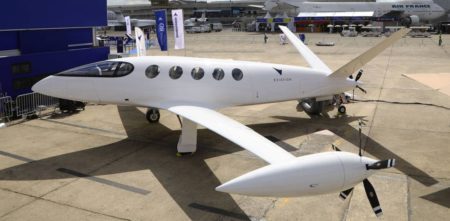
At the Paris Air Show, an Israeli company, Eviation, is showing an all-electric prototype called Alice. A nine-passenger commuter aircraft, Alice runs solely on electric power using motors developed by Siemens.
And then there is NASA whose scientists and engineers are developing hybrid gas-electric propulsion systems that could power an existing Boeing 737, and the X-57, an all-electric aircraft. In NASA’s planning, it sees the year 2035 and beyond as when sustainable alternatives to fossil-fuel powered aircraft will become mainstream.
Why NASA continues to believe in this project boggles my mind. Why?
The schedule for NASA’s rollout of SLS originally planned for a December 2017 launch with the Orion in an uncrewed voyage around the Moon. Now the target date is June 2020 and no SLS even close to ready to meet the launch window.
The second mission with a crew aboard was to happen in mid-2021. Now that date has slipped to 2022 and will likely be put off even further into the future as SLS continues to see completion dates slip.
In the latest audit of the SLS contract, published in October of last year, it states that Boeing will have spent $8.9 billion, double the budgeted amount for delivery of the core stage of the SLS. That’s not even the whole rocket.
Why has this happened?
The audit points to “Boeing’s poor performance.” How so?
The audit further points out that NASA oversight has been seriously lacking or slipshod with Boeing performance rating reports of “excellent” and “very good” issued leading to money being released to the company without work shown results that warranted these ratings. Nowhere in the audit does it refer to the 72 cents per dollar being spent on Agency administration of the contract which seems a bit strange. Instead the audit points out that NASA has been making attempts to implement better oversight (at what cost?) to ensure Boeing meets the SLS program objectives. Despite these changes, the audit concludes that contract performance in the future remains uncertain.
The audit proposes solutions that include a corrective task-based action plan, a renegotiation of the contract, federal government involvement in costing, a contracting officer in charge of and monitoring Boeing performance, and separate fixed-price, end-term deliverable payouts based on completion of each task.
What is an alternative launch strategy?
NASA has the ability to do all these three strategies. Why no one at NASA has put this plan in place defies logic.
