In today’s announcement, NASA administrator, Bill Nelson stated that the Agency needs more than one option for the Artemis Program. Nelson describes the current efforts as representing “a golden age of human spaceflight” stimulated by NASA’s partnerships with companies like SpaceX and Blue Origin, as well its international partners, the European Space Agency (ESA), the Japanese agency, JAXA, the Canadian Space Agency and others. Nelson noted that “together, we are making an investment in the infrastructure that will pave the way to land the first astronauts on Mars.”
Lisa Watson-Morgan, Manager of NASA’s Human Landing System Program describes the value of having options. “Having two distinct lunar lander designs, with different approaches to how they meet NASA’s mission needs, provides more robustness and ensures a regular cadence of Moon landings. This competitive approach drives innovation, brings down costs, and invests in commercial capabilities to grow the business opportunities that can serve other customers and foster a lunar economy.”
Where Artemis IV will use a modified SpaceX Starship, the HLS, as its lunar lander, Artemis V will use Blue Moon. Watson-Morgan’s claim that NASA’s methodology will bring down costs needs to be proven. Artemis V, slated for 2029, has a budgeted cost of $3.4 billion. It’s a fixed-cost contract which is an improvement over those previously negotiated by NASA with its commercial partners. Take, for example, the Boeing Space Launch System (SLS) negotiated as “cost-plus” and running billions of dollars over the original amount and years late in delivery.
It started with Artemis I in November 2022 with the first test run of the SLS and Orion space capsule. The mission lasted 25 days going beyond the Moon. It was uncrewed. and tested the launch system and space capsule.
Artemis II is next up on a schedule that bears no resemblance to the dogged pace of the Apollo Program in the 1960s. With NASA no longer in a space race with the Soviet Union, the timelines are stretched in getting back to the Moon.
If there is a competitor to NASA in a future Moon and Mars race, it is China, but the latter’s program is still in catch-up mode.
Artemis II will launch in November 2024 with a crew of four onboard the Orion for a ten-day flight around the Moon and back to Earth. It won’t attempt to enter lunar orbit. Instead, it will be a long fly-around.
Artemis III is planned for November 2025. It will demonstrate the Starship HLS which will launch separately from Earth. The two will rendezvous in lunar orbit with two crewmembers transferring to the HLS for the first return mission to the Moon’s surface since the last Apollo Program flight in 1972. The Moon visit will last a little over six days before rejoining Orion for the return flight to Earth.
Artemis IV is scheduled for September 2028, almost three years later. Lots of new hardware will be featured in this mission including an upgrade to the SLS, and the addition of the Lunar Gateway which will be delivered to the Moon by SpaceX. The Gateway will become a lunar space station and serve as a habitat for future missions. Its role in Artemis IV will be to serve as the rendezvous point for Orion and the SpaceX HLS. Two crew members will transfer to the latter from the Gateway and two will remain in orbit to give the new lunar space station a complete shakedown. HLS will descend to the lunar surface on a multi-day mission, then return to Orion for the flight back to Earth.
Then comes the Artemis V mission sometime in 2029. This time Orion will dock with the Gateway where 2 of the crew will transfer to Blue Moon. This lunar lander stands over 15 meters (50 feet) tall. It can handle a crew of up to 4 for lunar descent. The current plans, however, call for a lunar surface mission with 2 on board. How it gets to lunar orbit is still unknown.
The status of the New Glenn launch system to take Blue Moon to lunar orbit and rendezvous with the Gateway is only one of several deliverables needed for all of these missions to work.
Before that, the SpaceX HLS has to work. Currently, HLS is based on the Starship with its mated heavy launch booster. The two had to be blown up after technical malfunctions just a few weeks ago. This first flight reached an altitude of 39 kilometres (24 miles), a far cry from getting to orbit let alone making it to the Moon.
The Gateway has to be delivered and assembled through several missions while in lunar orbit.
And finally, Blue Moon has to be built and work to specification. Artemis V is not called a demonstration mission but it will be for the lunar lander.
The entire Artemis Program is counting on succeeding as a public-private partnership. This is NASA’s model for the “golden age” of space exploration. It is dependent on all of these disparate parts and players to come together.
At the same time, the Agency has to be cognizant of the enormous cost of Artemis as a staging exercise for the ultimate goal, a crewed mission to Mars by the mid-2030s.
If Artemis’ cost overruns impact NASA’s scientific programs, will this return to the Moon be worth what gets dropped from the Agency’s exploration of the Solar System and the search for life elsewhere in The Universe?
Let’s hope Artemis unfolds as planned providing us all with a new reason to look up at the Moon where humans will once again tread on its surface.
]]>NASA is currently working with Axiom (designers of the new Artemis space suit), the developer of the Axiom Orbital Segment which is scheduled for launch in 2025 to be attached to the ISS to provide an onboard commercial working environment. Other NASA-supported ventures include those being built by Blue Origin, Nanoracks, and Northrop Grumman. Joining these four is Vast which recently signed a contract with SpaceX to put its station into orbit by 2025.
The non-commercial players in LEO space include the on-and-off-again Russian plans for a waystation independent from ISS, and India’s ISRO with its plans to put a station into LEO by 2030.
So in this first part of a multi-part series, we look at the current commercial frontrunners and their status in the LEO space race.

Axiom Space is well on its way to being the first commercial space station operator. NASA and Thales Alenia Space are partners with the latter responsible for building the first space module’s primary structure. The plan is to attach it to the ISS, and later separate from it to become a go-it-alone going concern. The current section of the future space station is scheduled for completion and launch using a SpaceX Falcon 9, sometime in 2025. It is an egg-like structure with large viewing ports and comfortable accommodations for its occupants.
Axiom has already flown one private mission using a SpaceX Dragon to the ISS. A second one will be launched this month and a third private mission is already planned. Axiom has also designed the spacesuits to be worn by NASA’s Artemis astronauts for their lunar missions.
So what are Axiom’s plans beyond the first module mating with the ISS? Multiple modules in the future will be sent to join the one slated for launch in 2025. These will piggyback onto ISSand sometime before the end of its life separate to become a standalone commercial station and a destination for future NASA and commercial space voyagers.
Impediments to its future success are few. Once the first module proves itself, subsequent station sections will be mass-produced. Even before 2030, the Axiom Space Station should be operational and ready to host people, become a space manufacturing hub, and support research by private companies and governments in many fields.

This Jeff Bezos company, whose New Shepard suborbital rocket launcher crashed in September 2022, has yet to fly again. Before the accident, the New Shepard was, other than the SpaceX Falcon 9, the only reusable commercial rocket being flown regularly. The crash during a science and research suborbital mission had no crew onboard and the capsule was able to successfully land.
Getting from the New Shepard to the far more ambitious program that is Orbital Reef will be a significant task. Blue Origin does not intend to do this alone. It is partnering with Sierra Space, Boeing, Arizona State University, Genesis Engineering Solutions, Amazon Web Services and Supply Chain, and Redwire Space to create what it describes as the first open-system architectured space station to circle the Earth. NASA has announced its plans to use Orbital Reef as a destination for its astronauts after the ISS is de-orbited sometime around 2030. Orbital Reef is expected to be fully deployed before that milestone.
Orbital Reef is a mixed-use environment for both commercial and non-commercial visitors. Sierra Space’s Dream Chaser and Boeing’s Starliner will serve as space taxis to deliver passengers and materials to and from Earth. The Blue Origin New Glenn which has yet to be flown will be the primary launch vehicle to deliver the pieces that will eventually become the Orbital Reef.
A recently-launched Reef Challenge announced four winners in December 2022 who plan to build and test breakthrough in-space solutions onboard as the first commercial tenants. The companies include Prometheus Life Technologies with its plans to do large-scale production of human tissue in microgravity to support new pharmaceutical development and regenerative medicine; Lunasonde which will operate technology to map the ionosphere to improve atmospheric and space weather predictions; Ecoatoms with its plans to batch-manufacture biosensors onboard to do life science development on Earth and in LEO; and Fluix Inc, who will use the space environment to build nano-suspension cooling technology for data centres on Earth and in space.
The promise to meet the 2030 data needs a lot of moving parts to come together. Starliner has yet to prove it is as capable as the SpaceX-Dragon system in providing a space-taxi service to the ISS. That certification should happen sometime this year. The Dream Chaser cargo space plane has seen its development timeline slip to the last quarter of this year. A crew version is years behind the cargo version’s first launch. And New Glenn has yet to fly which may happen sometime in 2024.
In Part 2 we look at the plans for space stations from Nanoracks, Northrop Grumman and Vast, this new upstart that promises with the help of SpaceX to beat the others by being first to deploy as early as 2025.
]]>Maybe that is a partial explanation for the April 30, 2020 announcement by NASA in its selecting of the design and development of the lunar lander for Artemis. The three companies selected included:
The funding for this stage of the Artemis program will cover the costs for all three companies to further develop their concepts for review by the end of February 2021, less than 10 months from now.
NASA during the Apollo Program used private contractors to build the many components that made up the missions to the Moon fifty years ago. Working with commercial partners, therefore, is not new. But with Artemis, the reliance on the commercial sector appears to be far greater since two of these three companies, Blue Origin and SpaceX, have been developing fully-integrated launch and component sub-systems for space exploration on their own.
The following is a closer look at what NASA is actually funding.
The Jeff Bezos’ project is known as the National Team and includes three commercial partners: Lockheed Martin, Northrop Grumman, and Draper. The ILV will be powered by Blue Origin’s BE-7 rocket engines. Lockheed will build the ascent system and crew cabin. Northrop will build the transfer component based on the Cygnus cargo ship that has been used to deliver payloads to the International Space Station (ISS). Draper will build the navigation, guidance, and control systems which have been its strength in its past work with NASA.
The DHLS will be a product produced by 25 different commercial partners headed up by Dynetics with support from its wholly-owned parent, Leidos, a company that claims more than 60 years of experience in serving NASA and space industry along with business in both the defense and intelligence arenas for the United States. DHLS will be a single integrated descent and ascent module with multiple refuelable engines designed for different purposes throughout the lunar mission. DHLS describes its solution as launch vehicle agnostic, adaptable to a number of rocket systems. Leidos has a long history with ISS and lunar missions having process and packaged 87 different payloads for NASA. The company’s strength is in human factors engineering, critical to ensure reliable habitability for Artemis in all facets of its execution.
By far the most radical departure from NASA’s past is the Starship designed to be fully reusable, and capable of traveling from the Earth to the Moon and back, as well as to other space destinations including Mars. The Starship is powered by SpaceX’s Raptor engines, and will use its expertise learned from the successful Falcon and Dragon programs. Falcon and Dragon have delivered 19 payloads to the ISS. Both the rocket and the Dragon capsule have been reused. Starship will have the same reusability factor in its design. It can be refueled in flight using Starship tankers parked in Earth orbit. The Super Heavy rocket will launch Starship from Earth and is fully reusable as well.
In November of last year, Boeing proposed an integrated Human Lander System (HLS) designed to descend from lunar orbit to the surface and ascend back to orbit later as a single unit. The HLS would be launched by the SLS Block 1B rocket and would use the proven technology of the Boeing CST-100 Starliner developed for ferrying human crews from Earth to the ISS. Consider that SLS remains a giant boondoggle and money pit, and the Starliner’s test mission failed to rendezvous and dock with the ISS, requiring a second try in the next few months, ascribing the word “proven” to Boeing’s proposal is suspect.

Vivace, a San Antonio, Texas-based company was one of the initial five submitting proposals to NASA for Artemis. Vivace builds guided missiles and spacecraft. The company has an ongoing NASA relationship doing systems engineering for ISS, as well as work on the commercial human and material transportation components in support of the station. Although I looked for more information on the company’s submission, the only thing I could find was a Lunar Lander Study illustration seen below.

Is NASA limited to picking only one solution from these three finalists? Probably yes. In the initial acquisition strategy, the agency had described up to four prime contractors with finalists providing crewed demonstration missions. But this is unlikely for the final three. The decision on one will come next spring or early summer.
In the meantime, here is a summary of the merits of the final three.

But before Bezos described his Blue Origin technology, he took us on a journey of discovery about his vision for humans in space, one far different from that conceived by his rocket company rival Elon Musk at SpaceX. Bezos sees humans in space and not on Mars, or any other planetary real estate. To him it makes little sense colonizing the Moon and Mars which are both unsuitable for life unless it is enclosed in a controlled environment. And then those humans living and working on the Moon or Mars would have to contend with low gravity environments for which our bodies are not designed. Instead, Bezos envisions manufactured worlds designed to provide internal Earth-equivalent gravity environments and in parking orbits near-Earth. He sees artificial habitats designed to be zero-gravity play environments or to be replicas of Earth cities, or some of our wild places. Bezos sees all of the heavy industry moving off Earth to space environments allowing us to make our planet a much healthier environment.
But this vision cannot happen in the space we know of today. The space of NASA, Roscosmos, ESA and other national space agencies is an expensive place. There is little infrastructure in place today to get there. Bezos sees the role of Blue Origin in achieving the vision as being equivalent to building a road that is easily accessible, and that is inexpensive. And once the road is built with highly reusable launch vehicles we can then move to the next stage.
That stage is all about harnessing space resources with the Moon as Bezos’ objective. And that is where Blue Moon comes in, a lander that can deliver a wide variety of payloads to the lunar surface. The stretched version of Blue Moon would include an ascent module for human crew descent and ascent from the lunar surface.
Blue Moon is configured to handle a wide range of payloads as well as act as a launch platform for micro-satellites in lunar orbit. It uses a navy-inspired davit system for despatching cargo from its payload surface to the lunar surface. It can also be topped with an attachable, pressurized vessel which can carry astronauts to the surface, and then act as an ascent vehicle to return humans to lunar orbit. Bezos plans to use Blue Origin’s second generation rocket, New Glenn, which will make its first flight in 2021, to be the launch vehicle for Blue Moon.
Blue Moon will use the hydrogen-fueled BE-7 rocket engine which has been under development at Blue Origin for the last three years. Unlike the Apollo Lunar Module, which was powered by hypergolic rocket engines, the Blue Moon is powered by Blue Origin’s liquid hydrogen-fueled BE-7 engine, the evolution of the BE series of engines designed from 3D-printed parts and built for reuse and very precise throttling capability to support soft landings and refiring. The BE-7 will begin full testing with a hot fire planned for this summer.
The BE-7 will burn liquid hydrogen. And once Blue Moon is on the lunar surface it will be powered by hydrogen fuel cells. In using hydrogen for lunar activities, Blue Origin has made a conscious choice since the first mining activity on the Moon will be the harvesting of water which when broken down will provide oxygen and hydrogen, the former for life support and as an oxidizer, and the latter useful for topping up both the fuel cells and refilling the BE-7 engine tank. The BE-7 engine generates 40 KiloNewtons (10,000 pounds) of thrust.
NASA continues to work on the details of its return to the Moon initiative. With Blue Moon, it adds another commercial provider to the several contenders for the contract to build including Lougheed Martin, Boeing, and SpaceX. The 2024 date is a mere five years in the future. NASA took six years to develop Apollo before the first lunar landing in 1969. If done right, there should be plenty of time to make that 2024 date.

]]>
So much for my Canadian editorial. Now on to the business at hand which is all about creating a new carnival attraction for the well-heeled traveler. It is called space tourism and whether it is Richard Branson, Jeff Bezos, or Elon Musk, we are getting very close to moving beyond the selling ticket stage and actually seeing passengers take off on sub-orbital and orbit-to-moon-capable spacecraft over the next couple of years.
Blue Origin
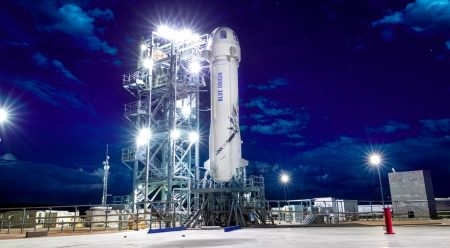
With Blue Origin, the company Jeff Bezos founded, the first test passenger flights are just around the corner according to Senior Vice President, Rob Meyerson. New Shepard, the first generation Blue Origin rocket, and its multi-windowed crew capsule, have been undergoing test flights and landings for a considerable time now. Eight flights so far have gone well so it appears the technology is nearly good to go. What’s left is to determine ticket prices for what would be a sub-orbital ride to the edge of space followed by the capsule separating and descending back by parachute to a ground landing. Likely first passenger flights will happen next year. That means it is time to sell tickets.
Virgin Galactic
Meanwhile, Richard Branson’s Virgin Galactic has successfully completed two test flights of its reconfigured Unity spacecraft, a rocket-powered space airliner that is launched from an airborne mothership named Eve. Branson already has pre-booked over 700 to fly on Unity. Few have backed away from wanting to go even after the 2014 crash of SpaceShipTwo which delayed Branson’s plans by three years. Learning from design flaws and pilot error made on the SpaceShipTwo flight, the company has made significant redesigns to Unity, its successor. Testing both powered and unpowered flight has shown that the new passenger space airliner is very close to being ready for those first paying passengers. Branson hopes that happens before year-end or at the latest early in 2019.
SpaceX
And then there is Elon Musk who recently announced SpaceX’s planned first flight to the Moon and back with two paying passengers aboard is delayed. It will not happen this year and probably not in 2019. The rocket that was to be used is the Falcon Heavy which has successfully flown once so far. Its second flight will be the launch of a satellite for its first paying customer, the U.S. Department of Defense. The launch stages of the Falcon Heavy are designed for reuse making this heavy payload rocket the cheapest to fly in the world.
But Musk has much grander plans than just flying tourists to the Moon and back. Like his competition, Bezos and Branson, he sees the ultimate goal to have millions of humans flying to space and back or living in space or on other Solar System bodies as the century unfolds. And there is a side business which Musk envisions, to use his rockets as a passenger service for sub-orbital travel around planet Earth. In other words, a space airline.
To do this Musk wants to use components of the future BFR launch system, a rocket that he hopes will take the first colonists to Mars. Musk intends to build spaceports in numerous cities around the world, flying passengers between them with his multi-use rockets. How real is this? SpaceX has set up its BFR shop in Los Angeles harbour where all rocket and passenger modules will be researched, manufactured and assembled. There is no timetable as of yet to determine when will be first flight. Musk promises component tests of pieces of the BFR as early as 2019. More realistically based on the slipping of past SpaceX milestones, we likely won’t see a fully completed BFR by the mid-2020s even though Musk believes he can get a first flight to Mars by 2024.
A final word, to all my Canadian readers, a happy Canada Day. And two my American audience, a happy Fourth of July. The rockets that mark these two celebrations, lighting up our evening skies, represent less ambitious efforts than what I have described above, but nonetheless will provide wonderful entertainment for those of us watching. The bigger rocket show is yet to come.
]]>

SpaceX has invested more than a billion dollars in rocket design for reusability. Now comes the opportunity to begin recovering these costs. The company has plans to launch rockets at a rate of one every two to three weeks from its Kennedy Space Center pad and from Vandenberg Air Force Base in California.
Currently, the company has on its books some 70 missions worth $10 billion in launch fees. The plan is to incorporate used first stages on many of these flights. The current flown Falcon 9s are rated to fly up to 10 times without refurbishment and 100 times with moderate refurbishment. Eight flown boosters are currently in inventory. Two will be used in the launch of the Falcon Heavy this year. They will be strapped on either side of the main rocket. The plan is to recover and reuse all three first stages after that first test.
Not all is perfect in this first reusability test of the Falcon 9. On the first stage return to the drone ship off the Florida coast, the grid fins that provide guidance caught fire but managed to maintain integrity in the landing. The current fins are made of aluminum coated with thermal insulation. The replacements will be titanium.
Not to be left behind, Blue Origin, has plans to being launching tourists into suborbital space using the reusable New Shepard rocket which has been reflown five times since the first launch in November 2015. Space tourists will be on board sometime in 2018.

And then there is Virgin Galactic with its WhiteKnightTwo and VSS Unity spaceship. Last December the new spaceship underwent its first glide test flights achieving a maximum speed of Mach 0.6. VSS Unity will eventually carry space tourists on suborbital flights. But that’s not all. Virgin Galactic has also established Virgin Orbit, a new company that will use a Boeing 747-400 launch platform combined with a hitchhiking rocket, named LauncherOne, to put small satellites into low-Earth orbit. The aircraft, of course, will be fully reusable. The LauncherOne currently is not recoverable. But that too may change in time.

Blue Origin submitted a confidential white paper on January 4th of this year that proposes developing a regular translunar service to drop food and equipment off to moon settlements. The service could also provide the homes for lunar colonists, shipping inflatable habitats such as those created by Bigelow Aerospace, another private space company. Bigelow has promised to have lunar inflatables ready to go within the next three years.
The announcement, coming after SpaceX notified the world of its intention to send two private citizens on a trip around the Moon in 2018, appears to be the beginning of a private company lunar space race.
Bezos though seems to have one-upped Musk with his plan. He’s in it to permanently inhabit the lunar surface stating in an exclusive interview with the Washington Post, a paper he owns, “It is time for America to return to the Moon, this time to stay.” He went on stating “A permanently inhabited lunar settlement is a difficult and worthy objective. I sense a lot of people are excited about this.”
Bezos’ timetable, a first test delivery in 2020. The initial test would leave cargo on the surface for future colonists to use. Once the conveyor belt gets established, regular deliveries could quickly provide the materials and tools to build a permanent infrastructure.
Bezos isn’t alone in this ambition. United Launch Alliance, the Boeing-Lockheed joint venture, has proposed a translunar transportation network. And Bigelow wants to build a permanent warehouse and supply depot orbiting the Moon.
The refocus on the Moon by private companies is a departure from NASA’s longer term focus on a human expedition to Mars. The private companies see Mars as far more challenging, whereas, the Moon is something that can be achieved now. And the benefit in the longer term would be the establishment of proven, workable infrastructure and technologies that could then serve a future Martian colony.
Bezos sees the latest successes with precision vertical landing by his Blue Origin rocket, New Shepard, as key to making a supply service work. He envisions combining his technology along with the horsepower of larger launch vehicles as a near future solution.
The site of the first delivery, the Shackleton Crater at the Moon’s south pole where there is ample water ice on the surface that could be used to create a way station for space travel, providing liquid water, oxygen for breathing, and hydrogen for rocket fuel.

Now the company in its Monday announcement has revealed the New Glenn, a multi-stage rocket with a reusable first stage that Bezos says has been worked on for four years. New Glenn comes in two and three-stage versions. The three-stage design is almost the height of the Apollo era Saturn V, standing 95 meters (313 feet). The two-stage version stands 83 meters (270 feet) tall. First flight is planned before the end of the decade.
So what exactly are Blue Origin’s plans? First of all the company is about to upgrade the New Shepard giving it a more powerful rocket motor. That change will put Blue Origin into the business of delivering payloads to low-Earth orbit. The less powerful New Shepard will be used for suborbital space tourism flights.
The plans for New Glenn are far more ambitious, putting Blue Origin into direct competition with SpaceX, ULA (Boeing-Lockheed), Roscosmos (Russia), ESA (Europe), ISRO (India) and China.
Bezos has been secretive about his company’s suborbital flights to date. Only one, the latest, was televised live. But he believes that caution has served them well. He states, “building, flying, landing, and re-flying New Shepard has taught us so much about how to design for practical, operable re-usability.” The New Glenn with seven rocket engines in its first stage, and generating 3.85 million pounds of thrust, will incorporate that same re-usability.
Blue Origin intends to use a launch pad at Cape Canaveral as its base for New Glenn operations.
And if you think New Glenn represents the end product in Blue Origin’s rocket evolution, Bezos raised the bar announcing plans for a next generation rocket that will go by the name of New Armstrong. Bezos vision is to see “millions of people living and working in space.”

Bigelow has successfully demonstrated its BEAM technology in the past when Russian rockets delivered into orbit its predecessors, Genesis 1 and 2, the prototypes for expandable space modules. BEAM will be attached to ISS and tested for two years to ensure its structural viability. If successful this may be the beginning of a revolution in the design of habitable orbiting platforms in near-Earth space, as well as be the basis for the building of habitations for the lunar and Martian surface. For Bigelow, a company founded by a hotelier, there is an ambition to build the first commercial space station, an orbiting hotel for space tourists.

The overshadowing milestones achieved by Blue Origin and SpaceX this past week will have enormous impact on space exploration as well. For the first time two companies demonstrated the ability to launch and return rockets to the surface of our planet not just once, but several times. For Blue Origin, the single-stage New Shepard rocket and capsule achieved a suborbital launch and return to the ground at its West Texas proving ground. For SpaceX, the two-stage Falcon 9 launched from Cape Canaveral, and then controlled the descent of its first stage to land on a floating platform anchored off Florida in the Atlantic Ocean.
Watching both flights in the last week was impressive. Blue Origin and SpaceX, their returning rockets seen below, presented amazing sights. I watched the SpaceX launch and recovery on live NASA television. As the swiftly descending first stage approached the drone ship landing pad its rocket engines ablaze, it pitched to vertical and parked itself. Looking after at the returned rocket stage afloat on that drone ship made the success seem even more palpable. I couldn’t help admire the technology that could produce the end results, landing the towering Falcon first stage on such a small moving target in the ocean.

At the post-flight press conference Elon Musk stated the first stage will be returned to Cape Canaveral where it will be cleaned up and refired in a series of tests. With the tests demonstrating the safe reuse of the stage, SpaceX will return it to service in a few months for a future space flight.
Launch. Land. Repeat. This seems to be where we are headed in space technology these days. To describe it as a pretty good week for commercial space companies would be an understatement.
]]>SpaceX has tried to bring its Falcon 9 rockets back to controlled water landings using a barge as the receiving platform. These have all failed and SpaceX has attributed some of its failures to choppy seas. So it appears based on a NASA leak that the company, as early as its next flight, or the one right after, is going to dispense with offshore landing attempts and go for broke returning to solid ground at the Cape.
The race between SpaceX and Blue Origin represents the next step in our species efforts to make space more accessible and affordable. Government and consortia have dominated to-date. The tight regulation plus formidable costs have imposed a barrier to entry. But not anymore with commercial operators winning government contracts to give them a kick start in the business. NASA has fueled much of this private launch business by making launch to low-Earth orbit the domain of commercial carriers. But the commercial companies don’t see low-Earth orbit as their ultimate destination. They are looking well beyond Earth with SpaceX’s founder, Elon Musk, talking about colonizing Mars.
Democratizing space has come with cubesats that piggyback on commercial launches. But costs remain high when each launch vehicle is destroyed. Blue Origin and SpaceX intend to end this expensive practice once and for all making getting to space no more expensive than flying a commercial passenger jet.

]]>


