If unfamiliar with data validation, the term refers to checking for the accuracy, completeness, and consistency of data to ensure it is correct and useful for an intended purpose.
We are witnessing an increasing rise in misinformation in the digital realm that often appears as “truth.” Ensuring facts are facts and not fake, therefore, is important. I’ll let Lucy explain the rest.
Data validation is now a fundamental security requirement for companies and organizations increasingly dependent on digital transactions. Conventional data validation concentrates on accuracy, error prevention, and compliance maintenance. Not anymore. Cyber threats, especially those driven by artificial intelligence (AI) are becoming more common. Deepfake data manipulation, synthetic identity fraud, and automated penetration testing by hostile actors are just a few of the new dangers from AI-driven attacks. Therefore, companies are developing more sophisticated validation methods to guard against AI-based cyber threat risks.
Financial transactions face AI-driven escalating risk. Invoicing, billing, and order processing are critical to business operations. Threats range from hyperrealistic phishing campaigns and deepfake impersonations that use voice-cloning tools.
Cybercriminals use AI to do model evasion where transaction data is modified without being detected. For companies using counteracting AI tools, cybercriminals rely on AI algorithms to corrupt the training sets and compromise risk assessments.
Increasingly, maintaining the integrity of procedures like order-to-cash reconciliation has become more important for fraud prevention than just a question of efficiency. Using AI, cyberattacks falsify payment records, tamper with transactional data, and use differences in reconciliation processes to get beyond conventional security systems.
Because of this, real-time AI-powered data validation systems using machine learning are needed to find and deal with problems before they cause financial harm.
Most companies fail to disclose details about cyberattacks for reputational reasons. Many continue to ignore the threat until they become its victims. For some, the stories have leaked out including the ones that follow:
Cybercriminals use fake datasets to fool validation systems. AI-generated hazards include fake consumer profiles, synthetic transactions, and financial entries that match genuine data. This condition causes typical rule-based validation systems to struggle to distinguish what is real from what is not. These malevolent AIs bypass CAPTCHA, exploit automated system flaws, and produce data discrepancies that disrupt operations.
Countering cyberattacks that involve fake data sets, businesses are using machine learning algorithms to detect suspicious patterns in massive data sets. The systems use predictive modelling, behavioural analysis, and anomaly detection to find potentially dangerous data entries on the fly before a company’s security gets compromised. Dynamically validating data instead of using guidelines improves AI-powered assault protection.
Companies also use AI-driven analytics to validate data and neutralize attacks. AI-boosted data validation learns from historical trends and improves accuracy, preventing attackers from exploiting security flaws. Neural networks and deep learning algorithms are used to automate complex data verification processes, reducing manual control and improving fraud detection.
Blockchain, the distributed ledger that underlies cryptocurrency transactions, is being used to provide an unchangeable, open ledger for essential data and improving validation. Blockchain ensures authorized and recorded data whether for finance, healthcare, or supply chains cannot be modified and dramatically reduces AI-generated data manipulation and forgeries boosting digital transaction confidence.
Combining AI analytics and blockchain is a multilayer defence against traditional and AI-based cyberattacks.
As AI impacts cybersecurity, organizations must proactively alter data validation methods. Companies that neglect these changes risk operational disruptions, financial fraud, and data breaches. AI-driven validation models, adaptive threat detection, and distributed security will become industry standards for data protection.
Investment in AI-driven data validation solutions is increasingly mandatory. Combining machine learning algorithms, behavioural analytics, and blockchain technology can help companies avoid AI-generated dangers and protect data in a hostile digital world. Increasingly, companies are deploying layered defences to block these increasingly sophisticated AI-driven attacks. It is becoming a cyberwar between AIs.
]]>What is a blockchain? For financial transactions, the blockchain is a ledger. For other applications, it is a database. It differs from other ledgers used in accounting technologies in the way it stores transaction records. Instead of a central ledger, transactions stored in encrypted blocks are distributed over many computers. There is no single point of failure for transactions that use a blockchain. It works the same way for database applications replicating file content in many locations.
Decentralizing transactions and data entries makes them more difficult to alter. Each file in a blockchain is called a block. Each block contains one or more transactions. Once a block is created it cannot be validated until it gets distributed over several computers (at least 5). Then the block is closed and becomes unalterable. It cannot be deleted without impacting blocks preceding or following it in the chain, like a chain of evidence used in trials. Each block receives a unique identity using a hash, an encrypted number and a time stamp.
Blockchain first appeared on the scene in 2009 as the method for managing Bitcoin transactions. Bitcoin was the first cryptocurrency. Ethereum, a company with its own cryptocurrency, recognized blockchain technology could serve many other purposes other than recording digital currency transactions. Instead, it could be a distributed ledger or database to hold information securely for almost anything.
The blockchain complements the Internet, the global network that connects us all. Like the blockchain, the Internet is a distributed medium with no central gatekeeper lording over users connected to it. That evolution is about to turn out a third iteration called Web 3.0 or Web 3.
The first World Wide Web (the “www” in website identifiers) is now referred to as Web 1.0. Currently, most of the world uses Web 2.0 which evolved with the introduction of social media and cloud computing. Web 2.0 has coincided with the emergence of technology giants, companies like Meta, Google, Amazon, Microsoft and Apple who provide us with hundreds of thousands of applications. In return, we freely share our personal information for their use which is making them billions of dollars. How, you ask? When you accept cookies, fill in forms and leave your email and mobile phone information, the giants sell it to third parties who use it to contact you to sell stuff.
The arrival of Web 3.0 will and is changing the relationship between and among Internet users. Using blockchain technology and artificial intelligence (AI), users can roam the Internet without surrendering themselves to the whims and chicaneries of technology giants. Web 3.0 and blockchain can protect our intellectual property, and prevent piracy, identity theft and fraud. When we bank or interact with other companies, the blockchain can record transactions, insurance claims, online payments and more, all while ensuring our privacy within the safety of encrypted information exchanges. Web 3.0’s use of the blockchain will alter communications, business transactions and even elections across the globe. We will be spared from hackers, scam artists, and cybercrooks.
Separating blockchain from its Bitcoin origins, you begin to see how useful this technology can be. Unlike Bitcoin, blockchain is not a speculative technology. Bitcoin rises and falls based on the whims of the marketplace. Blockchain is unassailable. Its distributed nature means individual blocks are recorded many times on many systems that are only accessible to those involved in the transactions, contracts, or other information contained within them.
There are two downsides to using blockchains. The time needed to complete a blockchain-based transaction takes longer than traditional computer exchanges conducted one-to-one. With more computers needed to confirm and close a block, more energy is needed per transaction.
The upside of the technology’s promise is much greater. That’s why in 2022 Canada and Alberta joined forces to create a consortium focused on digital decentralized assets and the blockchain to become a global leader in blockchain innovation. The consortium members include companies in finance and technology as well as government. Its activities have included hosting events and conferences, conducting research and development projects, and providing education and training programs for blockchain technology.
On August 1, 2024, Abu Dhabi announced the opening of The Blockchain Center, its initiative to encourage academic research and the development of “a thriving ecosystem to support startups.” The Center’s focus is similar to Canada’s blockchain consortium. It will provide five services and programs:
Blockchain has come a long way from being the little brother to Bitcoin. Billions of dollars are expected to fuel its use and growth from USD 17.57 billion in 2023 to 470 billion by 2030 as Web 3.0 becomes ubiquitous.
]]>SEEDS is an enterprise aimed at ending the disconnect between the goals of financial systems and the finite nature of Planet Earth. Financial systems have been built around the paradigm of growth. Portfolios aren’t just sustainable. They have to produce a yield that accumulates more. But if all of us are growing in exploiting the planet’s resources and accumulating more wealth, at what point do we hit a brick wall?
The Club of Rome 1972 publication, The Limits to Growth, is a book I read back then. It prophesied a mid-21st century catastrophe for human civilization as we consumed more of the Earth than the planet’s ability to regenerate. At the time of writing, the authors from the Massachusetts Institute of Technology didn’t factor in climate change which appears to have accelerated the impending prediction.
SEEDS vision is to create an economic and social system that provides incentives to address our current global challenges in the “pursuit of happiness and our collective self-actualization.” I know this sounds idealistic, in fact, like a modernizing of the words in the opening of documents like the American Declaration of Independence or the U.S. Constitution, but it may prove to be a way forward for humanity to collectively reverse the ominous trend of this century toward a climate-change-induced catastrophe.
SEEDS describes the creation of a global, transparent, equitable economy that better distributes both “voice and value” to all of us on Earth. Its vision includes:
The Seeds currency is digital in the model of Bitcoin, but with a very different purpose. Its distribution and growth support endeavours designed to improve the health of society, ecology, and the economy. SEEDs participants accept Seeds rather than other forms of exchange. That’s why SEEDS describes itself as a new economic system.
Members of SEEDS establish their own accounts. You can become a member by downloading the SEEDS Passport from the Apple or Play Store. Request an invitation and once accepted you can begin to interact with the community and to buy and swap Seeds. You may choose to be an ambassador or join by alliance which can give you access to SEEDS grants paid using Seeds.
What kinds of projects are currently using SEEDS? Here are four examples:
SEEDS is co-created by HyphaEARTH, a DAO (a decentralized autonomous organization). DAOs are organizations with no employees, no bosses, but rather focused on common objectives and nonstop production. A constitution of rules determines how a DAO operates, and all transactions go through a blockchain, the distributed general ledger that was introduced to the world with the arrival of Bitcoin.
HyphaEARTH description of SEEDS is a scaffolding or framework that is serving its participants by facilitating organic growth from within the community, and by delivering mutually agreed to value which is dispensed and swapped using the Seeds digital currency. All transactions are visible with anyone being able to access SEEDS financial dashboard.
Idealism never sounded so good in a world facing challenges that governments are struggling to address.
]]>The COVID-19 pandemic has affected nearly every aspect of ordinary life. Entire industries have been disrupted, and millions of people around the world are adjusting to a new daily routine. No corner of modern life has been unaffected by COVID-19 with the blockchain industry both negatively and positively affected. How so the latter? The blockchain is being seen as a way for many economic sectors to recover from COVID-19’s detrimental impacts. Similar to how shipping APIs help the transportation sector, the blockchain is being used to help supply chains bounce back.

Global shipping has been massively disrupted by the coronavirus and by each country’s response to the pandemic. Supply chains are no longer running smoothly as different precautions put in place try to slow the spread of the virus. Shipping products from overseas requires jumping through new hoops to meet health and safety guidelines from different countries. Customers aren’t sure how much stock retailers have, and retailers aren’t sure when they will receive new inventory. Even critical supplies like personal protection equipment (PPE) are being held up because of shipping complications. The standard paper trail businesses use to track shipments has become disjointed. But the blockchain is being used to rectify supply lines.
Using the blockchain provides trust and verification through a digital paper trail that is dependable and secure. When information is stored using the blockchain, the previous data within the chain can no longer be altered. Blockchain essentially locks the data, so the next person adding to the chain can do so with confidence knowing that the entire transaction is secure. This technological security gives users the ability to maintain visibility throughout the entire supply process. Users securely monitor quality control, worker standards, and performance tests. When everyone involved in the supply chain knows what is going on, the likelihood of mistakes happening decreases. For example, the permanent audit trail the blockchain gives buyers of medical equipment the power to check the provenance of all parts in the transaction. This works equally well whether the transaction is for masks, ventilators, or the ingredients for pharmaceuticals. Adding blockchain technology, therefore, produces safer and more dependable shipments that can be easily tracked through the entire supply process.
The blockchain can also be used for contact tracing. As governments try to track exposure to the virus they walk a fine line between data collection and privacy protection. By using blockchain processes, contact tracing can happen securely and privately. That’s because the blockchain does not have a central authority, and users ultimately control their own data. That means users participate in contact tracing data collection without compromising their privacy. Voluntary data collection only works if users feel safe enough to provide information and by giving privacy control to users, data collectors increase the odds of more people participating. Contact tracing only works with maximum participation to make the data set large enough to detect infection spread patterns.
Various companies across the world are working on contact tracing programs using the blockchain. Privacy experts in Europe propose using a decentralized privacy-oriented proximity tracing system that uses both Bluetooth and the blockchain. This proposed protocol was designed by a handful of research institutes in Europe with the express goal of ensuring user privacy and preventing the collected data from being misused. Another German tech company has created a blockchain contact tracing app that promises users absolute privacy. The decentralized biobank Genobank is building a blockchain contact tracing platform that lets users acquire anonymous COVID-19 tests and send the information to connected organizations.

Some consider the disrupted Wisconsin Democratic primary a missed opportunity to test a blockchain-based digital voting system. In the face of a pandemic, this type of voting would have been much preferred to having citizens standing in lines exposing themselves to COVID-19 which unfortunately led to new cases.
Digital voting is sometimes referred to as e-voting or i-voting. The “e” stands for electronic, and the “i” for the Internet. The biggest concern for either electronic device voting or casting a ballot through a web browser is the security of the transaction. Countries like Estonia have had e-voting since 2005, and i-voting since 2007. The system doesn’t use the blockchain but rather encrypted national ID cards. Cards can be stolen or lost. Other European countries have trialed electronic voting and subsequently abandoned the practice. But in the face of a global pandemic, security experts believe using the blockchain to create a digital voting system would solve the card issue in Estonia, and provide absolute privacy for every citizen casting a ballot. Using the blockchain eliminates dependency on the foibles of electronic voting machines. The transaction of each ballot cast is fully secure. A blockchain-based vote would require three distinct pieces of user authentication: a unique ID number, a one-time use password upon registering to vote, and an electronic ballot containing a URL specific to the locality of the voter and a QR code.
]]>Today I have interpreted the words of Peter Diamandis, in this his third contribution in a series on the subject of augmented reality (AR) which looks at converging technologies in the world of Web 3.0. I apologize for the length which I have considerably pared down and edited with the hope that you find the information of value. As always I welcome your comments.
How each of us sees the world is about to change dramatically. For all of our human history, looking at the world was roughly the same for all of us. But now the boundaries between the digital and physical world are beginning to fade. Today we have a world layered with digitized overlaid information that is rich, meaningful, and interactive. As a result, our experiences in perceiving the environment around us are becoming vastly different, personalized to goals, dreams, and desires.
Welcome to Web 3.0, also known as The Spatial Web. Web 1.0 featured static pages and read-only interactions limited to one-way exchanges. Web 2.0 provided multimedia content, interactive web pages, and participatory social media, all of this mediated by 2D screens. But today we are witnessing the rise of Web 3.0, riding the convergence of high-bandwidth 5G connectivity, rapidly evolving AR eyewear, an emerging trillion-sensor economy, and ultra-powerful artificial intelligence (AI). The result is we will soon be able to superimpose digital information atop any physical surrounding, freeing our eyes from the tyranny of the screen, immersing us in smart environments, and making our world endlessly dynamic.
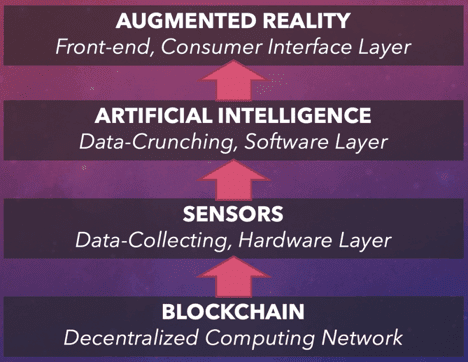
Let us explore this world further by looking at how all of these technologies will lead to an amazing convergence among AR, AI, sensors, blockchain, and other innovative technologies that are the world of Web 3.0.
Let’s deconstruct everything beneath the sleek AR display. It begins with the Graphics Processing Unit (GPU), an electric circuit that performs rapid calculations to render images. GPUs today are found in mobile phones, game consoles, and computers. Because AR requires significant computing power, a single GPU does not suffice. Instead, using blockchain we can enable distributed GPU processing power. As a result, blockchains specifically dedicated to AR holographic processing are on the rise.
Other features include:
AI in retail AR applications will use your purchasing history, current closet inventory, and possibly even mood indicators to display digitally rendered items most suitable for your wardrobe, tailored to your measurements.
In healthcare, AI built into AR glasses will provide physicians with immediately accessible and maximally relevant information parsed from a patient’s medical record and the current state of research relevant to him or her, to aid in accurate diagnoses and treatments, freeing doctors to engage in improving bed-side manners and the education of patients.
How will AR and the Web 3.0 world impact manufacturing?
Looking at large producers, it appears highly likely that over the next ten years, AR along with AI, sensors, and blockchain will multiply manufacturer productivity and vastly improve employee experiences.
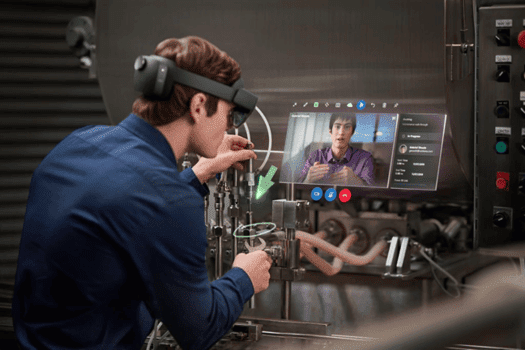
In the initial application, digital guides superimposed on production tables can vastly improve employee accuracy and speed, while minimizing error rates.
Already, the International Air Transport Association (IATA), responsible for 82% of global air travel today, have implemented the use of Atheer AR headsets in cargo management reporting a 30% improvement in cargo handling speed and no less than a 90% reduction in errors.
A similar success is occurring at Boeing which has brought Skylight AR glasses to the production line with the company experiencing a 25% drop in the time needed to produce an aircraft and near-zero error rates.
Beyond air travel, and aircraft manufacturing, smart AR headsets can be used for on-the-job training without reducing the productivity of other workers. Land Rover, for instance, has implemented Bosch’s Re’flekt One AR solution to give its technicians the vision to see the inside of Range Rover Sport vehicle without removing the dashboard.
And AI will soon provide go-to expertise to workers on other assembly lines providing instant guidance and real-time feedback to reduce production downtime, boost overall output, and even assist customers at home in do-it-yourself assembly (think IKEA).
AR guidance to mitigate supply chain inefficiencies is perhaps one of the most profitable business opportunities for implementing AI and AR together. Coordinating moving parts, eliminating the need for manned scanners at checkpoints, and directing traffic within warehouses, AR systems with AI should vastly improve workflow and quality assurance. A case example is DHL which initially implemented AR “vision picking” back in 2015. Now the company has expanded the scope using Google’s newest smart lens in warehouses across the planet and has noted a 15% jump in productivity. The DHL investment amounts to $300 million USD.
Ash Eldritch, CEO of Vital Enterprises, describes the convergence of these technologies and their ultimate impact stating, “All these…coming together around artificial intelligence are going to augment the capabilities of the worker and that’s very powerful. I call it Augmented Intelligence. The idea is that you can take someone of a certain skill level and by augmenting them with artificial intelligence via augmented reality and the Internet of Things…elevate the skill level of that worker.”
Eldritch’s point is well made by companies like Goodyear, ThyssenKrupp, and Johnson Controls who have adopted Microsoft HoloLens 2 in their manufacturing and design operations to elevate workers’ skills. What is most heartening in all of this is that AI isn’t taking away human jobs, but rather through an AR interface and collaboration, enhancing them.
On the hardware front, AI-enhanced AR systems will see a mass proliferation of sensors which will be used to detect what’s happening in the environment and through the application of computer vision be able to contribute to decision-making.
The current technologies used to sense the environment measure depth using scanning sensors to project a structured pattern of infrared light dots onto a scene, and generating 3D maps from the input. Or technology using stereoscopic imaging deploying two lenses produces equally accurate measurements.
But there is a new method being used by Microsoft’s HoloLens 2 and Intel’s RealSense 400-series camera, a process called “phased time-of-flight” (ToF). How does it work? The HoloLens 2 is equipped with numerous lasers, each with 100 milliwatts (mW) of power that fire in quick bursts. A wearer can automatically measure the distance between nearby objects because the headset callibrates the amount of light coming from the return laser beam which experiences a slight phase shift from the original signal. The phase difference creates an accurate reconstruction of what lies in front of the AR headset wearer. The advantage of phased ToF sensors is they are silicon-based, cheap to produce, and require far less computing overhead.
Other features in the HoloLens 2 include a built-in accelerometer, gyroscope, and magnetometer which can be applied to inertial measurement typically used by navigation systems in airplanes and spacecraft. With its four “environment understanding cameras” HoloLens 2 can track head movements while its 2.4 MegaPixel high definition video camera and ambient light sensor produce advanced computer vision. This is pretty neat stuff!
But Microsoft isn’t the only one pushing the technology envelope for digital displays. Nvidia is working on Foveated AR Display which brings the primary foveal area of the eye, the part of the retina that permits 100% visual acuity, letting peripheral regions fall into softer background images which mimicks natural visual perception.
Then there are gaze tracking sensors that grant users control over their screens without touching or hand gestures. Through simple visual cues such as staring at an object for more than three seconds, the technology can activate commands.
In other applications and industry niches, stacked convergence of blockchain, sensors, AI and AR will prove to be highly disruptive. A case in point is the field of healthcare where biometric sensors will soon give users a customized AR experience. Already, MIT Media Lab’s Deep Reality group has created an underwater VR relaxation experience that responds to real-time brain activity detected by a modified version of the Muse EEG. The experience even adapts to users’ biometric data, from heart rate to electro-dermal activity which is picked up through an Empatica E4 wristband.
Sensors converging with AR will improve physical-digital surface integration, intuitive hand-and-eye controls, and increasingly personalize the user’s augmented world. Companies to watch include MicroVision, making tremendous leaps in sensor technology.
Because AR requires much more compute power than the typical 2D experience, centralized GPUs and cloud computing systems are needed to provide the necessary infrastructure. The workload requirements are taxing and that’s where blockchain may prove a good solution.
Otoy is a company aiming to create the largest distributed GPU network in the world which it calls the Render Network or RNDR. It has been built specifically on the Ethereum blockchain for holographic media and is currently being Beta tested. This network could revolutionize AR deployment accessibility. One of Otoy’s investors is Eric Schmidt, former Chairman of Alphabet. Schmidt states “I predicted that 90% of computing would eventually reside in the web-based cloud… Otoy has created a remarkable technology which moves that last 10%—high-end graphics processing—entirely to the cloud. This is a disruptive and important achievement. In my view, it marks the tipping point where the web replaces the PC as the dominant computing platform of the future.”
RNDR allows anyone with a GPU to contribute their power to its network earning a commission of up to $300 a month in RNDR tokens, a cryptocurrency. These can be redeemed in cash or used to create AR content. In this way Otoy’s blockchain network allows designers to profit when not using their GPUs, and further democratizes the experience for newer members to enter the field. Beyond these networks’ power suppliers, distributing GPU processing power will allow manufacturing companies to access AR design tools and customize learning experiences. In this way deploying AR using blockchain will boost usage and deployment across many more industries.
For consumers, a new startup Scanetchain is also entering the blockchain-AR space to allow users to scan items using a smartphone. The app then provides access to a trove of information from the manufacturer including price, origin and shipping details. Based on NEM, a peer-to-peer cryptocurrency that implements a blockchain consensus algorithm, the Scanetchain app aims to make information far more accessible and, in the process, create a social network of purchasers. Users earn tokens through watching ads, and all transactions are hashed into blocks and securely recorded. For brick-and-mortar stores, the writing may be on the wall, as blockchain becomes the glue for cloud-based retailers.
Integrating AI into AR creates an “auto-magical” manufacturing pipeline that will fundamentally transform our industries, cutting down on marginal costs, reducing inefficiencies and waste, and maximizing employee productivity. Bolstering this will be sensor technology which is already blurring the boundaries between our augmented and the physical world. And while intuitive hand and eye motions will dictate commands using hands-free interfaces, biometric data is poised to customize each of our AR experiences to be far more in touch with our mental and physical health. And all of this will be underpinned by distributed computing power with blockchain networks.
This is the promise of AR in the Web 3.0 world. Whether in retail, manufacturing, entertainment, or elsewhere, the stacked convergence described above will receive significant investment in the next decade. The evidence is already present with 52 Fortune 500 companies beginning to test and deploy AR/VR technology. And while global revenue from AR/VR stood at $5.2 billion USD in 2016, IDC, the market intelligence firm, predicts that number will grow to $162 billion in value by next year.


July 27, 2019 – For those of you unfamiliar with the wheat and the chaff reference in our posting title, farmers to this day in various parts of the world toss harvested grain in the air (see image above) with the heavier grains falling to the ground and the chaff, the non-grain stuff, blowing away in the wind. It is a simple way to ensure that your wheat, oats, bran, rye, and other cereal crops are relatively free of contaminants.
Well, it seems that the New York Times is on a wheat and chaff exercise using blockchain technology to do exactly what farmers do to separate misinformation from real news. The Times is working with IBM Garage, a blockchain project designed to ensure transparency and trust in any media content, spotting fraud whether it be in printed words or images.
Why now? The New York Times describes the problem it is attempting to solve in its launch of The News Provenance Project:
“There is a gap between the vast amount of information news organizations possess about the media they publish (photos, videos as well as articles and other forms), and the subset of that information to which their users have ready access. That’s especially true when that media travels around the internet, largely stripped of its original context.”
“Into that gap, trolls and bad actors have established many tools for misleading people, generally using authentic photos and videos as source material. Some of the techniques are simple: recycling old images, selective cropping and editing, slowing down and speeding up videos, and so on. Other techniques are more sophisticated, involving the creation of ‘synthetic’ media such as deep fakes.”
How would applying a blockchain to information reporting ferret out the fakery and create certainty in the information we read and see each day?
Blockchain transactions contain a core of key elements:
The initial focus of the project will be the use of blockchain for the publishing of photographs to determine the legitimacy of the source, and whether an image has been edited before or after publication. From photojournalism the project hopes to eventually expand to the written word to determine the validity of material sources, facts, and stories.
So how will using blockchain technology prove the accuracy and validity of a photograph?
If photographs submitted for publication come to the paper with verifiable metadata secured in a blockchain transaction, it will be possible to ferret out fakes. Each blockchain transaction containing the photograph will capture the assocaited metadata including who took the picture, the time and place, any editing and revision history, watermarks, and copyright. photographs not containing metadata would not be accepted.
The New York Times intends to build an industry-wide “ecosystem in which news and information” are shareable with all news organizations that join the blockchain. Any blockchain transaction involving contributions to the newspaper will be able to be published anywhere in the digital realm with the assurance it is legitimate.

For those of you who don’t know what a blockchain is and how it works, here is a quick history and primer.
Blockchains emerged in 1991 as a way to timestamp digital documents but became much more widely-known in 2009 when Satoshi Nakamoto, whose true identity is disputed, used blockchain to create the cryptocurrency Bitcoin. What a blockchain is, is a decentralized database shared across a network of computers, or “nodes,” that can only be altered after approval from all the nodes in the system. Once information is created in a blockchain, it becomes very difficult to change.
Every block within a blockchain contains (1) data, (2) the hash, a digital fingerprint of the block, and (3) the hash from the previous block in the chain. Different types of data can be stored within blocks, including the name of the sender, the name of the receiver, and the transaction amount in the case of cryptocurrencies like Bitcoin. A block’s hash, generated using the data within the block, changes if that data is in any way altered.
Blockchains are seen as extremely secure because:
One of the most successful entrepreneurs in government and enterprise technology, Eric Pulier is the go-to expert on all things blockchain. The best-known venture capital groups in the world have financed companies that Pulier has founded or co-founded, including MediaPlatform, US Interactive, Desktone and SOA Software.
“Blockchain is a new way of looking at value and a new way of creating a transaction between parties where you don’t need a third-party intermediary and can track things and really have trust.” — Eric Pulier, Founder, CEO, vAtomic
Pulier’s predictions for blockchain trends for the next five years follow.
An NFT is a token on the Ethereum blockchain that contains unique metadata that differentiates it from other tokens. While currency is fungible and can be easily transferred, NFTs can be used to store much more complex and individual-specific information including government documents such as marriage certificates, land registrars, food-grade ratings, and driver’s licenses. In retail, consumers use can verify the legitimacy of luxury goods, digital goods, and tickets which can all easily be stored as NFTs on blockchains. Pulier predicts, “Now, the token, which is like a Bitcoin, can be a ticket, or a coupon, or a collectible. It could represent a real world good, like a coffee or a piece of art. So, what you’re going to see is the emergence of an entirely new space where non-fungible tokens are going to completely change the economy.”
Security tokens are cryptographic, programmable securities that serve as an asset that can also take action. Security tokens can pay dividends, pay interest, or even invest in other tokens or assets. Smart contracts, for instance, allow assets to automatically pay dividends on a specific date if all criteria are met. As Pulier explains, “Most of the tokens that you might be familiar with are called utility tokens, and they don’t represent a piece of a real-world object or of an actual equity. Security tokens are now emerging this year.” Security tokens have huge potential to decrease liquidity issues but will require additional infrastructure to take hold, such as their own exchanges, Security Token Offerings (STOs), and wallets.
“Everything that you can imagine that doesn’t have liquidity is going to be fractionalized and tokenized and put on exchanges,” predicts Pulier. Over the next five years, security tokens will start to represent a new form of liquidity in assets that traditionally have lacked liquidity, such as real estate or art. Pulier anticipates these assets will start trading 24/7, 365 days a year. Today, Malta and Switzerland are leading the way in developing the infrastructure for tokenized assets. The U.S. SEC and EUs ESMA have begun issuing comments about plans to put regulations in place.
As cyber attacks continue to proliferate, new forms of identity verification will emerge to protect users. Self-sovereign allows users to maintain a single digital identity across multiple platforms while selecting the information they wish to share on each. This mode of interaction would drastically transform the current digital marketplace that has turned personal data into a commodity. “Identity is going to be returned through blockchain back to the individual so that the individual will own their data and then be able to marshal it out based on what’s best for them as opposed to how Facebook or Google or other people may want to exploit it,” Pulier predicts.
In 2014, identity assurance processes cost the U.K. a staggering £3.3 billion. Self-sovereign identity would significantly reduce these costs. In e-commerce, online logins will be exponentially more secure and efficient. For financial services, Know-Your-Customer (KYC) and Anti-Money-Laundering (AML) work will be transferable from one bank to another, dramatically reducing costs. In healthcare, self-sovereign identities will put medical history records back into the hands of individual patients, and the transparency of permissible access will become the new standard.
“Blockchain allows you to have an immutable record, something that no government can tear down no matter what, because a distributed ledger all over the world is going to undermine the despots, undermine the organizations and the governments that want to clamp down on free speech, and coupled with ubiquitous bandwidth, create a world where everybody is going to be able to have a voice. No speech is going to be able to be brought down or in some way kept away from the masses,” predicts Pulier.
The trend away from hierarchical societies towards networked structures has become increasingly prevalent over the last few decades. Blockchain will only accelerate this transition across the globe, unleashing profound social impacts. Enabling trust within vast networks of decentralized control, blockchain is about to unlock a phenomenon that few human societies have ever achieved before.
Operating as peer-to-peer decentralized “digital ledgers,” blockchains will reduce the spread of corrupted information, increase transparency, witness multiplied efficiency in countless processes, and cut out unnecessary intermediaries across almost every industry.
Within supply chains, blockchains will seamlessly record each touchpoint of an item, increasing production transparency for buyers who wish to make more informed purchase decisions. For elections anywhere, blockchain is poised to decentralize the voting process while maintaining fidelity to prevent election hacks. And in real estate, property record histories stored on blockchains will dramatically shorten the time invested in due diligence and financial verifications.
At the individual level, blockchain technologies will allow you to more easily verify your identity, share your health records, maximize gain from your financial assets, and track the origins of each purchase.
And at the broader societal level, blockchains will catalyze a sweeping shift away from hierarchical structures towards democratized networks at larger scales than ever before experienced by humankind. A next-generation tool capable of maintaining trust in large populations, blockchain will define a brand new order.
Although not mentioned in Pulier’s predictions, I see the use of blockchain to help in mitigating climate change. For example, blockchain can become a place for the trading of carbon credits and currency exchange for a carbon token of which a quantity could be issued to citizens based on an initial calculation of their personal carbon footprints. In this use of blockchain, citizens would be able to buy and sell carbon tokens with the buyers those who have run out of tokens before each year ends, and the sellers, those who have managed to reduce their carbon footprints leaving them with a surplus. Carbon tokens like Bitcoins could be converted into currency so that those who have lowered their carbon footprints could exchange the tokens for hard cash.

]]>
Governments and businesses have struggled in coming to grips with cryptocurrencies, initial coin offerings (ICOs) as a way to raise funding, and using the blockchain technology within supply chains. But if we are to see blockchain ledgers become ubiquitous then the technology has to solve a number of its limitations.
On the Global Legal Insights website, it states that “blockchain and cryptocurrencies have taken the world by storm.” I believe this is meant to suggest a positive outcome. But I see “storm” and that to me is troubling.
Being a distributed ledger makes blockchain difficult to regulate. And don’t even start talking about cryptocurrencies like Bitcoin which have risen and fallen like the tide, and in some cases have seen fortunes won and lost in a matter of hours and days. Describing these digital currencies as the “Wild West” of financial instruments seems apt.
One concern is the laundering of real currencies through cryptocurrencies. Since transactions in Bitcoin or other digital currencies don’t go through organizations like banks and financial institutions, but rather get recorded and moved about using blockchain, the technology provides an attractive medium for financing criminal or terrorist activity.
With no central authority to police the currencies traded on it, and the ledger owing nothing to any legal jurisdiction it is no wonder that a number of countries today have banned both technologies. But Bitcoin has also inspired countries to consider using the underlying blockchain for a range of new purposes from managing taxation to voting. And some countries have begun to issue a national digital currency for a variety of purposes.
Canada enacted the first law to treat digital currencies as money service businesses to regulate the use of the blockchain technology in transacting Bitcoin and other digital currencies. The country’s mint even dabbled with the idea of issuing the MintChip, a national cryptocurrency. But for what purpose? At the time of its introduction, it was to be used by a limited number of merchants and storefronts in Toronto along with an e-wallet. The MintChip, however, was given dollar equivalency so that those making purchases could turn their digital coin into Canadian money. The experiment had limited success and by the end of December of last year the MintChip was declared dead, gone the way a number of other digital currencies.
And then there is the story of QuadrigaCX, a cryptocurrency exchange whose founder died while vacationing in India, and going to the grave were the passwords and encryption routines needed to access the 190 million USD equivalent dollars tied up in the company’s blockchain ledger records. To date, the money remains inaccessible for the many who invested their real cash in QuadrigaCX digital currencies.
Separating the blockchain from digital currencies may yet give us an exciting new technology that could serve to streamline and improve processes in many industries. Private blockchains are starting to be used by banks and financial institutions. Governments are considering using them to improve delivery of services to the public. Identity systems using blockchain could give users a secure online healthcare record. Lawyers are looking to blockchain for the issuance and management of contracts, and eliminating legacy document processes. Realtors are considering using blockchain for managing property transactions. Musicians, writers, and artists are considering it for ensuring ownership and provenance. And finally, for managing supply chains for manufacturers, distributors, and service providers, blockchain is seen as a tool that can replace proprietary databases.
At a conference this month in Thailand, attendees from around the world discussed blockchain, digital currencies and their transformative capabilities. Separating the coin from the ledger is where the future lies I think. Governments need to ensure incidents like QuadrigaCX don’t reoccur. And there has to be a way for a central authority to override the encryption that made digital currency transactions so attractive to the darker side of human nature. Existing laws such as those enacted in Canada and the European Union have to tackle the money laundering and tax avoidance that digital currencies and a distributed ledger owned and operated by no central authority can encourage.
In July of 2018, Malta passed legislation establishing a regulatory environment for blockchain, any other distributed-ledger technology, and any digital currencies using the technology for transactions. The new laws established a Digital Innovation Authority to certify distributed ledger platforms providing legal certainty to users, the setting up of exchanges and companies dealing with digital currencies, and a regulatory regime for all types of cryptocurrencies and other units being transacted over distributed ledgers.
Now if blockchain can solve the two nagging problems that remain – lower than acceptable feeds and speeds when compared to dedicated proprietary systems (you can’t do tens of thousands of transactions per second), and that because transactions are distributed across the network tying up lots of systems and the energy needed to run them every time, it may yet become a mainstay in our future rather than a passing fancy.

]]>
At a recent Forbes Global Tech Forum held in China, Lei Chen, CEO of Xunlei, pointed out what milestones blockchain still needs to achieve for it to go mainstream. Here list includes:
Xunlei’s blockchain technology hopes to achieve all these milestones. Called ThunderChain, she believes the million transactions per second speed is doable by harnessing unused processing power from idling computers connected to the Internet.
The second milestone is a bit harder. As witnessed by the proliferation of cryptocurrencies after the launch of Bitcoin, it appears that blockchain is another Wild West Internet creation with no specific regulatory body of oversight. That’s by design and that also is a cause for concern.
But in terms of applications, today there are 28 million Blockchain wallet users. The question is, does any one of these applications have 10 million subscribers? The answer is no. The bulk of the companies using blockchain are in the cryptocurrency transaction business. Ethereum, the second-ranked cryptocurrency is challenging Bitcoin for subscription leadership based on recent data analysis. But it is pretty hard to pin down the numbers because those dealing with cryptocurrencies can have many addresses or many unique contracts each registered as a unique Internet address. So estimates for these two cryptocurrencies vary wildly from as little as 2.9 to as high as 35 million global users.
A non-cryptocurrency application, Gameflip, which trades gamer digital goods has 3 million users.
Thunderchain, launched earlier this year, claims it can conduct millions of transactions per second. It uses a consensus model (see the diagram below), an algorithm based on its own regulatory framework to ensure that all transactions are uniquely defined, follow the same rules with no double entries, always feature consistent block formats, and proof-of-work is fully transparent.

Chen believes that once the milestones mentioned above are achieved and surpassed, then blockchain will change the way we share and own our personal data on the Internet.
In an article appearing in the BlockExplorer News yesterday, Chen states “blockchain will challenge the data ownership models of today because data should be of the people for the people by the people.” Sounds like she has been reading Lincoln’s Gettysburg Address and applying its principles to consensus-based distributed ledgers.

]]>
The World Wide Web of Tim Berners-Lee and the Internet, the electronic digital pathway that connects nearly half of us on the planet is truly mind-altering and yet it remains in its infancy, a mere 30 years young. But Peter Diamandis in his latest email blast describes just how much different the Web experience will be in a mere five years from now. He calls it the Spatial Web and it is about to transform every aspect of our lives. Read on to learn more.
For all human history, looking at the world through our eyes was the same experience for everyone. Beyond the bounds of an over-active imagination, what you see is the same as what I see. But all of this is about to change. This magical future ahead is called the Spatial Web.
Massive change is underway as a result of a series of converging technologies from 5G global networks and ubiquitous artificial intelligence, to 30+ billion connected devices (known as the Internet of Things or IoT), each of which will generate scores of real-world data every second, everywhere. The current A.I. explosion will make everything smart, autonomous, and self-programming. Blockchain and cloud-enabled services will support a secure data layer, putting data back in the hands of users and allowing us to build complex rule-based infrastructure in tomorrow’s virtual worlds. And with the rise of online-merge-offline (OMO) environments, two-dimensional screens will no longer serve as our exclusive portal to the World Wide Web. Instead, Virtual and Augmented Reality eyewear will allow us to interface with a digitally mapped world, richly layered with visual data.
While we humans exist in three dimensions, our web today is flat. It was designed for shared information, absorbed through a flat screen. But as proliferating sensors, ubiquitous AI and interconnected networks blur the lines between our physical and online worlds, we need a spatial web to help us digitally map a three-dimensional world.
In the late 1980s, the World Wide Web arrived providing static web pages, and a monumental system of published, linked information unlike any unified data system before it. The evolution to Web 2.0 came about as our connections got faster, and the digital technology and software enriched user interaction. This phase of Web development connected our planet more in one decade than all past empires. Today’s Web grants democratized participation through interactive sites and applications. It is turbocharged information-sharing and has created ripple effects in scientific discovery, economic growth and technological progress on an unprecedented scale. It has seen an explosion of social networking sites, wikis, and online collaboration platforms. Consumers have become creators. Physically isolated users have been handed a global microphone. And entrepreneurs now access billions of potential customers.
But if Web 2.0 took the world by storm, the Spatial Web emerging today will leave it in the dust. While there’s no clear consensus about its definition, the Spatial Web refers to a computing environment that exists in three-dimensional space, a twinning of real and virtual realities, enabled via billions of connected devices, and accessed through the interface of Virtual and Augmented Reality. The Spatial Web will enable us to both build a twin of our physical reality in a virtual realm and bring the digital world into our real one.
It’s the next era of web-like technologies that will include:
Geared with natural language search, data mining, machine learning, and AI agents, the Spatial Web will be a growing expanse of services and information, navigable with the use of ever more sophisticated AI assistants and revolutionary new interfaces. Wearables, smart glasses, AR/VR interfaces and IoT will seamlessly integrate the Spatial Web with our physical environment, overlaying every conversation, every road, every object, conference room and classroom providing intuitively presented data and AI-aided interaction.
In the Spatial Web in the not-too-distant future, every physical element of every building in the world will be fully digitized, existing as virtual incarnations and virtual work or meeting places. The digitization of life will mean that every piece of information becomes spatial. Every environment can be smarter by virtue of AI, and every data point about you and your assets, both virtual and physical, will be stored securely, enhanced and monetized. The Spatial Web, in essence, will be a digitally enhanced version of our world with builds to entirely fictional virtual worlds where we can run simulations, support entire economies and even give birth to new political systems.

The above stack diagram gives a good summary picture of the evolution of our digital computing world. The first PCs were standalone systems that operated with installed programs. Interaction was largely human-to-machine, in isolation with input through a keyboard and output to a digital storage medium (a floppy disk) or to a printer. The development of local area networks (LANs) allowed islands of shared data between PCs. Data migrated to computers designated as file servers. The arrival of the World Wide Web had the presentation of data migrating once again to Web servers which connected via service providers to the Internet. The arrival of Cloud computing where data no longer has to reside on local PCs or servers is where we are today. Our interfaces are no longer limited by keyboards. We can interact through Google Assist, Siri, or Alexa. Our smartphones can recognize who we are by reading our facial characteristics. More of us interact with the Web through portable devices than PC screens. We interact with the Web through apps. We can enter virtual worlds, or view snapshots of augmented reality through our smartphone devices. Today we extend our sight by seeing through IoT-empowered sensors.
The Spatial Web will take us many steps further. Our personal AI will act as an intermediary, accessing public or privately authorized data through the blockchain on our behalf, and then feed it back to us through an interface layer composed of everything from a VR headset, to numerous other wearables, or to a smart environment of IoT-connected devices or robots.
What Tools Are Needed?
For the Spatial Web to work it will need a set of basic standards with addresses for people, places and things. Just like the web today relies on the Internet Protocol (TCP/IP) and other infrastructure, by which a computer is addressed and data packets are transferred, we will need an infrastructure for the Spatial Web. Companies are already working on building the infrastructure attempting to evolve today’s web model of text-based web pages in 2D to three-dimensional AR and VR web experiences located in both digitally mapped physical worlds and newly created virtual ones. With a spatial programming language analogous to HTML, the language of today’s Web page construction, we will be able to build a linkable address for any physical or virtual space, granting it a format that then will make it interchangeable and interoperable with all other spaces. And as soon as we populate a virtual room with content, we will then need to encode who can see it, who can buy from it, and who has privileges to alter it.
The Spatial Web’s governing system (for posting content on a centralized grid) will allow users to address everything from the room we are sitting in, to the chair on the other side of the table, and to the building across the street. And just as we have a DNS for the web and the purchase of web domains, once we give addresses to spaces (akin to granting URLs), we then will have the ability to identify and visit addressable locations, physical objects, individuals or pieces of digital content in cyberspace. This will apply to everything in the real world as well as in the virtual worlds we create. As new mapping technologies emerge, we will be able to map rooms, objects, and large-scale environments in virtual space with increasing accuracy. We might then dictate who gets to move our coffee mug in our virtual conference room, or when a team gets to use the room itself. Rules and permissions will be set in the grid, decentralized governance systems or in the application layer. And taken one step further, imagine monetizing these virtual smart spaces and smart assets which we may pay for with secure digital currency.
Why Is It Happening Now?
While countless entrepreneurs have already started working on the tools that will make the Spatial Web a reality. These include:
